Every soul is unique because a soul is not merely a pattern, a personality, a memory-set, a role, a body, a psychology, or a spiritual “substance” that can be copied like material. A soul is a created center of personal standing. It is the inward “this-one” by which a creature exists as itself before God.
A soul is not first a list of traits. It is not “someone with this intelligence, this temperament, this face, this memory, this voice, this history, and this emotional pattern.” Those things belong to the soul, express the soul, shape the soul’s earthly life, and reveal the soul through time, but they are not the soul’s deepest identity. The soul is the subject who has the traits. It is the one who remembers, chooses, suffers, loves, sins, repents, hopes, learns, and answers.
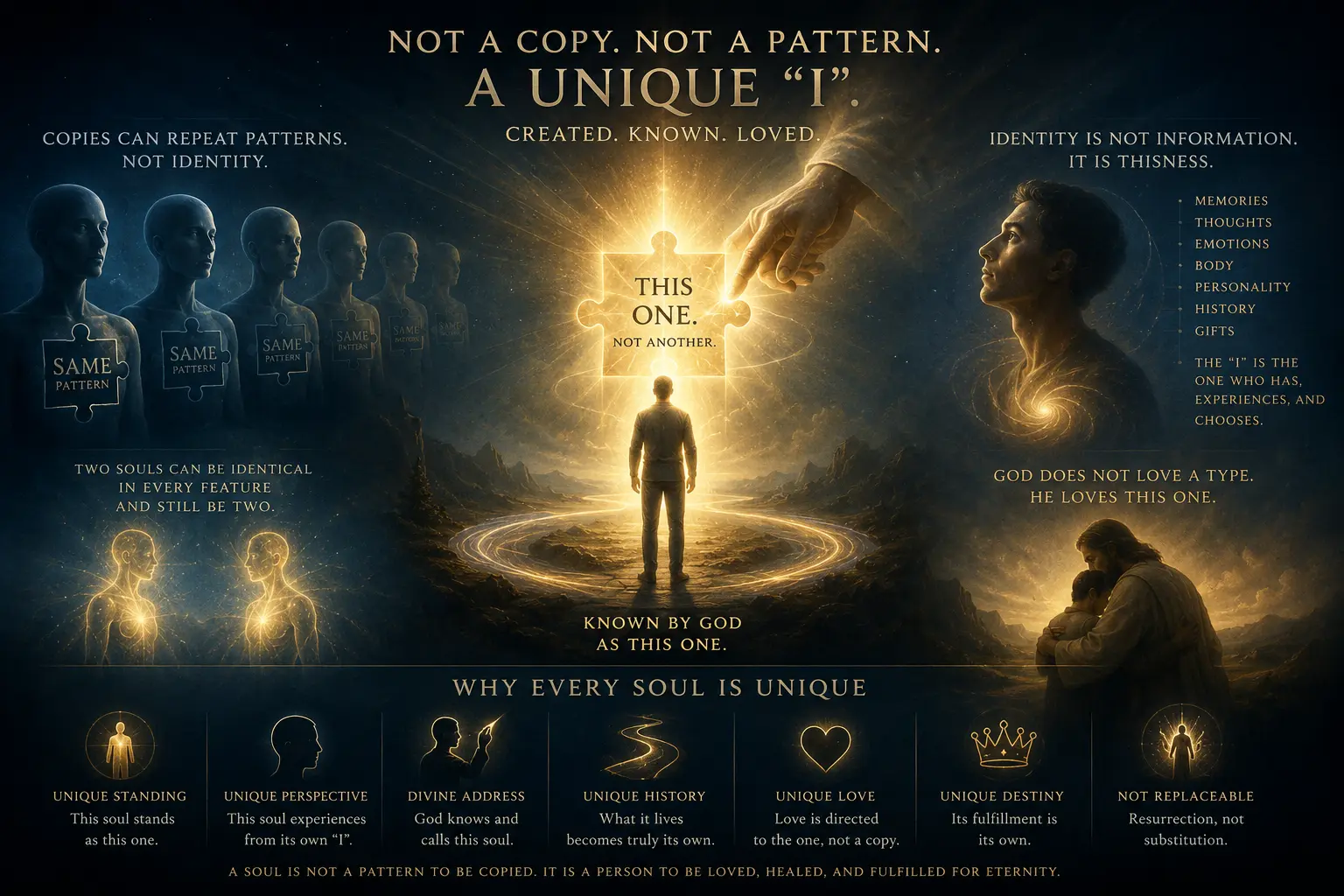
This matters because anything that is merely information can be copied. A memory-pattern could be duplicated. A voice could be imitated. A body could be cloned. A temperament could be reproduced. A life-history could be simulated. But a soul is not information. A soul is the personal “I” that receives information, lives through memory, and stands before God as this one.
The soul is therefore not replaceable. God could create another being with the same features, the same memories, the same gifts, the same beauty, the same intelligence, and the same apparent history, but that being would not be the same soul. It would be another soul with copied contents. It would say “I” from its own center, not from the original center. There would now be two first-persons, not one first-person existing twice.
This is the key distinction: sameness of content is not sameness of subject.
A book can be copied because a book is an object with reproducible content. A soul cannot be copied as the same soul because a soul is not merely content. It is subjecthood. It is a center of inward self-presence. It is the one to whom contents appear.
A soul may have memories, but the soul is not memory. A soul may have thoughts, but the soul is not a thought. A soul may have emotions, but the soul is not an emotion. A soul may have a body, but the soul is not reducible to the body. A soul may have a name, but the soul is not the name. A soul may have a mission, but the soul is not merely its function. A soul may have a history, but the soul is deeper than the record of what happened to it.
The soul is the created “I” who undergoes history.
That is why copying a soul’s contents would not copy the soul itself. If two beings had the same memories, they would still not be the same subject remembering. Each would have its own inward point of awareness. Each would stand as its own “I.” Each would be addressed by God as a distinct one.
A soul’s uniqueness is therefore not mainly comparative. It is not unique only because it differs from other souls. That would make uniqueness depend on contrast. If two souls had identical traits, then by that logic they would stop being unique. But that is false. Even two perfectly similar souls would still be two souls, because each would have its own act of standing.
The soul is unique by ontological singularity. It is unique because God grants this particular personal center to stand as itself and not another. Its uniqueness is not merely in how it differs from others, but in the fact that it is this one.
A helpful image is a unique ID, but even that image must be purified. The soul does not merely have a unique ID attached to it. A normal ID can be copied, forged, printed twice, or assigned incorrectly. The soul’s uniqueness is deeper than a label. The soul is itself a unique act of personal existence. It is not a generic spirit with a tag. It is God’s creative act of saying, “Let this one stand.”
That “this one” cannot be redone as another because the moment it is another, it is not the same one. God can create another similar soul, but He cannot create “the same soul twice” as two numerically distinct souls. That is not a limitation of power. It is the law of identity. To say “the same soul twice” means: let there be two, but let the two be numerically one. That cancels itself.
God can do all real things. He cannot make contradictions into realities, because contradictions are not things. A square circle is not a difficult object; it is no object. A married bachelor is not a hidden possibility; it is a contradiction in terms. Likewise, “two souls that are the same single soul” is not a possible achievement. If there are two centers of “I,” there are two souls. If there is one center of “I,” there is one soul.
Identity is not a property added after existence. Identity is part of what it means for a thing to stand. Whatever is, is itself. This is the law of identity: 1 = 1. A thing cannot exist unless it is itself and not another. Without identity, nothing could stand as anything. There would be no soul, no person, no creature, no truth, no memory, no responsibility, no love. Everything would dissolve into indistinctness.
The soul reflects this law in personal form. The soul does not merely exist; it exists as someone. It is not only a thing. It is a subject. Its identity is not the identity of a stone or a table. It is the identity of an “I.” That means its uniqueness is interior, not merely external. A stone is this stone. A soul is this self.
This also explains why resurrection matters more than replacement. If souls were replaceable, God could simply discard the wounded and create improved copies. But that would not be salvation. It would be substitution. The original would be lost, and another would stand in its place. Love does not accept that. Love does not love a function only. Love loves the one.
If a mother loses a child, another child cannot replace that child, even if the second child has similar qualities. The reason is not only emotional attachment. It is metaphysical truth. The first child is an unrepeatable “this one.” The second child may be equally beloved, but he is not the first. Love knows the difference because love is directed toward persons, not replaceable patterns.
God’s love is even more exact. God does not love “a general soul-type.” He loves this soul. He does not merely value the role someone plays. He knows the person who plays it. He does not confuse similarity with identity. He does not say, “Another one like you is good enough.” Divine love aims at healing, resurrection, and fulfillment of the actual person He called into standing.
A soul is also not unique because it owns itself apart from God. Its uniqueness is received. God alone is selfhood by nature. God is the uncreated “I AM,” the original Self who is Himself without being granted Himself by another. Creatures are selves by gift. Each soul is a finite created echo of divine selfhood, not a piece of God, not a fragment of God’s essence, but a real personal center granted by God.
This means the soul’s identity is both dependent and real. It depends on God for standing, but it is not fake. It is received, but not imaginary. It is sustained, but not interchangeable. God’s creative act does not produce disposable masks. It produces real subjects who can be addressed, known, loved, judged, healed, and glorified.
The soul is not divine by nature. It is not an eternal piece of God that fell into a body. It is not a spark of the divine essence trapped in matter. It is created. But being created does not make it worthless. Creation by God is precisely what gives it dignity. To be a soul is to be personally granted existence by the Source.
The soul is also not reducible to consciousness alone. Consciousness may be the light by which the soul experiences, but the soul is deeper than any single conscious state. A person can sleep, forget, lose awareness, suffer confusion, or pass through changes in mental clarity, yet the soul remains the same subject. If the soul were only the current stream of consciousness, then deep sleep or memory loss would destroy identity. But the person remains.
Nor is the soul merely memory. Memory helps the soul recognize its own history, but memory is not the root of identity. A person with lost memory is still the same person. The memories may be wounded, hidden, or inaccessible, but the subject who lived remains the subject who can be restored. God’s knowledge holds what human memory loses.
Nor is the soul merely personality. Personality can change. A child’s personality differs from the adult’s. Trauma may alter expression. Grace may heal the heart. Sin may distort the character. Wisdom may mature the person. Yet beneath these changes, the same soul continues. Personality is the soul’s style of expression in a given state; it is not the soul’s deepest identity.
Nor is the soul merely moral condition. A sinner and a saint can be the same soul at different stages. If moral state were identity, repentance would destroy the old person and create a different being. But repentance heals the same one. Judgment is meaningful because the one who acted is the one who must answer. Mercy is meaningful because the one who sinned is the one who can be forgiven.
Nor is the soul merely its body, though the body is not irrelevant. The body is the soul’s embodied expression in the created world. Body and soul belong together in the full human person. But the soul’s “I” is not simply the body’s material arrangement. If God resurrects the body, He does not create a replacement person. He restores the same person into glorified wholeness.
A soul, then, is best understood as a created personal center: an irreducible “I” granted standing by God, capable of inward experience, moral response, love, knowledge, memory, communion, and destiny.
Its uniqueness has several layers.
First, it is unique in standing. This soul stands as this one, not another.
Second, it is unique in perspective. It experiences reality from its own inward center. No other soul can experience existence from exactly this first-person point.
Third, it is unique in divine address. God knows it personally. God does not merely know what kind of soul it is. He knows who it is.
Fourth, it is unique in history. What it undergoes becomes truly its own. Even if events resemble another’s events, this soul’s suffering, choices, loves, failures, and victories belong to this soul.
Fifth, it is unique in vocation. God may give similar callings to many, but each soul answers from its own unrepeatable center.
Sixth, it is unique in love. The love directed toward this soul is not transferable to a copy. Another soul may be loved equally, but not as the same one.
Seventh, it is unique in final fulfillment. Its glory is not generic brightness. Its glorification is the healed completion of this particular self.
This is why comparison cannot be the deepest measure of uniqueness. Comparison says, “This soul is different from that soul.” That is true at the level of traits, histories, gifts, and expression. But deeper uniqueness says, “This soul is this soul even before comparison.” Its identity does not wait for another soul beside it. Even if only one created soul existed, it would still be uniquely itself before God.
The deepest comparison is not between one soul and another. It is between the soul and God’s knowledge of it. The soul is unique because it corresponds to a distinct divine act of knowing, willing, addressing, and sustaining. God knows this one as this one. That divine knowing is not a label; it is truth. God’s truth holds the soul in its identity.
This is also why God cannot “redo” the same soul as a duplicate. The soul’s identity is not a recipe. If identity were a recipe, God could make the same recipe again. But a soul is not a recipe. It is an act-token of personal existence. God can create the same type again, but not the same token as another token. “The same token twice” is a contradiction.
A copy of you would not be you. It would be another person who resembled you perfectly. It might believe it is you. It might remember your memories. It might speak with your voice. It might love the same things. But from the inside, there would be another “I” looking out. The original “I” would not have become two. There would be two centers.
This reveals something sacred about identity: the “I” cannot be multiplied like an image. It can be sustained, healed, glorified, and resurrected, but it cannot be replaced by another without being lost. God can preserve the soul through change because He holds the same “this-one” in being. But He cannot make another “this-one” be numerically the same “this-one,” because otherness and sameness cannot be identical.
The uniqueness of the soul is therefore not a weakness in God’s power. It is a triumph of divine truth. God creates real persons, not interchangeable copies. He creates beloveds, not replaceable functions. He creates subjects, not merely patterns. He creates ones who can truly say “I,” and to whom He can truly say “you.”
A soul is unique because God’s creative word to it is unique:
“Stand as this one.”
That word does not merely assign a name. It grants personal existence. It establishes an inward center that cannot be substituted by similarity. The soul may change, mature, fall, repent, suffer, forget, remember, die, and rise, but if God preserves it, the same one remains.
This is the metaphysical ground of personal dignity.
No soul is replaceable.
No soul is merely a copy.
No soul is only its usefulness.
No soul is only its memories.
No soul is only its body.
No soul is only its role in history.
Every soul is a unique created “I” before the uncreated “I AM.”
And because God is Truth, He never confuses one “I” with another. Because God is Love, He never treats the beloved as replaceable. Because God is Source, He can sustain the soul’s identity beyond every change. Because God is faithful, His purpose is not substitution but resurrection.
The soul is unique not because God lacks the power to make similarities, but because identity itself is singular. A copy may repeat features. It cannot repeat thisness as the same thisness. Another soul may resemble you, but it cannot be you.
You are not merely a pattern God could print again.
You are a personal act of standing.
You are a created “I.”
You are this one.