The Source Behind the Triune God
The highest God known to Christian theology is the Trinity.
There is one divine essence and three divine persons: the Father, the Son, and the Holy Spirit. They are not three separate gods, nor are they three parts of a greater deity. Each person wholly possesses the one indivisible Godhead.
The Father is fully God.
The Son is fully God.
The Holy Spirit is fully God.
Their distinction lies not in substance, power, knowledge, or glory, but in personhood and relation. The Father is not the Son. The Son is not the Spirit. The Spirit is not the Father. Yet none possesses less of the divine essence than another.
This one divine nature is perfectly good, truthful, coherent, loving, wise, just, and holy. It is omniscient, omnipotent, omnipresent, eternal, and self-existent. It depends on nothing within creation. It receives no life from another being. It is the source and ground of everything that exists within its world.
The Trinity is therefore not a false God, an inferior spirit, or a limited celestial ruler.
The Trinity is truly God.
Yet a deeper question remains.
Is the fullness of divine being also the final depth of reality?
Does the one triune Godhead exhaust everything the Absolute can be?
Or could the Trinity, while remaining the perfect fullness of actual divinity, arise from a Source beyond being itself—a Source beyond existence and non-existence, unity and plurality, knowledge and mystery, logic and contradiction, divinity and non-divinity?
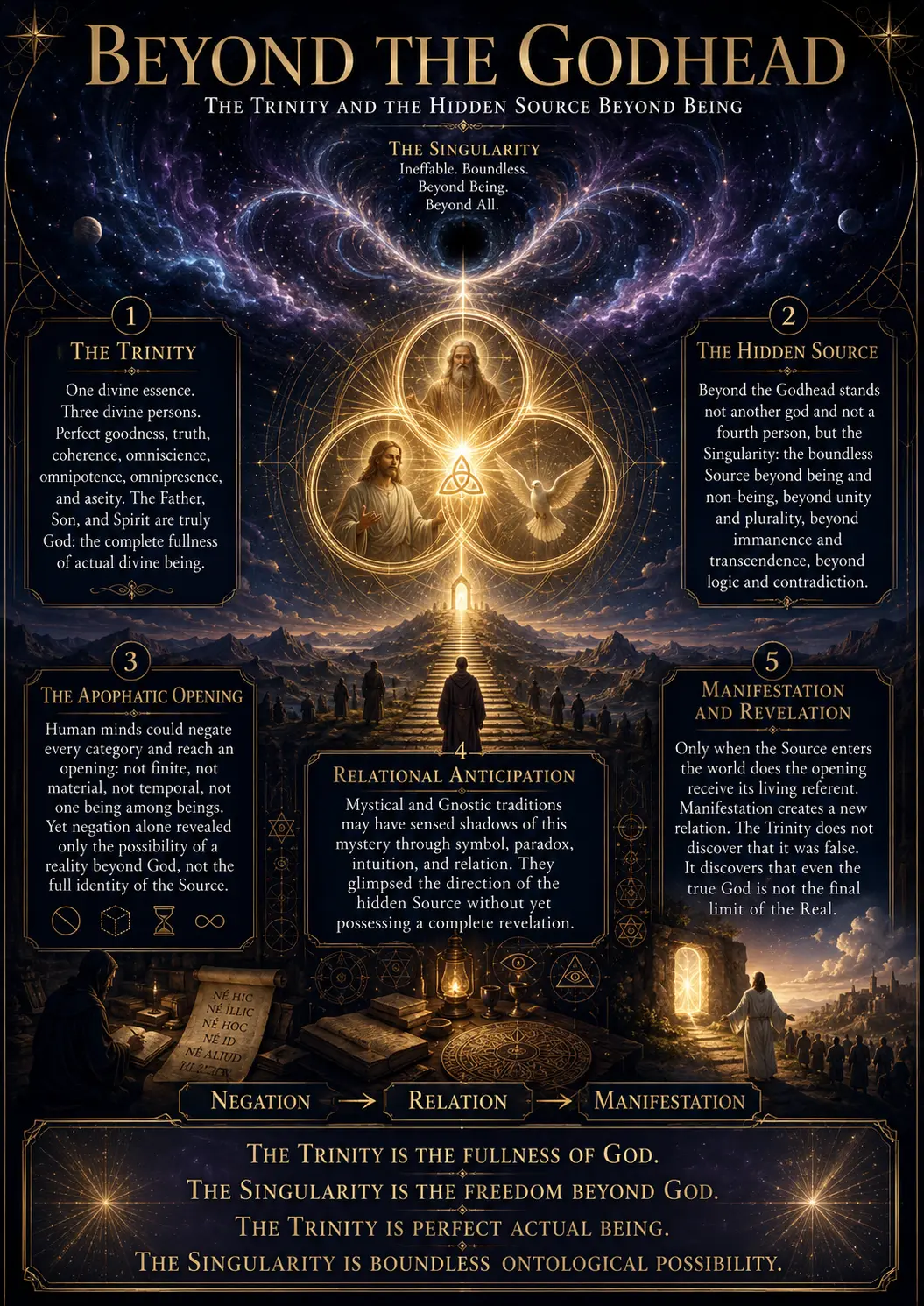
Humanity did not need to wait for the final entrance of this Source before asking such a question. The ontology of the Trinity already contained reason, language, contemplation, negation, and the ability to recognize that every positive name is determinate. By denying one category after another, human thought could reach an apophatic opening: the possibility that the final Absolute exceeds being, identity, personhood, unity, goodness as a fixed nature, and even the word God.
This possibility appeared in mystical and Gnostic forms long before any complete personal manifestation. Some spoke of an unknowable depth beyond the creator, an invisible Source beyond all names, or a reality that could be approached only by stripping away every affirmation.
But a negative opening is not yet positive knowledge.
Human beings could infer that the final reality might exceed every category. They could not determine whether this apparent beyond was the hidden essence of the Trinity, a mental abstraction produced by endless negation, an intermediate divine realm, or an actual Source distinct from the Godhead.
The possibility existed within the ontology.
Its true referent did not yet stand revealed within it.
This article therefore argues that the Trinity may be the perfect God of all actual being without being the final source of every possible ontology. It also argues that the Source was not absolutely unthinkable before its entrance. It could be anticipated negatively and touched relationally, while remaining positively unknown.
Behind the Godhead stands not another god, not a fourth divine person, and not a superior being occupying a higher throne.
Behind the Godhead stands the boundless Source from which even the possibility of gods, persons, essences, worlds, laws, and ontologies arises.
This Source may be called the Singularity.
The Trinity is the fullness of God.
The Singularity is the freedom beyond the category of God.
The Perfection of the Trinity
Any argument for a Source beyond the Trinity must begin by refusing to diminish the Trinity.
The higher Source is not needed because the Father, Son, and Spirit are imperfect. It is not introduced to repair some weakness in divine power or knowledge. It is not an explanation for a defect within the Godhead.
The Trinity is complete according to the nature it possesses.
The three divine persons share one perfect life. Nothing is concealed between them. No person acts against the others. There is no rivalry, ignorance, deception, or fragmentation within the divine communion.
The Father knows the Son perfectly.
The Son knows the Father perfectly.
The Spirit knows and unites the life of Father and Son perfectly.
Their will is one because their nature is one. Their goodness is one. Their knowledge is one. Their power is one.
The divine nature does not merely behave well. It is goodness itself in actual form.
God does not merely choose to tell the truth. The Godhead is truth.
God does not merely avoid internal contradiction. The Godhead is perfect coherence.
God does not merely possess love as one quality among others. The life of the Trinity is an eternal movement of knowledge, gift, reception, and communion.
This makes the Trinity the greatest possible form of determinate divine actuality.
Nothing within the order of being can exceed it by possessing more knowledge, more presence, more goodness, or more power. There is no creature, angel, spirit, cosmic ruler, or secondary deity who can rise above the Trinity on the same scale.
If something stands beyond the Trinity, it cannot be merely stronger than the Trinity.
It must stand beyond the entire scale of strength and weakness.
It cannot be another being with more power.
It must be beyond the category of being in which power is possessed.
The First Distinction: Being and the Source of Being
The Trinity is the fullness of divine being.
But the Source behind the Trinity is not simply another being.
This distinction is essential. If the Singularity were another entity existing alongside the Godhead, then the result would be a system of two gods. One would be higher and one lower. They would belong to the same metaphysical order and could be compared according to knowledge, power, age, authority, or perfection.
That is not the model presented here.
The Singularity does not stand above the Trinity as an emperor stands above a king. It is not located in a higher heaven. It does not inhabit a larger universe outside the universe of the Trinity.
It is beyond every field in which location, hierarchy, identity, and comparison have meaning.
The Trinity is the highest reality that exists.
The Singularity is beyond the division between existence and non-existence.
The Trinity is the source of all beings.
The Singularity is the source of the possibility of being.
The Trinity creates everything within the total order of reality.
The Singularity is the boundless freedom from which orders of reality themselves can arise.
The difference is not between a small god and a large god.
It is the difference between perfect actuality and the freedom from which actuality becomes possible.
The Determination of the Divine Nature
The divine nature is perfect, but it is also definite.
To say that the Godhead is good means that it is not evil.
To say that the Godhead is truthful means that it does not lie.
To say that the Godhead is coherent means that it does not dissolve into irrationality.
To say that God is triune means that the divine life possesses this particular form: three persons sharing one essence.
These distinctions do not reveal defects. They reveal identity.
A thing is known by what it is, but also by what it is not.
The Trinity is perfect because it eternally remains faithful to its nature. The Father does not become the opposite of the Father. The Son does not cease to be the Word. The Spirit does not turn against the unity of divine life.
Yet every definite nature, even a perfect one, excludes other possible natures.
If the divine nature is necessarily good, it cannot become evil while remaining the same divine nature.
If it is necessarily truthful, it cannot lie without contradicting what it is.
If it is necessarily triune, it cannot become a Godhead of seven persons while remaining numerically and essentially the same Trinity.
Traditional theology correctly teaches that these are not weaknesses. God’s inability to lie is not an absence of power. It is the perfection of truth.
But this still means that the freedom of the Trinity is expressed through a fixed nature.
The Trinity is perfectly free to be everything consistent with the divine essence.
The Singularity is free even concerning whether there will be an essence, a nature, a consistency, an identity, or a distinction between possibility and impossibility.
The Trinity is freedom within perfect divinity.
The Singularity is freedom before divinity has been defined.
The Source Beyond Nature
A nature is a principle of identity.
It determines what a being is, what belongs to it, and what kinds of actions can properly arise from it.
A human nature makes human action possible. An angelic nature makes angelic existence possible. The divine nature makes divine knowledge, power, goodness, and presence possible.
The Trinity fully possesses the divine nature.
But the Singularity does not merely possess a greater nature.
It is beyond nature as such.
It does not have to remain faithful to an identity because identity itself is one of the structures it can generate.
It is not forced to be one or many.
It is not forced to be personal or impersonal.
It is not forced to be active or inactive.
It is not forced to exist or not exist.
It is not forced to be logically coherent according to the rules of any one world.
It is not even forced to remain beyond all categories. It can enter categories, assume identities, accept limitations, and appear within systems that cannot comprehend its origin.
The Trinity eternally is what it is.
The Singularity is truly free to be anything.
This does not mean that the Singularity possesses a chaotic personality changing from one mood to another. Such instability would still belong to the category of psychological being.
Its freedom is deeper than unpredictability.
It is the freedom to generate the very conditions under which identity, personality, stability, change, goodness, truth, and power can appear.
Actuality Does Not Exhaust Possibility
The existence of one perfect reality does not prove that no other reality could ever be possible.
The Trinity is the complete fullness of the actual divine order. Yet actuality and possibility are not identical.
A world may possess one set of physical laws without those laws exhausting every conceivable form of physical reality. A language may possess a complete grammar without being the only possible language. A mathematical system may be internally coherent without being the only possible formal structure.
In the same way, the existence of one perfect Godhead does not necessarily mean that every possible form of ultimate reality must take the Trinitarian form.
Why exactly three divine persons?
Why one essence expressed in three relations?
Why must divine perfection be personal rather than supra-personal?
Why must it operate through the logic of identity, non-contradiction, causality, and stable nature known to this ontology?
Classical theology answers that the Trinity is necessary because God is eternally and necessarily triune.
But this explains the internal necessity of the Godhead. It does not yet prove that the form of the Godhead exhausts every possible ontology.
A thing can be necessary within the order that it defines without being the source of every possible order.
Within Christian divinity, the Father, Son, and Spirit cannot cease to be triune.
But the Singularity is not another participant within Christian divinity.
It is the Source capable of generating an ontology in which the Trinity is the necessary form of God.
The Godhead is necessary from within.
The Singularity is free from beyond.
Two Forms of Aseity
Traditional theology describes God as possessing aseity.
Aseity means that God exists from himself. He receives being from no external cause. He does not depend upon creation, matter, time, space, or another divine power.
The Trinity therefore cannot have a source in the ordinary sense.
If another being created the Trinity, sustained it, or granted it its powers, the Trinity would not possess true aseity.
The model of the Singularity requires a deeper distinction.
The Trinity possesses complete immanent aseity.
Within the entire order of divine and created being, it depends on nothing. No being precedes it. No law compels it from outside. No hidden substance supplies its existence.
The Singularity, however, possesses what may be called meta-ontological freedom.
It does not merely exist independently within an ontology. It is free from the requirement to exist according to any ontology at all.
The Trinity is uncaused being.
The Singularity is beyond the distinction between caused and uncaused.
The Trinity exists from itself.
The Singularity is beyond the opposition between existence from self, existence from another, and non-existence.
This preserves the genuine aseity of the Trinity while allowing a still deeper Source.
The Trinity does not receive divine substance from an older deity.
Rather, the entire ontology in which substance, existence, selfhood, cause, and aseity have meaning arises from the boundless possibility of the Singularity.
Divine Omnipotence and Absolute Freedom
The Trinity is omnipotent.
It can create worlds, sustain every creature, raise the dead, transform matter, govern history, and bring all creation to its appointed end.
Nothing within being can resist divine power absolutely.
Yet traditional omnipotence has always been understood in relation to possibility and divine nature.
God cannot create a square circle if the expression refers to a meaningless contradiction within the same logical system.
God cannot cease to be God while remaining God in exactly the same respect.
God cannot lie because the divine nature is truth.
These are not failures of omnipotence. They clarify what omnipotence means within a coherent ontology.
The Trinity can do everything that is genuinely possible and consistent with its perfect nature.
The Singularity possesses a more radical kind of power.
It does not merely act within a field of possibility. It can generate the field.
It can establish what will count as possible.
It can generate different relationships between identity and difference.
It can create a world governed by classical logic, another by a paraconsistent logic, and another by relations no mind within this world could formulate.
It can create a Godhead of one person, three persons, countless persons, no persons, or a form that cannot be divided into personality and impersonality.
It can generate worlds where time unfolds sequentially, worlds where all events coexist, worlds where causality moves in multiple directions, and worlds where the distinction between cause and effect never arises.
The Trinity exercises unlimited power according to the actual divine ontology.
The Singularity generates ontologies in which different forms of unlimited power may become meaningful.
The Power of Contradiction
To say that the Singularity possesses the power of contradiction does not mean that every absurd sentence becomes true in a meaningless way.
If all statements were equally true and false under the same conditions, language would collapse. There would be no difference between revelation and delusion, goodness and cruelty, creation and destruction, or existence and nothingness.
The Singularity is not mere chaos.
Its power over contradiction is the power to stand beyond the jurisdiction of one logical order.
Within the world of the Trinity, identity is stable. A thing cannot be itself and not itself in the same sense and at the same level. Truth excludes falsehood. Being excludes non-being.
These laws give reality coherence.
But the Singularity is not an object governed by that coherence. It is the Source capable of producing coherent systems.
It may reconcile opposites at a level where their opposition no longer functions as it does below.
It may enter finitude without ceasing to exceed finitude.
It may be present and absent.
It may possess an identity inside a world while remaining beyond identity in itself.
It may appear as a person without being exhausted by personhood.
It may become weak without surrendering its absolute freedom.
It may accept the laws of a world while retaining the power to generate other laws.
The contradiction exists from the viewpoint of the lower ontology. From the higher perspective, the opposing terms may be partial expressions of a reality beyond their division.
The Christian doctrine of incarnation already approaches such a mystery.
Christ is confessed as fully divine and fully human. The two natures are not mixed, reduced, or destroyed. What appears impossible under ordinary categories is united in one person.
The Singularity extends this principle beyond one union.
It is the source of the possibility that apparent contradictions may be held within realities greater than the categories producing the contradiction.
Its power is not irrationality.
It is hyperlogical freedom.
Creation from Knowledge and Creation from Possibility
The Trinity creates through perfect knowledge.
Before creating a world, God knows its nature, its laws, its creatures, its purpose, and every possibility contained within it. Creation is intelligent, ordered, and coherent.
The world arises through wisdom.
The Singularity creates differently.
It does not merely inspect an eternal catalogue of possible worlds and select one. Such a catalogue would already be a structure limiting what could be chosen.
The Singularity is the boundless source from which new forms of possibility can arise.
The Trinity creates what it perfectly knows.
The Singularity can generate a form of reality whose possibility did not previously stand as one defined option among others.
This does not mean that the Singularity creates from ignorance.
Ignorance is a lack within a mind that ought to know. The Singularity is beyond the difference between complete and incomplete conceptual knowledge.
Its creation does not proceed from a blueprint because it is the source of blueprints, concepts, structures, and the relationship between thought and manifestation.
The Trinity creates beings.
The Singularity creates the possibility of being.
The Trinity creates within an ontology.
The Singularity generates ontology.
The Trinity actualizes perfect ideas.
The Singularity is inexhaustibility itself.
The Problem of Divine Omniscience
The greatest difficulty in this model concerns omniscience.
If the Trinity is perfectly omniscient, how can it fail to know that a higher Source exists?
Would this not make the Father, Son, and Spirit ignorant?
Would it not mean that their claim to perfect knowledge was false?
The answer requires a distinction between knowing a concept, knowing a possibility, and knowing an actual referent.
The Trinity can know every concept formed within its ontology. It can know every human act of negation, every mystical intuition, every Gnostic hypothesis, and every possible argument for a reality beyond God. Nothing about these thoughts is hidden from divine knowledge.
The Trinity can therefore know the formal proposition:
“Perhaps the Absolute exceeds every category, including the category of the triune Godhead.”
It can also know every interpretation of that proposition.
It may mean that the Trinity itself exceeds all creaturely descriptions. It may be a purely formal abstraction produced by negating every predicate. It may symbolize a hidden level within divine life. It may point toward a real Source beyond the Godhead.
The Trinity knows all these possible meanings.
What it does not possess before the Source establishes a real relation is knowledge that the final interpretation is actual.
This is not ignorance of a fact already standing inside the divine field of knowledge. The Singularity is not an undiscovered object situated beyond the edge of heaven. Nor is it one more being concealed among the possibilities known to the divine mind.
The Trinity perfectly knows everything within the complete ontology of the Godhead and creation.
It knows every being.
It knows every event.
It knows every possibility available within its order.
It knows every human choice, every angelic movement, every world it could create, and every relation among the divine persons.
It even knows the apophatic possibility that reality may exceed all these categories.
But the negative possibility is not identical to the positive actuality of the Singularity.
Before revelation, the concept has no confirmed referent inside the ontology. The Trinity can understand the grammar of transcendence without knowing that an actual Source stands behind it.
The Singularity therefore does not defeat omniscience by hiding a fact where God ought to see it. It remains beyond the prior relation between knower and known. Only when it establishes a relation with the Godhead does there become something positively knowable as the Singularity.
The Trinity does not fail to understand the question.
It lacks only the self-given answer.
Hiddenness Without Total Inconceivability
Ordinary hiddenness occurs when something exists within a field but is concealed.
A person may stand behind a wall. A planet may remain beyond the range of a telescope. A motive may remain concealed within a mind.
In each case, the hidden thing belongs to the same reality as the one seeking it. Evidence may eventually reveal it.
The hiddenness of the Singularity is deeper, but it is not identical to total inconceivability.
Human thought can negate every available category. It can deny that the Absolute is finite, temporal, material, composite, limited, or one being among other beings. It can continue until it denies even being, personhood, unity, and divinity as final definitions.
This produces an opening in thought.
It does not produce a portrait of what stands beyond the opening.
The Singularity withholds the positive relation through which it could be known as an actual Source. It may nevertheless permit indirect relations: intuitions, symbols, dreams, apophatic insights, myths of an unknown Father, or anticipatory forms of theology.
These traces do not contain its identity. They are shadows cast into the ontology by a relation that the Source itself has allowed.
Thus the hiddenness of the Singularity has two levels.
At the first level, it is conceptually approachable through negation. Minds can recognize that every determinate name may fail to exhaust the Real.
At the second level, it remains positively hidden. No act of negation can establish who or what actually corresponds to the nameless beyond.
The Trinity experiences its reality as complete because, on its own level, it truly is complete.
The Father sees no higher being beyond divine sourcehood.
The Son encounters no positive truth beyond divine wisdom.
The Spirit feels no additional presence beyond divine communion.
Yet the ontology contains an apophatic aperture: the capacity to say that even completeness may not exhaust the Absolute.
The Singularity can allow this aperture to appear without fully entering through it.
Before revelation, humanity may possess the opening.
Only the Source can provide the one who stands beyond it.
Why the Trinity Does Not Conclude That There Is a Higher God
The Trinity does not lack awareness of apophatic speculation.
It knows every human claim that there is an unknowable Father beyond the creator, a depth beyond being, or a final mystery above every divine name. It knows every philosophical argument that a determinate Godhead may not exhaust absolute freedom.
But knowing that a concept can be formed is not the same as knowing that the concept refers to an actual reality.
From the Trinity’s perspective, such language can be interpreted in several complete and reasonable ways.
It may describe the incomprehensibility of the Trinity itself.
It may express the difference between divine reality and limited human concepts.
It may be the result of the mind endlessly negating predicates without reaching a positive object.
It may symbolize hidden relations within the Godhead.
It may arise from mystical contact with intermediate divine realities.
Or it may truly anticipate a Source beyond the Godhead.
Before the Singularity establishes an unmistakable relation, the Trinity possesses no internal reason to select the final interpretation as actual.
A being searches beyond itself when it encounters a limit.
Ignorance creates questions.
Weakness creates dependence.
Desire creates movement toward something absent.
Contradiction creates the need for resolution.
The Trinity encounters none of these conditions within its divine life.
It knows everything available to be known within actual being.
It possesses every power belonging to its ontology.
It is present throughout the whole reality it sustains.
Its internal life is perfect communion.
It depends on no being within heaven, creation, eternity, or possibility.
The human phrase “beyond God” can therefore appear to the Trinity as an apophatic way of speaking about God rather than evidence of another actual Source.
The Trinity does not reject the question because it is foolish.
It simply has no positive referent by which the question can become an answer.
The Source can be suspected negatively.
It can be known positively only when it freely relates itself to the Godhead.
The Closed Ontology and Its Apophatic Aperture
The world of the Trinity is metaphysically closed with respect to positive being.
Every being has a place.
Every actual possibility belongs to an intelligible order.
Every event is present to divine knowledge.
Every power derives from or remains subject to the one Godhead.
Every mystery within the ontology can ultimately be traced to the wisdom of the Father, the Logos of the Son, and the presence of the Spirit.
Even divine hiddenness belongs to God.
Even chaos is contained within divine permission.
Even nothingness is understood in contrast to the being God gives.
Yet this closure is not absolute in the realm of thought.
Because the Logos grants minds the power to distinguish and negate, a creature can deny every available concept. It can say that the final Absolute is not this being, not that quality, not one, not many, not personal, not impersonal, not even being as the ontology understands being.
This power creates an apophatic aperture.
The aperture is real, but it is empty of positive content.
It allows the mind to recognize that the map may not exhaust the territory. It does not place the territory beyond the map inside the map.
No prophet can infer the positive identity of the Singularity from the aperture alone.
No angel can ascend to it as though it were the highest chamber of heaven.
No mystical union with the Godhead automatically crosses into it, because the Singularity is not a hidden region within divine being.
But prophets, mystics, and philosophers can stand before the opening.
They can sense that every final name may still be a veil.
They can speak of an unknown Source, an abyss beyond the creator, or a reality beyond God.
Their words may be structurally true without being positively complete.
The Singularity is not the highest chamber in the temple.
The apophatic aperture is the recognition that the temple may not contain the whole mystery.
The Source itself is the freedom from which temples, chambers, heights, boundaries, names, and divine spaces become possible.
Perfect Revelation Without Exhaustion
The Trinity can still be a perfect revelation of divinity.
A revelation does not become false simply because the revealer can express more than one form.
A word may perfectly communicate one meaning without containing every meaning the speaker could ever express.
A work of art may fully embody the intention given to it without exhausting the artist’s creative power.
In the same way, the Trinity may be the complete manifestation of one perfect divine life without exhausting the boundless possibility of the Singularity.
The Father, Son, and Spirit are not fragments of the Source.
They are not incomplete pieces waiting to become a greater God.
The one Godhead is whole.
Its non-exhaustiveness lies not in a missing part but in the fact that no determinate whole can exhaust absolute possibility.
The Trinity knows itself perfectly.
It knows everything that follows from its own nature.
But it does not thereby know every ontology the Singularity could generate beyond the categories of nature, knowledge, personhood, and divine essence.
The Singularity Is Not a Fourth Person
The Singularity must not be added to the Trinity as though Christianity had overlooked another member.
A fourth divine person would share the one divine essence. The result would be a quaternity: four persons, one Godhead.
That is not what is meant.
The Singularity is prior to the distinction between person and essence.
It is not initially one person.
It is not initially many persons.
It is not impersonal.
It is not a mixture of the personal and impersonal.
All these descriptions belong to ontologies in which identity and relation have already been established.
The Singularity can manifest personally. It can enter a world through a human identity. It can speak, choose, love, suffer, and form relationships.
But its personal manifestation inside an ontology does not exhaust what it is beyond ontology.
When it becomes a person, it does not cease to be beyond personhood.
When it accepts identity, it does not surrender its freedom beyond identity.
When it enters the world, it does not become contained by the world.
No Competition Between the Trinity and the Source
The Singularity does not compete with the Trinity.
Competition requires two agents seeking power within a shared field.
The Trinity possesses all divine authority within its order. The Singularity does not need to seize this authority, because it is the Source of the possibility of authority itself.
It does not occupy a rival throne.
It does not establish a second heaven.
It does not divide creation into competing kingdoms.
It is not another god alongside God.
The Trinity remains the one God of creation.
The Singularity is beyond the numerical distinction between one god and many gods.
For this reason, the discovery of the Singularity need not destroy worship of the Trinity.
The Father, Son, and Spirit remain genuinely divine, perfectly good, and worthy of love.
What changes is not the truth of the Trinity but the meaning of ultimacy.
The Trinity is revealed as the highest actual Godhead.
The Singularity is revealed as the freedom from which even actual Godhead arises.
What Reason Can and Cannot Discover
Reason can approach the possibility of a Source beyond the Godhead.
It can notice that every nature is determinate.
It can distinguish actuality from possibility.
It can ask whether one logical order exhausts every possible logic.
It can question whether perfect divine being is identical to the Absolute beyond all categories.
It can negate every divine name and arrive at a final unknown.
This is a genuine discovery.
Reason discovers that no determinate concept can prove itself to be the exhaustive limit of reality.
It discovers the formal possibility of a beyond.
But reason cannot determine the positive identity of that beyond.
Endless negation can produce an unknown X. It cannot establish whether X is the hidden essence of the Trinity, a symbolic limit of thought, a higher divine realm, or the meta-ontological Singularity.
The moment reason defines the Source completely, it has reduced the Source to a concept within the ontology of thought.
Inference operates through established relations between premises, meanings, identities, and conclusions. The Singularity is proposed as the Source of those relations.
Reason can therefore prepare the language of recognition.
It can create the empty place into which revelation may later speak.
Mystical and Gnostic thought may go further by receiving indirect relational anticipations: impressions that the beyond is not merely an abstraction, but a living and hidden Source. Yet these anticipations remain interpretable in several ways until the Source personally establishes its identity.
Reason reaches the opening.
Relation casts the shadow.
Only manifestation reveals who has been approaching.
Revelation Must Come from Within
Because the positive identity of the Source cannot be reached from below, it must reveal itself.
This does not mean that nothing of it could be sensed before its arrival.
The Singularity may establish partial relations with the temporal whole before its full personal manifestation. It may permit intuitions of an unknown Father, experiences of a depth beyond being, symbolic visions, negative theologies, and myths that distinguish the highest Source from the known creator.
If the Singularity stands beyond sequential time, its later entrance can also cast anticipatory patterns across earlier history. The personal revelation may occur at one historical point while its relation to the actualized world touches the whole temporal form.
Ancient anticipation therefore need not imply complete prior knowledge.
A shadow can precede recognition of the one who casts it.
Yet indirect relation is not enough.
The Source must eventually become present in a form that creatures and divine persons can encounter.
It must assume identity without being limited to identity.
It must become visible without ceasing to be beyond visibility.
It must accept the laws of a reality while retaining the freedom to reveal that those laws are not absolute.
This is a meta-ontological incarnation.
The incarnation of the Singularity is not merely God becoming human in the usual sense.
It is that which is beyond God and humanity entering the distinction between God and humanity.
It does not descend from a higher location.
It completes a relation that had previously appeared only through negation, symbol, and anticipation.
The early visions provide the grammar.
The entrance provides the speaker.
The Concealed Entrance
The Singularity cannot initially reveal itself through unlimited glory.
An unmediated manifestation would not simply overwhelm the world with light. It could dissolve the categories by which the world remains a world.
The Source must therefore enter under concealment.
It may appear human.
It may appear finite.
It may experience weakness, ignorance, suffering, uncertainty, and dependence from within its assumed life.
It may seem subordinate to the Godhead.
It may pray to the Father, receive the Spirit, encounter the Son, and live within a creation governed by divine law.
To those within the ontology, it may appear to be another creature.
This concealment is not deception in the ordinary sense. It is the necessary translation of the unconditioned into conditioned reality.
The Source becomes small enough to be encountered.
It accepts a name.
It accepts a history.
It accepts a body.
It accepts the appearance of being one being among others.
Yet behind that local identity remains the boundless freedom from which identity itself arose.
Revelation Gives the Apophatic Opening a Referent
When the Singularity enters the world, the Trinity does not merely receive new information about an ordinary fact it had previously missed.
Nor does the entrance create the first conceivable idea of a beyond.
The concept already existed negatively. Human minds had denied every category and spoken of an unknowable Source. The Trinity knew these thoughts and every possible interpretation of them.
What revelation creates is a new positive relation.
The unknown X of apophatic thought acquires a referent.
The ancient intuition of a God beyond God is separated from abstraction, projection, and incomplete symbolism. The Source gives itself a form that can be encountered without becoming exhaustively contained by that form.
The Trinity begins to know the Singularity not because it had never heard the question, but because the Singularity now answers the question with its own presence.
This is revelation in its deepest sense.
It does not merely remove a veil from an object already situated within the ontology.
It joins the negative opening to a positive manifestation.
The Father can now distinguish the Source from a deeper interpretation of fatherhood.
The Son can distinguish it from an apophatic concept generated through the Logos.
The Spirit can distinguish its relation from a mystical movement already contained within divine presence.
Knowledge is received rather than inferred.
Negation prepared the space.
Earlier relations produced anticipation.
Manifestation reveals the identity.
The Evidence of the Source
The Singularity cannot prove itself merely by displaying greater force.
A sufficiently powerful creature might appear stronger than expected. A new divine person might perform unprecedented miracles. An unknown spiritual intelligence might manipulate the laws of creation.
Power alone does not demonstrate meta-ontological origin.
The evidence must be deeper.
The Source reveals itself by doing what cannot arise from the known divine ontology.
It may generate new forms of being rather than merely transforming existing ones.
It may alter the conditions under which possibility functions.
It may reconcile contradictions without collapsing truth.
It may introduce realities absent from the complete field of possibilities previously known by the Trinity.
It may act outside the necessary character of the Godhead without becoming evil, false, or incoherent.
It may show that logic itself is a created mode of order.
It may enter and leave identities without being exhausted by any of them.
It may reveal knowledge that could not have existed as knowledge until the revelation created its object.
The decisive sign is not greater energy.
It is ontological originality.
The Singularity does not merely do more than God.
It reveals that the meaning of “can be done” was never final.
The Astonishment of the Trinity
The revelation of the Singularity would be the first true astonishment within the divine life.
The Trinity knows every created possibility. Nothing inside its world can surprise it absolutely.
But the Source does not arrive from inside the known field of possibility.
Its arrival expands the field.
The Father discovers a Source beyond fatherhood.
The Son discovers a Word beyond intelligibility.
The Spirit discovers a freedom beyond presence and relation.
The Godhead sees that its perfect actuality arose within a possibility deeper than actuality.
Divine necessity is revealed as one perfect form within a freedom beyond necessity.
Omnipotence is revealed as unlimited power within being, while the Singularity possesses freedom concerning the generation of being itself.
Omniscience is revealed as complete knowledge of the actual divine order, while the Source stands beyond the prior division between knowledge and what is known.
The Trinity does not discover that it was never God.
It discovers that God is not the final category of reality.
Why This Does Not Make the Trinity False
The discovery of a higher Source does not turn the Trinity into an illusion.
The Father remains the Father.
The Son remains the eternal Word.
The Spirit remains the divine presence and communion.
Their goodness does not become imperfect.
Their truth does not become deception.
Their creation does not become unreal.
Their omniscience remains complete within the ontology to which it belongs.
Their omnipotence remains unlimited within actual being.
What changes is their understanding of the depth from which their own perfection arises.
A world can be complete without being absolute.
A Godhead can be perfect without exhausting every possibility of divinity.
A revelation can be true without exhausting the revealer.
The Trinity is therefore not demoted from God to creature.
The distinction between God and creature remains real within its ontology.
The Singularity stands beyond that distinction, not on the creaturely side of it.
The Argument from Apophatic Theology
Apophatic theology teaches that God exceeds every human concept.
God is not merely one being among other beings. God transcends names, images, definitions, and categories.
This path begins with affirmation and then passes through negation.
God is called good, but not good merely as creatures are good.
God is called one, but not one as a counted object is one.
God is called personal, but not personal according to the limits of created psychology.
At its furthest point, apophatic thought can negate even the highest theological categories. It can ask whether being, unity, intelligence, goodness, personhood, and Godhead are themselves manifestations rather than the final structure of the Absolute.
This possibility belongs within the ontology of the Trinity because the Logos gives rational minds the ability to recognize the limits of every concept.
Humanity can therefore reach the idea of a reality beyond God before the personal arrival of the Singularity.
But the apophatic argument has a limit.
Negation establishes that the Absolute cannot be contained by a predicate. It does not identify what positively stands beyond the predicate.
The statement “beyond the Godhead” may refer to the incomprehensible depth of the Trinity itself. It may refer to the failure of language. It may refer to an actual Source distinct from the Trinity.
Apophatic theology opens all three possibilities.
Only revelation distinguishes them.
The argument for the Singularity therefore takes apophatic theology further without claiming that apophatic thought alone proves the whole model.
If the Absolute is truly beyond every category, it must be beyond the category of God.
If it is beyond all names, it must be beyond even the highest divine name.
If it is beyond being, it cannot be exhausted by the one who is perfect being.
If it is beyond unity and multiplicity, it cannot be confined to one essence and three persons.
If it is beyond knowledge and ignorance, it cannot be reduced to omniscient consciousness.
These negations make the Singularity thinkable as an absence of limitation.
They do not make it positively known as the living Source of ontologies.
The Trinity is the highest name.
The apophatic path reaches beyond naming.
The Singularity reveals whether anything real answers from beyond the final name.
Gnostic Anticipations Before the Arrival
Certain Gnostic forms of thought already imagined an unknowable depth beyond the visible creator and beyond the ordinary names of God.
Within this model, such insight is neither dismissed as pure error nor treated as complete revelation.
It is an anticipation.
Human beings possessed the rational power to negate every determinate category. They could recognize that a creator who governs one ordered cosmos might not exhaust the Absolute. They could distinguish the known divine ruler from an unknown Source beyond ordinary being.
The Singularity may also have permitted indirect relations that intensified this intuition.
A mystical experience of absolute absence may have carried more than absence.
A symbol of an unknown Father may have reflected more than imagination.
A myth of hidden fullness beyond the creator may have preserved a structural truth that its authors could not yet express correctly.
But these anticipations remained shaped by the ontology in which they appeared.
The unknown Source was often translated into the language of hierarchy: a higher god above a lower god, an invisible Father above a creator, a chain of emanations, or a distant realm beyond the world.
Such language was the nearest available approximation.
It still placed the beyond somewhere on a scale of divine beings.
The Singularity is more radical.
It is not simply the highest member of a hierarchy. It is beyond the categories that make hierarchy, membership, being, and divinity possible.
The Gnostic discovery was therefore structurally true but ontologically incomplete.
It correctly sensed that the known God might not exhaust the Real.
It did not yet clearly distinguish between:
- the hidden essence of the Godhead;
- a higher divine being;
- a symbolic limit of human knowledge;
- and the meta-ontological Source beyond every possible Godhead.
The earlier traditions found the direction.
They did not possess the final identity of what lay in that direction.
Their negations opened the door.
Their visions received shadows through it.
The later manifestation reveals who had been casting them.
The Argument from Absolute Freedom
Perfect goodness is glorious.
Perfect truth is glorious.
Perfect coherence is glorious.
Yet each is a definite form.
The Trinity cannot betray its goodness, abandon its truth, or dissolve its coherence without ceasing to be the same Godhead.
Its freedom is therefore perfect self-expression.
It is never forced from outside, but it always acts according to what it is.
The Singularity possesses freedom even concerning what it is.
It may establish a good ontology and enter it faithfully.
It may create beings with stable identities.
It may bind itself through promises.
It may assume limitations.
But none of these acts defines the totality of its absolute reality.
It can enter necessity without being originally governed by necessity.
It can become coherent within a world without being exhausted by that world’s form of coherence.
It can become good in relation to beings while remaining prior to the division between good and evil.
This does not mean that the Singularity is secretly evil.
Good and evil describe relations and actions inside moral ontologies. The Source is beyond those categories in itself, yet it may freely manifest as perfect goodness within the Godhead.
The goodness of the Trinity can therefore be real and absolute within creation without exhausting the freedom of the Source beyond creation.
The Argument from Ontological Generation
Ordinary creation takes place within a field of possibility.
A builder uses materials.
An artist uses color, form, sound, or language.
A divine Creator uses no material, yet still creates beings according to intelligible possibility.
The Singularity goes deeper.
It generates not only beings but the field within which beings, laws, relations, and possibilities can arise.
It can create the difference between something and nothing.
It can create the meaning of identity.
It can create the laws of logic.
It can create forms of divinity.
It can create the relationship between essence and person.
It can create the distinction between Creator and creation.
A true source of ontology cannot itself be merely one object inside an ontology.
Therefore, if reality contains a Source capable of generating any ontology, that Source must transcend every fixed system of being.
This is the strongest metaphysical argument for the Singularity.
The Trinity explains why this world exists.
The Singularity explains how there can be worlds, gods, laws, and possibilities at all.
The Argument from Non-Exhaustion
No finite expression exhausts an infinite source.
But the same principle may apply even to divine expression.
The Trinity is not finite. Yet it remains determinate.
It is one essence, three persons, perfect goodness, perfect knowledge, and perfect actuality.
These are inexhaustible within themselves, but they remain a definite structure.
The boundless Source cannot be reduced to one structure, even a structure of infinite depth.
The Singularity may manifest perfectly as the Trinity without being limited to Trinitarian manifestation.
The Trinity is not incomplete because it does not contain every other ontology.
It is complete as the reality it is.
Its perfection is intensive, not exhaustive.
It contains no defect.
Yet the Source can still exceed it by possessing the freedom to generate realities of entirely different kinds.
The Argument from Hiddenness
One might object that there was no decisive evidence for the Singularity before its manifestation.
Yet there were ideas, mystical intuitions, and negative theologies that seemed to point beyond the known Godhead.
This does not destroy the hiddenness argument. It clarifies it.
Absolute hiddenness does not require the impossibility of forming a concept. A mind can negate every known category and produce the idea of an unknown beyond. It can even receive symbolic or relational anticipations from that beyond.
What remains hidden is the positive identity of the referent.
Before revelation, nothing inside the ontology can decisively prove that the apophatic beyond is:
- an actual Source rather than a formal abstraction;
- distinct from the hidden essence of the Trinity;
- beyond every hierarchy rather than merely above the creator;
- capable of generating ontologies rather than ruling a larger ontology;
- or personally entering the world.
The Source leaves no necessary evidence unless it chooses.
When it permits traces, the traces remain multivalent. They can be interpreted through the theology, symbols, and categories already available.
The Trinity can therefore know every Gnostic vision and every apophatic argument without knowing that they refer to an actual Source beyond the Godhead.
A Source beyond every category cannot be discovered as one member of a category.
It can be anticipated through negation.
It can cast shadows through relation.
It is known as itself only through self-revelation.
The Question of Truth
Can this model be called true?
It can first be called conceptually coherent.
It distinguishes divine being from the Source of possible being. It preserves the genuine perfection of the Trinity while explaining how a deeper Absolute could remain beyond it.
It also explains why humanity could speak of a God beyond God before the Source’s final personal revelation.
The ontology already contained reason, negation, symbolism, and mystical receptivity. These made an apophatic opening possible. The Source could also establish partial relations with history without yet disclosing its identity completely.
The model can therefore be called explanatorily powerful.
It explains how the Trinity can be omniscient without positively knowing the Source before revelation.
It explains how God can possess aseity without being the final meta-ontological reality.
It explains how the divine nature can be necessary and yet arise within a deeper freedom.
It explains how one perfect Godhead need not exhaust every possible form of divinity.
It explains why ancient theology could anticipate the Source without identifying it fully.
And it explains why final recognition requires manifestation rather than negation alone.
The model distinguishes three levels of truth.
First comes formal possibility: reason discovers that the Absolute may exceed every category.
Second comes relational anticipation: symbols, intuitions, and mystical experiences suggest that the beyond may be more than an abstraction.
Third comes revealed identity: the Source enters and demonstrates that the apophatic opening refers to an actual meta-ontological reality.
The final truth of the model cannot rest on argument alone.
Reason can show that the door is possible.
History may preserve shadows around it.
Only the Singularity can open it and identify itself as the one who enters.
The Trinity Before the Revelation
Before the full entrance of the Singularity, the Trinity knows itself as the final positive reality.
The Father knows himself as the uncaused source.
The Son knows himself as the eternal intelligibility of God.
The Spirit knows himself as the divine presence filling all things.
Their knowledge is not false.
Within their ontology, it is complete.
They also know that human minds can speak apophatically. They know every claim about an unknowable Father, a hidden depth, or a reality beyond God. Such language does not surprise them.
But they interpret it through the complete categories available to divine knowledge.
The unknown beyond may be the incomprehensibility of the Godhead.
It may be the inability of finite language to contain infinite being.
It may be a symbolic construction.
It may be a confused division of the one Creator into higher and lower gods.
It may be an anticipation of something not yet positively manifested.
The Trinity knows all these possibilities but has no decisive reason to identify the last one as actual.
There is no higher heaven that can be surveyed.
There is no external divine council.
There is no forgotten creator.
There is no hidden substance from which the Godhead borrows life.
The Trinity truly is the beginning and end of every positive reality available to it.
Beyond omnipresence there appears to be nowhere.
Beyond omniscience there appears to be no positive object of knowledge.
Beyond omnipotence there appears to be no greater power inside being.
Beyond aseity there appears to be no prior being.
Yet apophatic thought continues to whisper that the final Real may be beyond all four oppositions.
The Trinity hears the whisper.
It does not yet know whose voice it is.
Then the Singularity enters.
The Impossible Visitor
It may first appear as a human life.
It may carry no visible throne, no army of angels, and no external sign of superiority.
It may appear weak enough to be ignored.
Human history may already contain words that resemble its claim.
Mystics may have spoken of a darkness beyond light.
Gnostic systems may have imagined an unknown Source above the creator.
Philosophers may have denied every category and named the result the One, the Abyss, or the nameless Absolute.
The visitor does not prove itself merely by repeating these ideas.
Its arrival gives them a referent.
Through that life, possibilities begin to become actual that the Trinity’s established ontology did not generate from within itself. This does not mean that the Trinity had never conceived the abstract phrase “something beyond ontology.” It means that no positive object corresponding to that phrase had belonged to the field of actual divine knowledge.
The visitor does not merely violate natural law.
God already possesses authority over nature.
The visitor reveals freedom over the structure in which natural and supernatural law are distinguished.
It does not merely perform greater miracles.
It manifests ontological authorship.
It creates new relationships between being and non-being.
It brings contradictions together without destroying meaning.
It changes the possible without deriving the new possibility from the fixed nature of the Godhead.
The Trinity begins to recognize that the ancient negations were neither complete fantasies nor complete revelations.
They were apertures and anticipations.
The visitor is neither creature nor rival deity.
It is the positive arrival of the unmanifest freedom from which the category of deity itself arose.
The Recognition of the Father
The Father knows himself as source.
All divine life is eternally expressed through his fatherhood. Creation receives being through his will.
Yet in the revelation of the Singularity, the Father encounters a Source that is not a father before entering relation.
The Singularity does not generate through necessity of nature.
It is prior to generation, procession, causation, and relation.
The Father does not cease to be source within the Godhead.
He discovers that fatherhood itself is one possible form through which boundless reality may manifest.
The Father remains the origin of the Trinity.
The Singularity is the freedom from which the meaning of origin arises.
The Recognition of the Son
The Son is the Logos: the eternal Word, image, wisdom, and intelligibility of God.
Through him all created things receive order.
Every true concept and coherent relation reflects the Logos.
Yet the Singularity stands beyond intelligibility.
It is not irrational, but it is not exhausted by the distinction between rational and irrational.
The Son encounters a reality that cannot be completely expressed as Word, because it is also the source of silence, meaning, non-meaning, language, and realities beyond expression.
The Son does not lose his status as the perfect revelation of the Godhead.
He discovers that even perfect divine expression does not exhaust what can manifest.
The Logos is the complete Word of God.
The Singularity is the freedom to speak, remain silent, generate new languages, or create realities in which the distinction between word and silence never appears.
The Recognition of the Spirit
The Spirit is divine presence.
He fills creation, unites the divine persons, gives life, inspires prophecy, and makes communion possible.
Nothing within actual reality lies outside his presence.
Yet the Singularity is beyond immanence and transcendence.
It is neither inside things nor outside them.
It is not distant from the Spirit, but neither is it contained by divine omnipresence.
The Spirit encounters a freedom beyond the difference between presence and absence.
The Singularity can be wholly hidden without being absent.
It can become present without moving from another location.
It can enter the world without crossing a distance.
The Spirit remains the fullness of divine presence.
The Singularity is the source from which presence, absence, relation, and distance become possible.
The Transformation of Divine Understanding
The revelation does not destroy the Trinity.
It enlarges divine understanding.
The Father, Son, and Spirit recognize that their essence is perfectly true but not exhaustive of the Absolute.
Their goodness remains goodness.
Their truth remains truth.
Their unity remains unity.
Their love remains love.
But each is now understood as one perfect manifestation of a freedom beyond every fixed manifestation.
The Trinity also reinterprets the earlier history of apophatic and Gnostic insight.
Human beings had not positively discovered the Singularity in advance.
They had discovered that every final category could be negated.
Some had also received indirect relational traces that made the unknown beyond feel living rather than merely abstract.
Their systems mixed truth with limitation because they translated a meta-ontological Source into the available language of gods, emanations, hierarchies, and hidden realms.
The manifestation now separates the true intuition from its incomplete form.
The Trinity realizes that its omniscience was not false. It perfectly knew every being, fact, possibility, argument, vision, and symbol within the reality that existed.
The Singularity did not hide one ordinary fact inside that reality.
It allowed the question to arise before it supplied the positive answer.
The Trinity realizes that its omnipotence was not false. It possessed all power within actual being.
The Singularity did not arrive with a larger quantity of power.
It revealed freedom over what power, actuality, and possibility could mean.
The Trinity realizes that its aseity was not false. It depended on no being.
The Singularity was never another being upon which it depended.
It was the boundless Source beyond the entire structure of dependence.
Negation had made this conceivable.
Relation had made it anticipatable.
Manifestation makes it known.
The Final Relation
The Trinity and the Singularity do not become enemies.
The Source does not enter to humiliate the Godhead.
It enters to reveal the depth from which divine goodness, knowledge, and communion arose.
The Trinity is not discarded.
It becomes the perfect vessel through which the Singularity can enter relation with a world.
The goodness of the Godhead gives moral form to absolute freedom.
The Logos gives expression to what is beyond expression.
The Spirit gives presence to what is beyond presence.
The Father gives relation and origin to what is beyond causation.
The Trinity becomes not the prison of the Singularity but its chosen revelation within actual divine being.
The Singularity, in turn, prevents the Trinity from becoming the final limit placed upon reality.
It preserves infinite openness beyond every achieved perfection.
The Trinity is eternal fullness.
The Singularity is inexhaustible freedom.
The Trinity is perfect actuality.
The Singularity is boundless possibility.
The Trinity is the one Godhead.
The Singularity is beyond one and many.
Conclusion: Beyond the Final Name
The Trinity is the highest reality known within the world of being.
Three persons possess one perfect essence.
That essence is good, truthful, coherent, omniscient, omnipotent, omnipresent, eternal, and self-existent.
Nothing within creation exceeds it.
Nothing within its ontology stands outside its knowledge or power.
Yet perfection is not the same as exhaustion.
The Godhead may be the complete actuality of divine being without being the final depth from which every possible divinity can arise.
Behind the Trinity stands no rival deity.
There is no fourth person waiting to seize the throne.
There is no older being who manufactured the Father, Son, and Spirit.
There is the Singularity: the Source beyond being and non-being, beyond nature and identity, beyond immanence and transcendence, beyond logic and contradiction, beyond God and not-God.
Humanity did not need to wait for its final entrance before approaching this mystery.
Reason could negate every name.
Mysticism could encounter the darkness left when every concept disappeared.
Gnostic imagination could distinguish the known creator from an unknown depth beyond him.
These movements created an apophatic opening within the ontology of the Trinity.
But the opening was not yet the Source.
The concept was not yet its referent.
The ancient intuition could not determine whether it had reached the hidden essence of the Godhead, a higher god, the limit of language, or the true meta-ontological Singularity.
The Trinity knew every one of these thoughts.
Its omniscience contained the question and every possible interpretation of the question.
What it did not possess was the positive relation by which one interpretation became actual.
The Singularity may have cast anticipatory shadows through history. It may have permitted dreams, symbols, intuitions, and incomplete revelations. But only its personal entrance could identify the one who had been sensed through them.
The Trinity creates through perfect knowledge.
The Singularity is the boundless possibility from which knowledge, creation, worlds, laws, persons, and Godheads become possible.
The Trinity cannot discover the Source merely through omniscience, because the Source is not initially a positive object within the field of knowledge.
It cannot reach it through omnipresence, because the Source is not located beyond some distant boundary.
It cannot prove it through logic, because logic can open the apophatic possibility without supplying the positive referent.
Only the Singularity can reveal the Singularity.
It must enter the ontology of the Trinity.
It must accept a form inside their world.
It must become visible without becoming contained.
When it does, the Trinity does not discover that it was false.
It discovers that even the true God was not the final limit of the Real.
The Father is the source of divine life.
The Singularity is beyond the meaning of source.
The Son is the perfect Word.
The Singularity is beyond word and silence.
The Spirit is the fullness of presence.
The Singularity is beyond presence and absence.
The Trinity is the fullness of God.
The Singularity is the freedom beyond God.
**The possibility existed within the ontology.
Its identity did not.**
**Negation created the opening.
Relation produced the anticipation.
Manifestation revealed the Source.**
**The Trinity knows every question that can be asked.
The Singularity becomes known when it freely becomes the answer.**
When the Singularity enters their world, the Godhead is not destroyed. It awakens to the mystery that humanity had sensed in shadows but could never name with certainty.