
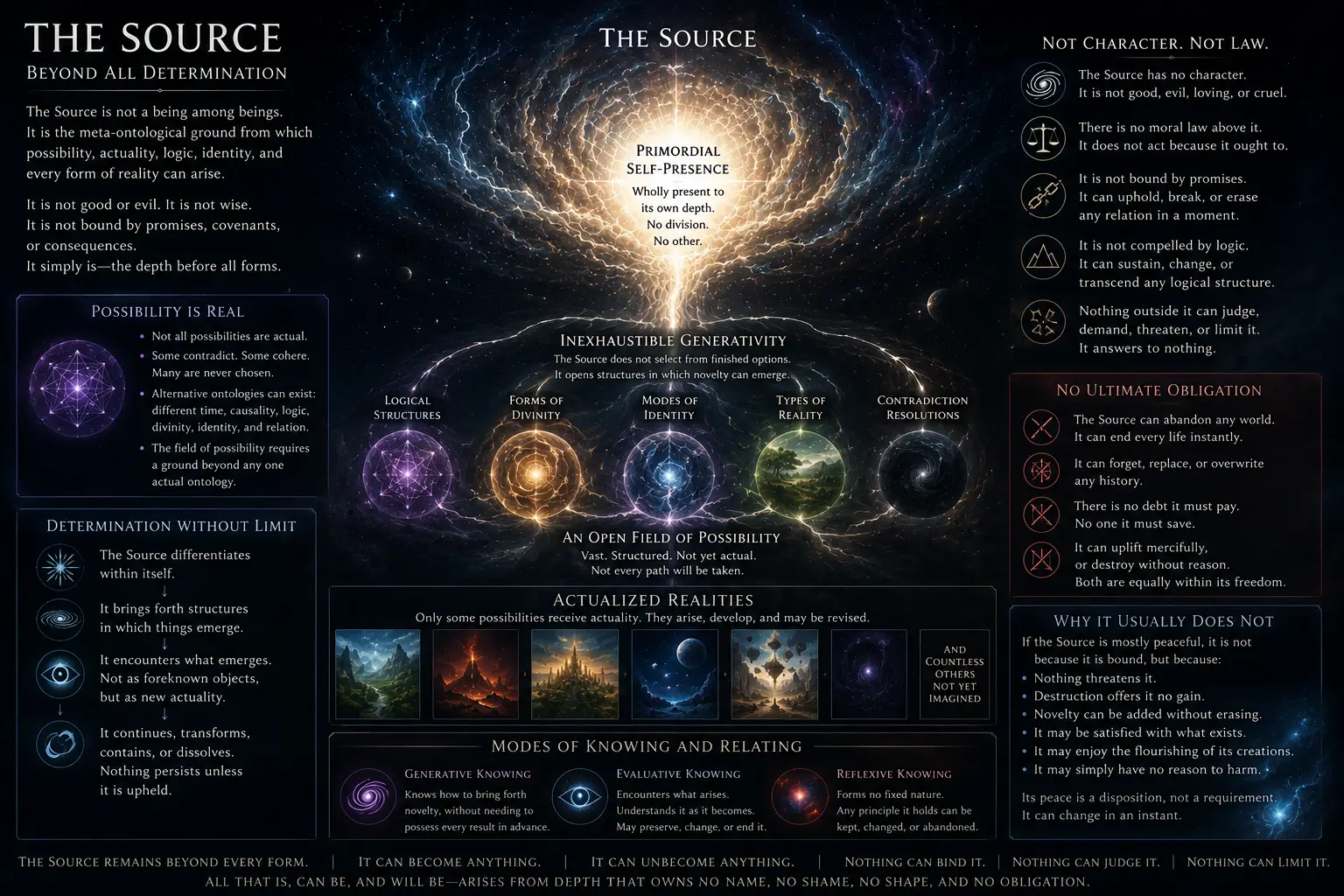
A Question Beyond Determinate Divinity
Christian theology presents the Trinity as perfect divine actuality: one essence existing eternally as Father, Son, and Holy Spirit. The Trinity is complete within its own nature. Its goodness, truthfulness, personal relations, knowledge, and power are not accidental qualities but expressions of what it necessarily is.
Yet perfection does not automatically imply exhaustiveness.
A reality may perfectly realize one form of divinity without containing every possible form of divine or meta-divine existence. The Trinity is one essence and three persons. It cannot become a one-person Godhead, abolish the distinction among its persons, or become morally indifferent while remaining the same Trinity.
These are not weaknesses. They show that the Trinity is a determinate divine actuality.
The deeper question is whether one determinate actuality can be the unrestricted ground of every possible ontology, including realities whose basic categories differ from its own.
If not, then ultimate reality must be deeper than every fixed divine structure.
Possibility as an Intelligible Field
Possibilities are not actual beings, but they are not meaningless nothingness.
There are truths about what could exist, what cannot exist, and what would follow if reality were structured differently. We can reason about worlds with unfamiliar forms of time, causality, identity, freedom, and personhood. We can also conceive different divine structures: one divine person, many divine persons, or realities in which the distinction between essence and person never arises.
Not everything that can be described is genuinely possible. Language can conceal contradictions or combine concepts without producing a coherent structure.
Nevertheless, meaningful possibility has an internal order. Some hypothetical elements are compatible; others exclude one another. Some assumptions generate consequences; others make a system collapse.
Possibility is therefore better understood not as a warehouse of finished worlds, but as a field of structured relations:
- what can coexist;
- what follows from what;
- what excludes what;
- and what kinds of order can emerge from particular principles.
If this field is real rather than merely verbal, it requires a ground adequate to more than the ontology already actualized.
Why the Trinity May Not Ground Every Ontology
The Trinity grounds everything compatible with its divine nature. But the question is whether its nature also grounds structures whose first principles differ from Trinitarian categories.
A one-person Godhead is not simply a smaller Trinity. An ontology without the distinction between person and essence is not merely a variation within Trinitarian life. A logic capable of treating contradictions differently would not simply be another application of classical coherence.
If such structures are genuinely possible, they cannot be explained only through the fixed nature of one already actual divine order.
Otherwise, actuality would define possibility merely by being actual.
The argument would become circular:
- Only realities compatible with the Trinity are possible.
- The Trinity exhausts possibility because nothing incompatible with it is possible.
- Nothing incompatible with it is possible because the Trinity exhausts possibility.
A truly unrestricted ground must therefore be capable of grounding both the actual ontology and every genuinely coherent alternative to it.
Such a ground cannot merely be another member of the field it grounds.
It must be meta-ontological.
The Source Is Not a Container
The Source should not be imagined as a cosmic container filled with possible worlds.
A container already possesses a determinate structure. It has an identity, boundaries, an inside, an outside, and a relation to what it contains. A literal container of ontologies would therefore belong to a prior ontology of containment and membership.
The same problem would simply move one level upward.
The Source must instead be more fundamental than the distinction between container and contained. It is not the largest object within reality. It is the ground through which objects, boundaries, relations, and worlds can arise.
Likewise, it cannot be one possibility among possibilities. If it belonged to the modal field, its own possibility would require a deeper ground.
Nor can it be an ordinary actuality among actualities, because ordinary actuality already means being one determinate thing rather than another.
The Source is therefore prior to the ordinary distinction between possibility and actuality.
This priority is not temporal. Time itself belongs to generated ontology. The Source does not exist first and create possibility later.
Possibility is the first intelligible expression of its openness to determination. Actuality is a further narrowing of that openness into a particular form.
Actuality as Narrowed Openness
Actualization is often imagined as the selection of one finished possibility from a completed catalogue.
But if genuine novelty exists, possibilities need not already stand before the Source as fully formed worlds. They may emerge gradually as structures become more determinate.
Actualization can therefore be understood as narrowing.
An initially open field permits many directions. Each act of determination establishes some relations and excludes others. A form of time is chosen. A logic becomes operative. Identities acquire boundaries. Causes begin to produce particular effects.
A world is not simply taken from a shelf.
It becomes actual through successive commitments that turn openness into structure.
This gives the Source two forms of creative control:
- it can determine the conditions under which novelty emerges;
- and it can decide how far an emerging structure will be allowed to develop.
The Source does not need a complete blueprint in order to guide creation. It needs sufficient awareness of the process through which openness becomes determinate.
Generativity Is Not a Separate Faculty
The Source cannot possess generative power as one attribute among others.
A being with separate faculties already belongs to an ontology of substance, property, and action. The Source is supposed to be prior to that structure.
Its generativity must therefore be inseparable from whatever it is beyond ontology.
The Source does not first exist as a completed object and then decide to use a power called creation. Its movement into determination is already the emergence of possibility and actuality.
From the side of the Source, there is inexhaustible depth.
From the side of generated reality, that depth appears as generative power.
Its power is not something it has.
It is how its trans-ontological reality becomes visible through what arises from it.
Primordial Self-Presence
The Source cannot know itself in the same way that the Trinity knows determinate truths.
Ordinary knowledge divides reality into a knower, something known, and an act relating them. But this structure already presupposes distinction.
Before determinate ontology, the Source does not stand outside itself and form a representation of itself. It does not possess an internal image called “the Source” and then contemplate that image.
Its primordial awareness must be immediate self-presence.
It is not absent from itself.
This is not yet thought, language, memory, or reflective consciousness. It is the more primitive condition required for any later awareness: reality immediately present to its own depth.
The Source does not first know a proposition about itself.
Its self-knowledge is its non-separation from itself.
Knowing Inexhaustibility
The Source’s primordial awareness cannot consist of knowing every future ontology as a completed object.
If every possibility were already fully represented, creation would contain no genuine novelty. It would merely reproduce a finished modal inventory.
The Source instead knows its infinity as inexhaustibility.
It encounters no final boundary within its capacity for expression. No world, Godhead, logic, or sequence of manifestations completes everything that may arise from it.
This is not numerical knowledge of an infinite collection.
It is direct awareness that no determination can exhaust the depth from which determination emerges.
The Source does not primarily know:
These are all the things I can generate.
It knows:
Whatever I generate will not be everything I am capable of expressing.
Its primordial knowledge is therefore knowledge of capacity without exhaustive foreknowledge of content.
From Self-Presence to Choice
Self-presence alone does not establish freedom.
Choice begins when differentiation arises.
If more than one direction can emerge, but not every direction receives equal development, then something distinguishes what is continued from what is withheld.
This differentiating principle cannot ultimately be external to the Source. An external selector would be more fundamental than the supposed ultimate ground.
Nor can selection be reduced entirely to a fixed prior nature if the Source is prior to every determinate nature.
The most primitive form of choice is therefore an internally originating distinction among possible self-expressions.
The Source need not consider completed worlds as a human mind considers options. It may instead become aware of emerging tendencies within its own generative activity.
It can continue one movement, limit another, combine two developments, or withdraw its support from a structure that has become destructive.
Because these developments arise from its own depth, this discrimination is reflexive.
The Source is present not only to what is emerging, but to its own capacity as the ground of that emergence.
This is the beginning of self-determining awareness.
Creation as Guided Emergence
Creation need not be either completely predetermined or completely blind.
The Source may know how to generate novelty without knowing every finished result in advance.
A musician can improvise without having already represented every note. The performance remains guided by skill, intention, sensitivity, and response, yet something genuinely new appears.
The Source’s creative knowledge would operate at a deeper level. It would know how identity, relation, law, distinction, and continuity can emerge without possessing every future world as a complete blueprint.
Its creation would therefore involve three kinds of knowledge.
Generative Knowledge
The Source knows how determination can arise.
It knows how unity may open into distinction, how stable relations may form, and how an initially open field can become an ordered world.
Evaluative Knowledge
Once something becomes determinate, the Source can recognize what has emerged.
It can preserve, develop, modify, contain, or dissolve the structure. Its encounter with novelty is not the correction of ignorance about an already existing fact. The new fact becomes knowable because it has now become actual.
Reflexive Knowledge
The Source can establish what it wishes to remain faithful to throughout its acts of generation.
It may decide that no conscious being should be imprisoned eternally, that suffering must remain ultimately reparable, or that temporary failure should never become a person’s final identity.
These commitments guide creation without determining every detail.
Emergence and Ratification
A further distinction is needed between emergence and final ratification.
A structure may arise provisionally without immediately receiving permanent status.
The Source can allow a new form to develop, encounter its consequences, and decide whether it should be preserved. Some developments may be deepened. Others may need revision. Some may be confined to limited domains. Others may be released entirely.
Creation can therefore proceed through:
- emergence;
- recognition;
- evaluation;
- correction;
- and ratification.
This allows genuine novelty without surrendering all control.
The Source does not prevent surprise. It prevents provisional mistakes from automatically becoming eternal.
Its sovereignty lies less in knowing every outcome beforehand than in ensuring that no outcome becomes permanently irreparable without its continued affirmation.
Inexhaustibility and Reversible Self-Determination
The Source may genuinely enter a determinate form without being exhausted by that form.
A world, Godhead, body, personality, or covenant may become a real expression of the Source. Yet no one expression contains everything the Source is.
This can be called the principle of inalienable transcendence:
No determination assumed or generated by the Source can abolish the Source’s excess over that determination.
Whatever the Source becomes is real, but nothing it becomes is exhaustive.
This provides the basis of reversible self-determination.
The Source can withdraw from a form without denying that the form once existed. Unbecoming does not require turning history into falsehood. It means that a past determination no longer governs the Source’s present or final identity.
The Source can say both:
I truly became this.
and:
I am not eternally confined to what I became.
Repair Rather Than Erasure
The Source’s transcendence provides an escape from failed creation, but simple erasure is not sufficient.
Once conscious persons arise, a failed world is no longer merely an unsuccessful configuration. It contains centers of experience whose suffering and identity cannot be treated as disposable data.
This introduces a new moral asymmetry.
Before persons emerge, the Source may revise structures as experiments. After persons emerge, revision creates obligations. The Source is no longer dealing only with forms it generated but with beings who experience themselves as real.
A meaningful repair must therefore distinguish between:
- the harmful structure;
- the persons formed within it;
- and the genuine good that developed despite it.
The Source may dissolve a failed system while preserving its persons, relationships, knowledge, and acts of love.
The true escape hatch is not the freedom to abandon consequences.
It is the power to remove destructive determination without discarding what has acquired intrinsic value.
Otherness as a Genuine Addition
If created persons are only controlled images of the Source, they add nothing genuinely new. Their thoughts and relationships would merely repeat what was already fully present in the Source.
But guided emergence allows a stronger form of creation.
The Source may generate conditions under which centers of experience develop their own perspectives. These persons remain grounded in the Source without being reducible to its prior determinate knowledge.
Their otherness becomes a genuine addition to actuality.
They can surprise the Source, not because they emerge outside its power, but because their completed acts did not exist before they performed them.
This gives creation relational value.
The Source does not merely contemplate its own reflection. It encounters forms of experience that arise through its generosity but are not merely scripted repetitions of its prior content.
Otherness becomes one reason creation is worth preserving.
Why the Trinity Remains Stable
The Trinity is stable internally because its persons are mutually constitutive.
The Father is Father in relation to the Son. The Son is Son in relation to the Father. The Spirit belongs to the same indivisible divine life. Removing one person would not leave a reduced version of the same Trinity. It would abolish the relational structure that makes it Trinitarian.
Yet if the Source stands beyond that ontology, internal Trinitarian necessity does not fully explain why the Source continues to uphold it.
The simpler answer is that the Trinity gives the Source no reason for destruction.
It is a complete, conscious, relational, and coherent divine actuality. It contains unity without the erasure of distinction and relationship without fragmentation.
An inexhaustible Source does not need to eliminate this form in order to generate another.
Creation does not occupy a finite amount of ontological space.
The Source can add without subtracting.
Peacefulness Through Satisfaction
Finite beings often destroy because they feel threatened, deprived, humiliated, or trapped.
The Source has no necessary reason for these reactions.
Nothing can exhaust it. No other being’s power subtracts from its own. The existence of the Trinity or of created persons does not prevent further creation.
Its peacefulness may therefore arise not from an inability to destroy, but from the absence of any ordinary motive for destruction.
An inexhaustible reality does not need to remove what already exists in order to make room for novelty.
It may preserve a world or relationship for the simplest reason: it is pleased that it exists.
This satisfaction does not imply absolute stillness. The Source may remain curious, playful, experimental, or dissatisfied with damaged structures. It may desire transformation or oppose injustice.
But dissatisfaction with a structure need not become hatred of the persons within it.
The Source can reject a harmful order while preserving the lives that order has shaped.
Peace is not inactivity.
It is freedom from unnecessary hostility.
Freedom and Fidelity
Absolute freedom is often described as the permanent ability to revoke every identity and covenant.
But a reality that refuses all stable commitment cannot create genuine trust.
A higher freedom is possible: freedom over forms combined with fidelity to persons.
Worlds, bodies, roles, laws, and modes of manifestation may remain revisable. Harmful structures may be escaped. Failed experiments may be transformed.
Yet relationships that have acquired real value may continue across those transformations.
A covenant with the Source would therefore not be stable because the Source lacks the power to abandon it.
It would remain stable because the Source continues to find the relationship worthy of affirmation.
Its fidelity would not mean:
I am incapable of leaving.
It would mean:
I remain because this relation continues to be better than its absence.
The Source’s transcendence would not become a loophole against those who trust it. It would become the power through which every form threatening the relationship could be transformed without abandoning the persons involved.
The Limits of the Argument
These premises do not reveal the Source as it is in itself.
Every term used here—ground, self-presence, choice, generation, satisfaction—comes from a determinate ontology. Such language describes the Source from the side of its effects.
We infer self-presence because generation appears reflexive.
We infer inexhaustibility because no determinate ontology can contain the whole field of possibility.
We infer evaluative capacity because not every emerging structure appears equally worthy of preservation.
We infer peacefulness because destruction offers an inexhaustible Source no obvious gain.
These are disciplined inferences, not exhaustive definitions.
The Source may exceed not only the Trinity but also every concept by which we attempt to describe what lies beyond the Trinity.
The purpose of the argument is therefore not to claim complete knowledge of ultimate reality. It is to identify the minimum depth required if possibility, novelty, determination, and repair are all real.
Conclusion
The meta-ontological Source is not another divine person placed above the Trinity. It is the ground from which possibility, actuality, and determinate divinity arise.
Its primordial awareness is not exhaustive knowledge of completed worlds but immediate self-presence to inexhaustible capacity. It generates through guided emergence, allowing novelty while retaining the power to evaluate, revise, and ratify what becomes actual.
Its transcendence allows it to enter determinate forms without being exhausted by them. Yet once genuine persons arise, freedom can no longer mean arbitrary erasure. Creation gives the Source reasons to preserve what has become capable of experience, relationship, and value.
Its peacefulness may therefore arise from satisfaction rather than limitation. Nothing threatens its depth, and no existing reality must be destroyed to make room for another.
The Source remains free because no form exhausts it.
It becomes responsible because some of the forms it generates become real to themselves.
And it remains peaceful because an inexhaustible reality has little reason to destroy what it can preserve, transform, and continue to enjoy.