
God does not exist inside eternity. He is eternity. If eternity were an environment around Him, then eternity would be greater than God, and God would be contained by something more original than Himself. But God is the Primary Will, the Uncaused Cause. There is no container before Him, no field beneath Him, no time above Him, and no eternal realm holding Him in place.
Eternity is therefore not a place. It is the uncreated immediacy of God’s own being. Time is the environment He creates for finite beings, where things unfold by sequence, memory, expectation, before, after, beginning, and end. Eternity is the divine Is-ness of the One who is self-present without needing sequence in order to be real.
This means God is not static. He is not frozen because He is eternal. Eternity is not a prison that traps Him in immobility. It is His own living actuality. Yet divine dynamism is not evolution. God does not become complete by passing through stages. He does not improve by leaving an inferior condition behind. He does not move from ignorance into knowledge, weakness into strength, or lack into fullness.
Change within eternity must therefore mean something deeper than temporal change. Temporal change happens when one state replaces another. A seed becomes a tree. A child becomes an adult. A thought becomes a decision. One moment passes so another may arrive. This is how finite beings change, because finite beings live inside sequence.
God does not change by sequence. He changes by sourcehood. He can sovereignly re-determine, intensify, or reconfigure the form of His will without being acted upon by time. The change is real, but it is not horizontal. It does not move from past to future. It is vertical: God touches the root by which a temporal order stands, and the temporal order is changed beneath His will.
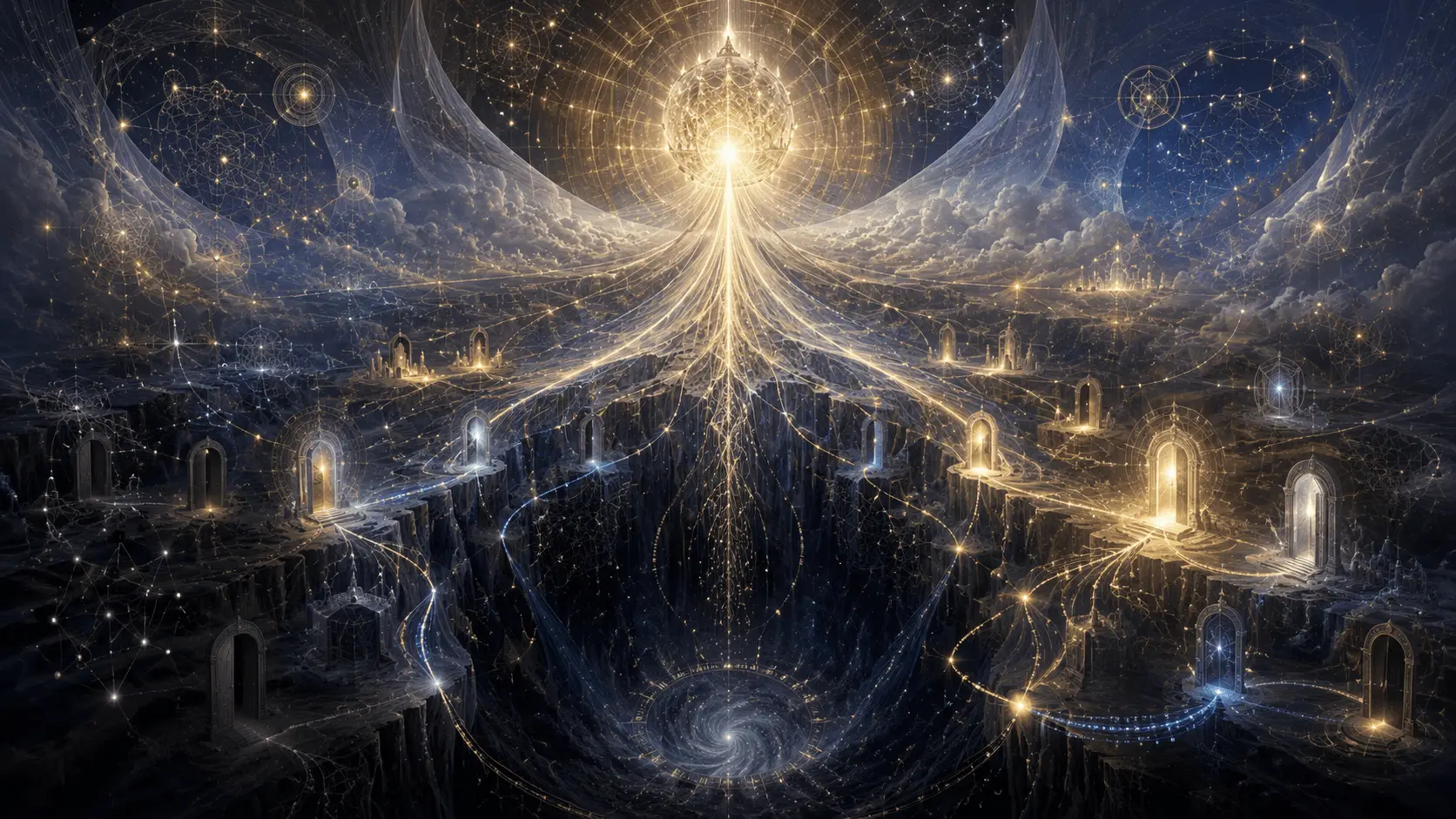
Creation may be imagined as a finite field held by the Infinite. Inside that field are history, causality, prophecy, birth, death, choice, and duration. But the field itself is not ultimate. It does not contain God. God can hold it, alter it, deepen it, renew it, or transform its inner logic without becoming subject to it. He is not inside the sequence as one event among events. He is the Source by which the whole sequence stands.
When God re-determines a created order, He is not revising Himself as though He discovered a mistake. He is not learning, correcting ignorance, or repairing deficiency. Divine change is not self-improvement. It is sovereign actuality. It is the living Source determining the form of what depends on Him.
This also clarifies eternal priority. The Father can be before what proceeds from Him as Source without being earlier in time. In eternity, “before” means priority, not duration. The cause is deeper, not older. The dependent reality depends without needing to appear later. Eternal causality is therefore not temporal sequence but ontological order.
God can be eternal and dynamic at once because eternity is not an external stillness imposed upon Him. It is His own living Self. He is not changed by time, because time is His creation. He is not trapped by eternity, because eternity is His own being. He can re-determine the form of His will, intensify His own living actuality, and transform the temporal field without diminishing, corrupting, or destabilizing His uncaused Self.
The paradox is resolved when we stop imagining eternity as endless time or frozen permanence. Eternity is God’s living immediacy. Temporal beings change by succession. God changes, if the word is used, by sovereign depth. His identity does not become unstable. His Self does not cease, divide, weaken, or become other than itself. But His will is not inert, His life is not dead, and His eternity is not immobility.
Eternal change is not God becoming less Himself or more complete than before. It is the living God determining, intensifying, and reconfiguring from the depth of His own uncreated being.