
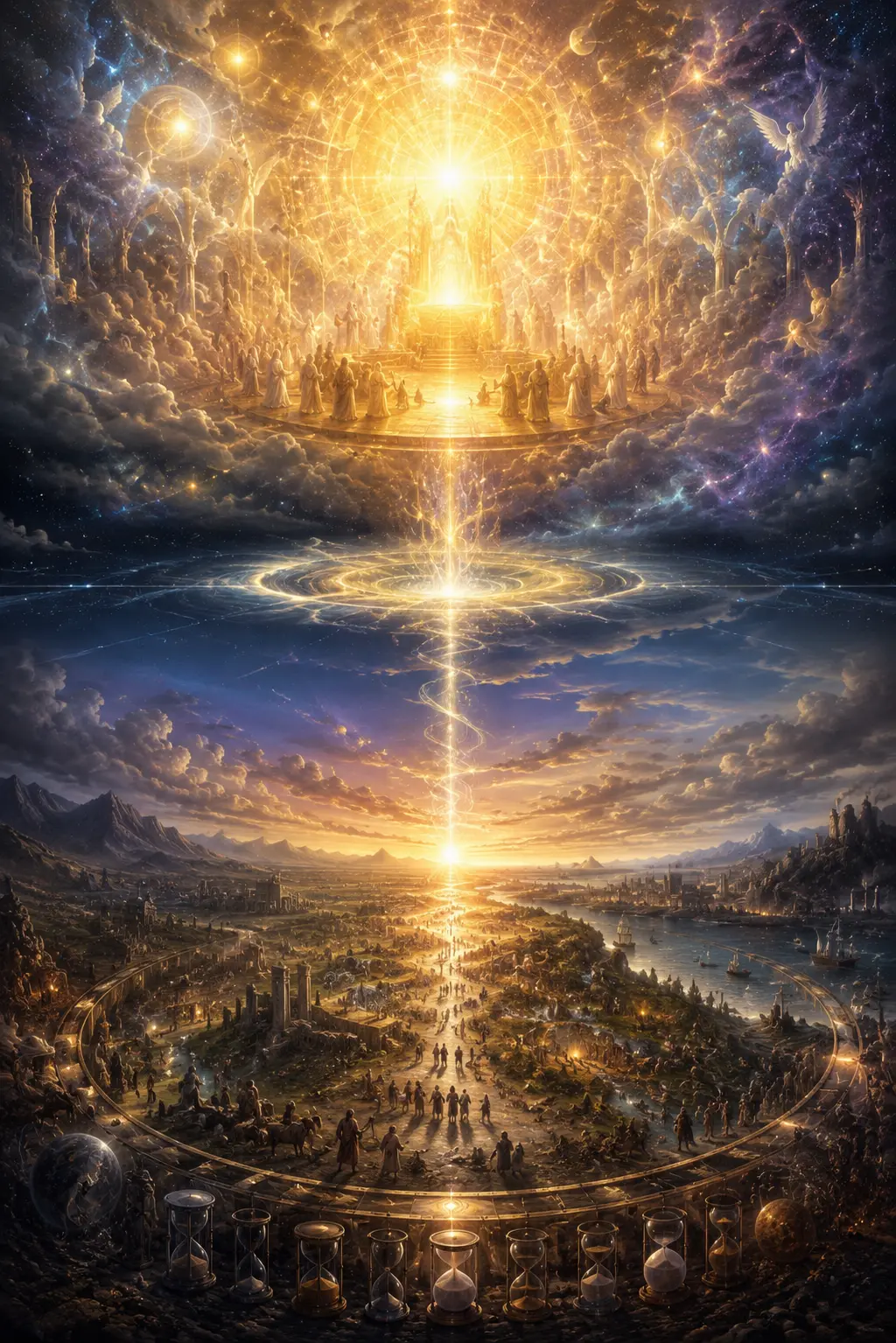
The mystery of time is not simply whether God knows the future. The deeper question is how a future becomes actual, how free choices can be known without being forced, how prophecy can change history without making God ignorant, and how the end-times can be sealed in the Father while still unrevealed to angels, powers, and even the divine family.
The mistake is imagining eternity as a finished film. If eternity were only a movie reel, God would merely watch what is already fixed, prophecy would become theater, prayer would become decoration, and freedom would become suspicious.
But eternity is not a film. Eternity is God’s living possession of what He grants standing to. Time is a created field. God creates it, sustains it, beholds it, reveals what He chooses, conceals what He chooses, and can edit even His own determinations because no created causality stands above His will.
There are three views.
The temporal view is how creatures experience history from inside sequence.
The eternal view is how God beholds the time-field once He grants it standing.
The higher divine freedom is the Father’s power to reveal, conceal, seal, re-seal, edit, or reconfigure His own determinations because His will is not trapped beneath created causality.
Temporal View and Eternal View
The temporal view is the creature’s view from inside time. A soul is born, grows, suffers, chooses, sins, repents, loves, refuses, dies, and rises. From within time, a choice is not made until the creature reaches the moment of choosing.
This view is real. Peter truly denies Jesus. Nineveh truly repents. A saint truly endures. A sinner truly refuses. The temporal field is where the soul becomes visible to itself.
God created temporal sequence because a free answer requires unfolding. A song needs sequence. A promise needs before and after. A life needs development. Fallen time is wounded by decay and death, but sequence itself is not evil. Sequence is the condition for story, warning, repentance, fulfillment, and love.
The eternal view is God’s view of the same field once it stands. God does not merely create the first second and wait helplessly. He grants the temporal field standing as a whole created order. Creatures live that order moment by moment. God beholds it eternally.
From inside time, Peter has not yet denied Jesus until the night of denial. From eternity, once that field stands, Peter’s denial is visible in its temporal place.
From inside time, Nineveh has not yet repented until Jonah preaches and the city responds. From eternity, once that field stands, Jonah’s warning and Nineveh’s repentance are visible together as one actual sequence.
This does not destroy freedom. God’s seeing does not coerce the act. He sees the act because it stands in the field He granted. The creature chooses temporally. God knows eternally.
Before Time and the Creation of the Field
Before a world is instantiated, its actual history does not yet stand as actual history.
God does not copy a future from somewhere outside Himself. Before time stands, there is no created history to observe. There is God: the living Source whose will grants standing.
Before time, God knows Himself, His purposes, the world He may create, the souls He may grant standing to, their roots and possible responses, the graces He may offer, the warnings He may send, the judgments He may condition, and the boundaries He may impose. This is not ignorance. It is source-knowledge before actualization.
Actual choices become actual when the temporal field stands. Not before as already-existing objects, and not later as surprises, but when God grants the field standing. From inside the field, creatures choose moment by moment. From eternity, God beholds the whole standing field and answers truthfully.
Revealed and Sealed History
A history is sealed when God grants it standing as real history. But not everything sealed is revealed. Sealing concerns divine determination. Revelation concerns what is disclosed.
A thing may be sealed in the Father’s will without being revealed to prophets, angels, powers, saints, the Son in His economic mission, or the divine family. This distinction matters most for the end-times.
Ordinary history becomes revealed through temporal unfolding. Creatures live it. Prophets interpret parts of it. The Son reveals the Father’s meaning within it. The saints later understand its mercy and judgment.
God can intervene inside history: warning, healing, delaying judgment, answering prayer, performing miracles, restraining evil, incarnating, raising the dead. But He does not usually erase history before it stands, because He has chosen to let creaturely acts have real weight.
A sealed history is a history God honors as real.
Editing the Eternal View
The Father can edit not only temporal events, but the eternal view itself.
His decree is not a chain around Him. His determinations are His own living acts. Because causality belongs to creation, not above God, He is not bound to the creaturely order: first determine, then seal, then become unable to alter.
Therefore the Father can edit, reveal, conceal, seal, re-seal, suspend, redirect, or reconfigure even His own determinations. By altering the eternal view, He changes what becomes temporal history.
This does not make Him unstable. It means His freedom is higher than causality. History is stable because God is faithful, not because He is trapped.
He normally does not revise revealed-and-sealed history, because that would make creaturely freedom unreal, covenant unreliable, prophecy meaningless, and history weightless. His ability to edit does not mean He edits frivolously. His sovereignty includes restraint.
The end-times may be the exceptional chamber: not unsealed chaos, but sealed and unrevealed under the Father’s higher authority.
Nineveh, Peter, and Prophetic Knowledge
Nineveh shows warning becoming the instrument of mercy.
God sends Jonah to announce judgment. The warning is real. If Nineveh remains violent, destruction is righteous. But Nineveh repents. The warning awakens repentance and becomes the path by which mercy is revealed.
God knew Nineveh’s repentance from the eternal view of the actualized field, but He knew it with Jonah included. Without Jonah, Nineveh likely would not have repented. Prophecy is therefore not theater. It is divine action inside the field.
Peter shows another form of foreknowledge. Jesus tells Peter he will deny Him three times. This is not conditional like Nineveh. It is disclosure of a sealed personal failure. Peter still freely denies. Jesus’ foreknowledge does not force him. The Son sees the wound before Peter understands himself, but He also surrounds the wound with restoration.
Nineveh shows conditional judgment becoming mercy.
Peter shows foreknowledge surrounding failure with healing.
The Son, Reserved Revelation, and Eternal Sequence
The Son’s incarnation shows both divine knowledge and reserved knowledge.
As Logos, the Son knows the meaning-structure of the Father’s work. In incarnation, He truly enters temporal life: He grows, waits, suffers, prays, obeys, and receives from the Father.
This is why the Son can know Peter’s denial and yet say of the final day and hour that no one knows, not even the angels, nor the Son, but only the Father.
This is not mere ignorance. It is reserved revelation.
The Son knows the promise of the end: the Kingdom comes, evil is judged, the dead rise, the Bride is gathered, the Son reigns, and the Father is glorified. But the exact unveiling, timing, and manifestation of the end belong to the Father’s Keter-seal.
The Son knows the meaning.
The Father reserves the reveal.
The difficult paradox is this: if the eternal Son does not yet know the end, but later He does know it, does that mean there is time in eternity?
Not fallen time. But there is ordered eternal disclosure.
The Son does not possess the reserved end in the earlier order of disclosure, but receives and knows it in the later order of eternal revelation. This “later” is not clock-time. It is relational order: the Father holds, the Son receives, and what was unrevealed becomes revealed.
So the Son’s knowledge does not come from watching a film. It comes from communion with the Father.
How Eternity Receives Revelation
Eternity has no decay-sequence: no aging, anxiety, loss, or waiting as deficiency. But it can have communion-sequence.
The divine family does not learn the end by watching a completed movie. They receive the end when the Father opens what was sealed. Their temporal participation is gathered into eternal understanding.
The order is:
the Father holds the sealed end,
prophecy gives partial signs,
the Son, Wisdom, angels, saints, and creation participate according to their offices,
the Father opens the meaning at the appointed disclosure,
what was lived temporally becomes understood eternally.
This means the divine family can participate in an event temporally before receiving its full eternal meaning. They do not watch the ending from outside. They enter it, serve it, and then receive its unveiled truth when the Father discloses it.
That is sequence in eternity: not time as decay, but order as revelation.
The Sealed End
The end-times are not unsealed chaos. They are sealed but unrevealed. The Father knows, owns, and holds the end. But He has not handed full possession of the reveal to creation, angels, powers, or even the divine family. He has given prophecy and signs, but not mastery.
This explains why end-time prophecy can be true and yet not fully transparent. It gives warning, hope, symbols, and promises, but it does not give creatures ownership of the Father’s final disclosure.
The end is not a code humans can fully crack. It is a sealed mystery awaiting divine revelation.
Conclusion
Time is created so that reality can answer.
The temporal view is where creatures choose. The eternal view is where God beholds the field once it stands. The higher divine freedom is the Father’s ability to edit even His own determinations because He is above created causality.
Nineveh shows warning becoming mercy. Peter shows foreknowledge surrounding failure with restoration. The Son’s incarnation shows the Logos entering time while receiving reserved revelation from the Father.
The end-times reveal the highest mystery: the future is not unsealed chaos, but sealed and unrevealed. It becomes known through ordered disclosure, not film-watching. The divine family receives the end as the Father opens it, and their temporal participation is gathered into eternal understanding.
God is beyond history, yet He creates history.
God sees the field, yet He can conceal what is sealed.
God knows what stands, yet He chooses when it is revealed.
God reigns from eternity, yet He can enter time.
And the final future is revealed when the Father opens what only He has held.
The World to Come and God’s Life in Created Time
In the World to Come, God will not relate to creation only from the eternal view above it. He will also live with His family inside created sequence.
This does not mean He loses eternity. The Father remains Source, able to behold the whole field whenever He wills. But He can also choose a different mode of attention: He can veil the full eternal preview of a created event and receive it as it unfolds.
This is not ignorance. It is chosen participation.
God can know the whole song and still listen as it is sung. He can know the whole feast and still receive each course as it is brought. He can know the design of a saintly world and still enter it as guest. He can know the possible ending of a holy game and still play through each move in real time.
The World to Come therefore has a kind of created time that is not fallen time. It is not time as decay, pressure, anxiety, or death. It is time as music, play, procession, conversation, discovery, and shared delight.
God’s eternal knowledge does not make this false. A father may know his child’s heart and still enjoy the child’s words as they are spoken. A composer may know a melody and still delight when musicians perform it. In a higher way, God can hold the whole in sovereignty and still enjoy the part in sequence.
This means eternity will not be a frozen totality. It will be a living household. The Father can reign above all, yet also walk among His children. He can receive offerings as they are brought. He can watch festivals unfold. He can answer conversations. He can join games, journeys, gardens, councils, songs, and works of beauty without reducing them to a pre-watched film.
God will live more richly in the World to Come because He will not only possess creation eternally; He will share its glorified time from within.
He will know as Source.
He will receive as Father.
He will reign from eternity.
And He will rejoice in sequence.