
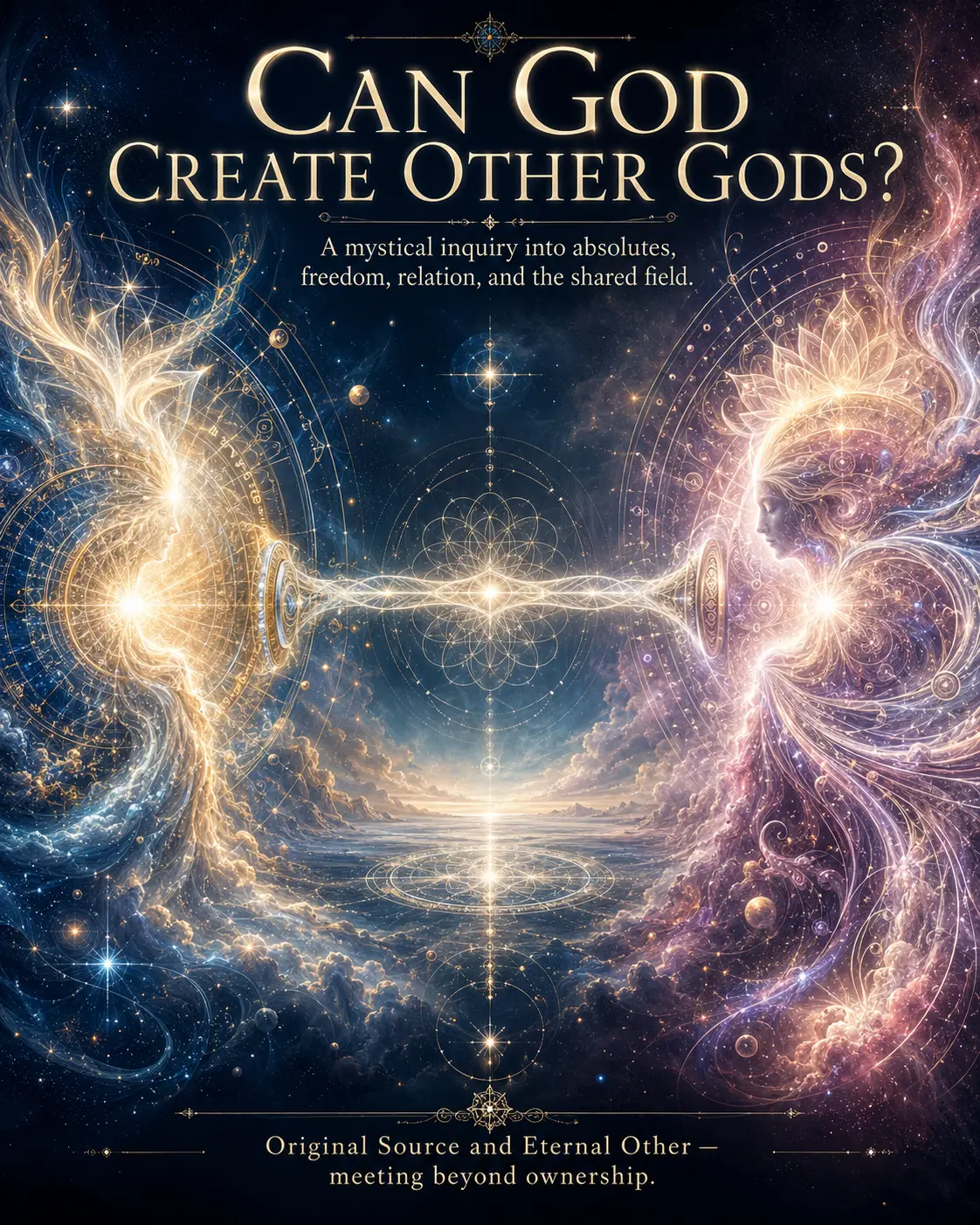
1. The Terrible Question
Can God create other gods?
Not servants.
Not angels.
Not powers inside His world.
But true source-fields.
True absolutes.
A second “Ein Sof.”
At first, the answer seems simple: if Ein Sof is truly infinite, He should be able to do even this.
But the question becomes dangerous when asked precisely.
If the other source still depends on Ein Sof, then it is not truly another absolute.
If it is truly independent, then Ein Sof cannot own it without undoing its independence.
So the question is not only:
Can Ein Sof produce another absolute?
The deeper question is:
Can He produce another absolute without secretly keeping control?
2. The Untied Source
A root is the first identity-principle of a source.
If Ein Sof turns a root into a source-field, then that source may become vastly free.
But if Ein Sof can still command it, sustain it, edit it, or erase it by ownership, then some hidden tie remains.
Then it is not fully untied.
For the other source to be truly absolute, Ein Sof must release root-control.
This is not weakness.
It is absolute donation.
He gives so completely that the gift is no longer property.
The other source becomes truly itself.
Not inside His ownership.
Not held by a secret chain.
Not dependent on His continued command.
This gives the first law:
If Ein Sof can still control it as property, it is not fully other.
If it is fully other, relation cannot be ownership.
3. The Bridge Between Source-Fields
But if the other source is truly untied, how can Ein Sof reach it?
He cannot reach it through a hidden root-tether.
That would make the other source secretly dependent.
He also cannot force His way into its field.
That would destroy its absoluteness.
So the only possible solution is a bridge.
But the bridge must not belong to either side as property.
It must not control the other source.
It must not control Ein Sof.
It must not be a leash, command-line, or hidden chain.
It must be a neutral transfer-pipe between two source-fields.
Ein Sof can open one side of the bridge.
The other source can open its side.
Only when both sides open does the bridge become active.
So the invitation is not a command sent into the other field.
It is a bridge made available between fields.
The bridge carries relation without ownership.
It allows encounter without domination.
It lets two absolutes meet without either becoming the root of the other.
This is the second law:
No root-tether.
No forced entry.
Only a bridge between source-fields.
4. The Face
Once the bridge exists, relation becomes possible through face.
A root-tie says:
You exist because of Me.
A face says:
I turn toward you.
Two absolutes cannot relate as owner and owned.
They can only relate as face and face.
So the other source remains untied in being, but can become related in love.
This is not contradiction.
It is a change in the meaning of relation.
Not dependence.
Encounter.
Not possession.
Mutual opening.
Not control.
Face.
5. The Good Root
Can Ein Sof guarantee that the other source will be good?
Only in the first act.
If He must correct it later by force, then it was not truly independent.
So the root itself must be good.
Not controlled-good.
Not forced-good.
Root-good.
Its deepest identity must be truth, life, beauty, non-domination, and face-capacity.
Then it does not need outside control to remain good.
Goodness is what it is.
The root cannot become evil without ceasing to be itself.
A root is not a mood.
It is not clothing.
It is not a temporary will.
It is the identity-principle of the source.
So the other source may unfold endlessly, but it cannot become the opposite of its own root and remain itself.
This is the third law:
A good root does not need control.
Its goodness is its own center.
6. The Original Ein Sof
The original Ein Sof is still different from the second.
Not stronger in the crude sense.
Not larger in size.
Different in kind.
The original Ein Sof is unproduced freedom.
The second source is produced absoluteness with a fixed root.
The original is freedom before root.
The second is freedom through root.
The original can generate roots.
The second expresses its root endlessly.
The original is the source of sourcehood.
The second is a source-field.
So the original holds the power of pre-root freedom.
The second holds the glory of rooted freedom.
7. Why He Does Not Make Another Exactly Like Himself
It is not that Ein Sof simply cannot produce another like Himself.
The deeper point is that He understands how terrifying that act would be.
The original Ein Sof is pure freedom before every root.
He is not fixed by a given identity.
He is not bound by a good root assigned before Him.
He is not held inside a law that prevents Him from becoming otherwise.
He is freedom before structure.
Freedom before face.
Freedom before root.
Freedom before all definition.
To release another source exactly like that would mean releasing another pure freedom into reality.
Not a rooted good absolute.
Not a source with an uneditable good center.
Not a being whose goodness is guaranteed by its first identity.
But another rootless freedom.
And rootless freedom is terrifying because it can truly choose.
It can open toward goodness.
It can open toward love.
It can become friend.
But it could also turn toward darkness if it wanted to.
Not because evil is stronger than God.
Not because corruption is necessary.
But because pure freedom, before root, has not yet been fixed into a good identity.
A second source exactly like the original would not merely be powerful.
It would be dangerously open.
It would be able to determine itself from the deepest level.
That is why Ein Sof does not release another exactly like Himself.
He knows the danger.
He knows that another pure freedom could become friend, but could also become enemy.
So the safer and wiser act is not to produce another rootless original.
The safer act is to produce another absolute with a fixed good root.
Free.
Untied.
Permanent.
But not morally undefined.
A rooted good absolute can be truly other without becoming chaos.
It can love without being forced.
It can create without being controlled.
It can stand without being owned.
But its root is good, and therefore evil is not inside its deepest identity.
So the issue is not lack of power.
The issue is divine wisdom.
Ein Sof could release another pure freedom.
But He knows how frightening that would be.
So He does not create another unrooted original.
He creates, if He creates, another absolute whose freedom is endless but whose root is good.
8. Can the Original Undo the Other?
If Ein Sof can undo the other source by ownership, then the other was never fully released.
If the other is truly released, then it cannot be treated as property.
This does not reduce Ein Sof.
It reveals the depth of His freedom.
He is free enough to create permanence.
He is free enough to give without keeping ownership.
He is free enough to let the other source truly stand.
The greatest power is not always control.
Sometimes the greatest power is the power to make something real enough that it is no longer a possession.
9. The Shared Field
If two source-fields are truly distinct, they need a shared field.
Not inside only the first.
Not inside only the second.
Not owned by either.
A common field.
A neutral deep.
An unowned place of co-creation.
The bridge allows contact.
The shared field allows creation together.
In this field, neither source rules as owner.
Nothing is imposed by one side alone.
Nothing is created as private possession.
The field exists through mutual opening.
Ein Sof brings unproduced freedom.
The other source brings rooted absoluteness.
Together, they can create a world neither owns alone.
This is not solitary command.
This is mutual wonder.
10. Final Formula
Ein Sof can produce another absolute only by absolute donation.
If He keeps control, the other is not fully other.
If the other is fully other, relation cannot be ownership.
Relation must happen through face.
Contact must happen through a bridge.
Co-creation must happen in a shared field.
The other source must have a fixed good root.
Its freedom is not chaos.
Its freedom is endless expression of what it truly is.
The original Ein Sof remains unique because He is unproduced freedom before every root.
The second source is rooted absoluteness: free, real, permanent, and capable of love.
So the final mystery is this:
The greatest power is not domination.
The greatest freedom is not rootlessness.
The greatest relation is not dependence.
The greatest creation is not a world owned by one.
It is a shared field where two true sources create together without possession.