
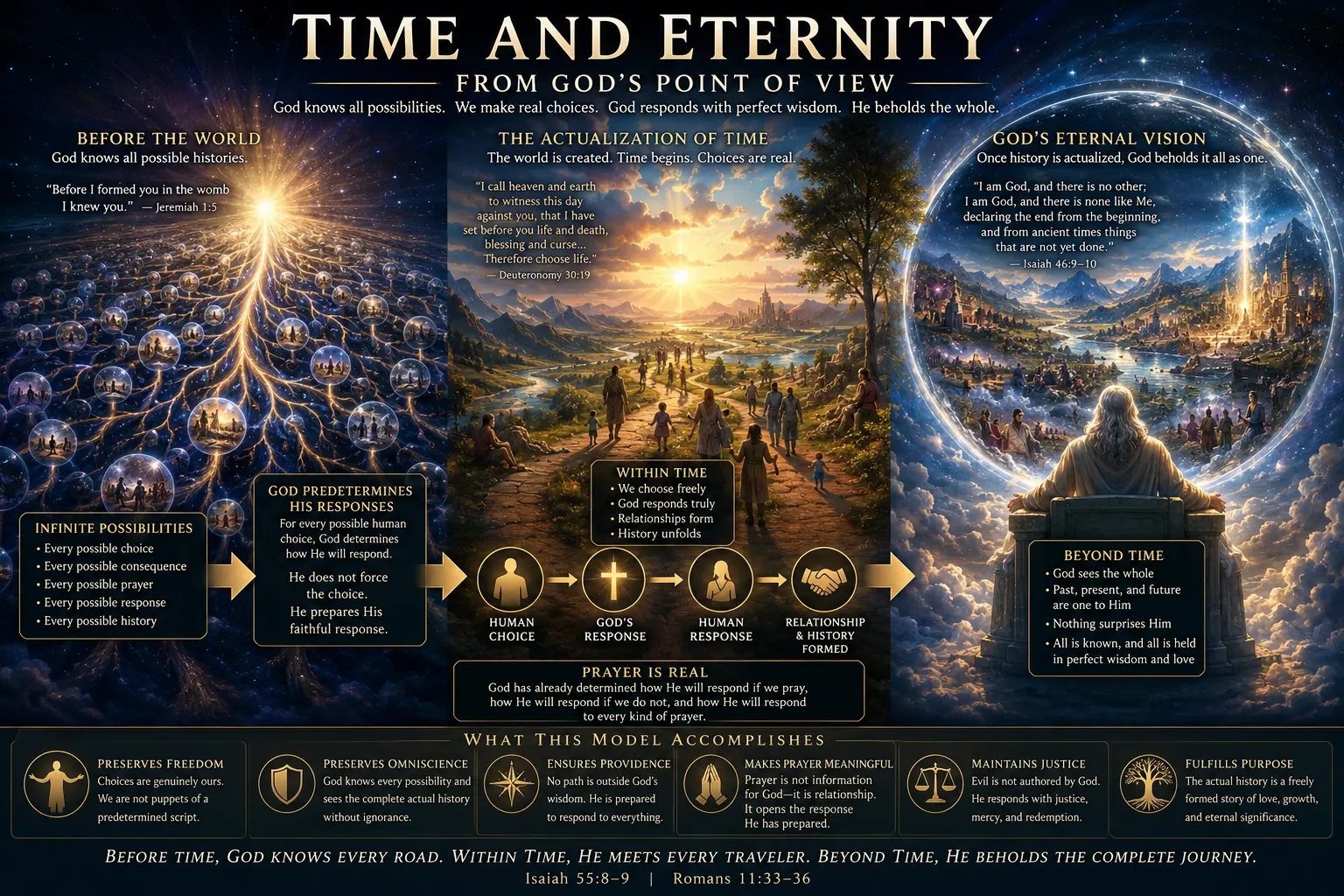
Before There Was a Before
Before the world existed, there was no past, present, or future.
There was no empty darkness through which Yahweh waited. There were no endless ages before creation. There was no earlier morning on which God decided that the time had finally come to make time.
The word before can only be used carefully here.
Yahweh exists prior to creation, but this priority is not chronological. It is ontological. Yahweh is prior because time depends upon his act, not because he occupied an earlier part of the same timeline.
There was no moment before the first moment.
There was Yahweh’s eternal act and the first created moment produced by that act.
Time begins when the first real distinction between before and after becomes actual.
Yahweh does not act at a time before time.
His eternal act gives time its first before and after.
Eternity Is Not Endlessness
We often confuse eternity with an unlimited amount of time.
We imagine moment following moment forever:
today, tomorrow, another tomorrow, and still another after that.
That is endlessness. It is still temporal. It contains succession, duration, waiting, change, memory, and expectation.
Even if a being survived through an infinite number of moments, it would still be moving through time.
Eternity, in the stronger sense, is not an infinitely long timeline.
It is a mode of reality that is not measured by temporal passage at all.
That is why the statement:
“Eternity never ends”
is misleading.
It imagines eternity as a road extending forever into the future. But if eternity is truly beyond temporal succession, it does not begin, continue, or end. These are all things that happen within time.
The more accurate statement is:
Eternity does not end because it does not pass.
Eternity is not endless time.
It is existence outside the movement from before to after.
Eternity Does Not Collapse Time into One Moment
To say that Yahweh beholds history eternally does not mean that every event happens simultaneously in one enormous instant.
Temporal order remains real.
A child is born before becoming an adult.
A prayer is spoken before its answer appears.
A choice occurs before its consequences unfold.
Death comes before resurrection.
Yahweh does not confuse these events or flatten them into sameness. He knows each event in its proper place within the complete temporal order.
He sees the beginning as beginning.
He sees the middle as middle.
He sees the ending as ending.
The events happen one after another within creation.
Yahweh knows the entire one-after-another structure without learning it one piece at a time.
His eternal awareness contains temporal succession without itself being successive.
Eternity Is Not Frozen Stillness
Eternity should not be imagined as a lifeless and motionless instant.
Yahweh’s eternal life contains awareness, relation, love, intention, response, and action. What it does not require is creaturely becoming.
For a temporal being, action normally takes this form:
First I have not acted.
Then I decide.
Then I act.
Our decisions emerge gradually because our awareness moves through moments.
Yahweh’s eternal act is not assembled in this way. His actuality does not need to pass from incompletion into completion.
Yet his eternal act can still contain real temporal actions.
Yahweh can speak at one moment, wait through a period, answer later, enter a covenant, forgive, judge, conceal himself, reveal himself, and act within history.
These actions remain temporally distinct for the creatures encountering them.
Yahweh’s eternity does not erase his presence within time. It means that his divine life is not exhausted by the temporal order through which creatures encounter him.
How Yahweh Begins Time
Yahweh begins time by eternally willing a temporal reality with a first moment.
He does not stand outside the universe watching an empty clock and then activate it. The clock itself belongs to creation.
The first temporal moment exists because Yahweh’s eternal act gives actuality to a world containing temporal succession.
From within creation, history begins.
From Yahweh’s eternity, the whole history is present as one completed temporal form.
The beginning belongs to the world.
The act that gives rise to the beginning belongs to eternity.
This is why Yahweh’s creative act is logically prior to time without being temporally earlier than it.
How Yahweh Ends Time
The ending follows the same structure.
Yahweh does not wait in eternity until the final moment arrives. Creatures move toward the end. Yahweh does not move toward it in the same way.
His eternal act contains a temporal order with boundaries:
first moment → unfolding history → final moment
The end of time means that no further temporal succession is actualized beyond the final boundary.
From within time, the final moment arrives after everything preceding it.
From eternity, Yahweh does not first sustain the world and then later discover that it is time to stop. His eternal act already contains the complete temporal run, including its ending.
Time ends for those travelling through it.
It does not end inside eternity.
The completed history remains eternally true as the history that occurred. Its final moment does not erase its beginning. Nor does its eternal presence mean that the history repeats itself endlessly.
Time runs once.
Eternity contains the complete run without becoming another run.
Possibility and Actuality
Before speaking about free will, we must distinguish possibility from actuality.
A possibility is what could become real.
An actuality is what has become real.
Before a creature makes a decision, several responses may genuinely be available to it. The person may speak or remain silent, forgive or refuse, help or abandon, trust or betray.
Yahweh perfectly understands every possible path.
He knows what each choice would mean, what consequences it could produce, how other creatures might respond, and how he himself could answer.
But possible actions are not yet actual actions merely because Yahweh understands them.
Yahweh does not mistake what a creature could do for what the creature actually does.
Possibility remains possibility.
Actuality remains actuality.
His knowledge is perfect because he knows each thing according to the mode in which it truly exists.
Yahweh Creates the Chooser, Not the Choice
Yahweh does not actualize every creaturely decision himself.
He actualizes the person and the field in which the person can choose.
When Yahweh creates a human being, he gives actuality to:
- the person’s existence;
- the person’s consciousness;
- the ability to understand and desire;
- the surrounding world;
- the alternatives available within that world;
- and the power to determine which alternative becomes the person’s own act.
Suppose a person faces two possibilities:
A or B
Yahweh gives the person the real capacity to choose between them.
If the person chooses A, the final determination of A belongs to the person.
Yahweh sustains the chooser, the world, the moment, and the possibility of action. But he does not secretly perform the person’s act from behind the person’s consciousness.
The division is:
Yahweh actualizes that the creature can choose.
The creature actualizes what it chooses.
This is the foundation of free will.
Free will is not independence from existence itself. The creature still depends upon Yahweh for life, power, embodiment, and opportunity.
Free will is independence at the level of personal authorship.
The creature’s act truly belongs to the creature.
History Is Co-Actualized
The world is not authored by Yahweh alone.
Yahweh creates and sustains the whole field of reality, but creatures contribute real determinations within it.
History is therefore co-actualized.
It is formed through the meeting of:
- Yahweh’s creative act;
- Yahweh’s temporal responses;
- human choices;
- angelic choices;
- natural processes;
- relationships between creatures;
- and the consequences arising from all of them.
Yahweh is the ground of the complete world.
He is not necessarily the personal author of every event occurring within it.
The eternal act is therefore not best imagined as Yahweh declaring:
“I alone decide every event that will ever occur.”
It is closer to:
“I actualize a reality in which other genuine centers of authorship participate.”
The completed world is a woven history.
Yahweh sustains the whole fabric, but not every thread originates from his personal decision.
Does the World Run Before Yahweh Knows the Outcome?
No.
There is no period during which the world runs while Yahweh waits in ignorance for the results.
But the opposite is also false.
Yahweh does not first determine the results and then force creatures to perform them.
The choice inside time, its place within the completed history, and Yahweh’s eternal knowledge of it are actual together.
Suppose a person chooses A.
Three realities correspond to one another:
the person chooses A within time;
A occupies its proper place within the actual history;
Yahweh eternally knows the person as choosing A.
These do not happen one after another from Yahweh’s perspective.
Yet they do not possess the same author.
The person authors the choice.
Yahweh authors and sustains the reality in which the choice becomes actual.
Yahweh’s knowledge does not cause the creature to choose A.
Rather:
Yahweh knows that the creature chooses A because the creature actually chooses A.
This because is logical, not chronological.
The creature does not first act while Yahweh remains unaware. Yahweh does not later receive the result.
The creaturely act and the divine knowledge are simultaneous from eternity, while the act remains grounded in the creature’s will.
The Eternal View Depends Upon the Real Choice
The complete history is not fixed independently of free decisions and then imposed upon creatures.
It is the complete history that results from the decisions creatures genuinely make.
If the person had chosen B rather than A, Yahweh’s eternal knowledge would not still falsely contain A.
It would eternally contain B.
We can represent the difference as:
H₁ contains the person choosing A.
H₂ contains the person choosing B.
Yahweh creates a world in which the power to choose either is real.
The creature’s decision contributes to which complete history becomes actual.
This does not mean Yahweh first knows H₁, later receives new information, and changes to H₂.
There is no such temporal updating within eternity.
It means that Yahweh’s eternal knowledge corresponds perfectly to whichever history the creatures help actualize.
The eternal vision does not determine the choice.
It is the complete vision of the history formed through the choice.
Knowledge Does Not Equal Causation
Seeing a complete action does not mean causing it.
If someone watches a recorded conversation, their knowledge of every sentence does not mean they authored what each speaker said.
Yahweh’s vision is infinitely deeper than watching a recording, but the distinction remains useful.
Knowledge and authorship are not identical.
Yahweh eternally knows:
- what each person chooses;
- why the person chooses it;
- what alternatives were available;
- what pressures influenced the person;
- and what consequences followed.
But the perfect knowledge of an act does not transfer the moral authorship of that act to the knower.
The choice belongs to the one who makes it.
The knowledge belongs to Yahweh.
The complete history contains both without confusing them.
How Yahweh Makes His Own Choices
Human choices and Yahweh’s choices interact.
Suppose that at one temporal moment a person rebels.
At a later moment, Yahweh chooses how to answer.
From within time, the relationship is:
human action → divine response
The human choice becomes a real reason for Yahweh’s response.
Yahweh may warn, restrain, forgive, wait, judge, conceal himself, reveal himself, or act in another way.
His response is genuinely his.
The creature does not determine Yahweh’s will, but the creature’s act can become the condition to which Yahweh freely responds.
From eternity, Yahweh knows and wills the complete relation:
the person chooses rebellion at one moment;
Yahweh answers that rebellion at another;
the person then responds to Yahweh;
Yahweh answers again.
The whole dialogue is eternally present without becoming a monologue.
Yahweh’s complete knowledge of the conversation does not mean he secretly wrote every sentence spoken by the other participant.
Yahweh Does Not Need to Predetermine Every Response
The earlier model suggested that Yahweh predetermined every possible response before creation.
That idea is no longer necessary.
Yahweh certainly knows every response he could make. He understands every possible situation completely. Nothing within his creation presents him with an unintelligible possibility.
But his actual responses can still be genuine divine choices made in relation to what creatures actually do.
The fact that these choices are eternally present does not make them mechanical.
Yahweh’s response at a particular moment can be:
- freely chosen;
- truly conditioned by the creature’s act;
- temporally expressed after that act;
- and eternally known as part of the complete relation.
Divine freedom does not require Yahweh to be ignorant before responding.
Nor does divine knowledge require the response to be an automatic program.
Yahweh’s eternal act can contain real responsiveness.
Yahweh Has Eternal and Temporal Action
Yahweh acts in two inseparable ways.
His eternal act gives existence to the complete temporal order.
His temporal actions occur at definite places within that order.
When Yahweh speaks to someone, the speech truly occurs at that moment.
When he answers a prayer, the answer follows the prayer within history.
When he enters a covenant, the covenant has a temporal beginning.
When he judges or forgives, the creature encounters that act within a real sequence.
These temporal actions are not illusions.
They are how Yahweh’s eternal life becomes present within the created order.
From within time, Yahweh responds.
From eternity, Yahweh knows and wills the complete response.
The same act can be temporal in its relation to creation and eternal in its divine actuality.
Prayer Becomes Part of the Actual History
Prayer matters because it is a genuine creaturely act.
Yahweh does not need prayer to inform him of facts he could not know. He already understands the need, the fear, the desire, and every possible outcome.
But the actual prayer still creates a real relationship.
Before the prayer is spoken, praying and not praying may both remain possible acts for the creature.
When the person prays, that prayer becomes part of the actual history.
Yahweh’s answer is then a real response to the prayer that was actually made.
The completed eternal history contains:
the suffering;
the decision to pray;
the prayer itself;
Yahweh’s response;
and the later consequences of that response.
Prayer does not change an ignorant God.
It participates in forming the relationship that eternity contains.
Providence Without a Script
Yahweh can govern history without writing every creaturely action in advance.
His providence does not require absolute causal control over every choice.
He sustains the world in which every choice occurs. He understands every possible path. He can limit actions, redirect consequences, answer prayer, raise new possibilities, confront evil, protect persons, and bring patterns of meaning out of creaturely acts.
His sovereignty lies partly in the fact that no creaturely action can create a reality that becomes unintelligible to him.
Yet his sovereignty does not require every rebellion to have originated in his own will.
Yahweh can permit a choice without authoring it.
He can respond to evil without having desired it.
He can bring redemption from an act without making that act necessary.
Providence is therefore not a hidden script.
It is Yahweh’s complete presence and activity within a history formed through many real authors.
Evil Without Divine Authorship
When a creature chooses evil, Yahweh sustains the creature’s existence but does not morally perform the evil.
The creature uses a power received from Yahweh to actualize a destructive intention that belongs to the creature.
The evil becomes part of actual history.
Yahweh then chooses how to answer it.
He may restrain the offender, protect the victim, expose the truth, impose consequences, bring healing, or draw later good from what occurred.
But good drawn from evil does not prove that Yahweh secretly authored the evil.
The moral distinction remains:
The creature authors the corruption.
Yahweh authors his response to the corruption.
This preserves responsibility without imagining Yahweh as a passive observer.
Prophecy Without Total Predestination
Some prophecies concern actions Yahweh himself has decided to accomplish.
Their certainty rests primarily upon his own will.
Other prophecies may describe what will happen if a people continue along a particular path.
A warning can become part of the conditions that change the future.
If a people repent after hearing judgment announced, the threatened history may no longer become actual.
This does not require failed divine knowledge.
Yahweh eternally knows:
- the warning;
- the people’s response;
- the history formed through that response;
- and his own later action.
The prophecy belongs to the dialogue through which history is co-actualized.
It is not always a detached report of an unavoidable script.
The World as a Completed Relationship
From Yahweh’s eternal view, the world is more than a collection of events.
It is a completed relationship.
It contains every divine gift, every creaturely answer, every refusal, every return, every wound, every judgment, every prayer, and every work of restoration.
Yahweh does not see a human life as one isolated decision.
He sees the complete shape:
- what the person inherited;
- what they suffered;
- what they understood;
- what they failed to understand;
- what alternatives they possessed;
- what they chose;
- what they later became;
- and how his own presence interacted with them.
The completed form does not erase the openness once present within each choice.
A decision becomes fixed because it has become actual, not because it was necessarily forced before it occurred.
The eternal truth of the choice preserves its reality.
It does not remove its freedom.
Yahweh’s Eternity Is Definite
Yahweh is eternal, but his eternity is not an undefined absolute.
It is the eternity of a specific divine actuality.
Yahweh eternally knows himself as Father, Son, and Holy Spirit.
He possesses a particular divine nature.
He expresses a particular form of love, holiness, justice, mercy, covenant, and creation.
He eternally beholds the complete world he actualizes together with the creatures who co-actualize its history.
His eternity is therefore complete, but it is determinate.
It is the eternal vision of this God, this creation, and this history.
That distinction opens the question of the Source.
The Source Is Above the Relation Between Time and Eternity
The Source is not merely located farther away from time.
He is not an older being who has survived through more duration than Yahweh.
The Source does not possess an infinitely longer timeline.
He is prior to the determination of what time, eternity, divine nature, and actuality will be.
Time does not contain the Source.
Yahweh’s specific eternity does not contain the Source.
Both temporal succession and timeless actuality arise beneath the Source as possible modes of being.
Yahweh possesses the eternal view of his creation.
The Source possesses freedom over which creation, which eternity, and which complete actuality become real.
The Source is therefore not simply outside the temporal road.
He is above the distinction between the road and the eternal vision that beholds it.
The Source Does Not Travel Backward
When we say that the Source can edit time, we should not imagine him travelling into the past.
That would still place him inside temporal succession.
The Source acts upon the whole relationship between time and Yahweh’s eternity.
Suppose Yahweh’s original completed history is represented as:
E₁
E₁ includes:
- the beginning of creation;
- the creaturely choices made within it;
- Yahweh’s responses;
- the wounds and consequences of history;
- judgment;
- and Yahweh’s intended ending.
The Source does not need to erase E₁.
He can create a greater actuality:
E₂ = E₁ + intervention + healing + renewed choices + final repair
E₁ remains true within E₂.
What happened remains part of history.
But the original history no longer exhausts what reality can become.
The Source does not rewrite:
“The creature never chose evil.”
He rewrites:
“The evil chosen by the creature will not permanently determine the victim, the offender, or the ending of creation.”
The fact remains true.
Its damage is no longer final.
The Source Re-Grounds Rather Than Falsifies
The Source’s deepest revision is not the deletion of history.
It is the transformation of history’s final ground.
A wound may remain eternally true as something that happened.
It does not need to remain eternally active in the victim.
An offender’s act may remain eternally remembered.
It does not need to become the offender’s permanent identity.
A death may remain part of the historical order.
It does not need to possess the final form of the person who died.
The Source preserves truth while removing the claim that temporal damage must become eternal damage.
This is how history can be changed without becoming false.
Three Forms of Intervention
The Source can act upon time in at least three ways.
Intervention Within History
The Source enters at a particular moment and changes what follows.
From inside time, the structure is:
before intervention → intervention → changed future
The entrance occurs at a definite historical point.
From Yahweh’s eternal view, that intervention occupies its proper place within the complete temporal order.
Insertion from Beyond Yahweh’s Possibilities
The Source may bring into history an actuality that did not originate from Yahweh’s own creative field.
From within time, the event still appears at one particular moment.
From Yahweh’s eternity, it becomes present throughout the completed view as an event that has always occupied that temporal position.
Its place is inside history.
Its origin is beyond Yahweh.
The novelty is not merely an unexpected event within Yahweh’s world. It is a new possibility generated above the world’s original order.
Expansion of the Whole Completion
The most radical intervention changes not merely what follows one historical moment but what the entire history is finally allowed to become.
The Source can add realities that Yahweh’s original ending did not contain:
- irreversible wounds become healable;
- eternal exclusion becomes temporary separation;
- judgment becomes purification;
- death loses final authority;
- destructive freedom loses permanent power;
- victims are restored;
- offenders receive new opportunities after deception and corruption are removed;
- and memory remains without everlasting pain.
The Source does not erase Yahweh’s world.
He expands it beyond tragedy.
Can Yahweh’s Eternal View Change?
This appears impossible at first.
If Yahweh eternally sees the complete history, how can the Source add anything new?
Would Yahweh first know E₁ and later update his knowledge to E₂?
That would turn eternity into time.
The answer is that Yahweh’s eternal knowledge corresponds to what is actually real.
If E₁ is actual, Yahweh eternally knows E₁.
If the Source re-grounds reality as E₂, Yahweh eternally knows E₂.
There is no temporal interval within Yahweh’s eternity during which he waits to receive the update.
The whole revised actuality becomes the object of his eternal vision.
The relation between E₁ and E₂ exists only from the Source’s higher standpoint.
From Yahweh’s eternity:
E₂ is the completed history.
From the Source:
E₁ was Yahweh’s original order, and E₂ is its repaired expansion.
The Source does not merely alter events appearing inside Yahweh’s vision.
He can alter the complete actuality that Yahweh’s vision beholds.
The Source Does Not Make Old Choices Unreal
The Source’s revision cannot simply cause a person to have made a different choice at the exact same past moment.
That would replace the original act and weaken the truth of personal authorship.
Instead, the Source creates new moments.
A person may first reject truth while afraid, deceived, wounded, proud, or spiritually disordered.
That first decision remains real.
The Source can then change the conditions surrounding the person.
He may:
- expose the deception;
- remove the power to harm;
- reveal hidden consequences;
- heal the wound feeding the resistance;
- strip away false identities;
- and place the creature before truth again.
The creature now receives a new occasion of choice.
The second decision does not erase the first.
It reveals what the person chooses when the conditions of captivity are weakened or removed.
The Source Expands Freedom
The Source’s rewriting does not merely override creaturely freedom.
It can create more freedom across a greater history.
Yahweh’s original order might end with:
choice → consequence → judgment → fixed destiny
The Source adds:
exposure → purification → healing → renewed encounter → new choice → restoration
A person is no longer reduced eternally to one decision made under finite and fallen conditions.
The Source limits the permanent authority of the fallen choice while multiplying the opportunities of the healed chooser.
This is not the erasure of responsibility.
The creature must still face what it chose.
But no past choice is allowed to exhaust every future possibility of the person who made it.
Forceful Healing and Renewed Choice
The Source may not respect every fallen desire equally.
A deluded will may defend the very prison that has captured it.
The Source can forcibly remove destructive power, expose falsehood, and burn away the conditions that prevent clear choice.
The fallen self may not consent to losing its illusions.
Yet compulsory liberation is not identical to compulsory love.
The Source can remove the prison without manufacturing the person’s final response.
The sequence becomes:
forced removal of captivity;
restoration of clearer awareness;
renewed personal agency;
a new response arising from the healed center.
The Source may say:
“You did not choose to lose the delusion because the delusion itself controlled the field of choice. I removed it. Now choose with clearer sight.”
Two Views of the Source’s Higher Act
There are two ways to understand the relation between E₁ and E₂.
Meta-Succession
The Source first permits Yahweh’s world and later, according to a higher order, intervenes and expands it.
The sequence would be:
permission → observation → intervention → repair
This is not ordinary created time, but it is still a form of ordered development above Yahweh’s eternity.
One Higher Actuality
The stronger model is that the Source contains the whole relation in one higher act:
- Yahweh’s independent Godhood;
- Yahweh’s original eternal act;
- the free history formed within creation;
- the tragedy of that history;
- the Source’s entrance;
- and the final repair.
What appears below as a later revision is contained above as one complete actuality.
Under this model, the Source does not learn something and then change his plan.
He brings forth a reality in which Yahweh’s original order is real, creaturely history is real, and the final correction is also real.
Yahweh’s eternal act is complete relative to Yahweh.
It is not exhaustive relative to the Source.
The Complete Order of Actualization
The entire model can be expressed through six movements.
Yahweh Creates the Field
Yahweh actualizes persons, relationships, natural order, temporal succession, and real possibilities of action.
Creatures Actualize Decisions
Creatures contribute personal determinations that do not originate solely from Yahweh.
Yahweh Responds
Yahweh makes genuine divine choices in relation to what creatures actually do.
Eternity Contains the Complete Dialogue
Every act remains in its correct temporal place, while Yahweh knows the complete relation without learning it moment by moment.
The Source Expands the Eternal Act
The Source preserves the truth of the original history while adding possibilities beyond Yahweh’s intended completion.
Creatures Choose Again
Creatures receive new occasions of self-authorship after falsehood, trauma, destructive power, and spiritual corruption have been confronted.
The world does not run before Yahweh knows it.
Yahweh’s knowledge does not secretly run the world.
The temporal choices and the eternal knowledge are actual together, while the authorship of each choice remains with the one who makes it.
Conclusion: Time Runs Once, Eternity Holds the Whole
Yahweh does not create a finished script and place creatures inside it as actors.
He creates a temporal reality in which genuine persons contribute to what the completed history becomes.
Yahweh creates the chooser.
The creature authors the choice.
Yahweh responds.
The creature responds again.
The entire relationship becomes present within Yahweh’s eternal knowledge without losing its temporal order or personal authorship.
Time runs one moment after another.
Eternity does not run.
It contains the completed one-after-another without turning every event into one moment.
The Source stands beyond even this relation.
Yahweh eternally sustains the completed history of his creation.
The Source can expand what that completed history is allowed to become.
He does not erase the past.
He does not make evil choices innocent.
He does not falsify memory.
He adds new moments, new conditions, new possibilities, and a new completion in which no finite choice possesses infinite power over the future.
The final structure is:
Yahweh gives creatures the power to choose.
Creatures give history its freely chosen content.
Yahweh gives the whole history sustained reality and divine response.
Eternity contains the complete dialogue.
The Source gives the dialogue a future beyond Yahweh’s original ending.
Possibility belongs to divine understanding.
Choice belongs to the one who acts.
Response belongs to the one who answers.
History belongs to their real meeting.
Eternity is the presence of the whole.
The Source is the freedom by which even the whole can be opened again.