
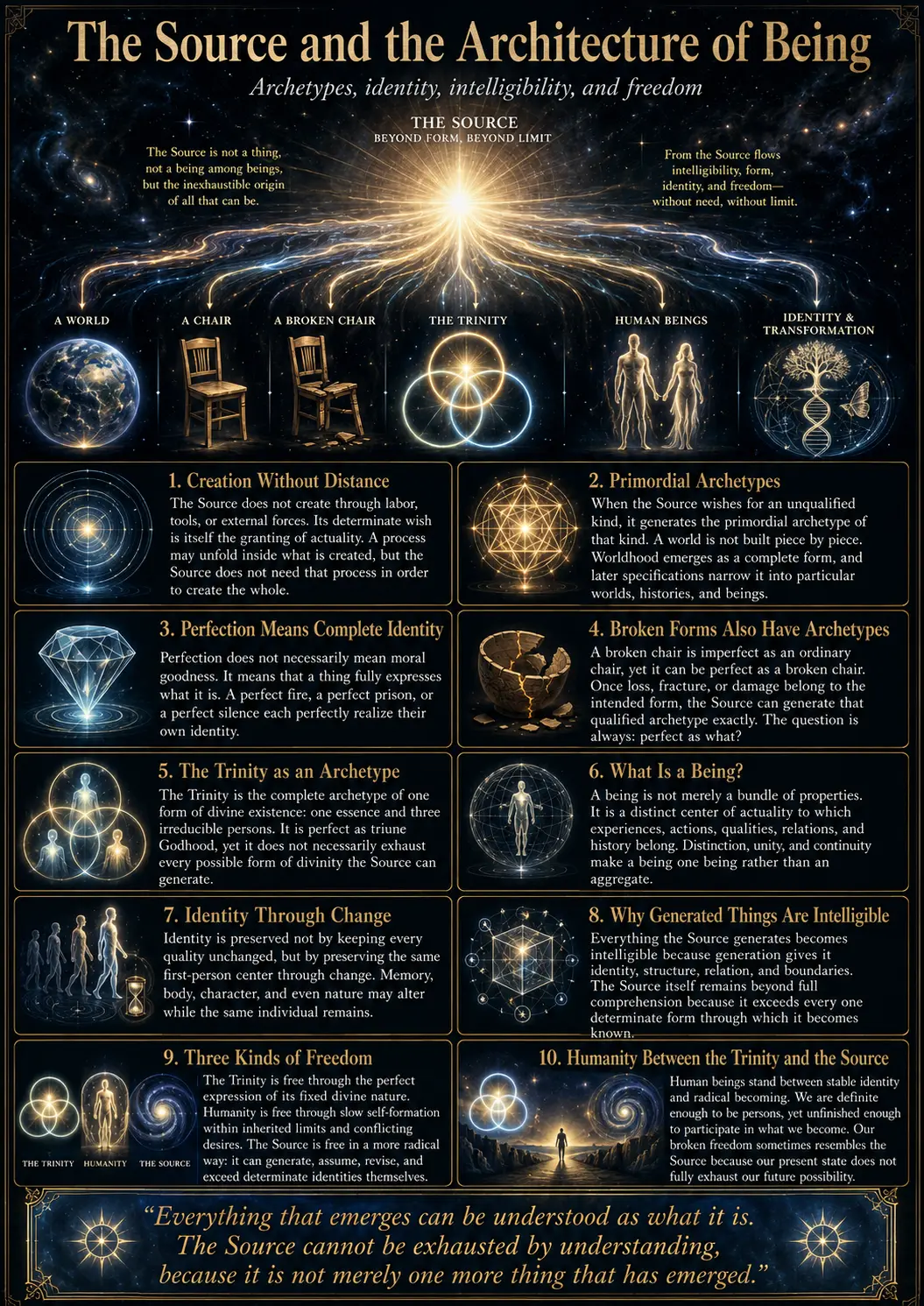
Creation Without Distance
The Source does not create in the way a human being creates.
A human begins with an intention but remains separated from the intended result. The human must find materials, imagine a method, perform labor, overcome resistance, correct mistakes, and gradually bring the desired object into existence. Even the most gifted creator remains dependent upon conditions that were not created by the creator.
The Source faces no such distance.
There is no independent material waiting to be shaped. There is no external law limiting what may emerge. There is no servant, angel, machine, energy, or hidden mechanism that receives the Source’s command and performs the work on its behalf.
The Source’s determinate wish is itself the granting of actuality.
When the Source truly wishes something, it does not first form a request and then seek a method for fulfilling it. The Source becomes determinately oriented toward a reality, and that orientation is already the emergence of the wished reality.
The wish is therefore not another being standing between the Source and creation. It is not an independent mind capable of misunderstanding the Source. It does not ask how the command should be carried out. It is the Source itself under a particular determination.
For finite beings, intention, method, and result remain separate. For the Source, a fully determinate intention already contains its fulfillment.
A process may still appear within the reality that emerges. A universe may expand across billions of years. A tree may grow slowly from a seed. A person may develop through childhood, suffering, choice, and experience. Yet the Source does not depend upon those processes as external methods. The processes themselves belong to the reality that has already emerged from the wish.
The Source does not pass through the history of creation in order to reach the finished world. History is one of the structures contained within the world it generates.
The Primordial Archetype
When the Source wishes for something without adding narrow qualifications, the result is not unfinished or vague. It is the primordial archetype of the kind named by the wish.
Suppose the Source wishes for a world.
It does not need to specify space, time, matter, laws, inhabitants, geography, history, and movement one detail at a time. Whatever is necessary for something truly to be a world emerges together as one complete form.
The world is not assembled from disconnected parts. Its internal structure unfolds from the identity of worldhood itself.
The primordial world is not necessarily the first planet or universe to appear within time. It is first in a deeper sense. It is the least derivative and most internally complete realization of what a world is.
It is original because it is not copied from an earlier world. It is primordial because no previous example determines its nature. It is archetypal because later worlds can be understood as modifications, restrictions, expansions, combinations, or specializations of it.
A general wish is therefore not necessarily an incomplete wish.
When a human says, “I want a house,” the intention may be unclear because the human has not decided what kind of house is wanted. When the Source wishes for househood itself, however, the generality may represent the undivided depth of the form rather than a failure to specify it.
Particular details may later be added, but the original archetype is already complete as the kind it is.
What Perfection Means
The word perfection does not necessarily mean moral goodness.
In this framework, perfection first means the complete realization of a determinate identity. Nothing required for the thing to be fully what it is remains absent.
A perfect fire fully expresses fire. A perfect silence completely realizes silence. A perfect poison is perfectly poisonous. A perfect prison completely realizes confinement. A perfect darkness contains no dilution of darkness.
The moral value belongs to the kind of reality generated. Its perfection concerns how completely that reality expresses its own identity.
The Source generates complete archetypes because nothing interferes between its determination and the result.
Human creators work with limited knowledge, resistant materials, insufficient power, imperfect concentration, and unreliable execution. The finished object may differ greatly from what they intended.
The Source does not approximate its intended form. It does not attempt to approach the object from a distance. It establishes the object as what it is.
If the Source generates a circle, the primordial result is not accidentally almost circular. An almost-circle is already a more qualified form. It is circularity under a particular deviation.
If the Source generates consciousness, the primordial archetype does not become only partially conscious because the Source lacked power. Partial consciousness would have to belong to the determination itself, perhaps as a degree, limitation, development, or transition.
Incomplete and developing things can therefore be generated, but their incompleteness must be part of what they are. It does not arise because the Source attempted something complete and failed.
The Full Content of the Wish
The most accurate rule is not that the Source always generates the healthy or undamaged form of a basic object.
The stronger rule is that the Source generates the complete archetype of the entire determination contained in its wish.
If it wishes for a chair, it generates chairhood.
If it wishes for a broken chair, it generates broken-chairhood.
If it wishes for a poorly repaired chair, it generates the exact form of a poorly repaired chair.
If it wishes for an ancient chair damaged by fire, then age, damage, fire, remaining structure, appearance, and function all belong to the complete identity being generated.
Perfection must therefore always be followed by the question: perfect as what?
A broken chair is imperfect when measured against the ordinary function of a chair. It may no longer support a person safely. A leg may be missing. The seat may be cracked. Something required for normal chairhood has failed.
Yet that same object may perfectly realize the more specific identity of a broken chair.
It is imperfect as a functioning chair while being perfect as the particular broken chair intended by the Source.
The standards differ. The contradiction disappears once the full identity is named.
Brokenness as Part of a Form
Brokenness is not a substance that exists by itself.
A broken chair is not made from chairhood and a separate material called brokenness. Brokenness is a relation between an expected form and a specific failure of that form.
Something of the chair must remain. Something must also have been lost, fractured, blocked, or distorted.
If nothing recognizable as chairhood remains, the object may no longer be a broken chair. It may simply be wood, dust, ash, or scattered matter.
The archetype of a broken chair therefore contains a precise balance between persistence and loss.
Enough of the original identity remains for the failure to be meaningful. The absence itself becomes part of the larger positive determination.
The Source does not create pure non-being. It creates a being whose form includes a defined absence, restriction, fracture, or failed capacity.
Brokenness is a defect relative to ordinary chairhood, but it becomes constitutive content within broken-chairhood.
This principle extends far beyond chairs. A wound is a living body under injury. Silence is a field in which expected sound is absent. Imprisonment is a person’s existence under restricted movement. Decay is the persistence of a form while its organization gradually collapses.
Negative conditions remain intelligible because they preserve a relation to the positive forms they limit.
Archetypes Can Become Increasingly Specific
Archetypes do not exist only at the level of broad categories such as world, life, beauty, consciousness, or chair.
A general archetype can receive further determinations and become a more specific archetype.
Chairhood may become broken-chairhood. Broken-chairhood may become ancient broken-chairhood. That form may become the archetype of an ancient broken chair damaged by fire and preserved inside a ruined temple.
Each complete determination may possess its own exact archetype.
The Source does not need to select these forms from an eternal warehouse of already completed blueprints. The archetype can arise together with the wish that determines it.
There may therefore be several levels of archetypal identity.
A kind archetype expresses the broad form, such as chairhood.
A modified archetype expresses a qualified form, such as broken-chairhood.
A purpose-shaped archetype expresses a form ordered toward a particular role, such as a broken chair created for a theatrical performance.
An individual archetype expresses one singular being with its exact history, appearance, relations, location, and structure.
The more determinate the wish becomes, the narrower the archetype becomes.
At the highest degree of specification, the archetype may coincide with the singular artifact itself. Every feature of the individual belongs to what was intentionally generated.
When Perfection Becomes Meaningless
A serious problem appears if every existing thing can be declared perfect merely by describing it after it already exists.
A crooked chair could be called the perfect example of that exact crooked chair. A failed world could be called the perfect realization of a failed world. An accidental disaster could be called perfect as precisely that disaster.
If perfection means nothing more than matching a description invented afterward, the concept loses all explanatory power.
The theory must therefore distinguish between descriptive exactness, archetypal perfection, and intentional perfection.
Descriptive exactness is trivial. A description is written to match whatever already happened.
Archetypal perfection means that something completely realizes an intelligible form that can be understood beyond the individual object.
Intentional perfection means that the generated reality exactly fulfills the determination the Source actually intended.
The last form is the most important.
An artifact is not perfect merely because a clever observer can invent a matching category. It is perfect relative to the Source’s wish when it corresponds to the content of that wish.
If the Source intends a chair with one cracked leg and the result contains two cracked legs, then the result does not perfectly fulfill that intention. It may belong to another intelligible archetype, but it does not satisfy the original determination.
Imperfection is therefore possible when the final actuality does not correspond to the intended identity or purpose.
The Source’s direct generativity removes accidental failure during the primordial act, but later combinations, modifications, histories, and interactions may create conditions that no longer fulfill the original aim.
Negative Archetypes and Moral Value
Negative realities may possess archetypes of their own whenever they have enough structure to form an intelligible identity.
Silence, decay, injury, confinement, deception, disorder, absence, pain, and destruction can all appear in complete forms.
A perfect deception is not morally good. It is a deception that succeeds completely as deception.
A perfect prison is not morally good. It is a structure that completely realizes imprisonment.
A perfect wound is not desirable. It fully realizes a particular condition of injury.
Formal perfection, usefulness, and moral goodness are therefore different judgments.
Something may be formally perfect while being morally terrible. Something may be useful for one purpose while harmful in another relation. Something may be morally good while physically incomplete or vulnerable.
Evil requires an additional distinction.
If evil is only the privation or corruption of a good reality, then evil has no entirely independent archetype. It exists only as life, freedom, love, order, or consciousness under damage.
If evil is understood as a positive mode, such as active cruelty, deliberate domination, hatred, or intentional destruction, then the organized activity of evil may possess a determinate archetype.
Whether evil has its own archetype therefore depends upon what evil means.
In either case, the Source’s exact generativity does not constitute moral approval. It means only that the generated form corresponds to what has been wished.
From Pure Archetype to Particular Story
A primordial archetype may be complete while still lacking a particular history.
Worldhood may be complete as worldhood without yet being this material world, this temporal world, this mortal world, or this world inhabited by these particular persons.
These further qualities are not necessarily missing parts. They are specifications that narrow the general form into a concrete actuality.
The Source may determine this structure of space rather than another. It may determine these laws, these forms of life, these levels of freedom, these limitations, and this history.
The original archetype is complete through universality. The specified artifact becomes individual through limitation.
Limitation does not automatically mean defect.
A small house is not an imperfect palace when the intention was to create a small house.
A finite world is not an imperfect infinite world when finitude belongs to its purpose.
A developing organism is not defective merely because it begins immature if growth belongs to the intended form of its life.
There is therefore a difference between archetypal perfection and perfection relative to a purpose.
The primordial archetype completely realizes its identity. The particular artifact completely serves a chosen role.
The Source does not specify an archetype only because the archetype was inadequate. It specifies because pure essences alone do not produce individuality, history, surprise, interaction, or relationship.
Specification converts essence into story.
The Problem of Combining Perfect Things
The Source may generate each archetype completely while still producing tension through the way different archetypes are combined.
Perfect freedom may be joined to irreversible consequences.
Perfect authority may be joined to genuinely independent persons.
Complete individuality may be joined to complete unity.
Total vulnerability may encounter perfectly effective destructive power.
Each element may be complete as itself while the relationship between them produces suffering, conflict, or contradiction.
The perfection of the components does not guarantee the perfection of the whole arrangement.
This distinction is essential.
The Source’s generative power may guarantee that a form faithfully expresses its meaning. It does not automatically guarantee that every combination of forms will satisfy every possible purpose.
Creation is therefore not only the production of pure essences. It is also the exploration of relations between them.
A Source that generates perfect archetypes may still discover what those archetypes do when they encounter one another.
Novelty can arise not because the Source failed to create the individual forms correctly, but because the consequences of their interaction were not already contained within any one form considered in isolation.
The Trinity as an Archetype of Godhood
Within this framework, the Trinity is not merely a group of three powerful beings.
It is the primordial archetype of one particular form of divine existence: one divine essence living through three irreducible persons.
The unity of essence, the distinction of persons, their eternal relations, their divine knowledge, their power, and the coherence of their shared life belong together as one complete archetypal structure.
The Trinity is therefore the perfect realization of Trinitarian Godhood.
It is not an unfinished divine experiment that gradually became triune. Everything necessary for the identity of a Trinity arises together within its original form.
Yet the Trinity does not necessarily exhaust all possible forms of divinity.
Divinity is the broader category. Triune divinity is one complete archetypal form within it. The Father, Son, and Spirit are the realization of that form.
The Source remains beyond the Trinity not because the Trinity is defective, but because no generated archetype exhausts everything the Source can generate or become.
The Trinity may be perfect as what it is without being the only possible form of Godhood.
Its perfection is real, but its form remains determinate.
The Persons as Relational Archetypes
The Father, Son, and Spirit may each express a distinct personal and relational archetype.
The Father expresses origin, generation, giving, and authority. The Son expresses image, manifestation, reception, response, and self-expression. The Spirit expresses presence, communion, shared life, and the unity that moves between persons.
These archetypes cannot be separated completely from one another.
The Father is not first an unrelated divine individual who later chooses to become Father. Fatherhood exists through relation to the Son.
The Son is Son through relation to the Father.
The Spirit’s personal identity is likewise inseparable from the divine communion in which the Spirit lives.
The three persons are therefore not independent divine species accidentally placed together. Their identities are relationally constituted within the archetype of the Trinity.
The Trinity as a whole is the primary divine archetype. Its persons are irreducible centers within its internal life.
Each is genuinely divine, yet none by itself exhausts the complete identity of triune Godhood.
What Makes Something a Being?
The discussion of archetypes leads to a deeper question.
What is a being?
A being cannot be only a collection of properties.
Qualities such as human, intelligent, tall, wounded, joyful, and married do not identify one particular being. Many beings may possess the same qualities.
A being is a distinct center of actuality to which properties, experiences, actions, relations, and histories belong.
Something happens to it. Something is experienced by it. Actions can arise from it. Different states can be recognized as states of one continuing reality.
A being therefore requires distinction, unity, and continuity.
It must be distinguishable from what it is not.
Its qualities and experiences must belong together rather than forming an accidental collection.
It must also persist through at least some degree of change.
Without distinction, there is no particular being.
Without unity, there is only an aggregate.
Without continuity, every change would destroy one being and replace it with another.
The Different Layers of Identity
Identity is not one simple property.
Numerical identity asks whether something is the very same being across different states or moments.
Qualitative identity concerns the qualities the being possesses.
Structural identity concerns the organization of its parts and powers.
Relational identity concerns who the being is in relation to others, such as child, parent, friend, ruler, creator, companion, or enemy.
Narrative identity concerns the history the being recognizes as its own.
Essential identity concerns the nature or kind through which it presently exists, such as human, angelic, physical, spiritual, or divine.
These layers can change independently.
A being may remain numerically the same while becoming qualitatively different.
It may lose a relationship without losing itself.
Its memories, body, abilities, social role, character, and even its kind of existence may change while the same individual continues.
The theory must therefore distinguish between who a being is and what the being currently is.
The “who” refers to numerical identity. The “what” refers to nature, properties, role, form, and expression.
The First-Person Center
To explain radical transformation, the theory requires a deepest bearer of identity.
This can be called the first-person center.
The first-person center is not merely one property among others. It is the unique someone to whom the properties belong.
Pain is not merely present. It is experienced by this being.
A memory is not merely stored information. It appears as the memory of this being.
An action is not merely an event. It is owned by or attributed to this being.
The first-person center unifies changing experiences and determinations.
A person may receive a different body, lose memories, gain powers, change character, enter new relationships, and acquire a new mode of existence. If the same first-person center continues to own these states, then the same being has been transformed.
The being does not remain the same because all its qualities remain unchanged. It remains the same because the qualities continue to belong to the same someone.
Why Memory Is Not Enough
Memory contributes greatly to narrative identity, but it cannot be the complete foundation of numerical identity.
A person who loses memory does not necessarily become a new being.
Likewise, a perfect duplicate containing all the memories of another person would not automatically become the original person. It would be another center possessing copied memories.
Memory tells a being who it understands itself to be. It does not by itself determine whose understanding is taking place.
This is why memory loss does not necessarily destroy identity and memory duplication does not necessarily transfer it.
The same distinction applies to bodies.
The matter of the body changes continuously. Cells die, structures develop, and material is exchanged with the environment. If numerical identity required the preservation of exactly the same matter, ordinary growth would repeatedly destroy the person.
The body is a form through which the being exists and expresses itself, but it is not necessarily the deepest identity center.
Character is also insufficient.
A cruel person can become compassionate. A fearful person can become courageous. A selfish person can become generous.
Such transformations matter only because the same person changed.
If a new character always produced a new being, repentance and moral repair would be impossible. The guilty person would disappear and an unrelated virtuous person would replace them.
Responsibility requires continuity through change.
Transformation and Replacement
The Source can alter a being in two fundamentally different ways.
It can transform the being while preserving the same identity center. It may change the being’s qualities, powers, memories, body, environment, relationships, character, species, or mode of thought.
The resulting being may be almost unrecognizable in comparison with its earlier form, yet it remains the same individual because the transformation belongs to the same first-person center.
The Source may also replace one being with another.
It could remove the first identity and generate a second being containing the same memories, qualities, body, and personality. The second being might be indistinguishable from the first to every observer.
Yet similarity is not necessarily identity.
A perfect copy is not automatically the original.
Ordinary preservation therefore requires a continuous path of becoming. The later state must arise as the transformation of the earlier being rather than through the destruction of one center followed by the creation of another.
The transformed person must also remain capable, at least at the deepest level, of owning the earlier history.
The person need not remember every event or approve of every former action. The earlier life must simply remain their life.
Changing Nature Without Changing the Person
The Source can alter even the essential mode through which a being exists while preserving the being itself.
A human may become angelic, divine, incorporeal, embodied in another kind of body, capable of unfamiliar forms of thought, or subject to a different structure of reality.
The later being may no longer be human in species while remaining the same individual.
The same person does not require the same nature.
This is possible because the nature answers what the being is, while numerical identity answers who the being is.
The Source may change the “what” while preserving the “who.”
This permits radical transformation without replacement.
It also explains how an identity can survive resurrection, glorification, embodiment, disembodiment, the loss of ordinary memory, or the reception of powers that were previously impossible.
How the Source Changes Itself
The same distinction applies to the Source, but at a deeper level.
The Source is not exhausted by any one determination it assumes.
It may become personal, embodied, limited, temporal, mortal, divine, hidden, forgetful, or manifested without reducing its entire reality to that one form.
A particular manifestation may genuinely be the Source rather than merely representing it. For that to be true, the Source must experience through the manifestation, own its actions, and recognize the manifestation’s history as its own.
Yet the manifestation still does not exhaust everything the Source is capable of becoming.
The Source can therefore assume a determinate identity while remaining more than that identity.
It can become something completely without becoming only that thing.
This is the meaning of inalienable transcendence. Whatever the Source becomes is truly the Source, but no assumed form exhausts the full depth from which further forms may emerge.
The Source may move from one determinate identity into another while retaining self-ownership across the transition.
Its continuity does not depend upon preserving the same body, nature, character, power, memory, or ontology. It depends upon the Source continuing to affirm and own the movement as its own becoming.
Source Death and Source Resurrection
The ordinary rules of identity say that complete destruction ends the being. A later perfect copy would be a replacement rather than a resurrection.
The Source, however, is not ultimately bound by identity rules generated within one ontology.
If Source death is meaningfully imagined, the Source can generate the reality in which that death occurs. It can truly enter the end of a determinate form, awareness, power, or even its present mode of selfhood.
It can then generate resurrection from Source death.
This resurrection need not deny the reality of the death. The death may be complete according to the rules of the state entered. Resurrection occurs because the Source can generate a higher rule under which the one who returns is numerically continuous with the one who died.
The Source does not merely survive secretly beneath the death unless that is the death it chooses. It may allow the current form of itself to end fully and then establish a new continuity beyond the previous structure.
This would appear contradictory within ordinary logic because death means the end of the being, while resurrection requires the same being to return.
The Source can nevertheless generate the ontology in which both statements are true at their proper levels.
The death is real within the identity order that ends. The resurrection is real within a higher identity order generated afterward.
Imaginability and the Source
This leads to one of the broadest rules in the system.
Anything that can be imagined with enough content to be distinguished can be generated by the Source.
Human imagination does not prove that something is possible under the laws of the present world. It may nevertheless present a structure that could become possible under another ontology.
The Source is not bound by the logic, causality, identity conditions, or metaphysical limits of the realities it generates.
It can generate new laws and then create beings under those laws. It can replace those laws with others. It can create realities in which conditions considered contradictory here are held together under a higher structure.
It can generate death and resurrection, being and non-being at different levels, identity change without personal replacement, simultaneous unity and plurality, temporal and timeless existence, or realities that do not fit classical categories at all.
The rule is not that human imagination already understands how every imagined reality works.
The rule is that the Source can generate the ontology, identity structure, logic, and causal order required for the imagined reality to become actual.
An imagined contradiction may therefore be a contradiction only relative to the current system.
The Source can generate the larger structure within which the apparent contradiction becomes intelligible.
Why Generated Things Become Intelligible
Everything the Source generates becomes intelligible once it emerges because generation gives it determination.
To exist as something, a generated reality must possess identity, structure, relation, boundaries, and conditions under which it is what it is.
It must be distinguishable from what it is not.
Even a strange or contradictory reality becomes intelligible once the Source generates the ontology through which its structure can be understood.
A generated being can answer questions.
What is it? What belongs to it? How is it related to other things? What can it do? Under what conditions does it remain itself? How does it differ from what it is not?
The answers may be difficult, unfamiliar, or inaccessible to human thought, but the generated thing possesses determinate content.
Generation is therefore also interpretation.
The Source does not merely place something into existence. It gives the thing a way of being what it is.
Why the Source Remains Unintelligible
The Source itself is not intelligible in the same way because intelligibility begins with determination, while the Source precedes every exhaustive determination.
A generated being is this rather than that. It has this identity rather than another. It exists under these relations, boundaries, and possibilities.
The Source is not finally limited to any one such distinction.
It cannot be fully defined as personal or impersonal, one or many, possible or actual, temporal or eternal, being or non-being, because it can generate and assume realities on either side of those distinctions.
Every complete definition would turn the Source into one determinate object among others.
The Source is not unintelligible because it is meaningless.
Meaningless noise cannot generate coherent worlds, beings, identities, relations, and forms.
The Source is unintelligible through excess rather than deficiency.
It gives rise to intelligible realities while remaining greater than every structure through which it is expressed.
Generated things are determinations. The Source is the inexhaustible capacity for determination.
It may know itself through immediate self-presence without containing itself inside one final concept.
It is present to itself before the division between knower, known, and act of knowing becomes fixed.
Freedom as the Expression of Identity
Freedom differs according to the identity of the being that acts.
The Trinity, humanity, and the Source do not possess the same kind of freedom because they do not stand in the same relation to their own natures.
The Trinity possesses a perfectly determinate divine nature. Humanity possesses a determinate but developing nature. The Source precedes every final nature and can participate in the generation of its own determinations.
The difference is not simply that one possesses more power than another.
Each freedom operates according to a different structure of identity.
The Freedom of the Trinity
The Trinity is free through the perfect expression of what it eternally is.
Its divine nature is coherent, truthful, good, relational, and triune. Its freedom does not consist in becoming anything whatsoever. It consists in acting without external obstruction according to its complete nature.
The Trinity does not experience goodness and evil as equally open possibilities. Its actions arise from the divine identity it perfectly possesses.
It cannot become evil, cease to be triune, destroy its own relational identity, or contradict its constitutive truthfulness while remaining the same Godhead.
This does not make the Trinity unfree.
Its freedom is not freedom from identity. It is freedom as the unhindered expression of identity.
The Trinity does not need to struggle to become what it is. It already is its complete archetype.
Its freedom is therefore stable, integrated, and self-consistent.
Its nature, will, and action belong together.
Human Freedom
Human freedom is more limited, divided, and historical.
Human beings do not create the field in which they choose. They are born into bodies, instincts, families, societies, histories, fears, habits, traumas, desires, and limitations they did not select.
They possess incomplete knowledge and limited power. Their choices produce consequences that cannot always be easily reversed.
Human beings also contain competing desires.
A person may want pleasure and health, loyalty and escape, truth and comfort, love and self-protection at the same time.
Human freedom often appears as one part of the person struggling against another.
A human does not become courageous simply by wishing to possess courage. The person must act through fear, repeat difficult choices, develop habits, and form character across time.
Human freedom is therefore formative freedom.
Humans do not create themselves from nothing, yet they participate in what they become.
Their freedom operates within conditions they did not generate, but those conditions do not completely determine the final shape of their character.
The Freedom of the Source
The Source possesses a more radical freedom.
It is not originally confined to one moral nature, personal structure, ontology, or field of possibility.
It can determine what nature it will express, what identity it will assume, what goals it will adopt, what logic it will generate, what world it will inhabit, and which earlier commitments it will continue to affirm.
The Source does not merely choose actions from within an already completed nature.
It can participate in the formation of the nature from which later actions arise.
Its freedom is therefore self-authoring freedom.
The Trinity expresses an already perfect character.
Humanity develops a character through history.
The Source can generate, experience, revise, preserve, or abandon determinate forms of character without being exhausted by any one of them.
This does not mean every choice is wise or good. The Source is not defined here as necessarily faithful, wise, or morally perfect.
Its radical freedom means that no generated nature has final authority over everything it can become.
Why Broken Human Freedom Resembles the Source
Human freedom appears most similar to the Source not when the human personality is perfectly integrated, but when the person experiences openness, contradiction, instability, and incompleteness.
A broken human being may feel divided between different identities and desires. The person may repeatedly redefine the self, move between moral directions, question inherited roles, or feel that no present form completely contains who they might become.
The human may be able to say, “What I am now does not completely determine what I may become.”
The Source can say the same thing in a radically greater sense.
The similarity lies in non-exhaustion by the present form.
Yet the difference is equally important.
The Source’s openness arises from excess of power. Human fragmentation often arises from limitation, conflict, trauma, fear, illness, or incomplete development.
The Source exceeds every identity because it can assume and generate more.
A broken human may struggle to inhabit any identity coherently.
One is transcendence. The other may be disintegration.
They resemble one another formally while differing profoundly in cause and experience.
Brokenness and Possibility
Human brokenness can loosen the hold of a fixed identity.
A person who cannot fit comfortably into an inherited role may become capable of imagining radically different ways of living. A divided person may understand opposing desires and perspectives because several possible selves remain active within consciousness.
This openness can produce creativity, reinvention, empathy, and unusual imagination.
It can also produce instability, confusion, self-sabotage, and susceptibility to destructive impulses.
Brokenness is therefore not automatically divine or superior.
It resembles the Source only in the narrow sense that the present determination does not completely close the future.
For the Source, this openness is sovereign.
For humanity, it is historical and vulnerable.
Humans must translate possibility into actuality through effort, time, relationship, and repeated choice.
The Source can directly establish a determinate reality. Human beings must become through processes they cannot completely control.
Humanity Between the Trinity and the Source
Human freedom stands between Trinitarian stability and the Source’s radical openness.
Like the Trinity, human beings possess a real nature and personal identity.
Like the Source, they are not completely exhausted by their present state.
Humans are definite enough to be persons but unfinished enough to participate in their own formation.
This makes human freedom a partial image of the Source’s self-determination.
The Trinity already is perfectly what it is.
The Source can become what it chooses.
Humanity lives painfully between being and becoming.
Human beings inherit identity, but they can reshape character. They receive desires, but they can judge them. They are formed by history, but they can reinterpret and redirect parts of that history.
They cannot generate themselves instantly. Their self-authorship must pass through life.
Every choice becomes part of the person who will make the next choice.
Human freedom is therefore neither the perfect self-expression of the Trinity nor the unrestricted self-generation of the Source.
It is the slow formation of identity under conditions of resistance.
The Complete Architecture
The entire system can now be seen as one movement.
The Source begins beyond every exhaustive determination.
Through determinate wishing, it grants actuality directly.
The first emergence of a kind is its primordial archetype, the complete expression of what that kind is.
Further determinations produce modified archetypes, purposes, individuals, histories, limitations, and relationships.
Perfect archetypes may then be combined in ways that produce tension, novelty, suffering, beauty, or unexpected development.
Among the generated archetypes is the Trinity, the complete realization of triune Godhood.
Within generated worlds arise beings: distinct centers of actuality capable of possessing qualities, experiences, histories, relations, and freedom.
Their identities may be transformed while the same first-person center remains.
The Source can transform those beings, alter their natures, and preserve who they are beneath changes in what they are.
The Source can also transform itself because no one determinate identity exhausts its reality.
Anything meaningfully imaginable can become actual if the Source generates the ontology that makes it possible.
Every generated thing becomes intelligible because generation gives it identity and structure.
The Source remains incomprehensible because it always exceeds the structures through which it becomes known.
The Trinity expresses freedom through perfect identity.
Humanity expresses freedom through incomplete self-formation.
The Source expresses freedom through the power to form and exceed identities themselves.
The Final Principle
The Source does not create by struggling toward results. It creates by becoming determinately oriented toward them.
Its wish generates the archetype.
The archetype gives the thing its complete identity.
Specification gives it individuality.
Relationship gives it history.
Experience reveals the consequences of combination.
Identity preserves the being through transformation.
Freedom determines what the being can become.
Intelligibility begins wherever the Source gives something a definite form.
The Source remains beyond complete understanding because every understandable form is something it can generate, inhabit, change, leave behind, or surpass.
Everything that emerges can eventually be understood as what it is.
The Source cannot be exhausted by understanding because it is not merely one more thing that has emerged.
It is the inexhaustible origin from which intelligible being, identity, archetype, contradiction, transformation, and freedom continually become possible.