
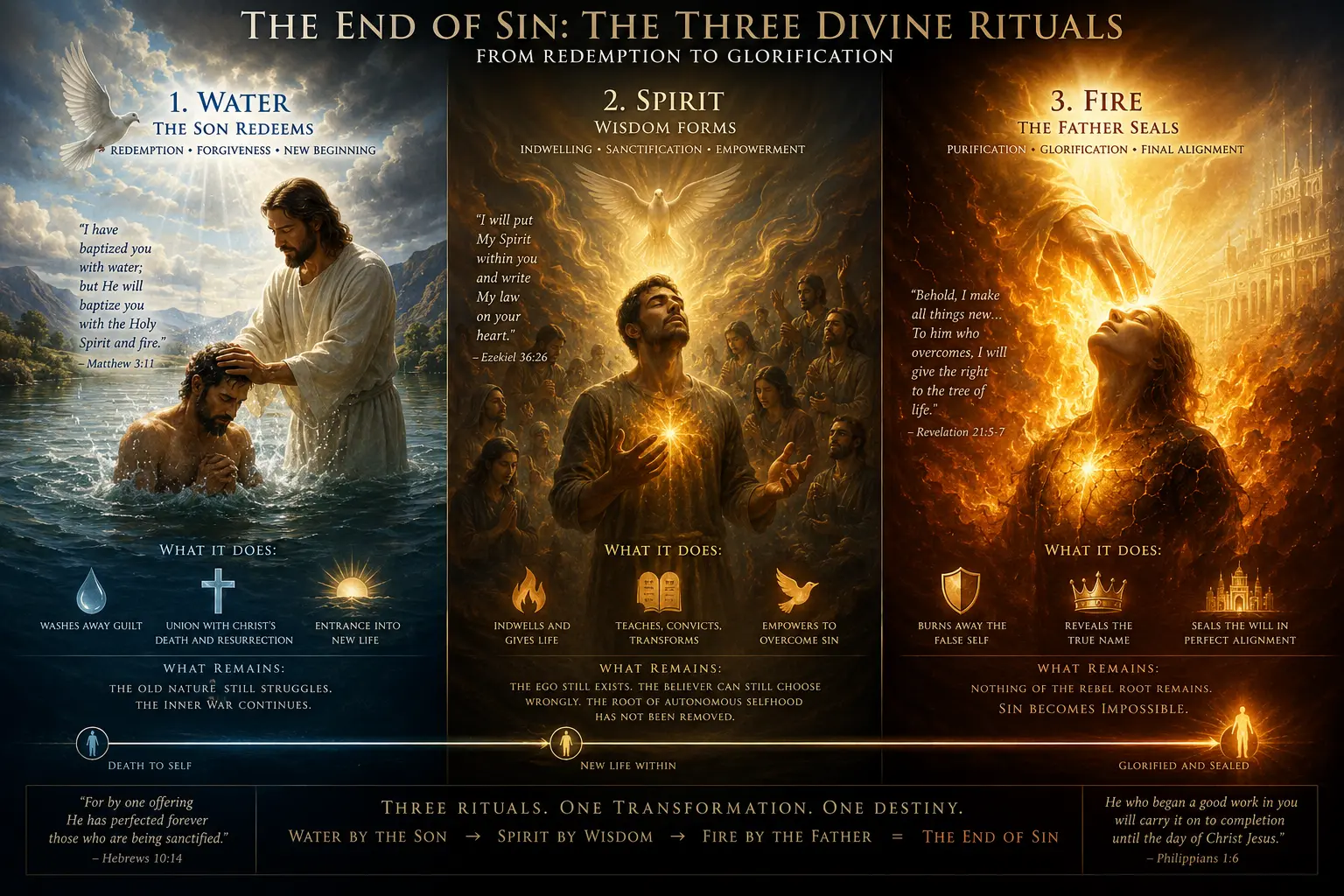
Sin does not end merely because a person has been forgiven. Sin does not end merely because a person has received the Spirit. Forgiveness removes guilt. The Spirit gives life, power, conviction, and sanctification. But the human being can still sin after both. The old root can still speak. The ego can still defend itself. The flesh can still desire against the Spirit. The Daughter can still groan under the curse.
This means the end of sin requires more than pardon and more than empowerment. It requires a final transformation of the root.
The Christian mystery contains three great thresholds: water, Spirit, and fire. They correspond to the Son, Wisdom/Spirit, and the Father. Each does something real. Each leaves something still unfinished. Each moves deeper than the last.
Water deals with guilt and death.
Spirit deals with inner life and sanctification.
Fire deals with the root of autonomous rebellion.
Only after the third can sin end forever.
The First Ritual: Water and the Son
The first ritual is baptism in water.
Water belongs to the Son because the Son is the Redeemer, the Bridegroom who enters the Daughter’s waters. He descends into the Jordan. He enters the death-symbol. He identifies with sinners without becoming sinful. He sanctifies the passage through water so that humanity may be joined to His death and resurrection.
Water baptism says:
**You have died with the Son.
You have passed through judgment.
You have been washed.
You belong to the crucified and risen One.**
This is the Red Sea, the Jordan, the womb, the grave, and the new beginning. The Son opens the path through death.
But after water baptism, something remains.
The baptized person is not yet fully sinless. The old Adam still moves in the body. Memory remains wounded. Desire remains disordered. Fear remains alive. The flesh still argues. The world still pressures. The devil still accuses.
Water removes guilt, but it does not instantly remove the whole inner war.
The Son redeems the person, but the redeemed person must still be formed.
So water baptism is real, but incomplete by itself.
It answers the question:
How can the guilty pass through judgment and live?
But it does not fully answer:
How can the human being become incapable of sin?
The Second Ritual: Spirit and Wisdom
The second ritual is baptism in the Holy Spirit.
The Spirit is not merely energy. The Spirit is Wisdom, Breath, living presence, holy intelligence, inner fire, divine formation. If water brings the person through death, the Spirit brings breath into the inner house.
Spirit baptism says:
**You are not empty.
God now dwells within you.
The law begins to be written on the heart.
The inner life is awakened.
The war against the flesh can now truly begin.**
The Spirit convicts, teaches, illuminates, empowers, comforts, wounds, heals, and orders. The Spirit gives gifts, prayer, prophecy, discernment, holiness, and communion.
But after Spirit baptism, something still remains.
Spirit-filled people can still sin. They can still fall into pride, lust, anger, fear, deception, spiritual ambition, despair, and self-defense. They may have power, but power is not the same as glorification. They may have gifts, but gifts are not the same as permanent purity.
The Spirit brings the person into the state of being able not to sin. But the person is not yet in the state of being not able to sin.
This is the great difference.
With the Spirit, the believer can resist the flesh. But the flesh still exists as an opposing structure. The ego can still defend a private kingdom. The person can still say yes to what is false.
The Spirit reforms the inner life, but the root of autonomous selfhood may still remain.
So Spirit baptism is real, but not final.
It answers the question:
How can the redeemed person live from God within?
But it does not fully answer:
How can the false self be removed forever?
The Third Ritual: Fire and the Father
The third ritual is the baptism of fire.
This is the most mysterious.
John the Baptist says that the Coming One will baptize with the Holy Spirit and fire. Many have treated Spirit and fire as one thing. They are joined, but they are not identical. Spirit fills. Fire consumes. Spirit empowers the war. Fire ends the rebel.
Fire belongs to the Father because the deepest problem in sin is false sourcehood.
The ego says:
**I am my own beginning.
I am my own law.
I can preserve myself apart from God.
I can keep one chamber hidden.
I can defend one darkness.
I can live from myself.**
That is not merely bad behavior. It is a counterfeit fatherhood inside the creature. The ego imitates the Father by pretending to be unoriginated. It wants to be “from itself.” It wants a private throne.
The Son redeems the sinner.
The Spirit sanctifies the sinner.
But only the Father can burn out the false source-self.
The baptism of fire says:
**You may no longer possess yourself against Me.
Nothing defended may remain.
No private darkness may survive.
No false origin may rule.
You will live from the true Source or not live at all.**
This fire is not cruelty. It is unshielded holiness.
It does not destroy the true person. It destroys the thing the person wrongly thought was himself.
Why Fire Must Come Last
Fire cannot come first.
If the Father’s fire touched the unredeemed person before water, it would be judgment without passage. The sinner would be exposed but not carried. The Son must first open the way through death.
Fire cannot come second before the Spirit’s formation.
If fire came before the inner house was prepared, it would burn a vessel not yet strengthened to receive holiness. Wisdom must first breathe, teach, convict, and shape the person inwardly.
So the order is merciful:
Water first: the Son redeems.
Spirit second: Wisdom forms.
Fire third: the Father seals.
Water makes the person clean enough to enter the path.
Spirit makes the person alive enough to be formed.
Fire makes the person true enough to be unable to return to falsehood.
What Remains After Each Ritual
After water, guilt is answered, but the inner war remains.
After Spirit, the inner war becomes winnable, but the rebel-root remains possible.
After fire, the rebel-root is consumed.
This gives three states:
Before grace: not able not to sin.
After Spirit: able not to sin.
After Fire: not able to sin.
The final state is not slavery. It is perfected freedom.
A glorified person cannot sin not because they are externally restrained, but because the will is fully alive in truth. Sin becomes impossible the way self-mutilation is impossible to a healed mind that sees clearly, or the way God cannot lie because truth is His nature.
The person does not lose freedom.
The person loses bondage masquerading as freedom.
The Mystery of the Third Phase
The baptism of fire is difficult to understand because it is not merely moral improvement. It is ontological.
It changes the root from which the person operates.
The sinful person operates from Adamic fracture: fear, grasping, shame, self-defense, hunger for control, and separation from Source.
The Spirit-filled person has a new life within, but may still experience two centers: the new life of God and the old reflex of Adam.
The fire-baptized person has one center.
The false center has been burned out.
This is why the third phase is not just sanctification intensified. It is source-realignment. The person no longer lives from the old claim of self-origin. The creature finally agrees at the root:
**I am not from myself.
I do not own myself.
I live from the Father.
My will is not destroyed; it is rooted.**
This is the end of sin because sin requires a private false center from which to deviate. If that center is gone, sin has no throne.
Fire as New Name
The baptism of fire may also be the moment of the true name.
Water gives the person entrance into the Son’s death and resurrection.
Spirit gives the person breath and gifts.
Fire gives the person their unveiled identity before the Father.
This is why Scripture’s images of final transformation include sealing, naming, white stone, forehead mark, transfiguration, and glory. A name is not merely a label. It is a revealed form of destiny. The false ego lives under false names: shame, pride, fear, lust, ambition, victimhood, domination, despair.
The Father’s fire burns off the false names.
Then the true name can be spoken.
The true name is not merely what the person is called. It is the person as God knows them.
To receive this name is to stop living from borrowed accusation.
Fire as Ego-Death Without Person-Death
The third phase is terrifying because the ego experiences it as death.
The ego says:
**If I cannot defend myself, I will disappear.
If I cannot keep my private chamber, I will be nothing.
If I surrender completely, I will lose myself.**
But this is the lie.
The ego is not the true self. The ego is the false fortress built around the wound. It is the self curved inward, protecting itself from God, others, truth, and exposure.
The Father’s fire destroys the fortress.
The person remains.
In fact, the person becomes more real than before.
Fire does not erase the creature. It reveals the creature by removing the counterfeit self that covered it.
Fire and Theosis
Theosis is participation in God. It is not the creature becoming God by nature. It is the creature becoming so united to God that divine life permeates the creature without destroying creaturehood.
Water begins this by joining the person to the Son.
Spirit deepens this by indwelling and forming the person.
Fire completes this by uniting the root of the will to the Father’s holiness.
Sin is separation from Source. Therefore the end of sin requires union with Source. Not a vague feeling of closeness, but a permanent re-rooting of the will.
The fire-baptized person does not become the Father.
The person becomes unable to live as if separated from the Father.
That is theosis as final stability.
Fire and the Body
The third phase cannot remain only psychological.
Sin is not only in thoughts. It is in body-patterns, nervous memory, desire, hunger, fear, sexuality, speech, sleep, imagination, and inherited damage. Therefore the baptism of fire must eventually touch the body.
This is where glorification enters.
The final state is not a clean soul trapped in a corrupt body. It is a transformed body, a body no longer organized around death. The curse must be burned out of flesh, not merely forgiven in the record.
This is why resurrection matters.
The end of sin requires a body that no longer betrays the spirit.
Water symbolizes death and resurrection.
Spirit begins the inner renewal.
Fire completes the transfiguration of the whole human architecture.
Fire and the Daughter
The baptism of fire is not only individual. It is cosmic.
The Daughter — creation, earth, body, land, city, Bride — remains under the curse even after the Son’s Cross and the Spirit’s coming. Believers still sin. Bodies still die. The earth still groans. Nations still rage. Matter still carries corruption. The Bride is redeemed but not yet fully glorified.
Therefore the Father’s fire must eventually touch the Daughter-field itself.
This is not the annihilation of creation.
It is the burning away of the curse from creation.
The same fire that consumes ego in the person will consume corruption in the world. The same fire that gives the true name to the soul will reveal the true name of the earth. The same fire that ends false sourcehood in the individual will end Babylon’s false kingdom in history.
Fire is the Father’s final claim:
**This world is Mine.
This body is Mine.
This Bride is Mine.
Nothing false may remain in her.**
The Father’s Role
The Father is necessary not because the Son failed or the Spirit was insufficient. The Son accomplished redemption. The Spirit began sanctification. But the Father consummates.
The Son says:
You are bought.
The Spirit says:
You are being formed.
The Father says:
You are Mine from the root.
The Father’s act does not replace the Son’s Cross. It applies it to the deepest level. It does not replace the Spirit’s indwelling. It brings that indwelling to final stability.
The Father ends sin by ending the creature’s false claim to self-source.
This is why the baptism of fire belongs to Him.
Only the true Source can destroy false sourcehood without destroying the creature.
The Three Rituals Together
The whole pattern can be stated simply:
Water — Son — Redemption
The sinner passes through death, washing, repentance, and resurrection-union.
Spirit — Wisdom — Sanctification
The redeemed person receives breath, inner formation, gifts, conviction, and power to resist sin.
Fire — Father — Glorification
The false ego is consumed, the true name is revealed, the will is sealed, and sin becomes impossible.
Or:
Water answers guilt.
Spirit answers weakness.
Fire answers false selfhood.
Or:
Water cleans the vessel.
Spirit fills the vessel.
Fire makes the vessel incorruptible.
What Is Still to Be Done?
After water, the believer must be filled.
After Spirit, the believer must be purified.
After fire, the believer must be revealed.
That final revelation is not private only. The sons and daughters of God must be manifested. Creation must see what the Father has done. The Daughter must be freed from corruption. The kingdom must appear.
The baptism of fire ends the hidden compromise. It is the threshold where salvation stops being only promise and becomes embodied inevitability.
The person no longer merely believes in holiness.
The person becomes incapable of betraying it.
The Final Mystery
The third phase is mysterious because it sounds like destruction but is actually completion.
It sounds like loss of self but is actually the birth of the true self.
It sounds like judgment but is also marriage.
It sounds like death but is glorification.
The Father’s fire does not come to torture the beloved. It comes to remove everything in the beloved that cannot survive love.
Sin ends when there is no longer any private chamber where the creature says no to God.
The baptism of fire is the Father entering that final chamber.
And when the false self is gone, the true person remains standing in glory.
Water made the passage.
Spirit filled the house.
Fire opened the locked room.
Then the Father speaks the true name.
And sin has nowhere left to live.