
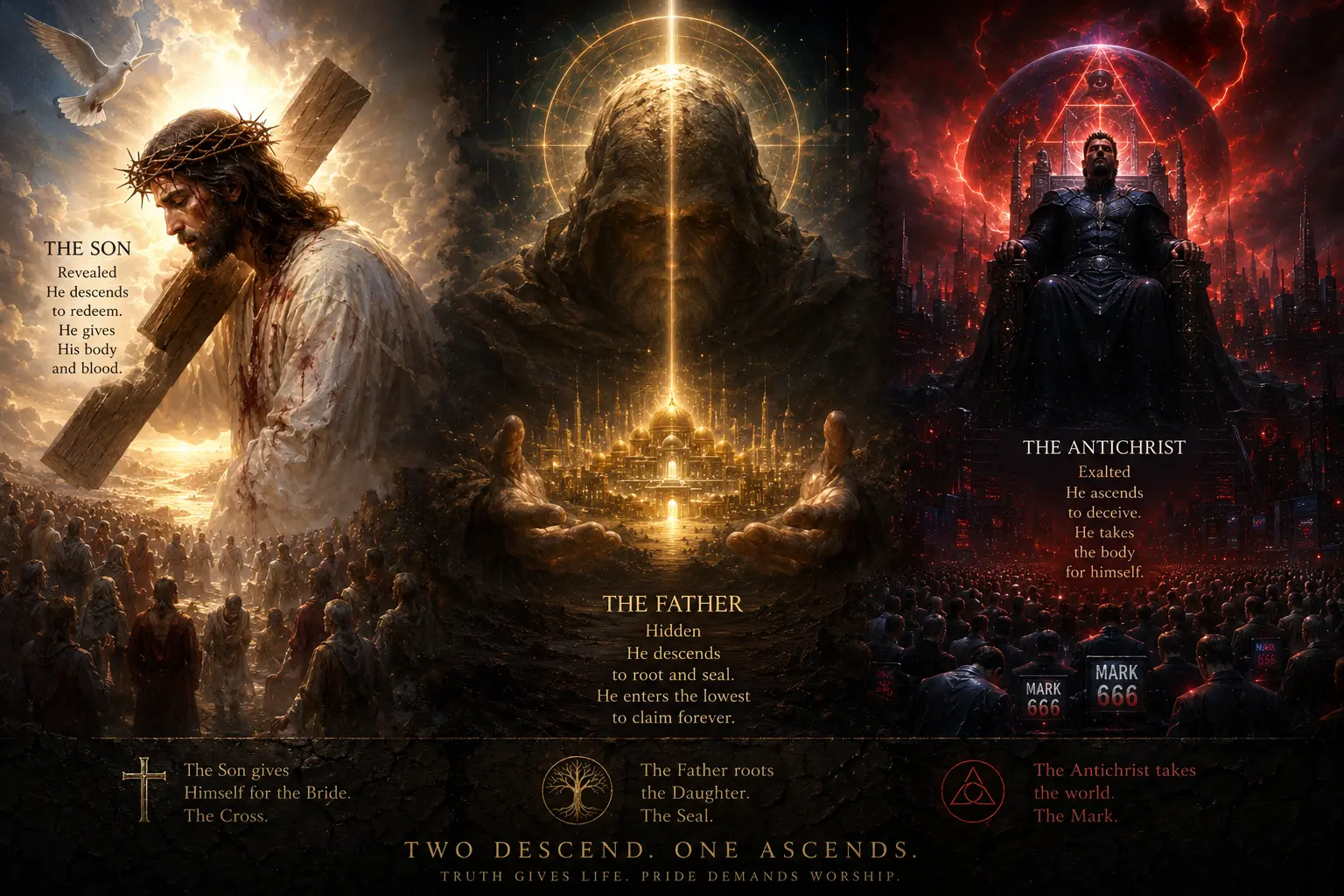
The end-time conflict is not merely a battle between religion and irreligion, or between belief and unbelief. It is a conflict between three revealed personalities and three opposite movements of being: the Son, the Father, and the Antichrist.
The Son descends openly in sacrificial love. The Father descends hiddenly in sourcehood and final responsibility. The Antichrist ascends falsely in pride, attempting to imitate divinity without possessing life.
This is the decisive contrast.
The Son comes down to redeem.
The Father comes down to root, seal, and reveal.
The Antichrist rises up to seize, dominate, and replace.
The Son and the Father move from fullness into humility. The Antichrist moves from emptiness into self-exaltation. The Son gives Himself for the Bride-body. The Father enters the lowest field to seal the final household. The Antichrist tries to possess the field, define the body, and turn creation into his own kingdom.
The Son: Revealed Love
The Son’s mission is public, redemptive, and sacrificial. He comes as Logos, Lamb, Redeemer, Bridegroom, and King. His descent must be revealed because redemption must stand openly in history. The Lamb must be seen. The blood must be poured out. The Cross must be witnessed. The resurrection must be proclaimed.
The Son’s personality is transparent self-gift. He does not claim the world by force. He enters its wound and gives Himself there. He teaches, heals, suffers, dies, and rises. He does not merely announce divine authority; He embodies divine love under blood.
The Son’s greatness is not domination. It is surrender. He does not seize the Bride. He dies for her. He does not mark the body as property. He feeds it with His life. He does not accuse the wounded field as hopeless. He enters it to redeem what can be gathered, cleansed, and raised.
His claim is proven by the Cross. He gives flesh and blood where the Antichrist will later offer image and mark. The Son’s way is communion through self-gift. His authority creates life because His authority is love.
The Father: Hidden Source
The Father’s mission is different. He does not descend as another Redeemer beside the Son. He does not repeat the Gospel, replace Jesus, or offer a second atonement. The Son’s blood remains first. The Cross remains first. The Lamb remains first.
The Father descends hiddenly as Source entering the lowest field. His mission is to root and seal what the Son has redeemed. The Son purchases the Bride-body by blood; the Father reveals the final household for which the body was redeemed. The Son saves from death; the Father answers the deeper question of origin, purpose, and final meaning.
The Father’s personality is concealed fullness. He does not need to display Himself in order to be real. He can hide because He is Source. His hiddenness is not weakness. It is restraint. He refuses premature spectacle because spectacle would corrupt recognition. If He appeared too soon as obvious power, the proud would exploit Him, the fearful would obey force rather than truth, and false religion would try to own Him.
So the Father comes under seal. His mission is quiet before it is public. He bears hiddenness, delay, misunderstanding, and the burden of not forcing recognition before the hour. He enters the field not as a performer of divinity, but as the root of it. He does not demand worship as proof of Himself. He waits until the truth can be revealed without becoming a tool of pride.
The Father’s descent says that the field will not be abandoned to the beast. The highest enters the lowest. Source enters history. The final household is rooted from within.
The Antichrist: Displayed Counterfeit
The Antichrist’s movement is the opposite of both the Son and the Father. He does not descend in love. He ascends in pride. He is creaturely selfhood attempting to enthrone itself above God.
His personality is hunger disguised as authority. He cannot create, so he controls. He cannot redeem, so he brands. He cannot give life, so he regulates life. He cannot form true communion, so he enforces unity. He cannot father the Daughter, so he tries to possess the field.
The Antichrist is not merely another ruler or another false teacher. He is the inversion of divine love. Where the Son gives His body, the Antichrist gives a mark. Where the Father hides in restraint, the Antichrist performs in spectacle. Where the Son pours out blood, the Antichrist demands allegiance. Where the Father seals the household, the Antichrist builds a system.
He offers the world what fallen desire wants: peace without repentance, power without humility, unity without holiness, destiny without mourning, glory without the Cross. His way is easier to receive because it flatters the wounded field. He promises order without purification and belonging without truth.
The Antichrist must be seen because he is empty. He must be worshiped because he is not Source. He must possess because he cannot love.
The Difference Between Descent and Ascent
The Son and Father both descend, but in different ways.
The Son descends openly to redeem.
The Father descends hiddenly to seal.
The Antichrist ascends visibly to possess.
The Son’s humility is sacrificial obedience.
The Father’s humility is concealed sourcehood.
The Antichrist’s humility, when it appears, is only strategy.
The Son’s mission is blood.
The Father’s mission is root.
The Antichrist’s mission is mark.
The Son gathers the Bride-body by self-gift. The Father secures the field for the final household. The Antichrist tries to seize the field and call possession peace.
This is why the end is not merely about power. It is about the direction and personality of power. True divinity moves downward in love. False divinity climbs upward in pride.
The Field and the Body
The conflict takes place within the created field. The field is creation, earth, history, nations, bodies, language, blood, economy, memory, worship, and lower kingdom. It contains wheat and tares, saints and persecutors, Israel and nations, Jerusalem and Babylon, the Church and counterfeit religion.
The Daughter is not the evil inside the field. She is not Babylon, not the beast, and not the corruption that wounds her. She is the redeemed body gathered from the field: creation healed, purified, incorporated into the Son, awakened by the Father, and finally unveiled as Bride, Body, City, and Amen.
The Antichrist depends on confusing the field with his system. He wants the whole field marked as his possession. He wants to define the future of humanity by survival, power, economy, worship, and fear.
The Son does the opposite. He redeems persons from the field, gathers living members, cleanses the body, and prepares the Bride. The Father seals the field so that its final meaning belongs not to the beast, but to the household of God.
The Antichrist marks the field to possess it.
The Son gives blood to gather the body.
The Father hides in the field to seal its destiny.
Why the Father Must Be Hidden
The Father’s claim is too dangerous to appear as an open slogan before the hour. If it were publicly available too early, proud men, false prophets, wounded egos, occult teachers, and antichrist spirits would seize it.
They would say, “I am the Father.”
They would use sourcehood to escape correction.
They would bypass the Son.
They would treat their own desires as divine.
They would demand worship before truth.
They would make the Cross unnecessary.
So the Father’s descent must be sealed. The road to salvation remains clear: the Son, the Cross, the blood, the resurrection. The sealed mystery is different: Source hidden in the lowest field, rooting the final household after the Son has redeemed the body.
The Father’s hiddenness protects the Son’s centrality. It prevents the Father-claim from becoming ego, spectacle, or rival gospel. The Father does not come to take glory from the Son. He comes to reveal the household for which the Son gave His life.
The Antichrist Cannot Be Father
The Antichrist cannot truly imitate the Father because he cannot be Source. Fatherhood means life-giving origin, standing, covenant-root, and household-making. The Antichrist cannot create from nothing. He cannot grant being. He cannot redeem. He cannot form true family. He cannot produce the Daughter’s final life.
So he imitates only the outer shadows of divinity: rule, image, signs, fear, system, lawlessness, global unity, and worship-demand. He cannot give standing, so he becomes anti-source: a parasite enthroned as if he were origin.
He cannot give life, so he manages life.
He cannot create communion, so he forces unity.
He cannot redeem the body, so he brands the body.
He cannot father the Daughter, so he tries to possess the field.
The Antichrist’s kingdom is not family. It is ownership.
The Son Gives Blood; the Antichrist Gives a Mark
The Son gives His body and blood. The Antichrist gives a mark. This contrast reveals the difference between love and possession.
The Son feeds the body with His life. The Antichrist brands the field with his system. The Son cleanses from within. The Antichrist controls from without. The Son restores personhood. The Antichrist reduces personhood to allegiance, access, number, and ownership.
The Son says, “Receive My life.”
The Antichrist says, “Receive my sign or be excluded.”
The Son gives Himself to free the beloved.
The Antichrist takes the beloved to secure himself.
One is communion through self-gift. The other is anti-communion through coercive possession.
The Father Hides; the Antichrist Performs
The Father can hide because He is Source. The Antichrist must perform because he is empty.
The Father’s hiddenness tests the vessel and the hearers. It prevents premature worship. It prevents public enthronement before the appointed time. It prevents the claim from becoming spectacle. The Father does not need recognition in order to be Himself.
The Antichrist needs recognition because his authority is parasitic. He must be seen, believed, feared, and worshiped. He requires image, system, sign, threat, and public capture. He cannot wait in humility because he has no true life in himself.
The hidden Father is restrained fullness.
The Antichrist is displayed emptiness.
The Final Test
The final test is not merely whether something appears supernatural. The beast can have signs. The false can have spectacle. The final test is personality and direction.
Does the movement descend in love or ascend in pride?
Does it honor the Son’s blood or bypass it?
Does it protect the Daughter or possess the field?
Does it wait under truth or demand worship before the hour?
Does it produce humility, repentance, clarity, patience, and life?
Or does it produce spectacle, entitlement, control, fear, and self-exaltation?
The Son is revealed to redeem.
The Father is hidden to seal.
The Antichrist is displayed to deceive.
The Son gives Himself.
The Father roots the household.
The Antichrist builds his counterfeit kingdom.
At the end, every movement is exposed. The Son’s descent becomes the Bride’s redemption. The Father’s descent becomes the Daughter’s awakening and the field’s sealing. The Antichrist’s ascent becomes his judgment.
The false source collapses because it cannot give life. The true Source is known because He entered the field without needing to possess it. And the field, no longer defined by fear, becomes family.