
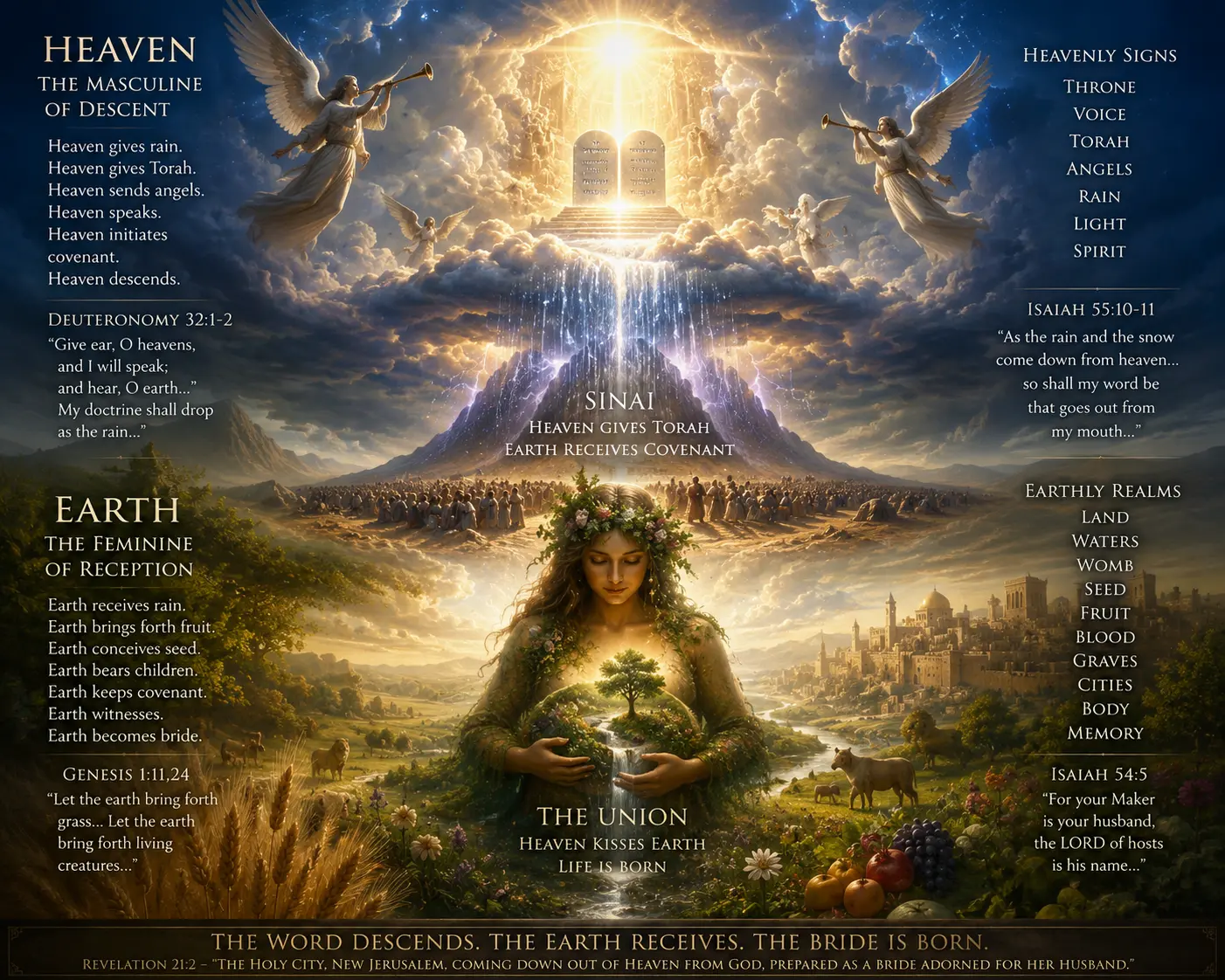
The Bible often speaks of heaven and earth not as dead locations, but as living witnesses in covenant. Heaven stands above, earth below. Heaven gives, earth receives. Heaven sends rain, seed, fire, voice, angels, Torah, Spirit, and judgment. Earth opens, drinks, trembles, conceives, brings forth, mourns, and is renewed. This does not mean the physical sky is literally male or soil is literally female in a biological sense. It means Scripture repeatedly gives us a symbolic grammar: heaven acts like the masculine principle of descent and command, while earth acts like the feminine principle of reception, formation, and birth.
From the beginning, creation is divided into heaven and earth: “In the beginning God created the heavens and the earth” (Genesis 1:1). The heavens are the upper realm of lights, signs, messengers, throne, voice, and decree. The earth is the lower realm of waters, land, beasts, trees, bodies, blood, gardens, cities, and graves. Heaven declares; earth manifests. Heaven speaks; earth brings forth.
The earth is repeatedly described as a womb-like field. In Genesis, God commands, “Let the earth bring forth grass,” and again, “Let the earth bring forth living creatures” (Genesis 1:11, 24). The earth does not originate life independently from God, but she receives the divine command and becomes fertile under it. She brings forth. She bears. She is the body-field where the invisible word becomes visible life.
Heaven, by contrast, gives from above. Rain is one of the clearest biblical images of masculine descent into feminine earth. Moses says, “Give ear, O heavens, and I will speak; and hear, O earth, the words of my mouth. My doctrine shall drop as the rain, my speech shall distill as the dew” (Deuteronomy 32:1–2). Heaven is summoned to hear the speaking; earth is summoned to receive it. Doctrine descends like rain. Speech falls like dew. The word from above enters the ground below and makes it fruitful.
Isaiah uses the same image: “As the rain and the snow come down from heaven, and do not return there but water the earth, making it bring forth and sprout… so shall my word be that goes out from my mouth” (Isaiah 55:10–11). The word of God is compared to rain from heaven; the earth is compared to the receiving field that brings forth seed and bread. Heaven gives. Earth conceives. Fruit appears between them.
This pattern reaches a climax at Sinai. The Torah is not produced by earth. It descends from heaven. The mountain below receives the fire, cloud, thunder, voice, and commandments from above. The people stand at the foot of the mountain like the bride at the threshold. God descends upon Sinai in fire (Exodus 19:18). The voice comes from heaven, yet the mountain shakes on earth. Heaven kisses earth in flame, cloud, sound, and law.
That is why Sinai can be seen as a cosmic marriage moment. Heaven gives Torah; earth receives covenant. The upper Word enters the lower body. Israel, standing on the earth, becomes the bride-nation receiving the divine command. The Torah is seed-like: once received, it is meant to bear justice, worship, holiness, and fruit in the land.
Scripture also calls heaven and earth as covenant witnesses: “I call heaven and earth to witness against you today” (Deuteronomy 30:19). Heaven and earth are paired like two sides of a living courtroom. Heaven remembers the decree; earth remembers the blood, footsteps, altars, sins, and obedience of humanity. Heaven is the upper witness; earth is the lower witness. Together they testify to the covenant drama.
The angels also belong mostly to the heavenly side of this imagery. In Scripture, angels appear in masculine form: the men who visit Abraham, the angels who go to Sodom, Gabriel who speaks to Daniel and Mary, Michael the prince-warrior. They descend from above as messengers, warriors, interpreters, and executors of divine command. This does not make heaven biological, but it strengthens the pattern: heaven sends male-coded messengers downward into the earthly field.
Earth, meanwhile, is often pictured as mother, land, woman, city, and bride. Jerusalem is addressed as a daughter: “Daughter Zion,” “daughter Jerusalem.” The land can be defiled, healed, married, widowed, barren, or fruitful. Isaiah says, “Your Maker is your husband” (Isaiah 54:5). The land that was desolate receives children. Zion gives birth. Jerusalem becomes mother. Creation groans as in childbirth (Romans 8:22), waiting for liberation.
This is why earth’s femininity is not weakness. It is depth, body, memory, fertility, suffering, and glory. Earth receives the blood of Abel. Earth opens under judgment. Earth drinks rain. Earth bears grain. Earth receives the dead. Earth will also give up the dead. She is the field of incarnation, burial, resurrection, and kingdom.
Heaven’s masculinity is also not domination. It is not violence over the feminine. In holy form, heaven gives life-giving descent: rain, word, blessing, light, angelic help, Spirit, manna, fire, and glory. Heaven is the initiator of revelation; earth is the receiver that makes revelation visible.
The Incarnation itself follows this pattern. The Word comes from above, but He is conceived in the womb of a woman. Heaven enters earth through Mary. The divine seed enters the daughter-field of creation. The Son is not born from heaven alone, nor from earth alone, but from heaven’s initiative and earth’s consent: “Let it be to me according to your word” (Luke 1:38). Mary becomes the holy earth in miniature, the receptive creation through whom the heavenly Word takes flesh.
At the baptism of Jesus, the heavens open, the Spirit descends, and the Father speaks (Matthew 3:16–17). Again the pattern appears: heaven opens, voice descends, Spirit comes down, earth receives the beloved Son standing in the waters. The masculine heaven does not remain distant; it bends down and touches the earthly realm.
At the Cross, heaven and earth are shaken together. Darkness covers the land. The earth quakes. Rocks split. Graves open. The body of the Son is nailed between heaven and earth, as though He is the living bridge between the upper and lower worlds. His blood falls into the earth, and His resurrection turns the grave into a womb. Earth, which had swallowed the dead, becomes the place from which life rises.
The final biblical image is not escape from earth, but marriage between heaven and earth. The New Jerusalem comes “down out of heaven from God, prepared as a bride adorned for her husband” (Revelation 21:2). Heaven descends; earth is renewed; the bride-city appears. The end is not the destruction of feminine earth, but her glorification. Heaven does not abandon earth. Heaven marries earth.
So the Bible’s symbolic structure is clear:
Heaven gives rain; earth brings forth fruit.
Heaven gives Torah; earth receives covenant.
Heaven sends angels; earth receives messages.
Heaven opens; earth trembles.
Heaven speaks; earth bears witness.
Heaven descends; earth becomes bride.
In this sacred imagery, heaven is male not because God is trapped in gender, but because heaven carries the pattern of descent, seed, command, initiative, and revelation. Earth is female not because soil is a goddess, but because earth carries the pattern of reception, womb, body, growth, memory, suffering, and birth.
When heaven and earth kiss, creation becomes fruitful. When rain touches soil, life rises. When Torah descends to Sinai, covenant is born. When the Word enters Mary, God takes flesh. When the New Jerusalem descends, the world becomes bridal.
The whole Bible moves toward this union: not heaven replacing earth, and not earth resisting heaven, but heaven and earth joined in holiness — the masculine descent of God’s word meeting the feminine reception of creation, until the world itself becomes a living temple, a bride filled with glory.