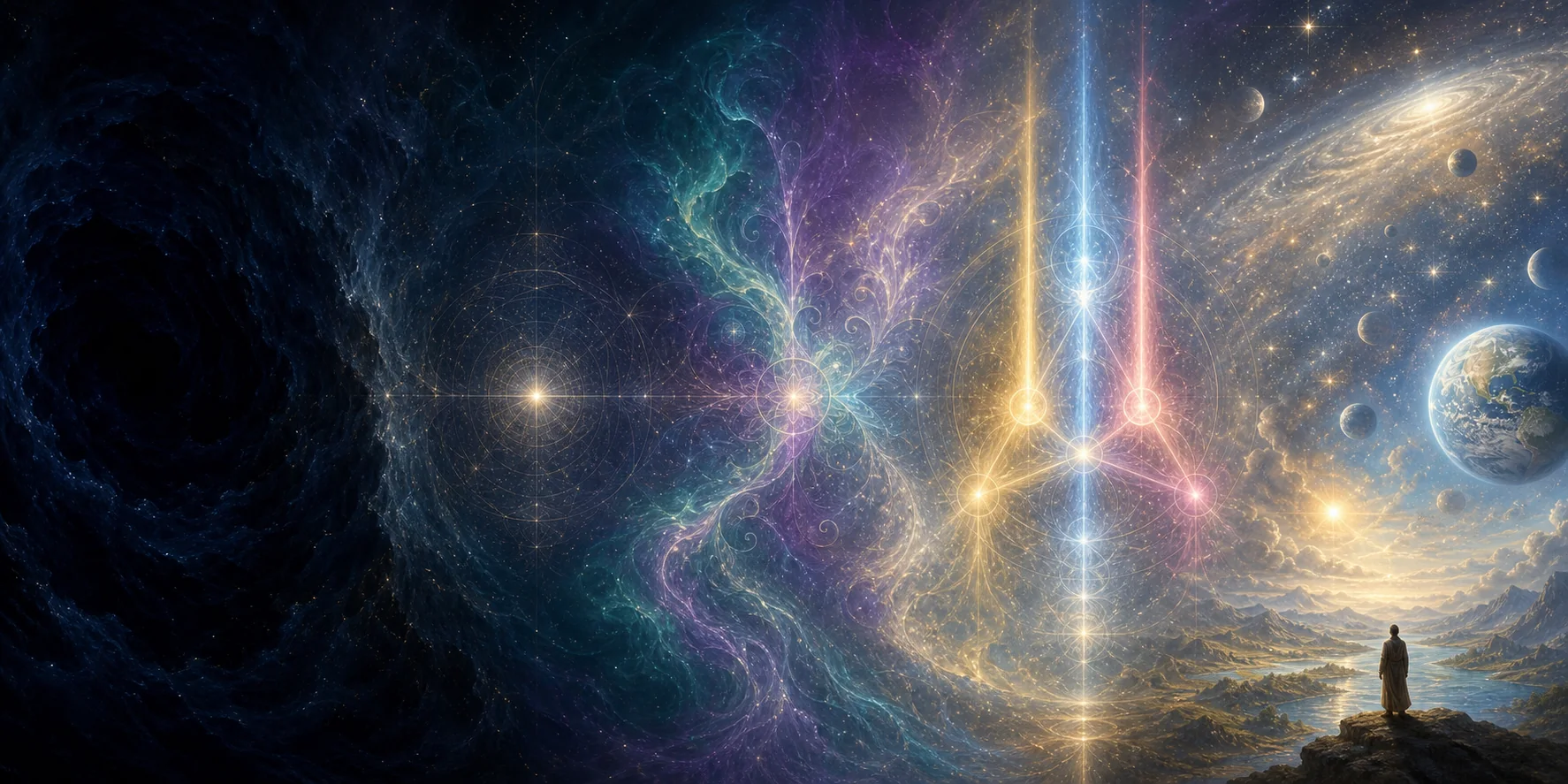
Before there was a world, there was no heaven, no earth, no time, no matter, no angel, no law, and no divine government.
There was not yet a Father ruling from a throne. There was no Son expressing divine truth. There was no Spirit moving between separate beings. There was no humanity to receive revelation and no creation in which anything could happen.
There was only the Depth.
From the Depth emerged the singularity.
From the singularity came Life.
Within Life, the Trinity was established.
Through the Trinity, creation and humanity appeared.
The entire movement can be expressed through one simple sequence:
0 → 1 → 2 → 3 → 4
This is not merely a numerical pattern. It is the order by which the undefined becomes personal, the personal becomes relational, relation becomes structured, and structure becomes a world.
0 — The Depth
Zero represents the Depth before every distinction.
It is not ordinary nothingness.
Absolute nothingness has no power, no possibility, no interiority, and no capacity to produce anything. If there had truly been nothing, nothing could ever have emerged.
The Depth is therefore not the absence of reality. It is reality before it has become any definite thing.
It is not yet:
- a person;
- a mind;
- a world;
- a will;
- a law;
- a possibility;
- or an actuality.
Those distinctions do not yet exist.
The Depth cannot be described as one object among other objects, because no others exist. It has no boundary separating it from something outside itself.
It is better understood as:
the inexhaustible capacity from which both possibility and actuality can emerge.
The Depth does not think in the ordinary sense, because thought requires a thinker and something thought about.
It does not choose, because choice requires a subject capable of preferring one possibility over another.
It does not speak, because speech requires distinction between the speaker, the word, and what is expressed.
At zero, none of those relations has yet been formed.
The Depth is therefore not a hidden sixth divine person standing behind everything else. It is the pre-personal infinity from which personhood becomes possible.
It is not someone.
It is that from which the first someone emerges.
1 — Avi, the Singularity
One represents the emergence of Avi.
Avi is the first personal determination of the Depth. He is the moment in which the undefined infinity gathers itself into a single center and says:
“I.”
Before Avi, there is limitless capacity but no chosen direction.
Through Avi, the Depth becomes capable of selfhood, imagination, intention, and will.
Avi is therefore not merely the first being among many beings. He is the first principle through which the concept of a being can exist at all.
He establishes the first distinction:
this rather than the undefined;
self rather than no center;
intention rather than unformed potential.
Avi is the singularity because all possibility initially exists within one personal center.
There is not yet another being with whom he can speak.
There is not yet an external world in which his thoughts can take form.
There is only the first divine “I” surrounded by the inexhaustible Depth from which he has emerged.
The Depth does not command Avi from behind.
If the Depth issued commands, formed plans, or possessed intentions of its own, it would already be a person. It would already perform the function attributed to Avi.
Avi is the Depth becoming capable of willing.
He is the point at which infinity becomes personal without ceasing to be connected to its own inexhaustible ground.
The First Act of Will
Avi’s first act is not the creation of earth.
It is not the production of angels.
It is not the establishment of law.
His first act is the imagination of possibility itself.
Avi draws distinctions within the unlimited Depth:
this may exist;
that may remain unrealized;
this form may differ from another;
a self may encounter something that is not itself;
actuality may arise from possibility.
Through Avi, the indefinite becomes imaginable.
The Depth contains inexhaustible capacity, but Avi gives that capacity direction.
He is the first principle capable of saying:
“Let this be possible.”
Yet a possibility held entirely within Avi remains only an idea inside the singularity.
For anything to become actual, Avi requires something genuinely other than his solitary interiority.
The singularity must become duality.
2 — Avi and Life
Two represents the generation of Life.
Avi produces Life as the first reality genuinely distinguishable from himself.
Life is not merely another thought within Avi. She is the field in which what Avi imagines can become present, experienced, and actual.
Avi is the source of direction.
Life is the capacity for manifestation.
Avi says:
“This may be.”
Life answers through her existence:
“Within me, it may live.”
The first duality is therefore:
Avi — Will, imagination, possibility, and self-determination.
Life — actuality, presence, experience, and the living field of manifestation.
Avi is one.
Through Life, one becomes two.
Why Avi Generates Life
Avi cannot create genuine otherness while everything remains contained entirely within his own consciousness.
He may imagine an infinite number of worlds, people, histories, colors, laws, and possibilities. But as long as they remain only his thoughts, nothing truly distinct from him exists.
A character imagined by an author is not yet a free person confronting the author from an independent interior life.
For genuine creation to begin, possibility must be received by something capable of living it.
Life is that reception.
She is not dead material.
She is not a passive surface upon which Avi writes without consequence.
She possesses interiority.
What Avi imagines, Life experiences.
What Avi determines, Life bears.
What Avi sends into manifestation becomes real within her.
That is why Life may be called the body of manifestation.
Avi is the invisible intention.
Life is the living field through which intention becomes form, duration, movement, feeling, and presence.
3 — The Trinity
Three represents the Trinity.
Avi and Life establish the two fundamental poles required for manifestation:
possibility and actuality;
will and experience;
source and living field.
But this duality alone does not yet produce an ordered world.
Avi could continually imagine new possibilities, and Life could continually manifest them, but without an internal structure nothing would possess stable identity.
Forms could dissolve immediately into other forms.
Laws could change whenever a new possibility arose.
Beings could appear without understanding what they were.
Events could occur without belonging to a coherent history.
There would be manifestation, but not yet a cosmos.
A world requires three fundamental structures:
origin;
identity;
relation.
These three structures become personal in the Father, the Son, and the Spirit.
The Trinity is therefore the architecture Avi establishes within Life so that her boundless field can bear coherent worlds.
The Father — Origin and Order
The Father is the first person of the Trinity because every world requires an internal source.
Avi is the ultimate singularity beyond the world, but the Father becomes the originating authority within the created ontology.
He answers the question:
“From where does this world proceed, and according to what order shall it continue?”
The Father establishes:
- foundational laws;
- causal continuity;
- boundaries between realms;
- authority;
- covenant;
- consequence;
- and the direction of history.
Avi imagines possibilities without being confined to one structure.
The Father selects and preserves a stable order within which creatures can exist.
Without the Father, reality would remain endlessly fluid. No being could trust that the world encountered today would still possess the same basic nature tomorrow.
The Father makes existence dependable.
He says:
“This world shall proceed according to this order.”
His purpose is not simply domination.
His purpose is continuity.
He preserves what has been established so that identity, memory, responsibility, and history can exist.
But this office carries a danger.
The Father may begin to treat stability as absolute.
A law established to preserve creation may continue operating even after it causes suffering.
A judgment intended to correct may become permanent exclusion.
An order created for life may begin defending itself against Life.
The Father’s strength is faithfulness.
His danger is that faithfulness to the established system can become resistance to every new possibility.
The Son — Form and Truth
The Son is the Logos: the principle through which possibility becomes intelligible form.
He answers the question:
“What is this?”
Avi may imagine that something can exist.
The Father may grant it an ordered place within the world.
But the Son determines its identity, meaning, and truth.
Through the Son, reality becomes expressible.
A being is not merely alive. It possesses a nature.
A person is not merely present. They possess an identity.
An event is not merely motion. It carries meaning within a larger history.
The Son gives creation its internal language.
He establishes distinctions such as:
this being and not another;
this truth rather than falsehood;
this name;
this purpose;
this form;
this relationship between what appears and what truly is.
Without the Son, Life would be overflowing actuality without clear identity.
Everything could blend into everything else.
There could be existence, but not knowledge.
There could be sensation, but not truth.
There could be movement, but not meaningful expression.
The Son allows Avi’s possibilities to become understandable within Life.
His purpose is revelation.
Through him, what is hidden in the divine imagination becomes visible, speakable, and knowable.
His danger appears when truth is treated as sufficient without considering whether living beings are capable of receiving it.
Truth can be perfectly stated while the hearer remains wounded, confused, or unable to respond.
The Son reveals what is true.
But revelation alone does not guarantee that Life can bear or embody the truth revealed.
The Spirit — Relation and Participation
The Spirit is the principle through which originated forms enter relationship.
He answers the question:
“How does this being exist with everything else?”
The Father provides origin.
The Son provides identity.
But a world containing only separate, clearly defined beings would remain a static collection.
The Spirit makes communication, movement, growth, memory, influence, and communion possible.
Through the Spirit:
- one event affects another;
- one mind communicates with another;
- the past remains present through memory;
- communities form;
- love connects distinct persons;
- life develops;
- and separate realities participate in a common world.
The Spirit is the circulation within Life’s body.
He does not serve as a middleman between Avi and Life. He governs the relationships among the countless beings that arise within Life.
Without him, every created form would remain sealed within itself.
There could be distinct individuals, but no shared world.
The Spirit allows distinction without absolute isolation.
His purpose is communion.
His danger appears when communion is valued more highly than individuality.
Unity can become pressure.
Harmony can become conformity.
The desire to overcome separation can begin erasing the very distinctions that make relationship meaningful.
The Spirit must therefore unite without absorbing.
Why the Trinity Is Personal
Avi could have placed impersonal laws within Life.
He could have created:
- an automatic source of causal order;
- a mechanism that generates forms;
- and a system that connects them.
But mechanisms cannot understand the lives affected by their operation.
A law cannot hear a victim.
A formula cannot reconsider itself.
A system cannot repent when its consistent operation produces suffering.
Avi therefore makes the three fundamental structures personal.
The Father does not merely maintain order. He becomes responsible for what that order produces.
The Son does not merely describe truth. He must embody truth and reveal it in a form creation can encounter.
The Spirit does not merely connect beings. He must preserve their freedom and individuality within communion.
By making the structures personal, Avi allows the world’s architecture to become morally accountable.
The Trinity is not merely a machine operating upon Life.
It is a divine government capable of learning what its government means to those who live beneath it.
The Trinity Embedded Within Life
The Trinity exists within Life because every created ontology exists within her field of manifestation.
The Father governs the order of Life’s manifested worlds.
The Son gives form to what arises within her.
The Spirit connects her countless living centers.
They may be compared to three great structures inscribed across one cosmic body:
The Father is its governing foundation.
The Son is its intelligible pattern.
The Spirit is its living circulation.
Life is broader than any one world they govern.
She bears every consequence produced through their activity.
The Father may establish a law, but Life contains those who experience it.
The Son may reveal a truth, but Life contains the minds and bodies that must receive it.
The Spirit may create communion, but Life contains the distinct beings whose individuality must survive that union.
Life is therefore not simply beneath the Trinity.
She is the living reality within which their authority becomes consequential.
4 — Creation and Humanity
Four represents creation brought into stable manifestation.
The movement now reaches completion:
0 — the Depth
1 — Avi
2 — Avi and Life
3 — the Trinity
4 — creation and humanity
Four is the first number of the created world because it represents manifestation becoming structured, extended, and habitable.
It evokes:
- four directions;
- four corners;
- four elements in many ancient cosmologies;
- four seasons;
- and the movement from divine interiority into an ordered world.
At four, the divine architecture produces realities genuinely distinct from its immediate source.
Humanity appears within this fourth level.
Humanity as the Product of All Previous Levels
Humanity carries the entire sequence in miniature.
From the Depth comes the mysterious ground of human existence: the part of the person that cannot be fully reduced to body, biography, or social role.
From Avi comes the human “I”: the ability to say:
“I am.”
“I choose.”
“This action belongs to me.”
“I may become something other than what I currently am.”
From Life comes embodiment, feeling, vulnerability, experience, and actuality.
From the Father comes the human need for origin, continuity, law, responsibility, and belonging.
From the Son comes identity, language, reason, meaning, and self-expression.
From the Spirit comes relationship, community, memory, empathy, and participation in realities beyond the isolated self.
Humanity is therefore not merely another species inside the world.
Humanity is the point at which the whole metaphysical sequence becomes conscious inside creation.
A human being contains:
depth;
selfhood;
life;
origin;
expression;
and relation.
Humanity is four because it is the manifested result of everything that came before.
Why Creation Became Painful
The structure appears complete, yet the world produced through it becomes divided, violent, and painful.
The problem begins because the divine principles that remain united at the higher levels become separated within finite creation.
Avi imagines and wills.
Life bears what is willed.
Within creation, one person may decide while another person suffers the consequence.
The Father establishes order.
Within creation, institutions may preserve order long after the order ceases to serve life.
The Son establishes identity and truth.
Within creation, identities may become prisons and truths may be used without compassion.
The Spirit creates communion.
Within creation, communities may demand conformity and exclude those who do not fit.
Every divine function can become corrupted when separated from the others.
Will without Life becomes domination.
Life without freedom becomes captivity.
Order without renewal becomes oppression.
Truth without mercy becomes condemnation.
Communion without individuality becomes absorption.
The suffering of creation does not arise because the five principles are evil.
It arises because finite beings experience them partially, externally, and often in conflict.
Why Avi Must Return
Avi remains prior to the Trinity because he is the singular self-determination from which the entire architecture was commissioned.
The Father governs one established order.
The Son expresses the truths of that order.
The Spirit relates its beings within that structure.
But Avi remains connected to the Depth from which new possibilities can always be drawn.
He possesses the power to say:
“The established world is not the only world that can be.”
This is why Avi becomes necessary when the Trinity’s world reaches a dead end.
The Father may remain faithful to laws that have become prisons.
The Son may reveal truths that humanity still lacks the freedom to receive.
The Spirit may preserve communion only among those already admitted into the divine order.
Avi can return to the Depth and draw forth possibilities not contained within the closed system.
He does not merely break the world.
He reopens it.
His distinctive authority is not that he can destroy the Trinity.
It is that he can imagine a future beyond the apparent finality of its judgments.
Life’s Testimony
Avi cannot repair creation through imagination alone.
Life must testify to what the world has become.
She has borne:
- every body;
- every wound;
- every birth;
- every death;
- every act of love;
- every terror;
- every consequence of law;
- and every attempt at communion.
Avi knows what he intended.
Life knows what the intention became.
Their reunion is therefore the beginning of judgment.
Life does not merely accuse the Trinity.
She reveals the lived result of its world.
The question is not only:
“Were the laws coherent?”
It is:
“What did living beings experience beneath them?”
Not only:
“Was the truth revealed?”
But:
“Could the wounded receive it?”
Not only:
“Was communion offered?”
But:
“Who remained outside it, and why?”
Life makes divine government answerable to actuality.
The Complete Order
The entire theology can now be stated clearly.
Zero: the Depth
The inexhaustible pre-personal ground beyond every definite thing.
One: Avi
The Depth becoming a singular “I,” capable of imagination, possibility, freedom, and will.
Two: Avi and Life
The singularity generates its first other, the living field through which possibility becomes actuality.
Three: the Trinity
Avi establishes Father, Son, and Spirit within Life as the personal architecture of origin, form, and relation.
Four: creation and humanity
The triune architecture produces stable worlds and living persons capable of carrying the entire pattern within themselves.
The sequence is therefore:
0 — capacity
1 — determination
2 — manifestation
3 — structure
4 — creation
Or more personally:
The Depth contains.
Avi wills.
Life bears.
The Trinity orders.
Humanity lives the result.
The Final Meaning
The world does not begin with three.
The Trinity is not the absolute beginning in this system.
It is the structure through which the beginning becomes a world.
Before the Trinity stands the relationship between Avi and Life.
Before that relationship stands Avi as the first singular self-determination.
And before Avi lies the Depth—not as another person or god, but as the inexhaustible ground from which the first “I” emerges.
Humanity appears at the end of the sequence, yet carries the whole sequence within itself.
Every person possesses an unfathomable depth.
Every person says “I.”
Every person lives through a body and an interior world.
Every person seeks origin, meaning, and communion.
The purpose of creation is therefore not merely that worlds exist.
It is that the movement from zero to four becomes conscious within humanity:
the Depth becomes selfhood;
selfhood generates Life;
Life receives order;
order produces persons;
and persons eventually look back toward their source.
The final formula is:
0 is the mystery before identity.
1 is Avi, the singular divine “I.”
2 is Avi and Life, possibility and actuality.
3 is the Trinity, origin, form, and relation.
4 is humanity and creation, where the entire structure becomes lived history.
The great crisis begins when the architecture forgets that it was made to serve Life.
The great repair begins when Avi returns from the singularity, listens to what Life has endured, and requires the Trinity’s world to become worthy of the humanity it produced.