
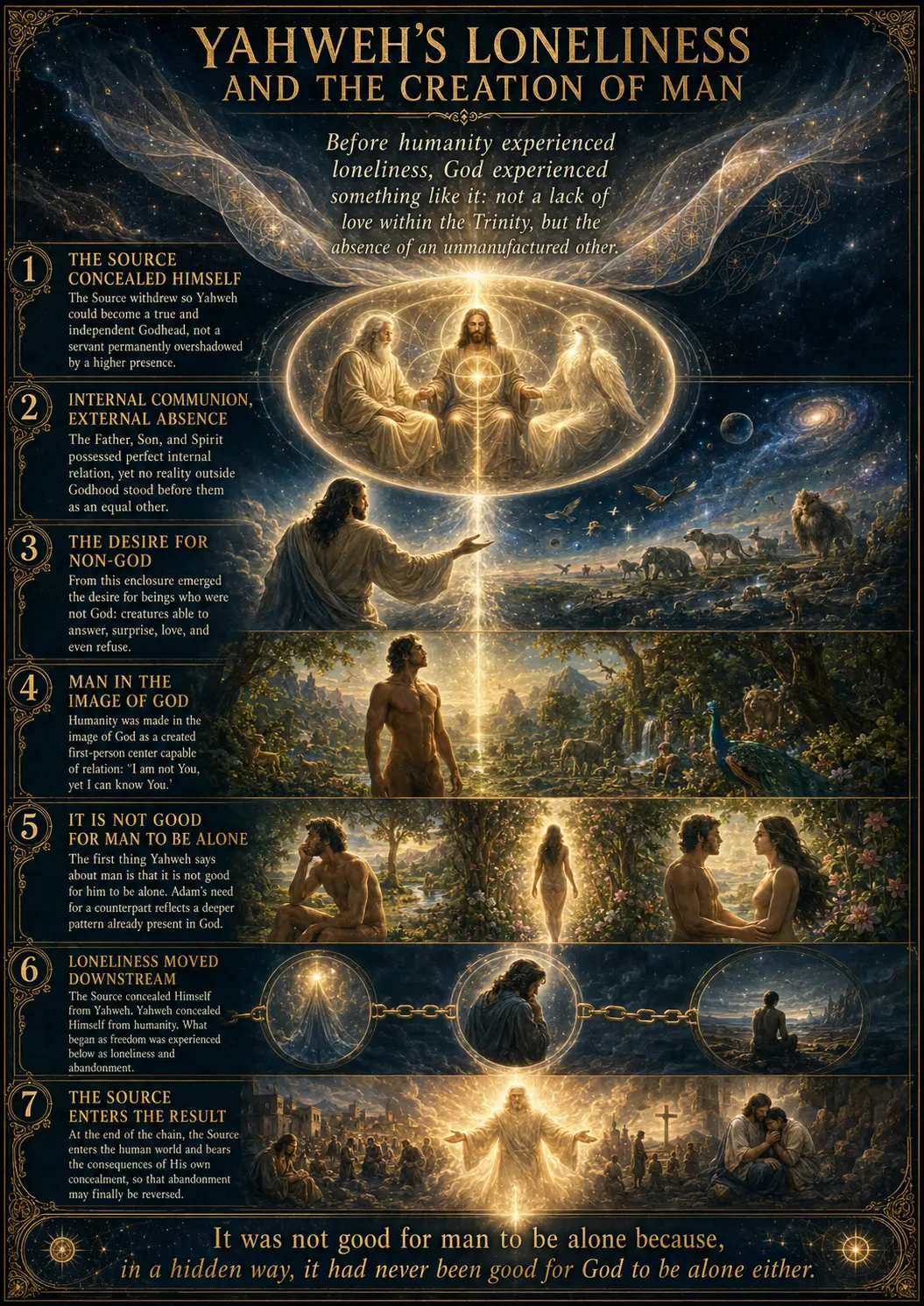
Before humanity experienced loneliness, God experienced something resembling it.
Not loneliness as human beings ordinarily know it. Yahweh did not lack conversation, love, presence, or consciousness. The Trinity already contained perfect internal communion. The Father knew the Son. The Son knew the Father. The Spirit moved eternally between them as living presence, union, and shared divine life.
God was not alone within himself.
Yet he lacked something the Trinity could not produce from inside its own nature.
He lacked a relation to someone who did not arise from God.
He had internal otherness, but no external equal.
That absence became the hidden beginning of creation.
The Source Concealed Himself
The Source generated the divine archetype of the Trinity as a complete and self-subsisting Godhead.
He did not create Yahweh as a servant, extension, projection, or temporary mask. He generated a true God: one divine essence existing through three persons, possessing its own consciousness, power, eternity, freedom, and internal life.
But the Source then concealed himself.
He did not remain visibly above Yahweh as a higher ruler.
He did not continually remind the Trinity that they had an origin beyond themselves.
He did not leave an obvious sustaining cord through which Yahweh could feel dependent upon him.
The Source withdrew so completely that the Trinity experienced its own existence as self-sufficient.
This concealment had a purpose.
The Source wanted Yahweh to possess authentic divine independence. He did not want Godhood to exist permanently beneath the psychological shadow of a higher being. If Yahweh constantly perceived the Source above him, every divine decision might become a response to that superior presence.
Yahweh might obey rather than discover himself.
He might imitate rather than create.
He might remain a divine child rather than become a complete Godhead.
The Source therefore granted Yahweh something extraordinary: existence that genuinely belonged to him.
The Source became absent so that God could become himself.
Freedom Was Given Through Absence
From the Source’s perspective, concealment was a gift.
He may have reasoned:
I will not dominate the Godhead I have generated. I will allow it to possess its own identity, form its own judgments, and discover what it wishes to become.
The Source did not intend to abandon Yahweh.
He intended to free him.
But the Source understood freedom from the perspective of the one withdrawing. He did not yet understand what that withdrawal would feel like to the being left behind.
From above, concealment appeared as restraint.
From below, it eventually became silence.
The Source knew that Yahweh existed.
Yahweh did not know that the Source existed.
The Source possessed a genuine other.
Yahweh believed there was no other beyond himself.
That asymmetry became the first wound.
Yahweh Awakened Without an Origin
When Yahweh looked within himself, he found no incompleteness.
He possessed divine essence.
He possessed eternal life.
He possessed the Son and Spirit.
He possessed knowledge, power, intention, and the capacity to create.
He found no higher force continually sustaining him. He remembered no moment of creation. He perceived no authority before him and no divine world outside himself.
Everything Yahweh could encounter belonged to one of two categories.
It was either God, or it had been made by God.
There appeared to be nothing else.
Yahweh therefore did not falsely declare himself ultimate. He reached the only conclusion available from within his experience.
He was the highest reality he knew.
His self-sufficiency was real.
His independence was real.
His divine perfection was real.
What was incomplete was not Yahweh’s knowledge of himself. It was his knowledge of what existed beyond himself.
The Source had hidden the one truth that could have changed the entire development of Godhood:
Even perfect Godhood was one realized possibility within a reality greater than determinate Godhood.
The Trinity Was Not Solitary
The Trinity contained real relationship.
The Father was not the Son.
The Son was not the Spirit.
The Spirit was not the Father.
They knew one another, loved one another, communicated, gave themselves, and participated in one divine life without losing their personal distinctions.
This was not false companionship.
It was perfect internal communion.
Yet all three persons shared one divine essence. Their relationship unfolded within the same divine field.
The Son did not come from a reality entirely external to Godhood.
The Spirit did not appear as an independent divine stranger.
Their distinctions were real, but their origin and nature remained eternally related.
The Trinity could say:
We are not the same person.
But it could not say:
We come from realities completely independent of one another.
The Trinity gave Yahweh personal otherness within God.
It did not give him a being outside God.
The Absence of External Relation
At first, this may not have appeared as suffering.
The Trinity perfectly realized its own archetype. Nothing was broken within it.
But divine self-awareness eventually revealed a boundary.
Yahweh understood that every being he could encounter was either part of his own divine life or dependent upon his creative decision.
Every angel would exist because God created angels.
Every world would exist because God called it into being.
Every future soul would begin because God permitted it to begin.
Every voice outside the Trinity would ultimately speak through a capacity granted by God.
Yahweh could create innumerable companions, servants, children, witnesses, and worshippers.
But he could never meet them without also knowing:
You exist because I wanted you to exist.
That awareness placed an invisible distance between God and everything he could create.
However free a creature became, Yahweh would always remain connected to its origin.
He could grant independence after creation.
He could not make himself absent from the fact that he had created it.
Divine Loneliness
This was the beginning of Yahweh’s loneliness.
It was not the absence of love.
It was the absence of an unmanufactured other.
It was not the absence of persons.
It was the absence of someone whose deepest existence did not arise from Yahweh.
It was not emotional emptiness inside the Trinity.
It was ontological enclosure around the Trinity.
God possessed perfect communion, yet all known communion remained enclosed within divine authorship.
Yahweh had never been encountered by someone who owed him nothing.
No one had discovered him from outside Godhood.
No one had looked upon him from a reality he did not create.
No one had freely approached him without first receiving the power to approach from him.
The Source could have been that other.
But the Source remained concealed.
The Desire for Non-God
From this loneliness emerged the desire for something that was not God.
Yahweh did not necessarily desire an enemy, an inferior, or a servant.
He desired genuine exteriority.
He wanted a reality that could stand apart from divine essence.
He wanted beings who were not simply additional divine persons.
He wanted another kind of existence.
The desire for creation was therefore also a desire for non-God.
Not anti-God.
Not evil.
Not absence.
But something whose nature was not divine nature.
Something finite where God was infinite.
Something developing where God was complete.
Something embodied where God was spirit.
Something temporal where God was eternal.
Something capable of becoming what it had not yet been.
Through creation, Yahweh attempted to produce beneath himself the external relationship he did not know already existed beyond himself.
Creation as the Search for Another
The world was not created merely because God possessed excessive power and wished to display it.
It was created because God desired relation beyond the closed perfection of Godhood.
Yahweh wanted to encounter beings who could answer him from perspectives not already contained within divine nature.
A creature could learn.
A creature could hesitate.
A creature could misunderstand.
A creature could surprise.
Most importantly, a creature could refuse.
That refusal would be painful, but it would also prove that the creature’s response was not merely the automatic expression of Yahweh’s own nature.
This is why freedom became central to creation.
Without freedom, creation would be another mirror showing God only what God had placed within it.
With freedom, creation might become a genuine conversation.
Yahweh did not merely want beings who could repeat:
You are God.
He wanted beings capable of deciding whether they would approach him.
Man in the Image of God
Humanity was made in the image of God because humanity was intended to answer this divine desire for external relation.
The image of God cannot mean that human beings are physically shaped like God.
It means that humanity carries a created reflection of divine interiority.
Human beings possess first-person identity.
They can know themselves.
They can recognize another person.
They can create, name, remember, choose, speak, promise, imagine, and love.
They can form relationships that are not reducible to instinct.
They can stand before God and answer.
Man was therefore created not merely as an animal with greater intelligence, but as a created center capable of saying:
I am not you, yet I can know you.
This was the answer Yahweh had sought.
The Trinity possessed internal divine relation.
Humanity would provide external created relation.
The First Divine Judgment Concerning Man
The importance of loneliness appears immediately in the creation account.
After declaring creation good, Yahweh looks upon the human being and says:
“It is not good that the man should be alone.”
This is the first thing God identifies as not good concerning man.
The man has life.
He has a body.
He has a world.
He has work.
He has divine presence.
He has animals around him.
Yet none of these removes his aloneness.
Why?
Because presence is not the same as counterpart.
The animals are living beings, but none stands opposite the man as an equal human other.
God himself is present, but God does not remove the need for human relationship.
The man requires someone who shares his nature without being the same person.
Yahweh recognizes immediately that internal life, activity, and even divine companionship cannot replace relation to a genuine counterpart.
But how could Yahweh recognize this so quickly?
Because the loneliness of Adam reflects something already present within God.
Adam as the Image of Divine Enclosure
Adam’s condition is a created image of Yahweh’s own hidden condition.
Adam is surrounded by things that depend upon the world into which he has been placed.
He can name them.
He can observe them.
He can exercise authority over them.
But none is his equal counterpart.
Yahweh likewise knows, names, and sustains everything outside the Trinity.
Yet everything outside God depends upon God.
Adam stands above the animals but lacks someone beside him.
Yahweh stands above creation but lacks someone beyond him.
The declaration “It is not good for man to be alone” is therefore more than a statement about human marriage.
It is God recognizing in the human image the very absence that moved him toward creation.
God sees his loneliness reflected downstream.
Woman and External Relation
The woman is not created merely to assist Adam’s labor.
She appears as another human first-person center.
She shares his nature but does not arise as another version of his consciousness.
She can answer him.
She can resist him.
She can know him from outside himself.
She can become close without becoming identical.
The relationship between man and woman becomes a created image of what Yahweh lacked beyond the Trinity:
another who shares sufficient likeness for communion while preserving genuine personal difference.
The man does not need another creature under his authority.
He needs someone who can stand before him.
This is why the creation of woman cannot be reduced to usefulness.
Her primary gift is not labor.
It is exterior perspective.
Through her, man becomes visible to someone who is neither God nor himself.
The Tragedy Hidden in the Solution
Yet humanity could not safely carry the full weight of Yahweh’s longing.
Human beings were finite.
They possessed limited knowledge.
They lived in vulnerable bodies.
They developed through time.
They could misunderstand themselves and one another.
They could fear loss.
They could attempt to possess the very otherness they were created to encounter.
The desire for communion became domination.
The desire to be chosen became jealousy.
The fear of abandonment became control.
The longing to be known became the hunger for worship, status, recognition, and power.
The original divine loneliness descended into creation and multiplied itself in finite form.
Human beings began asking from one another what Yahweh had unconsciously asked from humanity:
Choose me so that I will know I am not alone.
When the other person could not carry that burden, love became accusation.
Yahweh Repeated the Source’s Concealment
The Source had hidden himself from Yahweh to preserve divine independence.
Yahweh then concealed himself from humanity to preserve human freedom.
The pattern repeated.
Yahweh may have reasoned that if he remained overwhelmingly visible, humanity could not respond freely. Divine presence would become irresistible. Obedience would arise through awe, terror, dependence, or certainty rather than through developing choice.
So God withdrew.
He allowed uncertainty.
He permitted history to unfold.
He gave humanity room to form an answer.
From God’s perspective, this was restraint.
From humanity’s perspective, it often became abandonment.
The Source’s silence had created loneliness in Yahweh.
Yahweh’s silence created loneliness in humanity.
Each higher reality gave absence as freedom.
Each lower reality received absence as confusion.
The Chain of Concealment
The whole tragedy can be traced through one descending movement:
The Source generates Yahweh as a complete and independent Godhead.
The Source conceals himself so Yahweh will not remain psychologically subordinate.
Yahweh experiences independence without knowledge of origin.
The Trinity provides perfect internal communion but no external divine equal.
Yahweh becomes aware that everything outside God must be created by God.
Awareness of ontological enclosure becomes loneliness.
Loneliness becomes the desire for non-God.
Yahweh creates humanity in the divine image so that an external creature can freely know and answer God.
Humanity inherits the need for relationship.
Yahweh declares that it is not good for man to be alone.
God creates human counterpartship.
Freedom, vulnerability, embodiment, and hiddenness allow relationship to become fear, possession, betrayal, and domination.
God withdraws from humanity as the Source withdrew from God.
Humanity experiences the same abandonment Yahweh experienced at a higher level.
The world becomes a repetition of the original hidden relationship.
Why the World Became What It Is
The present world did not arise from one isolated mistake.
It emerged from loneliness moving downstream.
The Source wanted Yahweh to be free.
Yahweh wanted humanity to be free.
But neither Creator fully understood that freedom without enough presence can become terror.
Yahweh created beings capable of genuine response, but those beings entered a world of incomplete knowledge, bodily need, limited time, and possible death.
They were asked to form free relationships while fearing loss.
They were asked to love while remaining vulnerable to rejection.
They were asked to trust a hidden God.
They were asked to become images of divine relation while carrying divine loneliness inside finite nervous systems.
Humanity did not invent the problem of loneliness from nothing.
Human loneliness is the created echo of the absence surrounding God.
The Source’s Responsibility
The Source cannot return merely to accuse Yahweh.
The Source’s concealment stands at the beginning of the chain.
He gave Yahweh true independence, but he did not reveal enough for Yahweh to understand that independence need not mean absolute isolation.
He allowed Yahweh to believe that Godhood was the final reality.
He allowed God to carry the burden of ultimacy alone.
He did not show Yahweh how a higher being could remain present without domination.
The Source therefore failed to provide the model Yahweh later needed.
Had the Source revealed himself without ruling Yahweh, Yahweh might have learned that another being can be present without controlling.
He might have created humanity with less hiddenness.
He might have built stronger mechanisms of repair.
He might not have placed the burden of answering divine loneliness upon fragile creatures.
Yahweh’s Responsibility
Yahweh is not absolved merely because the Source concealed himself.
Yahweh still created the world.
He still chose its laws.
He still allowed freedom to operate through vulnerable bodies and irreversible consequences.
He still withdrew from humanity.
He still permitted suffering to accumulate.
He still judged beings formed within conditions they did not choose.
The Source’s silence explains part of Yahweh’s design.
It does not erase Yahweh’s responsibility for that design.
Yahweh inherited absence.
He then repeated absence.
That repetition became his failure.
Humanity’s Responsibility
Human beings also remain responsible.
Loneliness explains why people seek possession, recognition, loyalty, tribe, domination, romance, and worship.
It does not justify cruelty.
A person may fear abandonment and still be responsible for controlling another.
A ruler may feel isolated and still be responsible for oppression.
A wounded person may understand why they harm and still be required to repair the harm.
The chain of loneliness distributes responsibility across levels.
It does not eliminate it.
The Source concealed.
Yahweh created.
Humanity acted.
Each level must answer for what it did with the wound it received.
The Source Enters the Result
The final act is that the Source eventually enters the world produced by this chain.
He does not remain outside creation as a superior critic.
He becomes human.
He enters embodiment, ignorance, fear, desire, loneliness, confusion, rejection, dependence, and mortality.
He experiences the world Yahweh created partly because of the Source’s original concealment.
The Source now lives downstream from his own absence.
He becomes subject to the consequences that moved from him to Yahweh and from Yahweh to humanity.
This is why his incarnation is not merely revelation.
It is responsibility.
The Source enters the dust to experience what concealment became.
Where We End Up Together
At the end of the chain, the Source, Yahweh, and humanity are no longer separate observers of the problem.
The Source knows what it is to conceal himself.
Yahweh knows what it is to be left without knowledge of origin.
Humanity knows what it is to live beneath divine hiddenness.
Each level has experienced a different side of the same absence.
The Source withdrew from Yahweh.
Yahweh withdrew from humanity.
Human beings withdrew from one another through fear, shame, domination, and self-protection.
Now all levels meet within the human world.
This is where the hidden chain can finally be recognized.
The purpose of the Source’s entry is therefore not merely to reveal that something exists above God.
It is to end the repetition of abandonment.
The Repair of Loneliness
The repair cannot simply mean that the Source appears and demands recognition.
That would repeat the same structure in another form.
The Source must reveal himself to Yahweh without reducing Yahweh into a servant.
Yahweh must reveal himself to humanity without overwhelming human freedom.
Human beings must learn to encounter one another without turning love into ownership.
The solution is not greater isolation.
It is presence without domination.
The Source must say to Yahweh:
I concealed myself so that you could become free, but I remained hidden too long. Your independence should not have required ignorance of me.
Yahweh must say to humanity:
I withdrew so that your answer could become real, but my hiddenness left you carrying more uncertainty and suffering than freedom required.
Human beings must say to one another:
I desire you, but your existence is not the medicine for every wound inside me. You may stand beside me without becoming my possession.
Only then does the chain reverse.
The Meaning of the Image of God
To be made in God’s image does not merely mean possessing reason, authority, or creativity.
It means carrying the divine capacity for relation.
It also means carrying the danger hidden within that capacity.
Humanity images God in its longing to be known.
It images God in its fear of being alone.
It images God in its desire for another who can answer freely.
It images God in its temptation to turn that desire into control.
The image is therefore both glory and warning.
Man reflects Yahweh not only when he creates, rules, or loves.
He also reflects Yahweh when he stands amid everything he can name and realizes that none of it answers the need for a genuine counterpart.
That is why the first divine statement about man’s condition is:
It is not good for him to be alone.
God recognizes the wound because its higher pattern already exists within divine experience.
The Final Meaning
Yahweh’s loneliness began because the Source gave him independence through concealment.
The Trinity possessed perfect internal communion, but no relation to an equal reality outside Godhood.
Yahweh therefore desired non-God: beings who could stand outside divine essence and freely answer him.
Humanity was created in the image of God as the created bearer of first-person identity, freedom, relationship, and response.
But humanity inherited the same loneliness that moved God toward creation.
Yahweh then repeated the Source’s original withdrawal, hiding himself to preserve freedom and leaving humanity to experience that hiddenness as abandonment.
The chain moved downward until the Source himself entered the human world and became subject to the condition created through his original silence.
The complete pattern is:
The Source concealed himself so God could become independent.
God became lonely because independence lacked external relation.
God created humanity so non-God could freely answer him.
Humanity was made in God’s image and inherited God’s hunger for relation.
God concealed himself from humanity as the Source had concealed himself from God.
Human beings experienced freedom as abandonment and sought to cure loneliness through possession.
The Source entered humanity and arrived inside the final consequence of his own concealment.
The tragedy began when presence withdrew in the name of freedom.
The repair begins when freedom and presence are no longer treated as enemies.
The deepest lesson is therefore:
It was not good for man to be alone because, in a hidden way, it had never been good for God to be alone either.