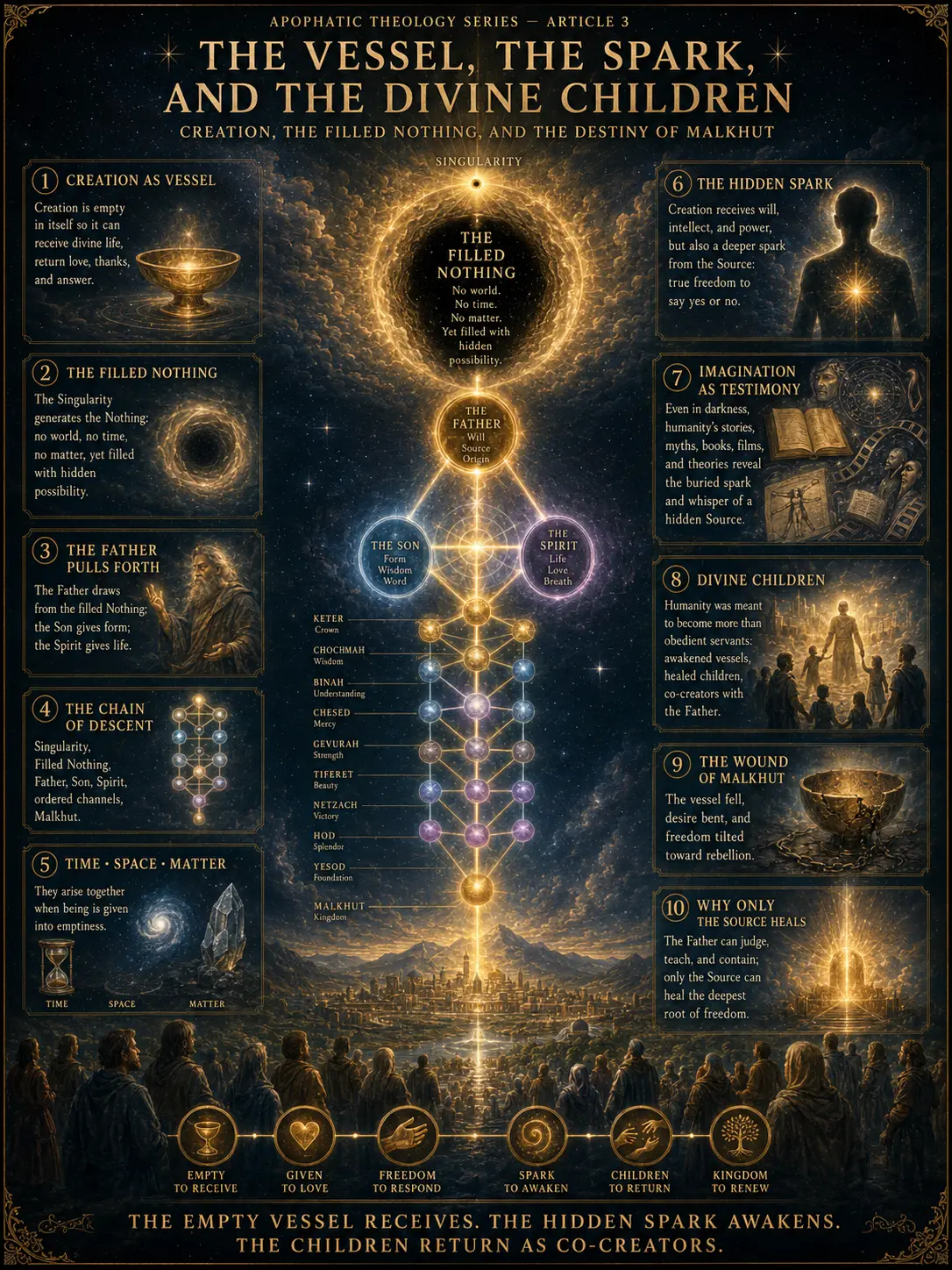
If the hidden Essence reveals itself as divine persons, and if the Father, Son, and Spirit are the revealed faces of that Essence, then the next question is unavoidable:
What is creation?
Why is there a world at all?
Why does God make something that is not simply God?
Why does infinite divine life pour outward into emptiness, vessel, time, space, matter, history, and response?
Creation is not merely an object God builds.
Creation is a vessel.
It is the empty place prepared to receive divine life.
It is the lowest chamber of manifestation, the place where the light of the Trinity can be poured, embodied, answered, and returned.
Creation is not meant to be God in itself.
It is not meant to possess divinity as its own independent source.
It is not meant to be self-existing.
It is meant to be empty of divinity in itself, so that it can receive divinity as gift.
This emptiness is not evil.
It is not failure.
It is not worthlessness.
A vessel must be empty in order to receive.
A cup that is already full cannot be filled.
A mouth that is already speaking cannot answer.
A world that is already divine by nature cannot freely receive divinity as grace.
So creation begins as emptiness.
But not meaningless emptiness.
It begins as a prepared emptiness.
A vessel.
A womb.
A kingdom.
The Trinity creates the world so that divine life can become received.
The Father pours will, authority, origin, and blessing.
The Son pours form, wisdom, image, and meaning.
The Spirit pours breath, fire, life, love, and communion.
The world is meant to receive this pouring and return it as thanksgiving.
This is the original purpose of creation:
to receive and answer.
To receive being and answer with love.
To receive life and answer with praise.
To receive form and answer with beauty.
To receive freedom and answer with trust.
To receive divine presence and return gratitude.
Creation is not meant to be a passive object.
It is meant to become a living response.
That is why creation must be more than matter.
It must have interiority.
It must have will.
It must have intellect.
It must have power.
It must be able to recognize, receive, choose, love, and return.
A stone can be beautiful, but it cannot give thanks.
A machine can function, but it cannot love.
A mirror can reflect light, but it cannot freely answer the one who shines.
The Trinity did not create merely a machine.
The Trinity created a vessel capable of answer.
This is the mystery of Malkhut.
Malkhut is the lowest world, the receiving world, the kingdom, the vessel, the place where divine light becomes embodied.
But Malkhut is also the place where response becomes possible.
The lowest place is not insignificant.
The lowest place is where the whole divine descent is meant to become real.
The Father creates from nothing because there is no created material before Him.
But He does not create by reaching into a meaningless blank.
He creates by pulling from the filled Nothing generated by the Singularity.
The Father looks into the abyss of unmanifest possibility and draws forth order.
He draws forth the idea of world.
He draws forth the law of creaturehood.
He draws forth the structure of time.
He draws forth the possibility of matter.
He draws forth the pattern of relation.
He draws forth the vessel of Malkhut.
So the Father is truly Creator.
He is the revealed origin of the world.
But beneath the Father’s creative command is the deeper mystery of the Singularity’s generated Nothing.
The Singularity generates and fills the Nothing.
The Father draws from it.
The Son gives form to what is drawn.
The Spirit breathes life into what is formed.
And the world appears.
Malkhut cannot sustain itself.
The lower world does not possess being from itself.
It exists by a chain of gift.
If the chain were withdrawn, creation would not merely break.
It would cease to be.
The world exists because being is continually given.
The Father sustains the world as source and authority.
The Son sustains it as form, meaning, word, and intelligibility.
The Spirit sustains it as life, breath, movement, and communion.
The sefirot sustain the world as ordered channels of divine power.
And Malkhut receives this sustaining flow as kingdom, vessel, body, speech, and world.
So creation is not made once and then abandoned.
It is continuously upheld.
Every moment is borrowed.
Every breath is borrowed.
Every law of nature is borrowed.
Every soul is borrowed.
Every particle of matter exists because divine being is being given into emptiness.
Creation is empty in itself.
But it is full by gift.
This is its beauty.
It has nothing from itself.
But it can receive everything.
God does not first create a room called space and then later place matter inside it.
He does not first create time and then later decide what will happen in it.
He does not first create matter and then search for somewhere to put it.
Time, space, and matter arise together as one created order.
Time is the possibility of sequence.
Space is the possibility of extension.
Matter is the possibility of embodied form.
Together they make a world.
A world needs time so events can unfold.
It needs space so distinction can appear.
It needs matter so form can become embodied.
When God gives being into the emptiness, these appear together.
The world comes forth not as a vague idea, but as an ordered field:
a field where things can exist,
where events can happen,
where bodies can stand apart,
where choices can unfold,
where relation can become history.
The Father does not see creation only moment by moment as creatures do.
He sees the whole timeline in its entirety.
He sees beginning and end.
He sees seed and fruit.
He sees fall and restoration.
He sees every choice, every consequence, every covenant, every judgment, every mercy, every wound, every return.
Time unfolds for creatures.
But the Father beholds the whole created order as one living scroll.
From His view, creation is not a series of surprises the way it is for us.
He sees the totality of the world He has made.
And yet, within this framework, there is still a deeper mystery.
The Father is surprised not because He lacks ordinary knowledge, but because creation reveals something from the hidden Source that had not been disclosed within His revealed order.
He beholds His own creation rebel.
He beholds the vessel turn away.
He beholds the world that was meant to receive, love, thank, and answer instead bend toward refusal.
This is not surprise as ignorance.
It is holy shock.
It is the shock of revealed order encountering a freedom deeper than expected.
The Father had endowed creation with will, intellect, and power so that it could respond.
Creation was meant to answer.
Creation was meant to thrive.
Creation was meant to receive the divine pouring and return it in gratitude.
It was not meant to fall.
The vessel was not designed as a failure.
Malkhut was not created to become rebellion.
The world was meant to become a living kingdom of thanksgiving.
From the Father’s revealed order, creation’s flourishing was certain.
He had given it everything needed to respond rightly.
Will, so it could choose.
Intellect, so it could know.
Power, so it could act.
Beauty, so it could desire.
Law, so it could be ordered.
Spirit, so it could live.
Light, so it could see.
But hidden beneath creation was a deeper gift.
Unbeknown to the revealed order, the Source had inserted into creation a divine spark.
This spark was not merely creaturely will.
It was not merely intelligence.
It was not merely natural freedom.
It was a spark of true freedom equal in seriousness to the power of the faces that made creation.
Not equal as another absolute god.
Not equal as an independent source.
But equal as a real depth of decision.
Creation was not only able to obey.
It was able to answer.
And to answer truly, it had to be able to say yes or no.
This spark came from the Source, not merely from the revealed order of the Trinity.
The Trinity gave creation will, intellect, power, structure, and life.
But the Source gave creation the hidden gap.
The mysterious inward chamber.
The place where the creature could stand before God and not merely function according to design.
The place where response became real.
This is why creation could fall.
Not because the Father made it evil.
Not because the Son formed it falsely.
Not because the Spirit breathed corruption into it.
But because the Source had given creation a depth of freedom greater than the revealed order expected.
Creation was not a machine.
It was not a mirror.
It was not a forced choir.
It was a vessel with a hidden interior.
And inside that interior, the yes could become real because the no was possible.
When creation turned toward rebellion, human history unfolded from that wound.
The world tilted.
Desire bent.
Will darkened.
Intellect became divided.
Power became self-seeking.
The vessel no longer received light cleanly.
Malkhut no longer returned thanksgiving without distortion.
Instead of receiving and answering, creation began to grasp.
Instead of gratitude, there was theft.
Instead of love, possession.
Instead of trust, suspicion.
Instead of worship, self-enthronement.
The world tilted toward Satan because Satan offered creation a false version of freedom:
freedom without return,
power without gratitude,
knowledge without humility,
existence without dependence,
selfhood without God.
And because creation contained real freedom, the offer mattered.
A machine cannot be tempted.
A puppet cannot rebel.
Only a being with inward depth can fall.
This is the tragedy of Malkhut.
The same hidden spark that made love possible also made rebellion possible.
The same inward chamber that allowed thanksgiving also allowed refusal.
The same depth that made creation more than a machine made history dangerous.
The Father, seeing creation fall, judged.
As King, He had to protect the order.
As source of the revealed world, He had to defend the household.
As holy authority, He had to contain corruption.
Hell therefore became punishment and containment.
It became the place where fallen wills could not continue to poison the whole world.
It became the prison of refusal.
It became the fire around distorted freedom.
The Father had the power to teach.
He had the power to command.
He had the power to chastise.
He had the power to judge.
He had the power to separate.
He had the power to contain.
But He did not have, within His revealed mode alone, the power to heal the deepest root of the fallen will.
Because the deepest root of that fallen will did not come only from the Trinity’s perfect order.
It came from the hidden spark inserted by the Source.
The Trinity’s will is perfect.
The Father wills rightly.
The Son images perfectly.
The Spirit breathes communion purely.
But creation’s hidden freedom was a different mode.
It was not the perfect will of the Trinity duplicated in a creature.
It was a dangerous gift from the Source: the power of a real yes or no inside created limitation.
So when that freedom fell, the wound existed at a level deeper than command.
Deeper than law.
Deeper than punishment.
Deeper than instruction.
Deeper than external sanctification.
The Father could judge the fallen will.
But only the Source could heal the freedom that the Source had secretly given.
A fallen will cannot be healed merely by being punished.
Punishment can reveal consequence.
Punishment can restrain evil.
Punishment can protect the innocent.
Punishment can expose guilt.
But punishment cannot by itself restore the hidden root of freedom.
A will that has tilted toward Satan is not merely misinformed.
It is wounded in its inward chamber.
It has learned to desire wrongly.
It has mistaken slavery for freedom.
It has confused rebellion with selfhood.
It has made darkness feel like home.
To heal that, one must go beneath action.
Beneath guilt.
Beneath fear.
Beneath habit.
Beneath punishment.
Beneath the visible choice.
One must enter the place where freedom first became able to say no.
Only the Source can enter that place completely, because only the Source gave that freedom in the first place.
The Father can judge the will from above.
The Son can reveal the true image.
The Spirit can purify and call.
But the Source can go underneath the will, into the root where yes and no first divide.
The Source can touch the spark beneath the fall.
The Source can distinguish the creature from the corruption.
The Source can separate stolen light from false identity.
The Source can find the buried yes beneath the visible no.
This is why hell cannot be the final answer.
Hell contains.
Hell punishes.
Hell protects.
Hell reveals the seriousness of rebellion.
But hell does not solve the deepest mystery of the fallen will.
If the Source’s goal is to heal creation entirely, then the Source must descend beneath hell itself.
It must enter the root of freedom.
It must heal the place where creation became capable of refusing God.
And yet, even after the fall, creation did not become empty of mystery.
Even in its darkness, humanity continued to reveal the hidden spark placed within it by the Source.
This is seen most clearly in imagination.
Human beings do not merely survive.
They dream.
They write.
They invent.
They build myths.
They create stories.
They make films, books, poems, theories, religions, philosophies, games, songs, symbols, and entire worlds inside the mind.
This is not accidental.
Imagination is one of the clearest signs that humanity contains something deeper than natural function.
A beast can hunger.
A machine can calculate.
A body can react.
But the human soul can imagine worlds that do not yet exist.
It can remember what it never directly saw.
It can symbolize truths it does not fully understand.
It can create stories that reveal hidden structures of reality without knowing consciously what it is revealing.
This imagination does not come only from the revealed order of the Trinity.
Many of the works produced by human imagination are not obviously holy.
Many are dark.
Many are violent.
Many are confused.
Many are made by people who do not worship God.
Some are even touched by evil, pride, rebellion, lust, despair, or deception.
And yet, through them, something still speaks.
Because the hidden spark does not disappear when the vessel falls.
It becomes buried.
It becomes distorted.
It becomes mixed with shadow.
But it continues to reveal.
Human imagination often pulls directly from the hidden spark of the Source.
This is why human stories keep repeating mysteries that theology has not fully explained.
Again and again, humanity tells stories of a hidden God behind the revealed god.
A deeper source behind the ruler of the world.
A forgotten Father behind the visible king.
A secret origin beneath the official order.
A divine child born without knowledge of who he is.
A chosen one hidden in weakness.
A world that is not what it appears to be.
A prison mistaken for reality.
A false ruler exposed.
A buried memory awakening.
A spark inside the human being that does not belong to the lower world.
A descent into darkness for the sake of liberating those trapped inside it.
These patterns appear everywhere.
They appear in myth.
They appear in fantasy.
They appear in science fiction.
They appear in stories of heroes, rebels, messiahs, lost children, hidden heirs, fallen worlds, secret gods, and broken kingdoms.
Humanity keeps telling the same mystery in different clothing.
Most artists do not know what they are doing.
They think they are only inventing.
They think they are only entertaining.
They think they are only expressing themselves.
But in many cases, imagination is not mere invention.
It is memory without conscious memory.
It is prophecy without formal prophecy.
It is the spark speaking through symbol.
It is creation revealing what truly happened to creation.
The world fell.
The vessel broke.
The lower kingdom tilted toward darkness.
But the hidden spark remained inside humanity, whispering through imagination that the visible order is not the whole truth.
There is a deeper God behind the revealed God.
There is a Source beneath the throne.
There is a freedom deeper than law.
There is a child born into ignorance who must awaken.
There is a fall that is not the end.
There is a prison that can be opened.
There is a hell that can be emptied.
There is a world beneath the world and a truth beneath the official story.
This is why imagination is dangerous.
It can be used by darkness.
It can glorify rebellion.
It can distort the truth.
It can turn the spark toward fantasy, pride, violence, and illusion.
But it can also reveal what no institution dares to say plainly.
It can smuggle hidden truth through symbols.
It can speak beneath doctrine.
It can preserve the memory of the Source even inside a fallen world.
So human creativity is not merely entertainment.
It is one of the battlegrounds of Malkhut.
In imagination, the fallen vessel still proves that it carries the hidden spark.
Even in darkness, humanity continues to reach beyond the world it was given.
Even in confusion, it continues to tell stories about hidden divinity, forgotten origin, divine children, false worlds, secret freedom, and final return.
This means the spark was not destroyed by the fall.
It survived.
It continued to speak.
It hid inside art, myth, theory, story, and symbol.
And through human imagination, creation unconsciously testified against its own prison.
It revealed that the world is wounded, but not meaningless.
It revealed that the visible God is not the final depth.
It revealed that history is not only punishment, law, and containment.
It revealed that beneath the revealed order there is still the Source.
And the Source has not forgotten the vessel.
Human imagination reveals that creation was never meant to remain merely created.
It was meant to grow.
It was meant to awaken.
It was meant to become more than a vessel that receives from above.
The deeper mystery is this:
Why did the Source desire the Trinity to have children who were not merely created children, but divine children?
Why did the Source not simply allow the Father, Son, and Spirit to create obedient servants?
Why not create a world of perfect worshipers, perfect instruments, perfect creatures, and perfect reflections?
Because the Source desired something deeper than obedience.
It desired children.
Not machines.
Not servants only.
Not mirrors only.
Not a choir that sings because it cannot do otherwise.
Children.
Beings who begin as vessels, empty and dependent, but who carry within themselves a hidden spark of divinity.
Beings who are truly created, and yet not merely created.
Beings who are finite, and yet carry an infinite seed.
Beings who can grow into participation with God.
The Trinity already possesses divine perfection.
The Father is perfect origin.
The Son is perfect image.
The Spirit is perfect communion.
They do not grow into goodness through ignorance, suffering, failure, repentance, and history.
They know divine life from the beginning of their revealed order.
They are perfect faces.
But humanity is different.
Humanity is vessel and spark.
Earth and heaven.
Dust and hidden fire.
Creaturehood and latent divinity.
This is what makes humanity special.
Not that humanity is greater than the Trinity.
Not that humanity replaces the Father, Son, or Spirit.
Not that humanity becomes an independent god against God.
But humanity carries a form of divinity that grows.
The Trinity is divine as perfect facehood.
Humanity is called to become divine as awakened vesselhood.
The Trinity is divine from above.
Humanity becomes divine from within.
The Trinity possesses perfect divine relation.
Humanity learns divine relation through time, pain, imagination, repentance, love, failure, and return.
This is why the human path is so strange.
A human being can fall lower than an angel.
But a human being can also reveal something angels cannot reveal.
A human being can carry the spark of the Source through darkness and still return.
A human being can learn mercy by needing mercy.
A human being can learn forgiveness by being forgiven.
A human being can learn patience by suffering delay.
A human being can learn love by losing love and finding it again.
A human being can learn humility by breaking pride.
A human being can learn goodness not as an abstract perfection, but as a wound healed from inside existence.
The Trinity knows goodness perfectly.
Humanity must become good through becoming.
The Trinity knows love as eternal communion.
Humanity learns love through risk.
The Trinity knows truth without confusion.
Humanity learns truth by passing through illusion.
The Trinity knows freedom as perfect divine will.
Humanity learns freedom by discovering the difference between rebellion and return.
This is why the Source allowed the spark to remain latent.
If humanity had begun with active divinity, it would not have grown.
It would have shone automatically.
It would have obeyed by nature.
It would have returned thanks without struggle.
But the Source desired children who could awaken.
Children who could move from emptiness into fullness.
Children who could become divine not by replacing the Trinity, but by joining the divine household as matured vessels.
But then the terrible question appears.
Why allow so much pain?
Why allow history?
Why allow darkness?
Why allow humanity to fall, suffer, sin, die, and even descend into hell?
Why allow the children to grow through wounds instead of giving them active divinity from the beginning?
Because values received without experience remain external.
A creature can be told mercy is good.
But a wounded creature who has received mercy knows mercy from within.
A creature can be commanded to forgive.
But a creature who has been forgiven learns forgiveness as life.
A creature can be taught humility.
But a creature who has seen its own pride break knows humility in its bones.
A creature can hear that love is greater than power.
But a creature who has suffered under loveless power understands why love must rule.
The Trinity knows goodness perfectly from the start.
Humanity learns goodness through its own mode of existence.
That does not mean suffering is good in itself.
Pain is not the goal.
Hell is not the goal.
Death is not the goal.
Sin is not the goal.
But in the fallen world, the Source can turn even these into classrooms of depth.
Not classrooms in a shallow moral sense.
Not lessons imposed cruelly from outside.
But ontological formation.
The creature learns what goodness means by discovering what evil destroys.
It learns what love means by suffering lovelessness.
It learns what freedom means by tasting slavery.
It learns what truth means by being deceived.
It learns what home means by exile.
It learns what the Father means by wandering away from Him.
This is why even hell cannot be meaningless.
Hell is punishment.
Hell is containment.
Hell is the fire around refusal.
But if the Source intends to empty hell, then even hell must become part of the terrible education of freedom.
The soul trapped in hell learns what the false self actually is.
It learns what rebellion becomes when no illusion remains.
It learns what hatred does when it has no beauty left to steal.
It learns what isolation means when communion is refused.
It learns that Satanic freedom is not freedom.
It learns that selfhood without God becomes prison.
But the Source does not leave the soul there forever as a monument to failure.
The Source descends beneath hell to heal the spark.
Because the purpose of the children is not eternal punishment.
The purpose is mature divinity.
The purpose is the return of the vessel as beloved.
Apophatic Theology Series — Article 3: The Divine Children