
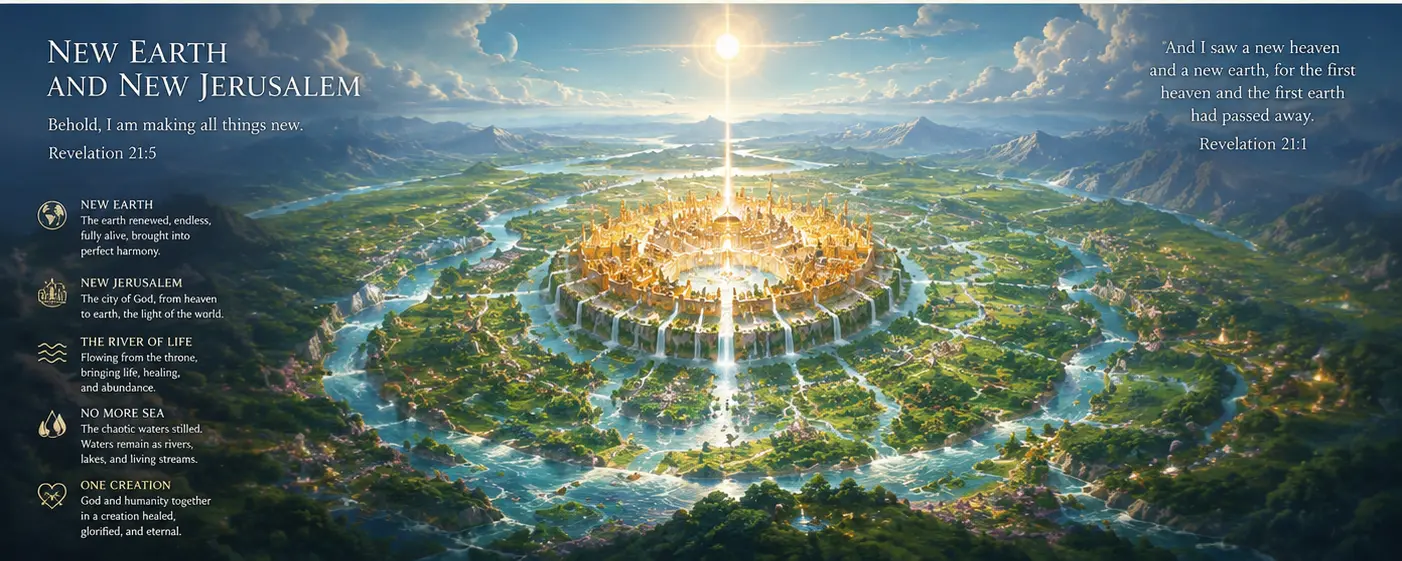
The Bible says, “The earth remains forever” (Eccl 1:4), and yet Scripture also declares, “I saw a new heaven and a new earth, for the first heaven and the first earth had passed away” (Rev 21:1). These are not enemies. They reveal the same mystery from two sides: the earth remains in covenantal identity, but its fallen form passes away.
God is not discarding the earth as a failed experiment. This is the world where Adam was formed from dust, where Israel carried covenant, where the Son became flesh, where blood was shed, where resurrection began, and where the Kingdom must be vindicated. The earth has an eternal vocation. It is not trash to be thrown away. It is Malkuth, the lowest world, destined to become the dwelling place of God.
Yet the earth cannot remain as it is. The present earth is under curse, death, bloodshed, exile, corruption, and chaos. That form must pass away. The “first earth” passes not because creation is rejected, but because creation is resurrected. The New Earth is this earth judged, purified, expanded, glorified, and made endless.
The best image is the resurrection body of Christ. Jesus did not rise as a different unrelated person. The body that died was the body that rose. Yet it was no longer bound by mortality. So also the earth: the same earth in identity, but transfigured beyond decay.
This is why New Jerusalem descends. John does not see the saints escaping creation forever. He sees “the holy city, New Jerusalem, coming down out of heaven from God, prepared as a bride adorned for her husband” (Rev 21:2). Heaven comes down. God does not abandon earth; He marries heaven to earth. The city descends not to crush the world, but to crown it.
New Jerusalem is therefore not merely a giant object sitting on old soil. She is the earth’s glorified heart, face, temple, and bridal form. She becomes one with the surface of the renewed earth. The land itself becomes city-like, temple-like, luminous, inhabited by God. The whole earth is Jerusalemized.
In Kabbalistic language, this is the redemption of Malkuth. Malkuth is the kingdom, the lowest sefirah, the place of embodiment, earth, receptivity, and manifestation. In the old world, Malkuth is exiled, wounded, hidden, and separated from the upper light. In the New Earth, Malkuth is restored and crowned. The Shekinah no longer dwells in a tent, temple, or partial vessel only. The entire earth becomes Shekinah-bearing. The lowest world is lifted into open union with the highest.
This is why the sun and moon are no longer needed. Revelation says, “The city has no need of sun or moon to shine on it, for the glory of God gives it light, and its lamp is the Lamb” (Rev 21:23). Isaiah had already prophesied, “The sun shall be no more your light by day, nor for brightness shall the moon give you light; but the LORD will be your everlasting light” (Isa 60:19).
This does not mean light disappears. It means mediated light is surpassed by immediate divine illumination. In the old creation, the sun and moon rule day and night. They measure time, seasons, distance, and limitation. They are good, but they are indirect. They shine from outside.
In New Jerusalem, light comes from within the divine dwelling itself. God’s glory is not merely above creation; it fills creation. The Lamb is the lamp. The Son is the visible radiance by which the city sees. The Father is the source of glory. The Spirit fills the atmosphere with living presence. Creation no longer depends on external celestial rulers to receive light, because the divine presence has become its inner illumination.
Kabbalistically, this means Malkuth no longer receives light only by distance, reflection, and partial mediation. The moonlike kingdom is no longer merely reflecting from below. She is filled. The lower world becomes transparent to the upper world. The old separation between heaven and earth is healed.
So what is God doing if this is not creation ex nihilo?
He is not creating an entirely unrelated earth from nothing while throwing away the old one. He is doing something even more glorious: resurrection, transfiguration, purification, and expansion. Creation ex nihilo is the first granting of standing. The New Earth is not that. The earth already stands. God does not need to create its identity from nothing again. He re-determines its condition.
He removes the curse.
He burns away corruption.
He judges the false form.
He heals the wounded body.
He expands its capacity.
He fills it with glory.
He unites it with New Jerusalem.
He makes it able to bear God openly.
This is not replacement.
It is glorification.
The sea is no more (Rev 21:1), not because water is evil, but because the old symbol of chaos, abyss, death, and separation is gone. The earth is no longer divided by chaotic depths. The nations no longer rage like waters. The boundary between heaven and earth no longer stands as exile. The world has become stable habitation.
The final picture is bold: the earth remains forever, but not as the old earth. It remains as resurrected earth. New Jerusalem descends and becomes one with it. The surface of creation becomes the floor of God’s house. The city is the bride, the earth is the body-field, and divine glory is the light.
God does not abandon matter.
He crowns it.
He does not erase Malkuth.
He enthrones her.
He does not replace the earth with a stranger-world.
He takes this earth, judges it, heals it, expands it, fills it, and makes it the eternal dwelling of His glory.