Within the profound metaphysical framework of Lurianic Kabbalah, the creation of reality is not described as a spontaneous, magical occurrence. Instead, it is a highly structured, ontological process governed by strict laws of cosmic physics, geometry, and intent. At the center of this process is the formation of the Sefirot—the fundamental vessels, or metaphysical channels, through which infinite light is filtered to create and sustain finite existence.
Far from being pre-existing containers waiting to be filled, the Sefirot were forged out of nothingness through a dynamic, precise collision of forces. To understand the Tree of Life is to understand the existential crisis of the void, the geometric structures of light, and the ultimate purpose of limitation.
Here is the complete, step-by-step metaphysical architecture detailing how the Sefirot were formed, organized, and ignited.
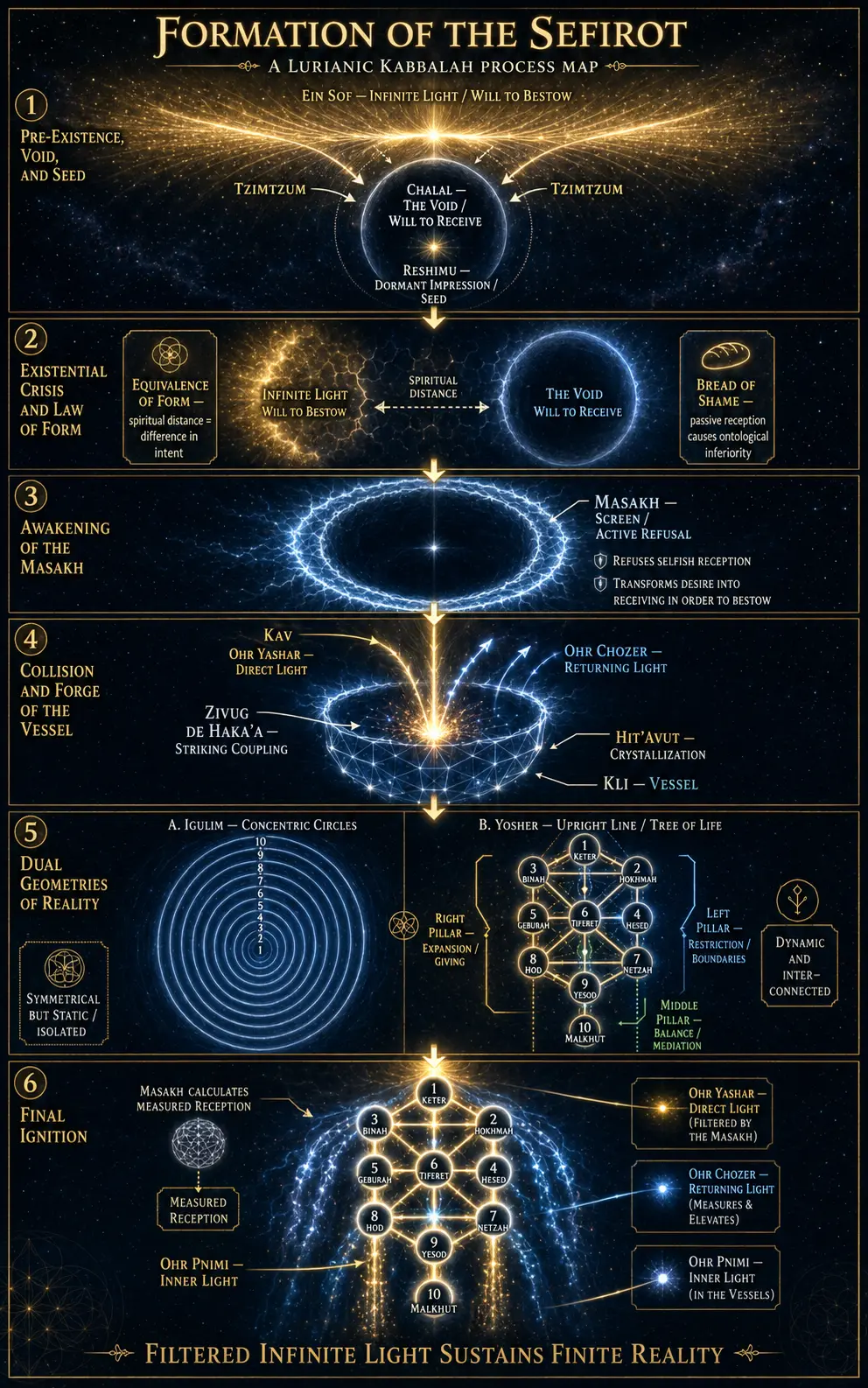
Phase 1: The Pre-Existence, the Void, and the Seed
Before the existence of space, time, or structure, reality consisted solely of a boundless, unified presence.
The Ein Sof (The Infinite)
The overarching reality before creation was the Ein Sof (Infinite Light). The Ein Sof is perfectly unified and defined by an absolute, singular property: the Will to Bestow (the infinite desire to give). However, because infinity leaves no conceptual room for a finite creation to exist, the Infinite had to carve out a space.
The Tzimtzum (The Contraction)
To make room for a reality independent of itself, the Ein Sof initiated the first act of creation through a deliberate withdrawal. It contracted its infinite light symmetrically away from a singular conceptual Center Point (Nekudah ha-Emtza'it).
The Chalal (The Void)
This symmetrical withdrawal created a spherical, conceptual vacuum called the Chalal (Void). Because the light of the Infinite (which desires to give) had departed, the fundamental ontological nature left behind in the void was a pure Will to Receive—an absolute, unquenchable desire to draw the infinite light back in.
The Reshimu (The Impression)
The Infinite did not abandon the void entirely. When it withdrew, it left behind a faint, dormant trace of its light, much like the lingering scent in an emptied wine glass. This residue is the Reshimu (The Impression). It served as the latent "seed" or blueprint for all future structures, waiting to be activated.
Phase 2: The Existential Crisis and the Law of Form
With the void established, a catastrophic metaphysical problem arose. If the infinite light were to simply flood back into the void, the void would instantly collapse back into the Infinite, nullifying any independent creation. To survive, the void had to navigate strict spiritual laws.
Equivalence of Form (Hishtavut HaTzura)
In physical space, distance is measured in miles. In this metaphysical framework, distance is measured entirely by a difference in intent or properties. The Ein Sof is the absolute "Will to Bestow." The void is the absolute "Will to Receive." Because these intents are diametric opposites, they are infinitely alienated from one another. For finite creation to exist in connection with the Infinite, it must bridge this gap by acquiring the property of giving.
The Bread of Shame (Nahama de-Kisufa)
If the void passively allowed the infinite light to re-enter simply because it desired it, it would act as a mere "black hole." Kabbalistic physics dictates that receiving an unearned, free gift creates a profound sense of ontological inferiority and shame, termed the Bread of Shame. A passive receiver remains fundamentally broken and alienated from the perfection of the Creator.
Phase 3: The Awakening of the Masakh (The Screen)
To escape the Bread of Shame and achieve Equivalence of Form, the latent vessel within the void had to stop acting like a passive receiver. It had to become a giver. But how can an empty void give anything to an Infinite source that lacks nothing? It does so through the ultimate assertion of willpower.
The Active Refusal
Recognizing that pure, selfish reception would lead to spiritual death, the void "awakened." It consciously chose to restrict its own base desire. It established a structural boundary known as the Masakh (Screen).
The Purpose of the Masakh
The Masakh is an active, militant force of resistance. When confronted with the prospect of incoming light, the Masakh declares: "I desire this light infinitely, but I absolutely refuse to receive it for my own selfish sake." By forcefully rejecting the light, the vessel ceases to be passive. This refusal transforms the base, selfish Will to Receive into the elevated, dynamic Will to Receive in Order to Bestow.
Phase 4: The Collision and the Forge of the Vessel
With the void prepared, the seed planted, and the boundary of resistance established, the active process of building the Sefirotic vessels (Kelim) commenced.
The Entry of the Kav
The Ein Sof extended a single, measured beam of light across the void, piercing its outer edge and aiming directly toward the Center Point. This descending vector is the Ohr Yashar (Direct Light).
Zivug de Haka'a (Striking Coupling)
As the Ohr Yashar traveled downward, it slammed into the unyielding resistance of the Masakh. The pure intent of the Infinite to give collided directly with the vessel's absolute refusal to receive.
Ohr Chozer (Returning Light)
Because the Masakh refused to let the direct light pass, the immense pressure of the strike rebounded. The light reversed its vector and reflected upward. This reversed wave is the Ohr Chozer (Returning Light). It surged upward, wrapping around the descending column of light like a protective sheath.
Hit'avut (Crystallization)
The upward-reflecting Ohr Chozer was inherently different from the pure direct light. Because it was born from restriction, resistance, and boundary, it possessed ontological density. As the Returning Light surged upward, its momentum slowed, and it began to condense. The light thickened, its boundaries hardening into a complex geometric shell. This crystallized boundary of restricted light is exactly what constitutes a Vessel (Kli).
Phase 5: The Dual Geometries of Reality
The Ray of Light (Kav) did not build the final Tree of Life immediately. It systematically organized the newly forged vessels into two distinct geometric phases to test their stability.
Phase A: The Igulim (Concentric Circles)
Because the void (Chalal) was a sphere, the initial Sefirot were formed as ten expanding, concentric spheres radiating inward from the edge toward the center.
The Flaw: While perfectly symmetrical, the Igulim were entirely static. Each circle encompassed the next (like layers of an onion), leaving them isolated. There was no "Right," "Left," or "Center," and therefore no dynamic interplay or communication between the vessels.
Phase B: The Yosher (The Upright Line)
To solve the static isolation of the circles, the light reorganized itself into the Yosher—a linear, upright, and highly networked structure.
The Tree of Life: This upright configuration organized the ten Sefirotic vessels into three distinct pillars:
The Right Pillar: Forces of unchecked expansion and giving.
The Left Pillar: Forces of severe restriction and boundaries.
The Middle Pillar: Forces of perfect balance and mediation.
By assembling the vessels into the Yosher (The Tree of Life), the system finally possessed the dynamic, interconnected pathways necessary to sustain complex existence without collapsing under the pressure of the Infinite.
Phase 6: The Final Ignition
Once the structural walls of the vessels were fully crystallized and perfectly networked into the Tree of Life, the final stage of creation occurred.
The Masakh (Screen) mathematically calculated exactly how much light each specific vessel could safely absorb not for its own pleasure, but strictly for the sake of interacting with the Infinite. Based on this calculation, the screen allowed a measured, highly filtered volume of the Direct Light (Ohr Yashar) to slip through the boundary and fill the empty vessel.
This internal, successfully contained light is the Ohr Pnimi (Inner Light).
The Ohr Pnimi is the eternal spark. It continually flows from the Kav, cascades down the balanced pillars of the Tree of Life, and ignites each individual Sefirah. It is this perpetual, carefully restricted flow of light that breathes life into the vessels, sustaining all of finite reality from moment to moment.