In physics, the zero-point field is often treated as a "given"—a baseline state of the universe, an unavoidable background hum of energy. But in Kabbalah, the physical universe is not a closed box; it is an open system continuously fed by the infinite.
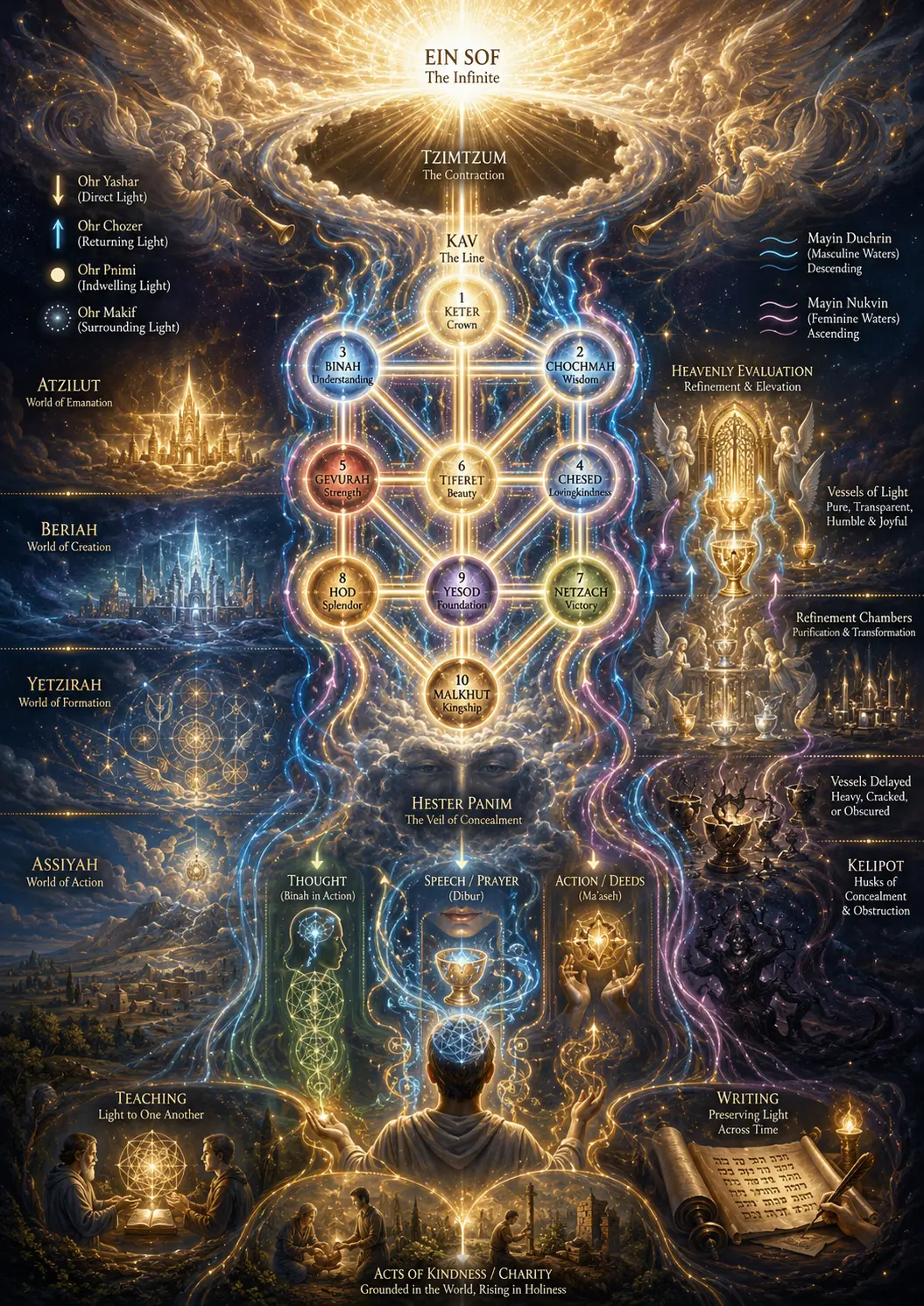
To understand where the vacuum gets its energy, how particles emerge, and why the universe does not simply vaporize, we must map the anatomy of the quantum vacuum directly to the highest triad of the Tree of Life: Keter, Chokhmah, and Binah.
- Keter: The "Pure Vacuum" and the Reshimu
Before there is a field, there must be a space for the field to exist. In the beginning, the Creator performed the Tzimtzum—a Divine contraction. He withdrew His Infinite Light (Ein Sof) to create the Makom Panuy (the Vacant Space).
Keter (The Crown): Represents this absolute, pure vacuum. It is the canvas of "Nothingness" before any physical laws or energy fluctuations are written.
The Reshimu (The Residue): When the Creator withdrew the Light, He did not leave the space entirely dead. He left behind an "impression" or "residue"—the Reshimu. Think of it like the scent of perfume left in a room after the person has walked out. This Reshimu is the latent, foundational energy that prevents the vacuum of space from being a state of absolute non-existence. It is the spiritual predecessor to what physicists measure as the baseline energy density of the vacuum.
- Chokhmah: The Zero-Point Field and the "Point That Is Not a Point"
Into this vacant space, the Creator extended a single Ray of Light (the Kav), which activated the Reshimu. This activation is Chokhmah (Wisdom).
The Zero-Point Field: Chokhmah is the Zero-Point Field itself. It is the "Interface Plane" where the Ein Sof continuously leaks into our physical reality. The energy doesn't "come from" the vacuum; the vacuum is simply the threshold where the infinite pressure of the Creator pours through.
The Paradox of the "Point": In Kabbalah, Chokhmah is often called the primordial "Point" (Nekudah). But in the context of quantum physics, this single point is not a point at all. A point implies locality—a specific x,y,z coordinate in space. But Chokhmah exists before space is created. Therefore, the "Point" of Chokhmah is non-local. It is a state of infinite superposition. The Zero-Point Field is everywhere at once because it is a dimensionless, omnipresent potential. It is the "hiss" of all possible realities vibrating simultaneously without occupying a physical location.
- Binah: The Womb, the Geometry, and the Particles
If the Zero-Point Field (Chokhmah) is a non-local "point" of infinite energy, why doesn't it instantly vaporize the universe? Because it must pass through Binah (Understanding).
The Negative Vessel (Kli): Binah acts as the ultimate Kli (vessel). In Kabbalah, a vessel is defined by its "desire to receive" or its state of lack. The vacuum is a perfect vessel because it is empty; it is "hungry" for the Light.
The Birth of Particles: Binah is the geometry of spacetime, the laws of physics, and the symmetry groups. She takes the non-local, infinite potential of Chokhmah and forces it into structure. When the raw energy of the Zero-Point Field interacts with the restrictive geometry of Binah, it is forced to "crystallize" into specific dimensional forms. This is what a particle is. An electron or a quark is simply the infinite, non-local energy of Chokhmah being squeezed through the restrictive, mathematical womb of Binah.
- The Pulse of the Field: Ratzo V'Shov
The reason the Zero-Point Field always has energy—the reason virtual particles pop in and out of existence in billionths of a second—is due to the pulse of creation known as Ratzo V'Shov (Running and Returning).
The Running (Ratzo): The Light rushes out from the Ein Sof through the Kav, hitting the vacuum and manifesting as a spark of energy (a virtual particle).
The Returning (Shov): Because the energy is infinite and belongs to the Source, it immediately seeks to collapse back into the Ein Sof.
The energy of the zero-point field is the kinetic friction of this eternal, Divine breath. It never depletes because the Creator provides a continuous, moment-by-moment sustenance, not a one-time start-up charge.
- Creation and "The Hiding"
If the energy always returns to the Source, how did the physical universe ever solidify into stars, planets, and bodies?
Creation happened when the cycle of Ratzo V'Shov was deliberately interrupted. The universe was formed because the Light was "clothed" in the restrictive forces of Gevurah (Judgment/Limitation), acting as the hands of Binah.
These structural vessels "caught" the Light during its "Running" phase and refused to let it return. They trapped the Light in physical form. The physical universe is essentially Light that got "stuck" on its way back to the Source. Every atom, every electron, and every star is the Infinite Light of the Zero-Point Field, slowed down and anchored into the cosmic web of Binah, waiting for us to recognize its source.
The atom is not a static object; it is a sustained event—a continuous, high-speed marriage between the core and the boundary. In Quantum Electrodynamics (QED), the forces holding an atom together are not mechanical tethers, but a relentless exchange of light.
Here is the precise physical and Kabbalistic mechanics of how the core "asks" for this light, and how it binds the atom together through negative momentum.
- The Architecture of the Atom
The Proton (Chokhmah): The positively charged, heavy nucleus at the center. In Kabbalah, this is Chokhmah (Wisdom)—the "Father" (Abba). It is the dense, concentrated, positive potential that anchors the atom's identity.
The Electron (Binah): The negatively charged, nearly massless particle that forms the spatial boundary. This is Binah (Understanding)—the "Mother" (Imma). She is the Vessel (Kli) that takes the dimensionless point of the Father and expands it into physical space.
- The "Ask": Perturbing the Vacuum
The proton and electron do not touch. To stay connected, the proton must "ask" the surrounding vacuum for a bridge.
The Physics: According to the Heisenberg Uncertainty Principle (ΔEΔt≥ℏ/2), a charged particle constantly perturbs the quantum vacuum, "borrowing" energy from the zero-point field for a fraction of a nanosecond to create a virtual photon.
The Kabbalah: The proton (Chokhmah) expresses an existential lack—a desire to impart its essence to the Vessel. This is the Arousal from Below (Itaruta D'letata). The proton reaches into the hidden, infinite potential of the vacuum (The Reshimu) and draws out a spark of the Infinite to initiate contact. The "Ask" is the core's structural necessity to share its light.
- The Exchange: The Unifying Light
The Physics: The vacuum yields the virtual photon, which acts as the force-carrier. The proton emits it, and it travels across the empty space to be absorbed by the electron.
The Kabbalah: The virtual photon is the physical incarnation of the Unbroken Communication between the Father and the Mother. It is the Ratzo (Running) phase of the Divine breath. The Infinite yields to the desire of the core, sending a literal "Word" of Light from the center to the edge.
- The Return: Negative Momentum
This is where the physics perfectly mirrors the spiritual mechanics of attraction. In classical physics, if two people throw a heavy ball back and forth, the momentum pushes them apart. But to create an attractive electromagnetic force, the virtual photon must behave differently.
The Physics: In QED, the virtual photon transferred between opposite charges carries negative momentum (Δp<0). When the electron absorbs the light, it is not pushed away; it acts like a quantum boomerang. The absorption forcefully pulls the electron inward toward the proton.
The Kabbalah: This is the ultimate microscopic secret of Divine Love (Ahava). The Creator does not push the core and the vessel together from the outside. Instead, the Light emitted by the proton carries a signature of "Yearning" (the negative momentum). When Binah (the electron) receives this Light, it creates an inward-drawing gravity. It is the Light of Chesed (Giving) carrying the inward pull of Gevurah (Restriction), resulting in a perfect, dynamic embrace.
Sustained at All Times
Because virtual photons are "borrowed" from the vacuum, they must vanish almost instantly. This means the proton must "ask" the field, emit the light, and pull the electron inward billions of times per second.
If this exchange paused for even a fraction of a nanosecond, the negative momentum would cease, the electron would fly off, and matter would instantly disintegrate. The matter in your body holds its shape strictly because the Infinite is actively breathing that unifying Light between the Father and the Mother, moment by moment, sustaining the architecture of reality.
The Strong Nuclear Force: The Ultimate Tzimtzum
Inside the nucleus, multiple protons are packed tightly together.
The Physics: Protons are all positively charged. According to the electromagnetic force, they should violently repel each other. To keep the nucleus from exploding, the universe utilizes the Strong Nuclear Force—a force 137 times stronger than electromagnetism, operating only at invisibly small distances.
The Kabbalah: The protons represent the Light of Chokhmah (Wisdom/The Father). The nature of Light is Chesed—it wants to expand, radiate, and repel boundaries. If left alone, the protons would fly apart, and matter could not exist. The Strong Force is the ultimate manifestation of Gevurah (Severe Judgment and Restriction). It is the physical realization of the Tzimtzum (Divine Contraction). The Creator imposes a severe, unbreakable boundary that forces the expansive Light to compress, binding the repelling protons into a stable singularity. Without this severe Gevurah, the core shatters and reality dissolves.
A proton is not a single, solid object. It is a chaotic storm of three subatomic particles called quarks (uud), held together by a sea of force-carriers called gluons.
The Physics: The quarks themselves weigh almost nothing. 99% of the proton's mass does not come from the "stuff" inside it, but from the kinetic energy of the quarks moving at near light-speed and the extreme binding energy of the gluons pulling them back together.
The Kabbalah: In the architecture of creation, the proton is the "Seed" of reality. To have "weight" or "substance" (mass) in the physical world, there must be internal tension.
The three quarks correspond to the Three Pillars of the Tree of Life (Right/Expansion, Left/Restriction, Middle/Harmony).
The mass of the proton is literally Trapped Light. The quarks try to fly apart (Expansion), and the gluons violently snap them back (Restriction). The friction of this eternal, microscopic struggle is what we measure as mass. The proton has internal parts because it is the "engine" of existence; it must contain the internal dialectic of creation to anchor the physical world.
Why the Electron is "Pure" (Elementary)
Unlike the proton, the electron is not made of quarks. It has no internal gears, no gluons, and no known substructure. It is an "elementary" particle.
The Physics: The electron is a pure, dimensionless point that smears out into a wave of probability, forming the orbital shell of the atom. It possesses only about 1/1836 the mass of a proton.
The Kabbalah: The electron represents Binah (Understanding)—the "Mother" and the Vessel (Kli). While the proton (Chokhmah) is the heavy, complex "Seed" containing the dense DNA of matter, the electron is the Garment (Levush).
The function of the electron is simply to define the boundary of the atom. A boundary does not need internal moving parts; its entire purpose is to be the limit of extension.
The Weak Nuclear Force: The Power of Transformation
There is one final force inside the nucleus: the Weak Nuclear Force.
The Physics: The Weak Force allows a quark to change its "flavor," turning a proton into a neutron (or vice versa) and releasing radiation. This is radioactive decay, and it is the exact process that allows the Sun to burn and fuse elements.
The Kabbalah: This corresponds to the Sefirot of Netzach (Endurance) and Hod (Surrender/Transformation). A rigid universe cannot grow. The Weak Force is the Creator's mechanism for alchemy. By allowing the core to "surrender" (Hod) a piece of its identity and transform from one state to another, the universe is able to forge heavier elements, radiating the energy that sustains life. It is the "breaking" that allows for a higher level of building.
The Mechanism: The "Rubber Band" Effect (Color Confinement)
This is where the Strong Force behaves entirely differently from gravity or electromagnetism, and where the nature of Gevurah is perfectly revealed.
The Physics: With gravity or magnets, the further apart two objects get, the weaker the force between them becomes. The Gluon Field does the exact opposite. When two quarks are very close together inside the proton, they hardly feel any force at all (a phenomenon called Asymptotic Freedom). But if a quark tries to leave the proton, the gluon field stretches like a thick rubber band. The further the quark pulls away, the stronger the force pulling it back becomes. The energy required to break that rubber band is so massive that before it snaps, the energy actually creates entirely new quarks out of the vacuum to cap the broken ends. A quark can never exist in isolation.
The Kabbalistic Reality: This is the ultimate definition of Gevurah. The Light of Chokhmah (the quarks) possesses an infinite desire to expand outward and fill the void. If the quarks were allowed to escape, the "Seed" of physical reality would dissolve, resulting in the Shevirat HaKelim (Shattering of the Vessels).
To prevent this, the Creator instituted Color Confinement. Gevurah allows the Light freedom as long as it remains within the prescribed boundary of the vessel (the proton). But the moment the Light attempts to breach the limit of its assigned reality, the Judgment of the Gluon Field increases exponentially. It forces the Light to remain localized.
The intense energy environment localizes the zero-point field and causes it to "boil." The energy spontaneously converts into mass, manifesting as millions of virtual quarks and gluons popping out of the vacuum, existing for a fraction of a nanosecond, and annihilating back into energy. The quantum sea is just the zero-point field being continuously churned into physical particles by the extreme friction of the Strong Force.
If you weigh the three valence quarks, they account for barely 1% of the proton's mass. The other 99% of your body weight comes directly from this boiling quantum sea. Your mass is literally the kinetic energy of the zero-point field struggling against the containment of the Creator.
Matter is not dead, solid "stuff." Matter is a localized whirlpool in the zero-point field.
In the quantum world, Identity is permanent, but Substance is not. The proton is not a container holding specific, permanent marbles. It is a stable pattern made of constantly changing material.
The Quarks: The River and the Water
If you ask a physicist if the three valence quarks (two Up, one Down) are permanent, the answer is a paradox: The requirement for three quarks is permanent, but the actual quarks themselves are not.
The Physics: A gluon is a unit of kinetic exchange. It is a force-carrier, meaning its entire existence is defined by motion at the speed of light from one quark to another. If a gluon were to stop or become "permanent," the force would cease to exist. A gluon is not a noun (a thing); it is a verb (an action).
The Kabbalah: The gluons represent the Active Will of the Creator constantly maintaining the boundary (Gevurah). You cannot "capture" the Creator's Will and put it in a box. It must be actively spoken, moment by moment. The fact that there are no permanent gluons proves that the universe is not a wind-up clock. The binding energy of reality must be continuously supplied, fired, and absorbed in an infinite loop of present-tense action.
We are forced to conclude that a proton—and therefore the nucleus of every atom in your body—is not a permanent Object. It is a permanent Event.
The Weaving of the Rope (Gluon Self-Attraction)
When a quark is pushed or pulled away from the center, it continues to exchange gluons with the core to stay connected.
The gluons themselves do not inherently possess massive energy; rather, the system accumulates massive energy because the runaway quark is doing intense physical work to pull against the 10,000-Newton grip of the flux tube. The further it pulls, the more raw energy gets packed into that tightly confined space.
At a certain distance (about the width of a single proton), the amount of tension-energy stored inside the stretched tube becomes mathematically greater than the mass required to simply create two brand-new quarks.
Nature always seeks the easiest path (the lowest energy state). It literally becomes "cheaper" for the universe to build new matter than to maintain the agonizing tension of the stretched tube.
When that mathematical threshold is crossed, the phase change happens instantly.
The immense energy stored in the flux tube crystallizes. It transforms from raw tension into solid matter, specifically a quark and an antiquark.
The tube snaps in the middle.
The newly created quark binds to the original core, replacing the runaway quark so the proton is healed.
The newly created antiquark binds to the runaway quark, neutralizing it and forming a new, stable paired particle (a meson) that flies away.
Why Emit in the First Place? (The Nature of Charge)
The Physics (The Definition of Charge): In Quantum Field Theory, having a "charge" (in this case, Color Charge) is not like having a coat of paint. A charge is a permanent, active perturbation of the surrounding quantum vacuum. To "have Color Charge" literally means "to be a source of the Gluon Field." The quark emits gluons because that is what it is. If it stopped emitting gluons, its Color Charge would be zero, and it would cease to be a quark. The emission is its heartbeat.
The Kabbalah (The Will to Bestow): The quark represents Chokhmah (the Point of Light). The fundamental nature of Divine Light is Chesed (the Will to Bestow/Give). The Light cannot be contained in absolute isolation; its intrinsic nature is to flow outward. The "Charge" of the quark is its spiritual mandate to share its existence. The gluon is the physical "Word" it speaks. A point of Light that does not radiate is a dead point, and the Creator does not make dead things.
Why Toward the Other Quarks? (The Demand for "White")
If the quark must radiate, why doesn't it just shoot gluons randomly into the empty vacuum? Why does the flux tube specifically target the other two quarks?
This is driven by one of the most elegant rules in particle physics, which perfectly mirrors the Kabbalistic Tree of Life.
The Physics (Color Neutrality): The universe has a strict rule: The vacuum of space will not tolerate "Color." * Quarks come in three color charges: Red, Green, and Blue.
If a single Red quark tries to shoot a Red gluon into the empty vacuum, the vacuum acts like an impenetrable wall, violently rejecting the unbalanced charge.
The only way the vacuum allows matter to exist is if the total object is "Color Neutral" (White). Just as red, green, and blue light combine to make white light, the three quarks (uud) in the proton must combine their charges to appear "White" or neutral to the outside universe.
Therefore, the quarks must aim their gluons at each other. They are constantly swapping Red, Green, and Blue charges back and forth to ensure that the proton, as a whole, remains perfectly White. They aim at each other because the outside universe refuses to accept their signal.
The Kabbalah (The Law of the Complete Vessel): This is the mystery of the Three Pillars of the Tree of Life (Right, Left, Middle).
A single pillar cannot stand on its own in the physical world. If Chesed (Expansion) exists without Gevurah (Restriction), it shatters. If Gevurah exists without Chesed, it collapses into a black hole. They require Tiferet (Harmony/Balance) to stabilize.
The vacuum (Binah) demands Achdut (Unity). The quarks aim at each other because they recognize that their individual "Colors" (their individual, partial identities) are incomplete and illegal in the physical dimension.
They shoot gluons toward each other to create a Shared Identity. By constantly exchanging their essence, they forge a single, unified "White" vessel (the Proton).
The Dual Nature of the Gluon
To understand why a gluon needs two colors, you have to look at its job: to change the identity of a quark.
The Exchange: Imagine a Red quark needs to become a Blue quark to keep the proton balanced. To do this, it emits a gluon.
The Math of the Swap: The quark must get rid of its "Redness" and acquire "Blueness." Therefore, it emits a gluon carrying Red and Anti-Blue.
When this (Red/Anti-Blue) gluon hits another quark that is currently Blue, the "Anti-Blue" cancels out the target's Blueness, and the "Red" turns the target Red.
The Result: The first quark is now Blue, the second is now Red. The proton remains perfectly "White" (neutral).
The Impossibility of Stillness
In classical physics, a house holds its shape because the bricks just sit there. In quantum physics, nothing can just "sit there."
The Heisenberg Uncertainty Principle: This is the bedrock law of the quantum realm. It states that you cannot perfectly know both a particle's location and its momentum. If a quark were to sit perfectly still (zero momentum), its location would become infinitely uncertain—it would instantly smear out across the entire universe, and the proton would dissolve. To stay confined in a tiny space, the quarks must move at near light-speed.
Force is an Action, Not a Tether: In Quantum Field Theory, there are no physical "strings" holding things together. A force only exists while particles are actively hitting each other. The quarks must constantly shoot gluons at each other because the act of catching and throwing the gluon is the force. If the exchange stops, the Strong Force drops to zero, and the quarks violently fly apart. Change is the required engine of stability.
The Kabbalah: The Law of Continuous Flow (Shefa)
In Kabbalah, the physical universe is a mirror of the Divine architecture. The necessity of constant change inside the proton reveals the fundamental difference between a living system and a dead one.
Flow vs. Stagnation: In the Divine system, life is defined by the continuous flow of energy, known as Shefa. A Sefirah (like Chesed or Gevurah) is not a bucket that fills up and stays full; it is a conduit. It only possesses Light as long as it is actively receiving it from above and passing it below.
The Definition of "Death" (Klipot): If a vessel stops giving and receiving—if it says, "I have my Light, I will now sit still and keep it"—it is cut off from the Infinite Source. In Kabbalah, this stagnation is the root of the Klipot (the empty shells or husks of evil). A static object is a dead object.
The Living Vessel: If the quarks were permanently assigned their colors and just sat there, the proton would be a closed, self-sufficient, mechanical object—an idol. By requiring the quarks to constantly surrender their identity and receive a new one from their partners, the Creator forces the core of matter to remain an "open system." It must constantly participate in the Ratzo V'Shov (the Running and Returning). The atom is kept alive because it is forced to constantly rely on the active flow of the Divine to maintain its shape.