Where the Light Goes, When the Vessel Is Created, and How Thought, Speech, Prayer, Praise, Action, Teaching, and Writing Differ
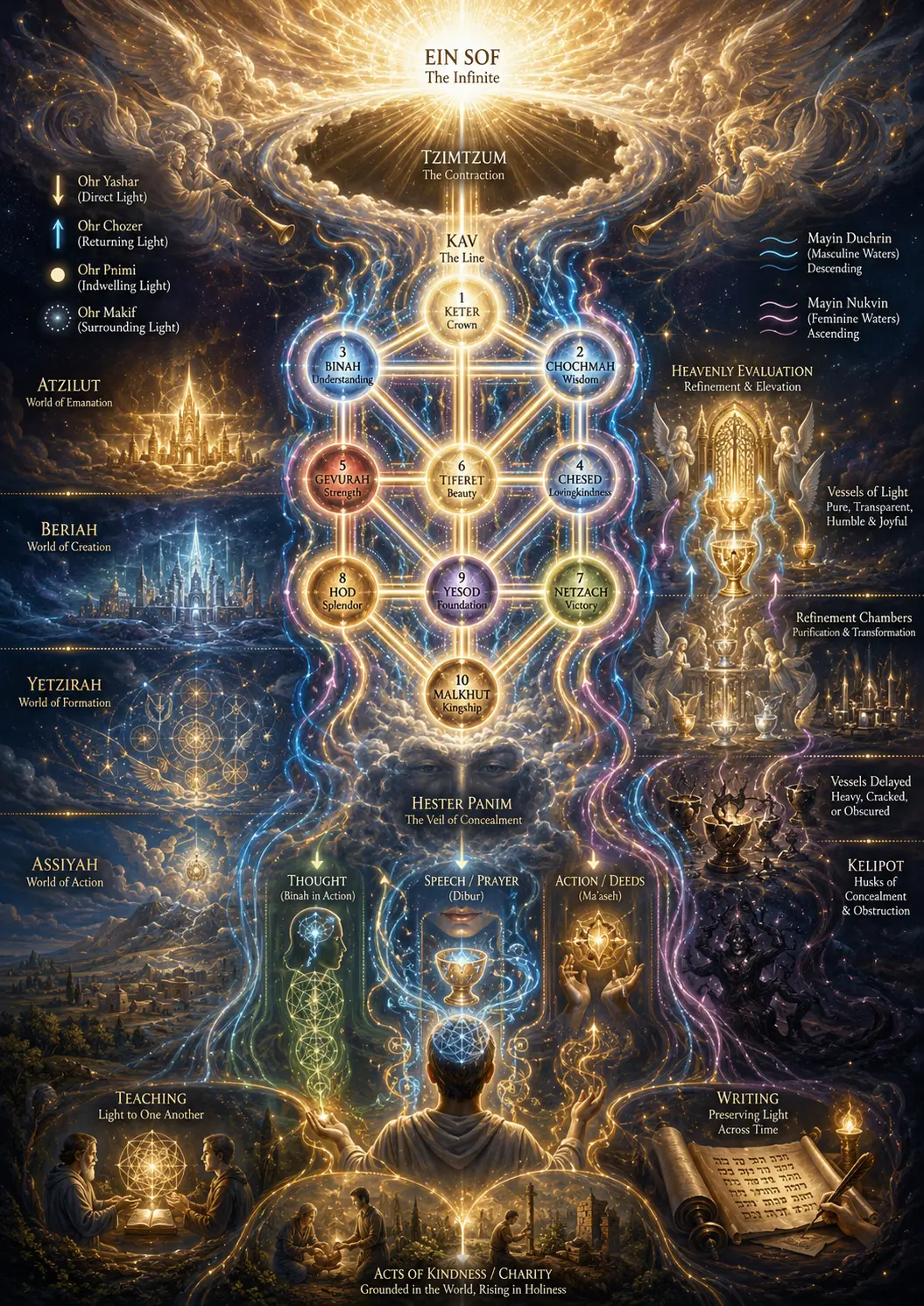
In the Kabbalistic framework, especially in the Lurianic system, existence is built on the relationship between light and vessel: Ohr and Kli.
The light is the living influx of Divine reality. It is the overflowing presence of God, the force of being, meaning, wisdom, life, and holiness. The vessel is the form that allows that light to be received. Without a vessel, the light is too infinite to be grasped. Without light, the vessel is an empty shell.
A vessel is created whenever infinity is given a boundary.
This is the secret of Tzimtzum. A vessel is not merely a container in the physical sense. It is a limit, a definition, a shape, a receptive structure. The moment light is restricted into a form — a word, an intention, a thought, a deed, a commandment, a teaching, a written sentence — a vessel has appeared.
But not all vessels are equal.
A thought creates one kind of vessel. Speech creates another. Physical action creates another still. Praise, prayer, teaching, writing, and good deeds each move the light differently. They do not all do the same thing in the spiritual worlds.
1. Where Does the Light Go If There Is No Vessel?
Light without a vessel is not destroyed. It does not vanish.
Rather, it remains ungrasped.
It may remain in the category of Ohr Makif, surrounding light. This means the light is present, but not inwardly received. It surrounds the person, the soul, or the world as possibility, inspiration, pressure, or longing. It is near, but not yet integrated.
This explains why a person can feel a holy desire, an inspiration, or a sudden awakening, yet nothing changes afterward. The light came close, but no vessel was formed strong enough to hold it.
A vessel is created when the inspiration receives structure.
For example:
A vague desire for God is light without a strong vessel.
A focused thought about God is already a subtle vessel.
A spoken prayer is a stronger vessel.
A physical act done for God is stronger still.
A written teaching that preserves Godly wisdom for others is an enduring vessel.
So the light does not “go nowhere.” It either remains above as surrounding light, enters a suitable vessel, or leaves behind a subtle impression called Reshimu — a trace, memory, or spiritual imprint.
Even when the moment passes, the trace remains.
2. When Is a Container Created?
A container is created at the moment Divine light is given a definite form.
This can happen through:
Thought.
Speech.
Action.
Intention.
Teaching.
Writing.
Prayer.
Praise.
A mitzvah.
An act of mercy.
A sacrifice of the ego.
The vessel begins when the infinite becomes specific.
If I merely feel love for God, the light is present but still fluid. If I think, “God is merciful,” the light now has a mental form. If I say, “Blessed are You, Lord,” the light has entered language and breath. If I give charity, forgive someone, teach wisdom, or write truth, the light has descended into a concrete vessel in the world of action.
So the vessel is not created only by physical action, but physical action creates the densest and most anchored vessel.
Thought creates a vessel above.
Speech creates a vessel between souls.
Action creates a vessel in the physical world.
The denser the vessel, the lower it reaches. But paradoxically, the lower it reaches, the higher the light it can ultimately draw down.
3. What Happens to the Vessel Afterward?
Every vessel has two aspects.
First, there is the temporary outer shell.
Second, there is the inner spiritual form.
The outer shell passes away.
The sound waves of prayer disappear.
The movement of the hand stops.
The ink may fade.
The body eventually dies.
The brain-state of the thought changes.
But the inner form of the act does not simply vanish.
The rectified intention, the spiritual geometry of the deed, ascends upward as Mayin Nukvin, the “feminine waters.” This means the vessel rises as a request, a lack, a longing, or a completed form that asks heaven for a response.
Then, from above, there is a descent of new light, sometimes called Mayin Duchrin, masculine waters, or renewed Ohr Yashar, direct light.
The lower act rises.
The higher light descends.
The world is changed.
The vessel therefore both remains and ascends.
It remains below as a Reshimu, an impression in the world.
It ascends above as a spiritual demand.
It draws down new light from the higher worlds.
This is why no holy thought, word, or action is truly lost.
4. Thinking: The Vessel of Inner Form
Thought belongs mainly to the world of Beriah, the world of creation and understanding. In thought, the light is not yet externalized. It has not entered sound, body, or physical matter.
Thinking creates an inner vessel.
When a person contemplates God, studies Torah, meditates on Divine attributes, or learns wisdom, the mind becomes a chamber. The raw flash of light, associated with Chokhmah, is expanded and shaped by Binah. The soul gives structure to the light.
This is not empty.
Thinking of God is already a vessel, because the thought gives form to the light. However, it is a subtle vessel. It exists inwardly. It affects the soul, the higher worlds, and the person’s inner architecture, but it does not yet fully anchor the light into the physical world.
The light in thought goes inward and upward.
It refines the mind.
It expands the vessel of understanding.
It prepares the person for speech and action.
It creates a hidden form that can later descend.
But if thought never becomes speech or action, it remains incomplete. It is real, but not fully embodied.
Thought is the womb of the vessel.
Speech is its birth.
Action is its incarnation.
5. Speech: The Vessel of Breath, Word, and Relationship
Speech belongs mainly to Yetzirah, the world of formation. Here the inner thought descends into breath, sound, rhythm, language, and relationship.
Speech is stronger than thought because it leaves the private interior of the soul and enters the shared world.
A spoken word creates a vibrational vessel. The sound itself fades quickly, but the form of the word remains in the spiritual order. Speech joins mind and body: it takes invisible meaning and gives it audible form.
But not all speech moves light in the same direction.
There is a difference between praise, prayer, teaching, blessing, confession, and ordinary speech.
6. Praise: Returning Light
Praise is not primarily about asking for something. Praise is the recognition of light that is already present.
When a person praises God, he takes the light hidden inside creation and returns it to its Source. This is the movement of Ohr Chozer, returning light.
Praise says:
The light is already here.
The good is already here.
The glory is already here.
I recognize it and return it upward.
Praise creates a vessel of alignment.
It does not carve out an empty space in the same way petitionary prayer does. Instead, it polishes the vessel of perception. It teaches Malchut, the lower world, to acknowledge the King. Praise lifts the world back toward its root.
In praise, the light moves upward.
Creation becomes a mirror.
The lower world reflects the higher world.
The soul returns received light back to God.
This is why praise is spiritually powerful even when nothing is being requested. It transforms the person from a receiver into a reflector.
7. Prayer: The Vessel of Lack and Request
Prayer is different from praise.
Prayer creates a vessel by articulating lack.
When a person prays, he gives shape to emptiness. He names what is missing: healing, mercy, forgiveness, wisdom, redemption, livelihood, peace, restoration. This named lack becomes a vessel in Malchut.
Prayer is therefore the construction of a holy vacuum.
The person says:
This is what is missing below.
This is the space that needs to be filled.
This is the broken place that must receive light.
That lack rises upward as Mayin Nukvin. It becomes a request from below. In response, higher light may descend as Ohr Yashar, direct light from above.
So praise returns existing light upward.
Prayer draws new light downward.
Praise says, “The light is here.”
Prayer says, “Let the light come here.”
Both are speech, but their vectors differ.
Praise reflects.
Prayer attracts.
Praise aligns the world with God.
Prayer opens a vessel for God to enter the world more deeply.
Even when a prayer is not immediately fulfilled in visible reality, the vessel is not wasted. It may be stored, refined, delayed, redirected, or used to transform the person who prayed. In Kabbalistic terms, sincere prayer always rises. The question is not whether it rises, but how and when the answering light descends.
8. Action: The Dense Vessel of Assiyah
Action belongs to Assiyah, the world of deed.
This is the lowest world, but also the world where the light becomes most real. A thought can be sincere and still remain hidden. A word can be beautiful and still fade. But an action changes the actual structure of the world.
This is why Kabbalah gives such importance to mitzvot and concrete goodness.
A good action creates the densest vessel because it involves the body, time, space, matter, and consequence. The light is no longer only understood or spoken. It is anchored.
When a person gives charity, feeds someone, honors parents, protects the weak, keeps a commandment, studies with discipline, or restrains an evil impulse, the light enters the physical world.
The physical movement passes.
The spiritual structure remains.
The vessel rises.
The world is marked.
Action unites the lowest and highest levels. The act happens in Assiyah, but because it is so low and concrete, it can draw down light from very high places. The highest light desires the lowest dwelling.
This is the paradox:
Thought is higher in subtlety.
Action is higher in completion.
Thought touches the upper worlds.
Action fulfills the purpose of creation below.
9. Good Actions: Anchoring Light into Reality
Good actions are not merely moral gestures. In Kabbalistic terms, they are vessels of rectification.
A good deed takes Divine light and gives it a place to dwell inside the broken world. It repairs separation. It joins intention, body, and reality.
If thought says, “I understand mercy,” and speech says, “Mercy is holy,” then action says, “Mercy has entered the world.”
This is why action is so powerful.
A hungry person is fed.
A lonely person is visited.
A debt is forgiven.
A sin is resisted.
A commandment is fulfilled.
A broken place receives order.
The vessel created by a good action is durable because it has entered actuality. It is no longer only potential. The deed becomes part of the world’s spiritual memory.
Its outer form passes away, but its inner form ascends.
The body acted below.
The vessel rose above.
The light descended again.
The world became slightly more habitable for God.
10. Teaching: Horizontal Transmission of Light
Teaching is a special case because it combines thought, speech, and action.
Teaching begins in thought. The teacher receives or understands a concept. That concept is an inner vessel in Beriah. Then the teacher compresses it into language, lowering it into Yetzirah. Then the student receives it and builds a new vessel inside his own mind.
Teaching therefore moves light horizontally through the human network.
It is not only a vertical movement between heaven and earth. It is also the transmission of light from soul to soul.
The teacher acts like Yesod, a channel. He receives from above or within, orders the light, and passes it onward. If the teaching is true, the student does not merely hear information. A new vessel is formed in the student.
This is why teaching is spiritually greater than private understanding alone.
Private thought builds one vessel.
Teaching multiplies vessels.
The teacher’s light becomes another person’s thought. That person may then speak it, write it, live it, or teach it again. In this way, one vessel produces many vessels.
Teaching causes light to reproduce without being diminished.
11. Writing: The Condensation of Light into Letters
Writing is even more condensed than speech.
Speech is alive, immediate, and breath-based. It appears and disappears. Writing freezes speech into visible form. It takes flowing thought and fixes it into letters, signs, marks, and spatial arrangement.
Writing creates a durable vessel.
A spoken teaching may disappear after the sound fades, unless remembered. But a written teaching can remain for years, centuries, or millennia. It can be entered again and again by different minds. It becomes a stored vessel of light.
Writing belongs to Assiyah because it uses physical material: ink, page, screen, hand, eye, symbol. But it also carries Beriah within it, because it contains thought. And it carries Yetzirah within it, because it preserves language.
Writing is therefore a bridge between worlds.
It is thought made visible.
Speech made permanent.
Action made intellectual.
Light condensed into form.
A holy text is not merely information. It is a spiritual battery. It holds the trace of the mind, soul, and intention that formed it. When another person reads it with attention, the letters become vessels again. The old light becomes present in a new mind.
This is why writing can outlive the writer. The body dies, the voice fades, but the vessel of letters remains accessible.
12. The Difference Between Thinking, Speaking, Acting, Teaching, and Writing
Thinking creates a subtle inward vessel.
The light goes into the mind and soul. It shapes understanding. It rises in the upper worlds but remains mostly hidden from the external world.
Praise creates a reflective vessel.
The light already present below is recognized and returned upward. Praise is returning light, the world becoming conscious of God.
Prayer creates an empty vessel.
The person names a lack and raises it upward. Prayer draws new light downward into the place of need.
Good action creates an embodied vessel.
The light is anchored into Assiyah. The deed changes reality and leaves a permanent spiritual impression.
Teaching creates a transmissive vessel.
The light moves from one mind to another. One vessel gives birth to more vessels.
Writing creates a durable vessel.
The light is condensed into letters and preserved across time. It becomes a stable form that can be reactivated by future readers.
13. Does the Vessel Remain or Ascend?
The answer is both.
The physical expression remains only temporarily. The sound fades. The movement ends. The thought changes. The ink may decay. The body passes.
But the inner spiritual form does not disappear.
It ascends as Mayin Nukvin.
It leaves a Reshimu below.
It draws a response from above.
It becomes part of the rectification of reality.
A holy vessel therefore has three lives.
First, it exists below as a thought, word, or deed.
Second, it ascends above as a spiritual form.
Third, it returns below as new light, blessing, transformation, or hidden repair.
This is the cycle of Divine service.
Light descends.
The human being forms a vessel.
The vessel rises.
Higher light descends.
Reality is changed.
14. The Final Principle
In Kabbalah, human life is not spiritually neutral.
Every thought, word, and action is a possible vessel.
A thought gives God a chamber in the mind.
Praise gives God a mirror in creation.
Prayer gives God an opening in lack.
A good deed gives God a dwelling in the physical world.
Teaching gives God a channel between souls.
Writing gives God a vessel that can endure through time.
The light is always flowing. The question is whether there is a vessel capable of receiving it.
Where there is no vessel, the light surrounds.
Where there is a weak vessel, the light flickers.
Where there is a pure vessel, the light rests.
Where there is a dense holy vessel, the light becomes part of the world.
This is why, in the deepest sense, the purpose of spiritual life is not merely to feel light, understand light, or speak of light.
It is to build vessels.
To think clearly.
To speak truthfully.
To praise faithfully.
To pray honestly.
To act mercifully.
To teach generously.
To write enduringly.
For every vessel formed below becomes a gate above, and every gate opened above sends new light back into the world.