Human beings often speak as though imagination manufactures new things by combining old ones.
A person has seen a city. They understand flight. Their mind joins the two concepts, and a flying city appears.
This explanation seems reasonable because the finished idea contains recognizable parts. Yet it mistakes the way the human mind analyzes an idea for the way the idea first comes into being.
The flying city is not truly born when the abstract concept of flight is attached to the abstract concept of a city.
First, there is the flying city.
Only afterward does the human intellect say:
It is a city.
It flies.
It contains buildings.
It moves through the sky.
It resembles things I have previously known.
The relations do not create the object.
The object allows the relations to be discovered.
This leads to a deeper account of imagination.
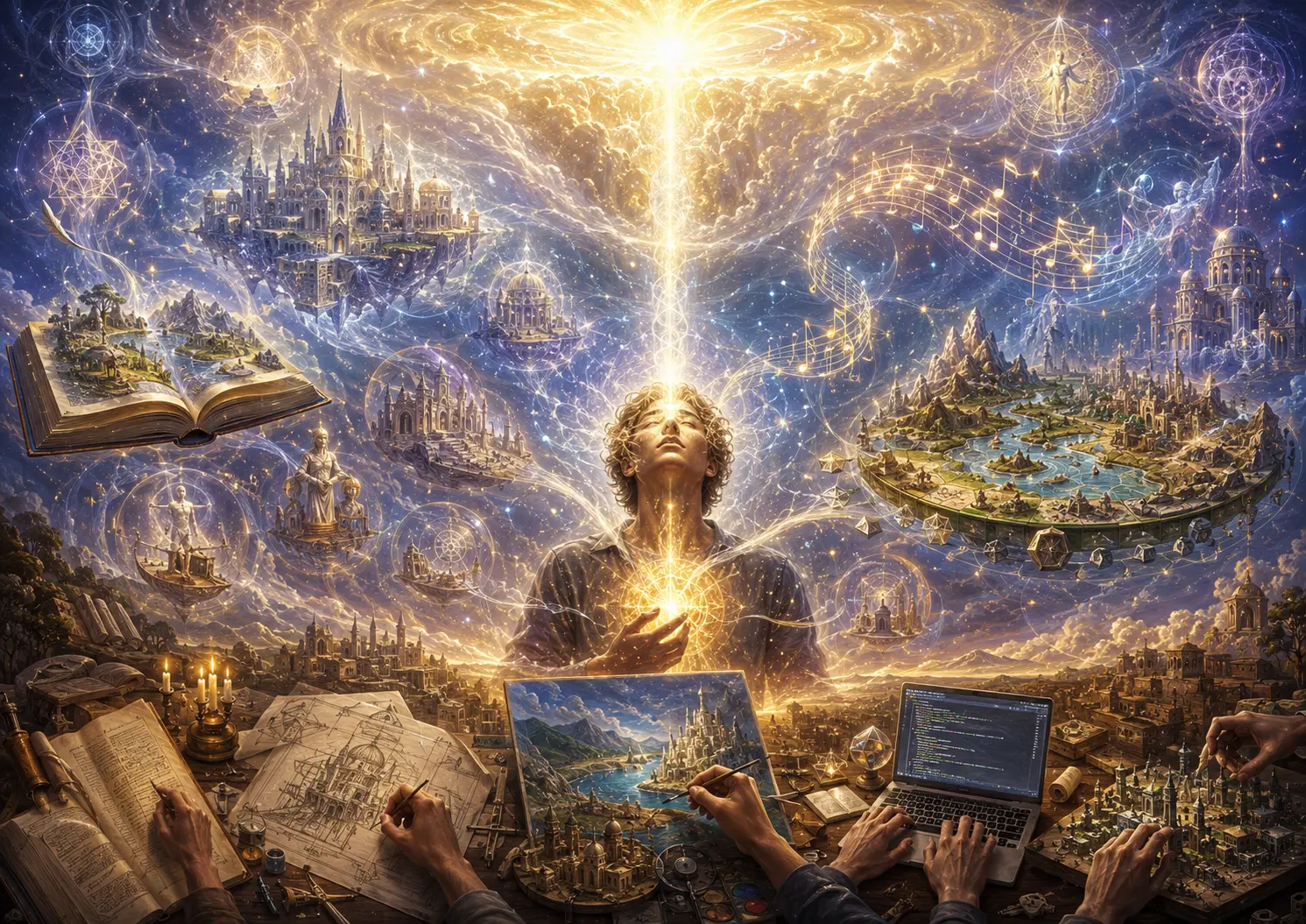
Human beings do not create the original identities of ideas. They receive complete intelligible objects from the inexhaustible freedom of the Source and construct vessels through which those objects can enter a particular world.
The creation of the idea belongs to Ein Sof.
The incarnation of the idea belongs to humanity.
An Idea Is Something
An idea is often treated as though it were merely a collection of descriptions.
A flying city is described as:
city plus flight;
buildings plus altitude;
inhabitants plus movement;
technology plus architecture.
But these descriptions do not equal the idea itself.
They are conceptual shadows cast by the idea when the human intellect turns toward it.
The flying city possesses a unity that precedes its analysis. It appears as one thing, one world, one formed possibility.
Its parts belong together because of the object it is.
It is not the object it is because a mind happened to place enough parts beside one another.
The same is true of a story.
A story is not merely:
characters plus events plus conflict plus setting.
Those elements may be identified after the story has appeared. Yet the living identity of the story is something more immediate. The creator may sense its atmosphere, destiny, emotional movement, and world before knowing the names of its characters or the order of its chapters.
A game is not merely mechanics, graphics, rules, and rewards.
A civilization is not merely people, buildings, laws, and customs.
A person is not merely a body, memories, qualities, and relations.
The whole possesses an identity that cannot be exhausted by listing its components.
Within this metaphysical model, an idea is therefore a real intelligible object.
It is not physically material. It does not yet occupy ordinary space. But it is not nothing.
It has form.
It has identity.
It has an inner unity.
It can be encountered, partially understood, translated, distorted, embodied, forgotten, and encountered again.
The Source Does Not Assemble Ideas
Ein Sof does not create an idea as a human engineer constructs a machine.
He does not begin with isolated concepts and ask how they might be connected.
He does not take “city,” “flight,” “crystal,” “empire,” and “sky,” then calculate which relations would turn them into a coherent whole.
That would make the Source dependent upon elements and laws more primordial than himself.
Instead, the Source produces the complete intelligible object.
The object appears with everything belonging to its identity.
When the Source produces a flying city, he does not first create the relation between city and flight.
He produces the flying city itself.
Because the flying city exists, it may then be recognized as possessing the qualities of flight, habitation, structure, movement, location, and communal life.
Its relations follow from its being.
Its being does not follow from relations imposed upon it.
This is why the freedom of Ein Sof is deeper than combination.
Combination works with what has already been given.
The Source gives the very identities that may later be combined, compared, embodied, or understood.
Relations Belong to Human Understanding
Human knowledge operates through distinction.
To understand something, the intellect asks:
What is this similar to?
How is it different?
What parts can be recognized within it?
What causes it?
What does it affect?
Where does it belong?
These questions generate relations.
The human mind identifies the flying city as being related to ordinary cities because both contain inhabitants, buildings, paths, and social structures.
It relates the object to flight because it moves or remains suspended above the ground.
It may relate the city to ships, planets, machines, kingdoms, birds, or islands.
These relations help the finite mind understand what it has received.
But they do not metaphysically manufacture the object.
Relations are bridges constructed by understanding.
The object is what the bridges lead toward.
This does not make relations false. They reveal genuine similarities and differences. They allow one idea to be communicated through concepts already familiar to another person.
Yet the human mind should not confuse its map with the thing it maps.
The flying city is more than its relation to flying things and more than its relation to cities.
It is itself.
The Whole Arrives Before the Explanation
Creators frequently experience an idea as a sudden whole.
A writer sees the atmosphere of a world before its history is known.
A composer hears the shape of a piece before every note has been written.
An inventor perceives what a device should accomplish before understanding how its components will function.
A game designer may glimpse an entire universe—its wars, economies, cities, machines, mysteries, and final purpose—before producing a single line of code.
The idea arrives simultaneously.
The explanation must unfold sequentially.
This is why creators often say:
“I can see it, but I cannot explain it yet.”
The problem is not necessarily that the idea is vague.
The idea may be clearer than the available language.
The human mind has received a whole, but speech can reveal only one part at a time.
The creator must turn around the object inwardly, discovering its sides:
first its world;
then its inhabitants;
then its history;
then its laws;
then its conflicts;
then its hidden center.
Creation becomes the process of learning what has already been received.
Recombination Happens After Reception
Human imagination certainly uses memory.
A person who has encountered cities, aircraft, kingdoms, games, machines, myths, and films possesses more symbols through which an unfamiliar idea can be interpreted.
But memory does not necessarily originate the idea.
It supplies a language for recognizing it.
Suppose two people receive contact with the same source-form of an inhabited structure moving through the heavens.
One has grown up among modern technology. They imagine a flying city powered by engines and reactors.
Another belongs to an ancient culture. They imagine a divine mountain, heavenly palace, or celestial chariot.
A third imagines a living organism whose body contains an entire civilization.
The deeper object may be related.
The human translations differ.
The mind does not create the source-form by recombining memories. It clothes the source-form in images that consciousness can receive.
What appears to be recombination is often the mind translating a whole through familiar fragments.
Ein Sof as the Origin of Idea-Objects
Ein Sof is not merely an empty field in which anything might hypothetically occur.
The Source is fertile.
His freedom produces definite forms.
An idea is not only logically possible because it contains no contradiction. It exists positively as an intelligible formation within the Source.
These forms may be called:
idea-objects;
source-forms;
intelligible beings;
archetypal objects;
world-seeds;
or produced possibilities.
None of these terms is perfect.
“Object” can sound too physical.
“Archetype” can suggest a fixed collection of ancient patterns.
“Thought” can make the form seem merely subjective.
“Possibility” can make it sound empty or unreal.
The term source-form may come closest.
A source-form is a complete intelligible identity produced in the freedom of Ein Sof before it receives finite embodiment.
It is not independent of the Source.
It is not a second eternal being standing beside him.
It exists because the Source gives it intelligible reality.
Yet once produced, it possesses a recognizable identity that can be encountered by finite consciousness.
Why the Source Alone Creates Ideas
Human beings cannot create absolutely from nothing.
Even when a person imagines something never before seen, the capacity for that thing to be itself must already be grounded in the Source.
The human did not create:
intelligibility;
identity;
possibility;
unity;
distinction;
consciousness;
or the capacity of a form to become meaningful.
These precede the individual human act.
The human creator may be the first person in history to receive and embody a particular idea. Yet the metaphysical possibility of that idea does not originate in the human brain.
The brain is a receiver, interpreter, and builder of vessels.
The source-form itself belongs to Ein Sof.
This gives the Source a form of creativity unlike all creaturely creativity.
Creatures bring forms into new locations.
The Source grants that forms can be.
Creatures discover identities.
The Source produces identity.
Creatures embody possibilities.
The Source gives possibility its intelligible reality.
The Yechidah as the Point of Contact
Within the structure of the soul, the yechidah is the deepest point of unity with Ein Sof.
It does not ordinarily communicate through complete sentences or conscious explanations.
It is the opening through which the finite person remains rooted in the inexhaustible Source.
A source-form may first touch the human person through this depth.
From there, it descends through the levels of the soul.
The movement can be imagined as:
Ein Sof — the source of the idea-object
Yechidah — contact with the undivided form
Chayah — intuitive awareness of its living possibility
Neshamah — intellectual recognition and interpretation
Ruach — imagination, emotion, desire, and expression
Nefesh — physical action and embodiment
World — the completed vessel through which others encounter it
At the level of the yechidah, the form is not yet divided into a list of features.
It is encountered as a unity.
At the level of chayah, it may appear as a powerful intuition or living vision.
At the level of neshamah, the mind begins asking what it is and how it functions.
At the level of ruach, it receives emotional color, imagery, narrative, and personal meaning.
At the level of nefesh, the person begins writing, drawing, programming, building, speaking, or organizing.
The idea descends from unity into articulation.
The Human Being Creates the Vessel
If the Source creates the idea, what does the human creator contribute?
The human creates the vessel.
A vessel is the finite structure that allows an intelligible object to become present within a particular world.
A novel is a vessel.
A painting is a vessel.
A mathematical notation is a vessel.
A game is a vessel.
A city is a vessel.
A ritual, philosophy, machine, institution, or musical composition can also become a vessel.
The vessel does not create the original identity of the idea.
It gives the idea a body.
This is real creation because embodiment is not automatic.
The human must decide:
which medium can carry the form;
which aspects can be expressed;
what must be simplified;
what resources are required;
how others will encounter it;
and how the vessel can remain coherent.
The source-form may be complete, but the earthly vessel is limited.
The creator therefore translates infinity into proportion.
Why Work Is Required
The source-form may arrive in a moment.
Its vessel may require years.
This is the suffering of human creativity.
The idea exists inwardly as a whole, while matter must be arranged piece by piece.
A complete game may appear in imagination with its worlds, factions, machines, economies, wars, alliances, artifacts, and final throne already belonging together.
But the vessel requires:
server architecture;
databases;
programming;
visual design;
balancing;
testing;
interfaces;
moderation;
hardware;
and other players.
The creator is not working to produce the metaphysical identity of the game.
That identity has already been received.
The creator is working to build matter, language, and systems capable of bearing it.
The pain comes from the difference between the wholeness of the received form and the slowness of its embodiment.
The mind sees the city.
The hands must place every stone.
Why Vessels Fail
Not every vessel successfully carries its idea.
The creator may lack skill.
The language may be insufficient.
The technology may not yet exist.
The project may become too large for the available resources.
Fear, exhaustion, illness, poverty, or lack of support may interrupt the work.
The creator may also misunderstand the source-form.
Personal desire can distort what was received. A vision of shared abundance may become a system of control. A world of freedom may become centered on the creator’s need for admiration.
The failure of a vessel does not necessarily mean the source-form was false.
It may mean the vessel could not yet contain it.
This is the ancient problem of light and vessels expressed through human imagination.
A great idea forced into an immature form may fracture.
The answer is not to abandon the idea.
It is to strengthen the vessel.
Why Several People Discover Similar Ideas
Different people often develop similar inventions, stories, philosophies, or artistic forms without directly copying one another.
A purely material explanation may point to shared environments, similar problems, cultural influence, and comparable patterns of association.
Within this metaphysical model, another possibility exists.
Several minds may encounter the same source-form or neighboring faces of it.
Each receives according to their nature.
One person sees a technological invention.
Another sees a myth.
Another sees a social structure.
Another sees a game mechanic.
Another sees a theological principle.
They are not necessarily drawing from completely separate ideas.
They may be constructing different vessels around one deeper object.
This is why ideas can seem to belong to an age rather than to one isolated person.
Humanity becomes collectively ready to receive a form that previously lacked suitable vessels.
Originality Without Absolute Origination
This model does not make human creativity meaningless.
The human creator may not produce the source-form from nothing, but their contribution remains irreplaceable.
They determine:
whether the form enters history;
which part becomes visible;
what language it receives;
how it relates to a particular culture;
what moral purpose it serves;
and whether it becomes a gift, a prison, a weapon, or a home.
A source-form may be infinite in depth, but every vessel presents it from a particular perspective.
No other person has precisely the same memories, wounds, loves, skills, limitations, and historical location.
The vessel therefore bears the creator’s real identity.
Human originality is not absolute sourcehood.
It is unique incarnation.
The Source creates the idea as itself.
The human creates the way it becomes present here.
The Idea Becomes More Than the Vessel
Once embodied, an idea enters relationships that did not exist in the same way before.
A book is read by people whom the author never knew.
A game develops histories its designer did not script.
A city becomes the setting of lives its architect could not foresee.
A philosophy is interpreted by later generations.
The source-form receives a temporal history.
The human creator provides the first vessel, but other persons continue the embodiment.
This produces three stages:
The Source creates the idea-object.
The human creator gives it a vessel.
The community gives it a history.
The final stage cannot be completely predetermined if the participants are genuinely free.
The Source may contain the intelligible form of the game, but the friendships, betrayals, empires, discoveries, and memories produced by its players become real through participation.
A vessel opens a world that others may enter.
Imagination Is a Form of Pulling
Human imagination can therefore be understood as a movement of drawing downward.
The person does not pull a physical object through space.
They draw an intelligible form from hidden unity toward visible embodiment.
At first, the idea may be almost beyond words.
Then it becomes an image.
The image becomes a concept.
The concept becomes a design.
The design becomes action.
Action produces a vessel.
The vessel allows the source-form to become present among other beings.
This pulling is not automatic.
A person must become receptive enough to encounter the form and disciplined enough to carry it downward without losing its identity.
Imagination receives.
Understanding translates.
Work embodies.
Fantasy and Distortion
Not every imagined object should be assumed to be a pure source-form received without alteration.
The human mind can distort, fragment, exaggerate, imitate, and combine imperfectly.
Fear may clothe an idea in violence.
Desire may turn beauty into possession.
Trauma may convert protection into domination.
Cultural limitations may hide parts of the form.
The source may be deep, while the reception remains mixed.
The test of an idea is therefore not merely that it appeared powerfully.
It must be examined through its effects.
Does its vessel preserve freedom?
Does it create hidden victims?
Does it make life more inhabitable?
Can others enter it without becoming property?
Does it permit development beyond the creator’s control?
The greater the idea, the greater the responsibility of the vessel-maker.
Creation as Incarnation
Every act of human creation repeats a sacred pattern.
Something invisible becomes visible.
Something unlimited accepts limitation.
Something simultaneous enters sequence.
Something existing as a whole is expressed through parts.
The source-form does not cease being greater than the vessel. Yet through the vessel, it becomes present in a way that it was not present before.
This is why creation resembles incarnation.
The idea descends without being exhausted by its descent.
A book cannot contain the complete world perceived by its author.
A game cannot contain every possibility of its original vision.
A symbol cannot contain the whole reality it signifies.
Yet the finite form is not worthless because it is incomplete.
It is a doorway.
The Origin of Human Imagination
Human imagination does not begin with empty fantasy.
It begins with the soul’s openness to intelligible forms whose origin lies deeper than the conscious mind.
The Source alone produces ideas in their own identity.
Humans do not give the flying city its original metaphysical being.
They encounter it.
They recognize it through familiar categories.
They compare it with cities, flight, technology, mythology, and architecture.
They construct relations so that the finite intellect can understand and communicate what has been received.
Then they create a vessel.
The complete order is:
The Source produces the idea-object.
The yechidah encounters its unity.
The higher soul receives it as living intuition.
The intellect discovers qualities and relations within it.
The imagination clothes it in recognizable forms.
The human will chooses whether to embody it.
Work constructs the vessel.
Other persons give the vessel a history.
The final formula is:
An idea is not created by its relations.
Relations are discovered because the idea already is.
The Source creates the idea as a whole.
The human mind analyzes the whole through similarities and differences.
The human creator builds the vessel through which the idea enters history.
Ein Sof creates the form.
Humanity gives the form a body.