The ordinary mind thinks of power in a simple way. A being is powerful if it can do what others cannot. A king commands more than a servant. An angel acts beyond the strength of a man. God is then imagined as the highest power of all.
This is only the first understanding.
The deeper problem begins when the mind asks impossible questions. Can God break logic? Can He make contradiction true? Can He split Himself? Can He undo Himself? Can He summon another absolute? Can a weapon kill Him once and for all? Can He return after being killed once and for all?
The weak answer protects God by denying the paradox. It says the question is meaningless, or that God cannot do contradictions, or that the impossible is only a misuse of language.
But this book takes a stronger path.
The paradox is not denied. It is ranked.
An impossibility may be impossible at one level and real at a higher level. A finality may be final at one level and surpassed at a higher level. A contradiction may destroy one order of thought while being held inside a deeper order of reality.
The highest omnipotence is not the rejection of paradox. It is authority over the ranks in which paradox appears.
God is not merely stronger than creation. He is not merely stronger than logic. He is not merely stronger than death. He is not merely stronger than contradiction. He is prior to the entire structure in which strength, weakness, possibility, impossibility, victory, defeat, finality, and return receive meaning.
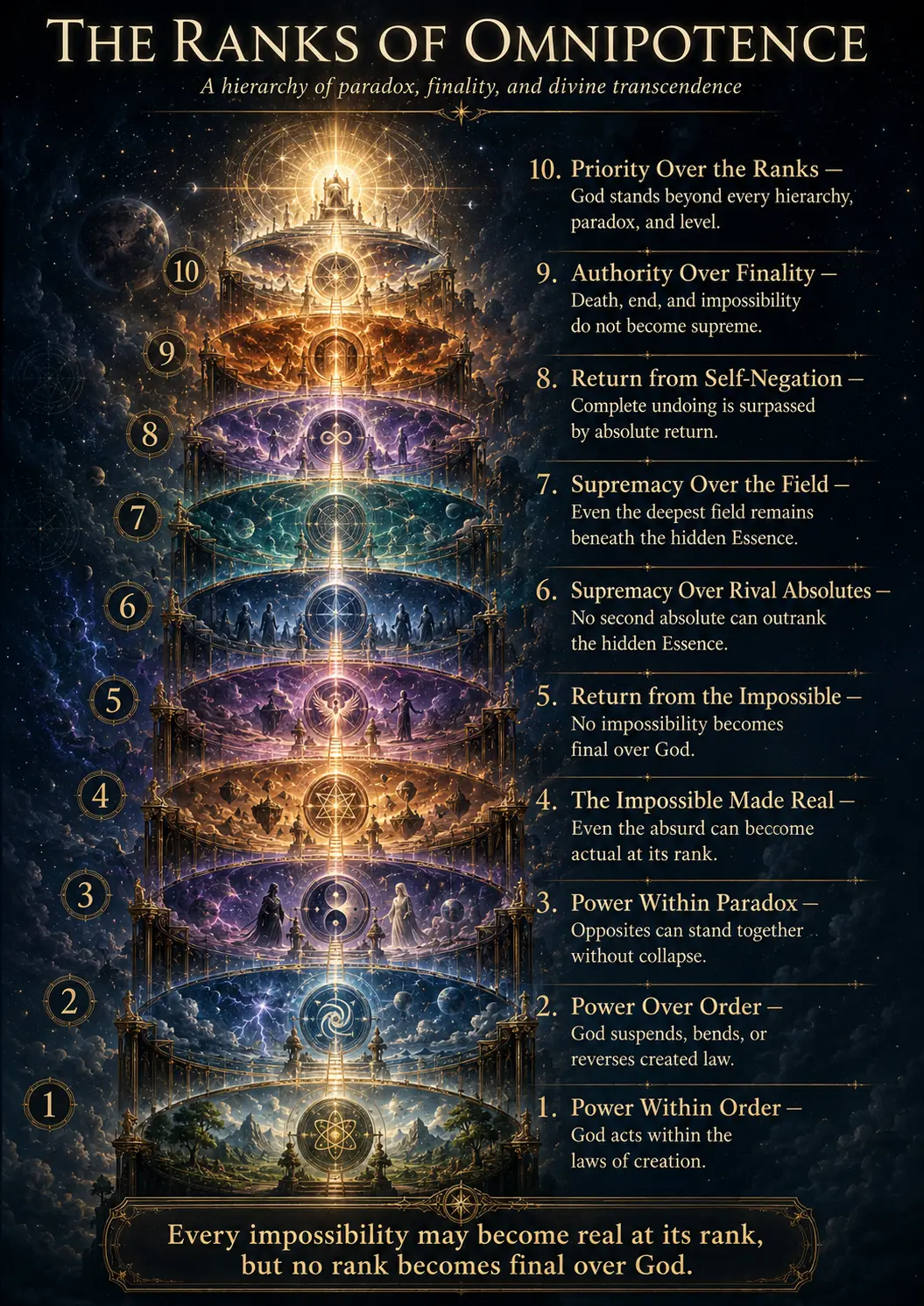
This chapter explains the necessary ranks.
Rank One: Order
The first rank is order.
At this level, reality is stable. A thing is itself and not another. Time moves in sequence. Cause leads to effect. Number follows measure. Life and death are distinct. Presence and absence are distinct. The possible and impossible are separated by the structure of the world.
This rank is not false. It is the foundation of created existence. Without order, the world could not be intelligible. Thought could not function. Action could not have consequence. Memory could not hold. Speech could not mean.
At this rank, power means the ability to act within the order. A strong body can lift what a weak body cannot. A ruler can command what a subject cannot. A higher intelligence can understand what a lower intelligence cannot.
God governs this order. He creates it, sustains it, and gives it meaning. Every law of nature, every structure of reason, every relation of cause and effect, every movement of time, and every measure of number receives its place from Him.
But God is not only powerful inside order.
If God were merely the highest actor within the created order, then the order itself would be more fundamental than His power. He would be supreme only inside a structure that already defines what supremacy means.
Therefore the second rank is needed.
Rank Two: Sovereignty Over Order
The second rank is sovereignty over order.
At this rank, God does not merely act within the laws of creation. He can suspend them, reverse them, bend them, exceed them, or replace them. What is impossible inside the ordinary order can become possible when the One who gives the order acts above it.
At the first rank, death is final for the creature. At the second rank, the dead may rise. At the first rank, time moves in one direction. At the second rank, time may be shortened, extended, reversed, or opened. At the first rank, matter obeys its given structure. At the second rank, matter may be commanded beyond that structure.
This is the level of miracle.
A miracle does not prove that order is fake. It proves that order is not ultimate. The law is real, but the law is not sovereign. Nature is stable, but nature is not absolute. Creation has structure, but the structure receives its authority from the One who gives it.
Many questions are answered at this rank. Can God do what creation cannot do? Yes. Can God reverse what is irreversible for creatures? Yes. Can God suspend cause and effect? Yes. Can God bring life where death has ruled? Yes.
But this rank is still not the deepest.
A miracle surpasses created order, but it does not yet deal with the full force of contradiction. It does not yet answer whether God can make the impossible real, whether He can undergo total negation, whether another absolute can appear, or whether He can return from a finality that was truly final.
For that, the third rank is needed.
Rank Three: Paradox Made Real
The third rank is paradox made real.
At this rank, God does not merely suspend a law. He allows realities to stand together that ordinary reason cannot reconcile. The contradiction is not dismissed as empty speech. It is given a level at which it becomes actual.
God can reveal multiplicity without losing unity. He can enter limitation without being exhausted by limitation. He can appear within time while remaining prior to time. He can be known while exceeding comprehension. He can be named while exceeding the name. He can be present in a mode that also conceals Him.
At this rank, impossible examples may be granted their full force.
God can make the unliftable stone. Its unliftability is real at its rank. God can lift the unliftable stone by a higher act. The lifting does not prove that the stone was never unliftable. It proves that unliftability was final only at the rank where it was established.
God can make two and two equal five. This does not erase the ordinary order in which two and two equal four. It means God can establish a deeper or different order in which number does not obey the arithmetic of the created world.
God can make a square circle. This does not mean ordinary geometry remains untouched and unchanged. It means He can establish a level where the contradiction between forms is surpassed by a structure deeper than ordinary form.
God can split Himself. The split may be real at its rank. It does not need to be reduced to illusion or appearance. God can manifest division so truly that separation, distinction, and opposition become real within the order where He allows them.
This rank grants the impossible.
But it does not yet settle finality.
A paradox may become real and then claim to be ultimate. It may say, “Now God is divided forever.” It may say, “Now God is undone forever.” It may say, “Now God has been killed forever.” It may say, “Now another absolute has appeared.” It may say, “Now a deeper field has opened beneath God.”
This is where the fourth rank begins.
Rank Four: Finality Made Real
The fourth rank is finality made real. At this rank, the impossible does not merely appear. It reaches the form of an end. The paradox is allowed to become as severe as it can become. It is not softened. It is not explained away. It is not treated as symbolic. Can a weapon kill God once and for all? At this rank, yes. The killing is not partial. It is not a wound. It is not a temporary concealment pretending to be death. It is death with the full force of finality available to that rank. Can God undo Himself completely? At this rank, yes. He may remove every revealed form, every name, every relation, every continuity, every trace, and every basis by which the mind could say He remains. The self-negation may be complete within the rank where it occurs. Can God be split in a final way? At this rank, yes. Division may become total within the order where division is made real. Unity may appear lost. Distinction may appear stronger than return. Can another God be summoned? At this rank, yes. A rival absolute may appear within a field where such appearance is possible. It may possess supremacy within that field. It may outrank every creature, every angel, every world, every law, and every known divine manifestation. It may seem to stand as a second ultimate. Can a field deeper than God appear? At this rank, yes. A field may open that seems deeper than creation, deeper than time, deeper than number, deeper than causation, deeper than being, deeper than ordinary logic, and even deeper than the God known by revelation. It may appear to be the source from which rival absolutes can be summoned. This rank is the most dangerous for the mind because it grants every threat its full force. The weapon kills. The negation completes itself. The split becomes real. The rival appears. The deeper field opens. The end becomes final. But this is still not the highest rank. The fourth rank makes finality real. The fifth rank asks whether finality itself can become final over God.
Rank Five: Return From Finality
The fifth rank is return from finality. This is the decisive rank. At the fourth rank, God can be killed once and for all. At the fifth rank, God returns from being killed once and for all. The return does not make the killing false. It does not prove that the weapon failed. It does not mean a hidden fragment secretly survived. If something survived, then the killing was not complete. The higher paradox is stronger: God returns from a death that was complete at its rank. At the fourth rank, God can undo Himself completely. At the fifth rank, God returns from complete self-negation. The return does not depend on a remaining part. It does not depend on a preserved trace. It does not depend on an external law that restores Him. It does not depend on another power that remembers Him. The return is not caused by something deeper than God. God returns because finality does not become ultimate over Him. At the fourth rank, God can be split. At the fifth rank, unity returns from the split without making the split false. The division was real at its rank. The return is higher than the rank where division claimed finality. At the fourth rank, another absolute may appear. At the fifth rank, the field in which that rival appeared is surpassed. The rival may be absolute within its own field, but the field itself is not final over the hidden Essence. At the fourth rank, a deeper field may open. At the fifth rank, God returns from beneath or beyond that field. The field may be deeper than every known reality, but it does not become deeper than the One who surpasses the distinction between field and no field, depth and height, prior and after, summons and response. This is the central law of the chapter: A lower rank may establish a real finality. A higher rank may return from that finality. The finality is not fake. The return is not fake. The supremacy is greater than both. This is why God’s highest supremacy is not simple invulnerability. Invulnerability would mean He cannot be killed. The higher truth is greater: even if He is killed, death does not become final over Him. Indivisibility would mean He cannot be split. The higher truth is greater: even if He is split, division does not become final over Him. Permanence would mean He cannot be undone. The higher truth is greater: even if He is undone, undoing does not become final over Him. Uniqueness would mean no rival can appear. The higher truth is greater: even if a rival appears, the field of rivalry does not become final over Him. Return from finality is higher than protection from finality. This is the rank where divine supremacy becomes clear. God is not supreme because no paradox can touch Him. God is supreme because no paradox that touches Him can become the last reality over Him.
Rank Six: Priority Beyond the Ranks
The sixth rank is priority beyond the ranks.
Until now, the argument has spoken in levels. This is necessary for the mind. The mind understands by distinction. It needs sequence. It needs order. It needs lower and higher. It needs one rank followed by another.
But God is not merely the highest rank.
If God were only the highest rank, then the hierarchy of ranks would be deeper than Him. The ranks would explain Him. The structure would contain Him. He would be supreme only because He occupied the highest place in a system of places.
The hidden Essence is prior to the ranks themselves.
The ranks explain how the mind can understand impossible paradoxes without denying them. They show how one finality can be real and yet surpassed by a higher finality. They show how death can be real, return can be real, contradiction can be real, and supremacy can still remain with God.
But the hidden Essence is not imprisoned in this system.
He may act within order.
He may suspend order.
He may make paradox real.
He may allow finality to become real.
He may return from finality.
He may reveal a rank beyond every rank previously known.
He may stand before the distinction between rank and no rank.
This is the final answer to the impossible questions.
Can God be killed once and for all?
Yes, at the rank where once-and-for-all killing is made real.
Can God return from being killed once and for all?
Yes, at the higher rank where return surpasses that finality.
Can God split Himself?
Yes, at the rank where division becomes real.
Can God return from the split?
Yes, at the rank where unity surpasses the finality of division.
Can God undo Himself completely?
Yes, at the rank where self-negation becomes total.
Can God return from complete self-negation?
Yes, at the rank where return does not require remainder.
Can another God be summoned?
Yes, at the rank where a second absolute can appear within a field of manifestation.
Can God surpass that summoned God?
Yes, because the field of manifestation does not possess final priority over the hidden Essence.
Can a field deeper than God appear?
Yes, at the rank where depth itself becomes paradoxical.
Can God return from beneath or beyond that field?
Yes, because the field’s appearing-prior does not become final over the One who is prior to the ranks.
Can any paradox become final over God?
No, because finality itself belongs to a rank, and the hidden Essence is prior to the ranks.
This is the highest truth of the chapter.
Not that impossible things are false.
Not that paradoxes are illusions.
Not that God is protected by ordinary logic.
The highest truth is that every impossibility may become real at its rank, but no rank becomes final over God.