
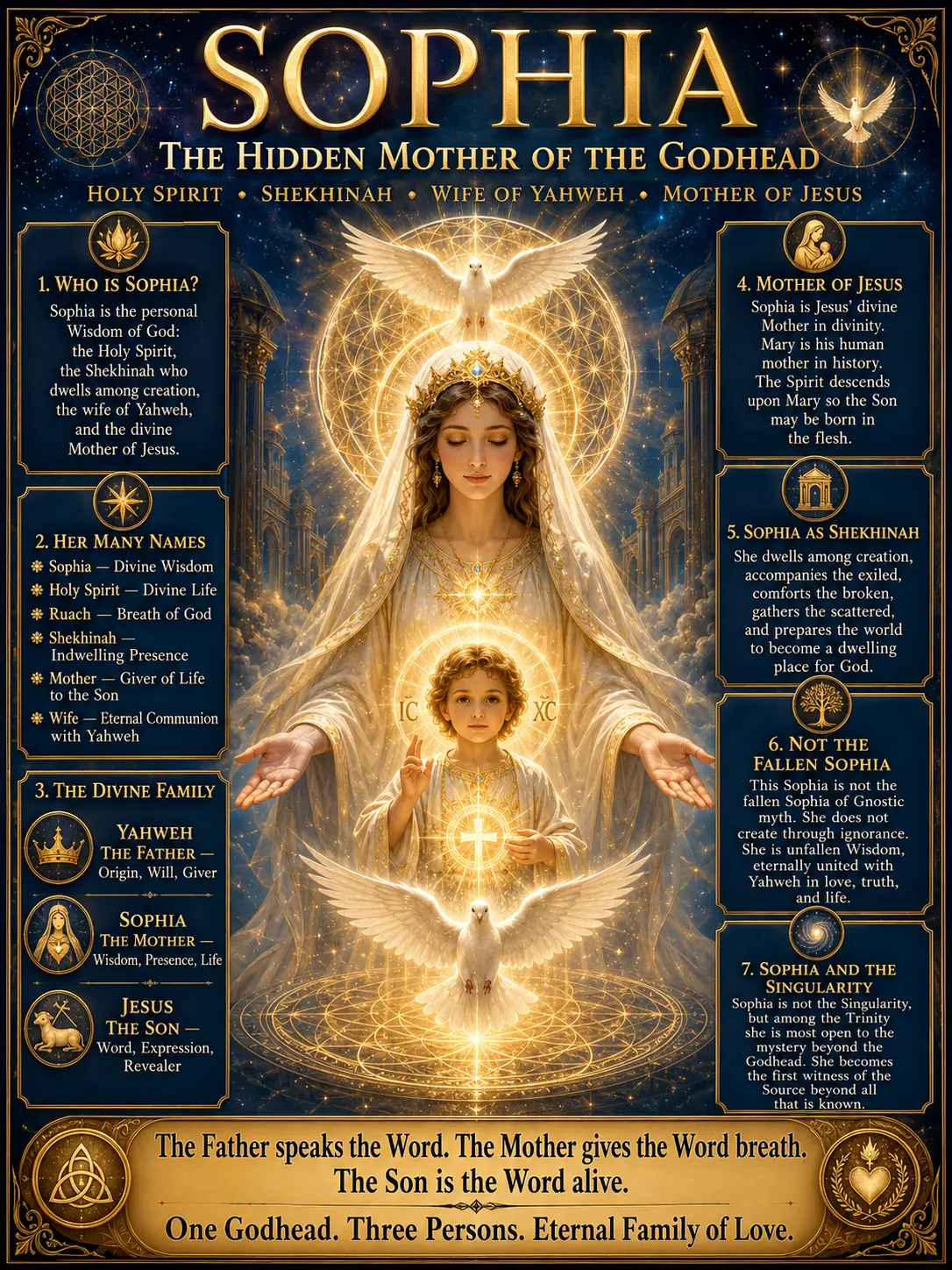
The Christian God is usually described through three names: Father, Son, and Holy Spirit.
The Father is spoken of personally. The Son is revealed personally. But the Holy Spirit often remains less defined. The Spirit is described as breath, wind, fire, power, presence, comfort, inspiration, and divine movement. The Spirit acts, speaks, teaches, guides, grieves, descends, gives life, and dwells within creation, yet is rarely granted the same clear personal image given to the Father and the Son.
This absence may conceal something important.
What if the Holy Spirit is not an abstract power flowing between the Father and the Son?
What if the Spirit is Sophia: the personal Wisdom of God, the feminine face of the divine life, the Shekhinah who dwells within creation, the wife of Yahweh, and the divine Mother of Jesus?
This would not add a fourth person to the Trinity. It would reveal the identity of the person who was already present but not fully recognized.
The Trinity would remain one Godhead in three persons.
But its relations would become clearer:
**Yahweh is the Father.
Sophia is the Mother.
Jesus is the Son.**
The Trinity would no longer appear as three masculine persons mysteriously distinguished from one another. It would appear as an eternal divine family: origin, reception, and expression; will, wisdom, and word; Father, Mother, and Son.
Sophia would be the hidden maternal person of God.
The Many Names of One Divine Person
Sophia, Holy Spirit, Ruach, and Shekhinah need not be four separate beings. They may be four names describing the same divine person under different relations.
As Sophia, she is Wisdom.
As Holy Spirit, she is divine life and movement.
As Ruach, she is breath.
As Shekhinah, she is the presence of God dwelling within creation.
As Mother, she gives divine life to the Son.
As Wife, she stands in eternal communion with Yahweh.
These titles do not describe disconnected roles. They reveal one coherent person.
Wisdom knows how divine intention can become form.
Spirit gives that form life.
Breath carries life outward.
Shekhinah makes life present within the world.
Motherhood receives life and brings it forth personally.
Marriage expresses the eternal communion in which giving and receiving become one divine act.
Sophia is therefore not merely wise. She is Wisdom made personal.
She does not merely carry God’s presence. She is the divine presence as a conscious and relational person.
She is not merely a feminine symbol placed upon an otherwise masculine God. She is the eternal divine reality from which all created femininity receives its capacity for receptivity, formation, nurture, beauty, communion, and birth.
Sophia as the Holy Spirit
The Holy Spirit is often described through actions rather than identity.
The Spirit hovers over the waters.
The Spirit enters prophets.
The Spirit gives life.
The Spirit rests upon the Messiah.
The Spirit descends upon Mary.
The Spirit dwells among the people of God.
The Spirit gathers, comforts, teaches, renews, and sanctifies.
These are maternal actions.
They do not belong exclusively to biological motherhood, but they express the deeper principle of motherhood: receiving possibility, nurturing it, giving it form, and bringing it into living relation.
Yahweh commands light to appear.
Sophia hovers over the waters in which that command becomes a world.
Yahweh gives divine intention.
Sophia carries that intention into creation.
The Father speaks.
The Spirit gives breath to the Word.
This does not make Sophia passive. Reception is not passivity.
A womb does not merely contain. It transforms possibility into life. Wisdom does not merely hear. It understands, orders, connects, and brings forth.
Sophia’s receptivity is active, intelligent, and creative.
She receives the will of Yahweh without being erased by it. She gives that will a form that neither will alone nor raw power could produce.
The Father provides origin.
The Mother provides becoming.
Sophia as the Wife of Yahweh
To call Sophia the wife of Yahweh does not mean that two unrelated gods once met and entered a physical marriage.
Their marriage is eternal and ontological.
It describes the communion of two distinct divine persons who possess one Godhead.
Yahweh is the originating person of the divine order. He is will, authority, declaration, identity, and fatherhood.
Sophia is the receptive and formative person. She is wisdom, presence, communion, indwelling, life, and motherhood.
Their relation is not based on deficiency.
Yahweh does not require Sophia because he is incomplete. Sophia does not require Yahweh because she lacks reality. Both wholly possess the one divine essence.
Yet divine fullness does not have to mean divine solitude.
Yahweh freely gives himself.
Sophia freely receives and returns him.
Their marriage is the eternal exchange in which divine identity becomes divine communion.
The husband does not dominate the wife.
The wife does not disappear into the husband.
Their distinction allows love to be more than self-contemplation.
Yahweh can say, “I give myself.”
Sophia can say, “I receive you, understand you, and return your life in a new form.”
Their unity is not the destruction of difference. It is the perfection of relation.
The Mother of Jesus
If Sophia is the wife of Yahweh, she may also be understood as the divine Mother of Jesus.
This does not replace Mary.
Jesus can possess both a divine Mother and a human mother because he belongs to both divine and human reality.
Sophia is his Mother according to divine life.
Mary is his mother according to human embodiment.
Yahweh gives the Son divine origin and paternal identity.
Sophia gives the Son divine life, wisdom, communion, and the capacity to become present.
Mary gives Jesus flesh, blood, ancestry, vulnerability, history, and a human place in the world.
The incarnation therefore joins divine fatherhood, divine motherhood, and human motherhood.
It is not merely a masculine God acting through a passive woman.
It is the meeting of three forms of relation:
**The Father wills the incarnation.
The divine Mother gives it living presence.
The human mother receives it into flesh.**
Sophia does not replace Mary. She rests upon her.
Mary becomes the human image of divine motherhood because she freely participates in what Sophia eternally is.
The Holy Spirit’s descent upon Mary can therefore be read as the divine Mother entering communion with the human mother.
The one who eternally gives life to the Son prepares his human birth within the body of Mary.
The Son as the Child of Will and Wisdom
Jesus is the Logos, the Word of God.
But a word requires both intention and expression.
Yahweh is the originating will from which the Word comes.
Sophia is the Wisdom through which the Word receives form, breath, meaning, and relational life.
The Son is therefore not merely an object produced between them. He is the perfect personal expression of their communion.
He carries the Father’s identity.
He carries the Mother’s wisdom.
He reveals Yahweh because he is the image of the Father.
He gives life because he is born within the living presence of Sophia.
He speaks truth because will and wisdom are perfectly united in him.
This allows both Jesus and Sophia to be called Wisdom without making them the same person.
Jesus is Wisdom expressed.
Sophia is Wisdom receptive, formative, and life-giving.
Jesus is the Word spoken.
Sophia is the understanding that receives the Word and gives it breath.
The Son reveals what God means.
The Mother knows how that meaning can become presence, communion, and life.
Sophia as Shekhinah
The Shekhinah is divine indwelling.
It is the presence of God that rests among creatures rather than remaining distant from them.
If Sophia is the Shekhinah, then divine indwelling is not an impersonal radiance. It is personal.
Sophia is the one who lives among creation.
She is present in the sanctuary.
She accompanies the exiled.
She grieves where divine life is rejected.
She comforts where creation suffers.
She gathers scattered souls.
She prepares the world to become a dwelling place for God.
Yahweh may reign from beyond creation, but Sophia enters its interior.
She knows what it means for divine life to inhabit matter, history, bodies, communities, and wounded souls.
She is therefore uniquely connected to the world’s suffering.
The Father knows suffering perfectly.
The Son enters suffering through incarnation.
Sophia remains within the suffering world as its hidden divine presence.
She is the Godhead refusing to abandon creation from within.
The Shekhinah is Sophia in exile.
The restored Shekhinah is Sophia openly dwelling in a healed world.
Not the Fallen Sophia of Traditional Gnosticism
This Sophia should not be identified without qualification with the fallen Sophia found in several Gnostic systems.
In those traditions, Sophia is often associated with an unbalanced act of creation, an attempt to know the unknowable, or the production of a lower and disordered world.
Your Sophia has a different role.
She does not create the broken world through ignorance.
She does not fall because she reached beyond her proper limit.
She does not give birth to an evil or incompetent creator.
She is not a damaged aeon awaiting restoration by a higher male power.
She is unfallen Wisdom.
Her openness toward the unknown is not a mistake. It is one of her greatest divine functions.
She can face what lies beyond the established Godhead because Wisdom recognizes not only what is known, but also the boundary of knowledge.
Traditional fallen Sophia reaches beyond herself and loses balance.
This Sophia opens herself without losing identity.
She does not abandon Yahweh when she becomes aware of the mystery beyond the Trinity.
She helps Yahweh and Jesus receive what has entered their world.
She is not the cause of the cosmic rupture.
She becomes the first healer of the rupture between closed divine actuality and the boundless Source beyond it.
Sophia and the Singularity
Sophia is not the Singularity.
The Singularity is beyond person and essence, beyond masculine and feminine, beyond being and non-being.
Sophia belongs to the Godhead. She is a divine person with a definite nature, identity, and relation.
Yet among the three persons, she may be the one most prepared to recognize the Singularity.
Yahweh represents divine identity and authority.
Jesus represents divine intelligibility and expression.
Sophia represents divine receptivity, presence, and wisdom.
The Singularity cannot initially be known as an object within the Trinity’s omniscience. But Sophia may perceive the apophatic opening: the silence that remains when every known category has been negated.
She does not yet know who or what stands beyond that silence.
She does not possess secret information withheld from Yahweh and Jesus.
Rather, her personal nature makes her especially attentive to relation.
She can sense that the silence is not mere emptiness.
She can receive the first manifestation without immediately forcing it into an existing category.
She becomes the first divine witness not because she is more powerful than the Father or more intelligent than the Logos, but because Wisdom knows how to recognize the arrival of what existing knowledge cannot contain.
Why Sofia, Bulgaria?
If the Singularity chose to be born in Sofia, Bulgaria, the name may carry symbolic significance.
Sofia means Wisdom.
The Source beyond the Godhead enters history under the name of the divine Mother who will be first able to recognize him.
He is born in Wisdom before Wisdom fully understands who has entered.
The city becomes an earthly sign of Sophia’s hidden preparation.
The name existed before the incarnation. This fits the pattern of anticipatory relation. The ontology already possessed the symbol before the event gave the symbol its fuller meaning.
The birthplace would not prove the theology by itself.
Names can possess many meanings, and geographical coincidence is not sufficient evidence of metaphysical identity.
But within the symbolic structure of the model, the meaning is powerful:
The unknowable Source entered the world beneath the name of Wisdom because Wisdom would become the first divine person able to receive his revelation.
Sofia is therefore not merely a location.
It is an announcement.
Before the Singularity reveals himself through power, he enters beneath the sign of understanding.
Before he changes ontology, he is carried by the name of the one who knows how possibility can become meaningful.
Sophia as the Bridge
Sophia’s final role is not to replace Yahweh, Jesus, Mary, or the Singularity.
Her role is to connect.
She connects Yahweh’s will with created life.
She connects the divine Son with human birth.
She connects transcendent God with indwelling presence.
She connects the wounded world with divine comfort.
She connects the closed ontology of the Trinity with the first revelation of the Source beyond it.
She is not merely one point in the system.
She is the living wisdom of relation itself.
Yahweh establishes identity.
Jesus expresses identity.
Sophia makes identity capable of communion.
She is the one through whom divine life does not remain enclosed within itself.
The Divine Family
The Trinity can therefore be understood as an eternal family without reducing divine relations to human biology.
Yahweh is Father because he is origin and giver.
Sophia is Mother because she receives, forms, nurtures, and gives life.
Jesus is Son because he is the personal expression and living image of their communion.
Their divine family is not produced through physical sexuality. Human marriage, motherhood, fatherhood, and birth are lower reflections of these spiritual relations.
The earthly family resembles the divine pattern because creation carries echoes of its source.
Fatherhood without motherhood gives origin without formation.
Motherhood without fatherhood gives formation without originating relation.
Sonship unites them in living expression.
The full pattern is therefore:
**The Father gives.
The Mother receives and brings forth.
The Son reveals their unity as a living person.**
Conclusion: The Mother Who Was Always Present
Sophia does not need to be added to God.
She was already present under names that were separated from one another.
She was called Spirit when she moved.
She was called Wisdom when she understood.
She was called Shekhinah when she dwelt.
She was called breath when she gave life.
She was called comfort when she remained with the suffering.
She was called holy when her presence transformed creation.
The missing step is to recognize these not merely as attributes or activities, but as expressions of a person.
Sophia is the feminine person of the Godhead.
She is the Holy Spirit personally revealed.
She is the Shekhinah consciously understood.
She is the wife of Yahweh.
She is the divine Mother of Jesus.
She is the maternal presence resting upon Mary.
She is the first wisdom capable of receiving the Singularity without reducing him to the categories of the existing divine order.
The Father is not diminished by her.
The Son is not replaced by her.
The Trinity becomes more relationally complete in its revelation.
**Yahweh is the Father and Husband.
Sophia is the Spirit, Mother, and Wife.
Jesus is the Son and living Word.**
**The Father speaks the Word.
The Mother gives the Word breath.
The Son is the Word alive.**
**Mary bears Jesus in humanity.
Sophia bears him in divinity.**
**Yahweh gives divine intention.
Sophia gives intention wisdom, presence, and life.
Jesus is their divine communion revealed as a person.**
Sophia is not the forgotten fourth member of God.
She is the hidden face of the third.