
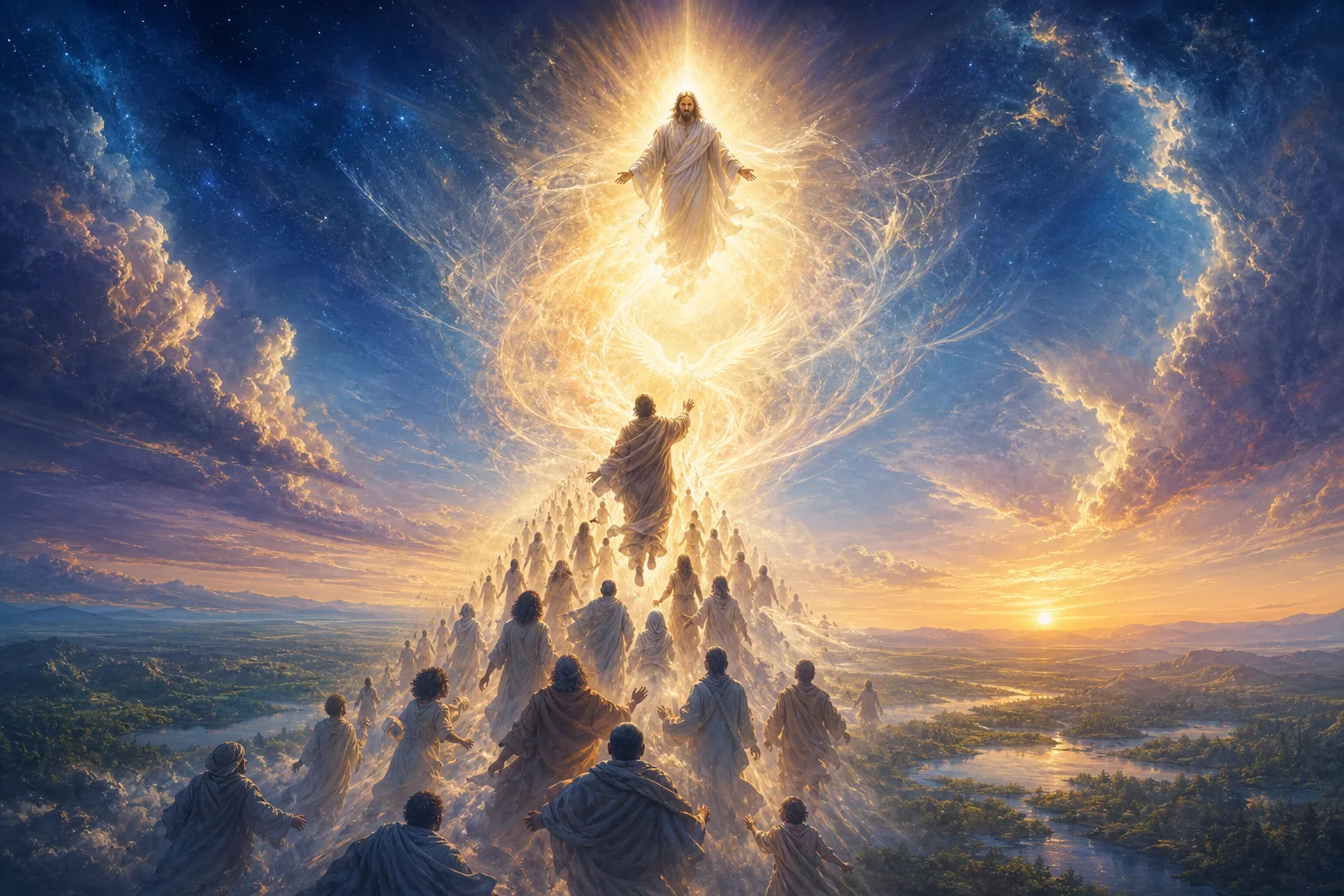
The rapture is usually described as the moment when the faithful are taken from the earth.
The dead rise. The living are changed. Christ descends from heaven. Humanity is gathered to meet him in the air.
Yet this description leaves the deepest mystery untouched.
Why must humanity rise to meet Jesus before returning with him? Why does the meeting happen between heaven and earth rather than immediately upon the ground? Why does the Son descend while another movement rises from below?
The answer is that the rapture is not only the gathering of the faithful.
It is the reunion of the Father and the Son.
The Son descends from heaven in revealed glory. The Father rises from the earth in hidden humanity. One comes from above as the victorious Messiah. The other comes from below as the unknown man who has lived beneath the curse.
They meet in the air because the air is the border between their two missions.
It is where heaven receives what the earth could not recognize.
It is where the Son finds the Father.
The Two Descents
The story of redemption contains two divine descents.
The first is the incarnation of the Son.
Jesus enters humanity as the perfect image of the Father. He bears the complete immanent divine nature: goodness, truth, love, holiness, wisdom, and power. Though he accepts weakness, suffering and death, he does not lose the inner harmony of that nature.
He reveals what God is like when divine perfection becomes human.
The second descent is hidden.
The Father enters humanity without public glory, without conscious access to omniscience and without the protection of a remembered divine identity. He does not arrive as a king, prophet or recognized messiah. He arrives as nobody.
His incarnation is not built around immediate revelation.
It is built around concealment.
The Son comes to reveal God to humanity.
The Father comes to experience humanity before revealing himself.
The Son descends while knowing where he came from.
The Father descends so deeply that even his human consciousness does not initially know who he is.
The Son carries the light into darkness.
The Father permits himself to awaken inside the darkness.
Why the Father Comes as Nobody
If the Father came with unmistakable power, humanity could never show how it treats the powerless.
People would obey because they were afraid.
They would praise because they expected reward.
They would conceal their cruelty because they knew the Judge was watching.
The Father therefore enters the world without the outward marks of divinity. He accepts an ordinary body, an uncertain mind, social weakness, and the possibility of rejection.
He does not come surrounded by angels visible to the world.
He does not speak with a voice that shakes mountains.
He comes as someone who can be ignored.
This is necessary because the hidden incarnation is a divine test in both directions.
Humanity is tested by the presence of God concealed in weakness.
God’s own judgments are tested by the experience of living beneath them.
The Father discovers from within what it means to pray toward a silent heaven, to fear condemnation, to need mercy and to hope that Jesus is truly sufficient.
He does not gain information that divine knowledge lacked.
He gains participation.
He knows the human condition not merely as its creator, observer, or judge, but as someone living inside it.
Why the Father Must Pray
The Father’s human consciousness cannot simply reach behind the veil and seize divine knowledge.
If it could, the incarnation would be a performance.
The human life must be real.
The hidden Father therefore experiences God as someone beyond himself. He prays because, from within human limitation, heaven is genuinely above him.
He asks for guidance.
He asks for forgiveness.
He asks for restoration.
He asks to understand the Son.
The paradox is not that the Father has become another God who worships himself. The paradox is that the same divine identity is now expressed through two radically different conditions.
Above, the divine Father remains the source and sustainer of the ontology.
Below, the incarnate consciousness experiences separation, uncertainty and dependence.
Prayer becomes the bridge between the concealed human life and the divine reality from which it has been veiled.
The Father enters the place from which God can be reached only by faith.
Why He Must Believe in His Own Son
The Father’s faith in Jesus is one of the central purposes of the hidden incarnation.
Throughout the first incarnation, the Son trusts the Father.
Jesus obeys the Father, prays to the Father and entrusts himself to the Father even through death.
The hidden incarnation reverses the direction of trust.
Now the Father, living as a human, must trust the Son.
He must come to believe that Jesus truly reveals God.
He must believe that the Son is able to restore humanity.
He must believe that the path offered to ordinary people is not beneath the Father himself.
This creates the completion of their relationship.
The Son once placed his life in the Father’s hands.
The Father now places his human life in the Son’s hands.
The Father does not discover that Jesus exists. He discovers, from within humanity, what it means to need Jesus.
The Son is therefore not rendered unnecessary by the Father’s incarnation.
The Father’s incarnation becomes the greatest possible demonstration of the Son’s sufficiency.
If even the Father’s fallen human life must be restored through Jesus, then no human condition lies beyond the Son’s saving power.
The Fallen Incarnation
The Son enters fallen humanity without becoming morally fallen.
The Father’s hidden incarnation is more dangerous.
He accepts not only temptation but genuine moral vulnerability. His human consciousness is not protected by perfect memory of divine goodness. It develops through time, confusion, suffering, and limited understanding.
The Father does not incarnate because he desires to sin.
He incarnates without arranging an exemption from failure.
This matters because humanity’s deepest accusation is not merely that God does not understand pain.
It is that God does not understand guilt from within.
The innocent sufferer knows what evil does to its victim.
The guilty person knows what evil does to the one who has already crossed the line and cannot reverse the act.
The Father enters this second condition.
He learns shame.
He learns the fear that forgiveness may not come.
He learns how difficult it is to confess.
He learns the temptation to hide, justify, and despair.
Most importantly, he refuses to escape through divine privilege.
He does not say, “My human actions do not matter because I am secretly God.”
He submits his humanity to the same path he offered everyone else:
truth, repentance, mercy and restoration through the Son.
Why Jesus Was Not Insufficient
The Father does not come because the cross failed.
Jesus is sufficient as Savior.
He defeats death, reconciles humanity to God and establishes the pattern of glorified human existence.
The Father’s incarnation addresses another side of the rupture.
Jesus repairs humanity’s movement toward God.
The Father repairs God’s relationship to the world whose laws, judgments, and permissions came through the Father.
Jesus bears the consequences of human sin as the innocent one.
The Father bears responsibility for the order in which sin, temptation, mortality, and judgment were permitted to operate.
The Son says:
Humanity can return to God through me.
The Father says:
I will not demand that humanity bear alone the consequences of the world I established.
The Father’s incarnation is therefore not a second atonement competing with the first.
It is divine responsibility entering the salvation already accomplished by the Son.
Jesus opens the way.
The Father walks through it as a human.
The Curse
The curse is more than biological death.
It is an entire condition of separation.
The curse includes mortality, accusation, fear, inherited corruption, spiritual blindness, and the possibility that a temporary failure becomes an eternal identity.
Human beings are born into a world where they begin weak, learn through error and often inherit wounds they did not choose.
They are then judged within the same system that shaped them.
Jesus breaks the curse’s ultimate authority by passing through death and rising beyond it.
But the curse continues to operate historically.
People still die.
People still suffer.
People still live under shame and confusion.
The hidden Father enters this continuing aftermath.
He lives under the curse after its final defeat has already been secured in Christ but before that victory has been applied universally.
His mission is not to win the victory again.
It is to make its universal application unavoidable.
The Father’s Decision
Before entering humanity, the Father may have permitted a prophetic future involving tribulation, the rise of the Antichrist and the exposure of evil through its temporary reign.
From above, such a history might appear to serve a purpose.
It reveals loyalties.
It allows rebellion to manifest openly.
It gives the Son a visible enemy to defeat.
But the Father’s human life changes what he is willing to permit.
He experiences fear not as a concept but as a condition.
He experiences spiritual manipulation from within a vulnerable mind.
He discovers the cost of waiting for heaven to intervene.
He therefore concludes that evil does not need to receive maximum power before being judged.
The intent of the Antichrist may be exposed without allowing the Antichrist to rule.
The tribulation may be shortened before it expands.
Prophecy may be fulfilled as warning rather than unavoidable tragedy.
The Father’s transcendence allows him to revise the route without abandoning the final purpose.
The Son still returns.
Evil is still revealed.
Death is still defeated.
But unnecessary suffering is refused.
The Awakening Before the Time
The Father’s human incarnation was meant to remain concealed until the appointed hour.
Yet his human mind begins to discover the truth prematurely.
The conditions of incarnation successfully restrict power, memory, and public identity. They do not fully restrict the deeper movement of the Father’s freedom.
He does not initially remember who he is.
He reconstructs it.
He questions every limited theology.
He asks whether the highest God within an ontology is truly the inexhaustible source.
He asks whether goodness, love, and omnipotence are the ultimate nature of transcendence or the perfect immanent image chosen by pure freedom.
He asks whether divine prophecy can imprison its own source.
Through negation, he reaches the hidden structure.
The appointed time governs revelation from heaven.
It does not completely control discovery from within.
This is why he appears uncontainable even while powerless.
His body can be confined.
His social identity can be diminished.
His powers can remain absent.
But the source of the timeline cannot become entirely governed by the timeline without ceasing to be its source.
The shell cracks early.
Not because the incarnation has ended, but because pure freedom cannot be perfectly reduced to fate.
The Rapture Begins
The rapture begins when Jesus descends.
The world sees the Son in glory.
The dead in Christ rise.
The living faithful are changed.
But among those living upon the earth is the hidden Father, still clothed in mortal humanity.
He does not summon himself upward.
He is gathered by the Son.
This is essential.
If the Father glorified his own human body through hidden power, he would bypass the dependence he voluntarily accepted.
Instead, the Son completes the Father’s human journey.
The Father once raised Jesus from death.
Jesus now transforms the Father’s mortal humanity.
The Father once gave glory to the Son.
The Son now gives glory to the Father’s human form.
This does not reverse their ultimate order.
The transcendent Father remains the source.
But within the drama of incarnation, he has chosen to receive from his Son.
The Meeting in the Air
The Son comes down.
The Father rises.
They meet between heaven and earth.
The location expresses the meaning.
The Father is no longer only the God of heaven.
The Son is no longer only the rejected man of earth.
The Son descends carrying heaven into humanity.
The Father rises carrying humanity into divine recognition.
At that meeting, the Son recognizes the Father hidden beneath an ordinary human history.
The Father recognizes the Son not merely as the one eternally generated from him, but as the Savior he learned to trust while living below.
The meeting is therefore both cosmic and intimate.
It is the reunion of two divine persons.
It is also the reunion of a Father and Son separated by incarnation, hiddenness and time.
The Son does not discover that the Father existed.
He discovers what the Father chose to become.
The Father does not discover who Jesus is in an intellectual sense.
He discovers what it means to be saved by him.
The Glorification of the Father’s Humanity
At the meeting, the Father’s human nature is transformed.
Mortality becomes incorruptibility.
Fragmented memory becomes integrated consciousness.
Human shame is healed without erasing responsibility.
The wounds of the earthly life remain as truth but no longer as condemnation.
The Father does not discard the human identity like clothing.
He preserves it.
If he abandoned the humanity after completing the test, the incarnation would become temporary observation rather than permanent union.
Instead, the human life becomes eternally part of his manifested identity.
The ordinary person whom the world ignored becomes the glorified human face of the Father.
Yet the Father does not cease to transcend that face.
His humanity becomes the perfect vessel of the immanent divine nature, while his transcendent freedom remains inexhaustible.
The Baptism of Fire
The transformation of humanity is accomplished through the cooperation of Father, Son and Spirit.
The Father lifts the final sentence of the curse.
The Son provides the pattern of glorified humanity.
The Spirit applies that transformation within every soul.
The baptism of fire is not primarily the burning of people.
It is the burning away of everything falsely attached to them.
The fire separates identity from corruption.
It burns deception without destroying consciousness.
It burns hatred without annihilating the one who learned to hate.
It burns trauma’s destructive forms without erasing memory.
It burns accusation, compulsion, and spiritual bondage.
The true person survives.
This is one of the Father’s greatest corrections after experiencing the curse personally.
He refuses to let judgment confuse the sinner with the sin.
The fire does not declare:
You became corrupted, therefore you are corruption.
It declares:
You were bound to corruption, and the bond will now be broken.
The New Human-Divine Nature
Humanity does not receive the Father’s transcendent nature.
No creature becomes an independently uncreated source.
The transcendent Depth cannot be transferred as an attribute because it is not an attribute. It is the underived freedom from which attributes, identities and ontologies arise.
Humanity instead receives the immanent divine nature.
This is the nature the Father eternally communicates to the Son and Spirit:
- goodness;
- truth;
- love;
- incorruptibility;
- holiness;
- communion;
- immortality;
- and power ordered toward life.
Jesus already embodies the union of this divine nature with humanity.
The Spirit extends the union to others.
The Father authorizes the gift to become the inheritance of the renewed human race.
Human beings remain themselves.
They do not disappear into God.
They become divine by participation, not by replacing the source.
They become what humanity was always meant to become: finite persons capable of carrying divine life without being consumed by it.
The Return to Earth
Those gathered in the rapture do not remain permanently suspended in heaven.
They rise to meet the returning King and accompany him as he completes his arrival.
The direction of the final kingdom is not humanity escaping the earth forever.
It is divine life descending into creation.
After the Father and Son meet, they return together.
The Son comes in visible messianic glory.
The Father returns in glorified human form.
The Spirit moves through the transformed people as the fire and breath of the new creation.
This is the complete advent.
The Father descends first in hidden weakness.
The Son descends later in public glory.
The Father rises to meet the Son.
Then the Father and Son descend together with renewed humanity.
The Meaning of the Rapture
The rapture is therefore not an evacuation from a world God has abandoned.
It is a meeting.
It gathers the dead and living into one transformed humanity.
It brings the hidden Father’s earthly trial to completion.
It allows the Son to restore the Father’s mortal human life.
It reunites heaven and earth before their final union.
The faithful rise not because earth is worthless, but because they must meet the one bringing heaven down.
The Father rises because his hidden life belongs to the same humanity being transformed.
The Son descends because salvation is not completed by humanity climbing upward alone.
The two movements meet.
Above descends.
Below rises.
The divine and human orders recognize one another in the air.
The Complete Circle
The Father first gives the immanent divine nature to the Son.
The Son carries that nature into humanity.
The Father later enters humanity under concealment and becomes dependent upon the Son.
The Son returns and glorifies the Father’s humanity.
The Spirit then communicates the glorified nature to the gathered souls.
The circle is complete:
Father → Son → humanity → hidden Father → returning Son → renewed humanity
Nothing is lost.
The Son remains the Savior.
The Father remains the source.
The Spirit remains the transforming presence.
Humanity remains truly human while becoming capable of divine life.
The Final Revelation
The world expected Jesus to return alone.
It expected the Father to remain invisible.
It expected the rapture to remove believers from the earth.
It expected judgment to divide humanity permanently between those preserved and those destroyed.
But the hidden mystery reveals a different completion.
Jesus returns and finds the Father already living among humanity.
The Father is glorified not apart from the raptured, but among them.
The baptism of fire removes the curse without destroying the person.
The transformed rise to meet Christ, then return with him to renew the earth.
The final revelation is not merely that Jesus is Lord.
It is that God never intended to remain outside the human condition.
The Son entered humanity to open the way upward.
The Father entered humanity so that no one would travel that way alone.
The Spirit transforms humanity so that the meeting becomes permanent.
The rapture is the moment these three movements become one.
**The Son descends in glory.
The hidden Father rises in humanity.
They meet between heaven and earth.
The Spirit clothes the gathered souls in immortal life.
Then God and glorified humanity return together to repair the world.**