
Before There Was a Future
Before the world existed, there was no past, present, or future.
There was no yesterday that had disappeared, no present moment passing away, and no tomorrow waiting to arrive. There was only God and the infinite field of what could be created.
From God’s point of view, therefore, the period “before creation” cannot be understood as an earlier stretch of time. God did not spend countless ages considering what might happen. There were no ages to spend. The word before describes a logical order, not a chronological one.
Possibility comes logically before actuality.
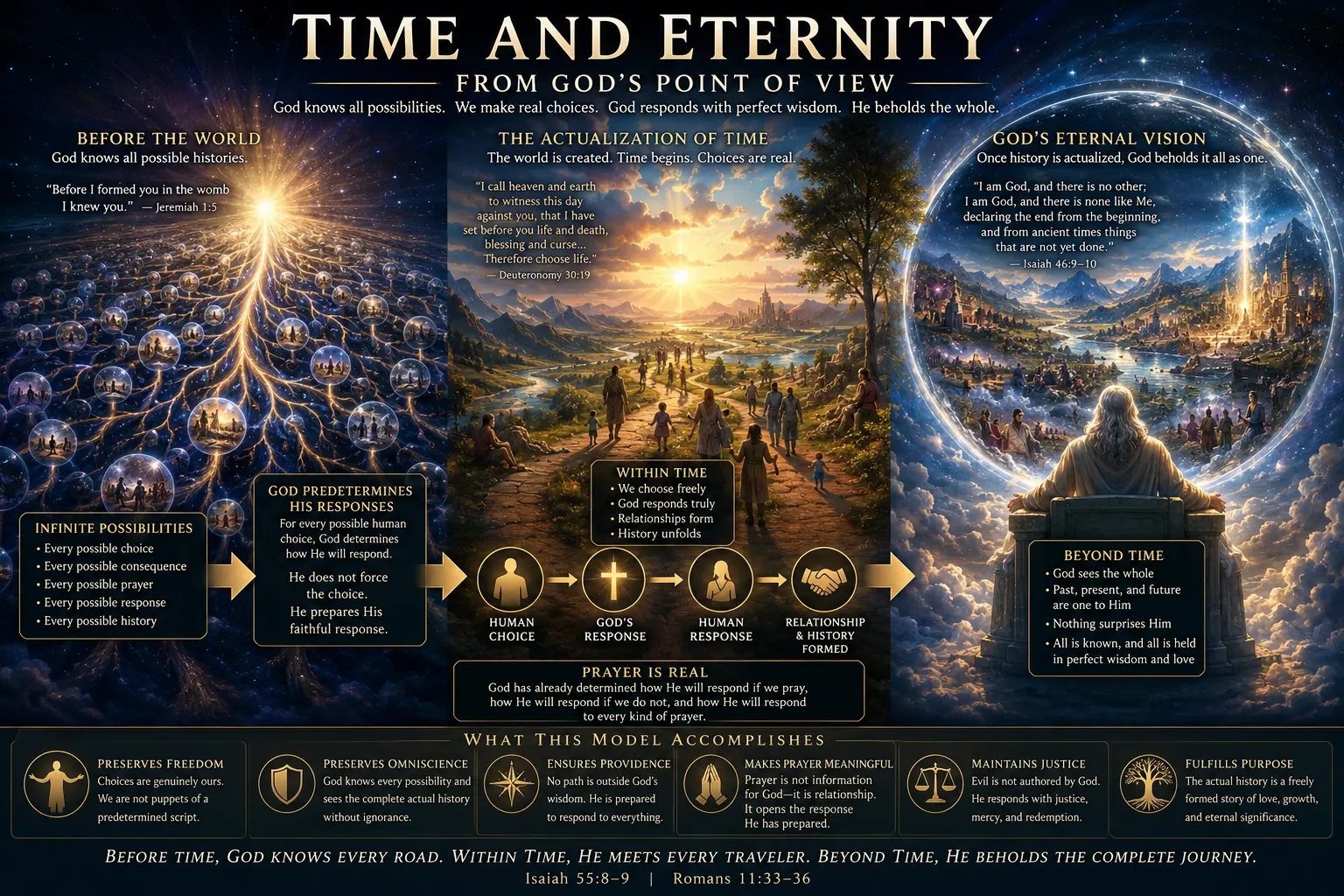
Before the actualization of the world and the dimension of time, God knew every history that could possibly exist. He knew every creature who could be created, every decision each creature could make, every consequence that could follow, and every response that he himself could give.
He knew all possible histories perfectly.
But he did not yet see one particular history as the actual history, because no history had yet been actualized.
There was not yet a real future containing settled human decisions. There was only the complete realm of possible futures.
This distinction is the foundation of the model:
Before time is actualized, God knows everything that can happen. Once time is actualized, God sees everything that has happened, is happening, and will happen within that history as one complete reality.
The Infinite Tree of Possible Histories
We can imagine the possibilities known by God as an immeasurable tree.
Every possible decision creates a branch.
A person may speak or remain silent. Trust or betray. Forgive or refuse to forgive. Pray or turn away. Help another person or ignore them. Every choice opens one path while leaving other paths unrealized.
But human choices are not the only branches.
God’s responses also belong to the structure of possible history. For every possible human action, God knows how he may respond. That divine response may then produce another human response, which may call forth another divine action.
History is therefore not merely a list of human choices observed by a passive God. It is a relational movement formed by the interaction between creatures and their Creator.
A human being acts.
God responds.
The human being responds to God’s response.
God answers again.
From this interaction, an entire history is formed.
Before creation, God knows every possible version of this interaction. He knows every possible prayer and every possible answer. Every rebellion and every correction. Every act of mercy, judgment, patience, concealment, revelation, rescue, and restoration.
He does not merely know isolated choices. He knows the complete histories that would arise from every possible combination of human and divine action.
God Predetermines His Responses
According to this model, God does not predetermine every human choice. Instead, he predetermines his own responses to every possible human choice.
This is an important difference.
God does not say:
“This person must betray, so that I may respond in this particular way.”
Rather, he establishes a complete conditional order:
“If this person remains faithful, I will respond in one way. If this person betrays, I will respond in another. If the person later repents, I will respond to the repentance. If the person continues in rebellion, I will answer that continued rebellion differently.”
The divine response exists as a real decision, but it exists conditionally.
It is similar to a promise whose application depends upon what the creature does. The promise is fixed, while the condition remains open.
God may determine:
“If they seek me, I will receive them.”
“If they oppress the innocent, I will oppose them.”
“If they repent, I will show mercy.”
“If they harden themselves, I will allow them to experience the consequences of that hardness.”
“If they ask for wisdom, I will guide them according to the form their life has taken.”
These responses are not improvised because God lacked preparation. They belong to the eternal structure of his will.
God has already considered every possible situation because every possible situation is completely present to his understanding.
His responsiveness does not arise from ignorance. It arises from relationship.
A Map Rather Than a Script
The result is not a single predetermined script. It is a complete divine map of all possible histories.
A script contains only one sequence of events. Every line is fixed in advance, and every actor merely performs what has already been written.
A map is different.
A map contains many possible paths. The traveler genuinely chooses which path to take, but every path is already understood by the one who possesses the complete map.
God’s knowledge before creation is therefore not merely the knowledge of one unavoidable timeline. It is the knowledge of the entire landscape of possibility.
God knows what would happen under every condition.
He knows what a person would face if they chose one path rather than another. He knows how his own action would alter the possibilities available afterward. He knows the full consequences of mercy, silence, judgment, intervention, delay, revelation, and concealment.
Nothing can surprise God in the sense of presenting him with a possibility he had never considered.
Yet a particular creaturely choice can still be genuinely undetermined until it becomes actual.
God eternally understands the possibility of the choice. He does not need to eternally treat that possibility as an already existing fact.
The Actualization of Time
Creation is more than the production of matter and space. It is also the actualization of temporal reality.
When time is created, possibility begins to take the form of history.
From within the world, this history is experienced sequentially.
A child is born before becoming an adult. A question is asked before it is answered. A wound occurs before it is healed. A decision is made before its consequences are experienced.
Human consciousness moves through time one moment after another. We remember what has passed, experience what is present, and imagine what may come.
God does not experience the created dimension of time in this restricted way.
Once temporal history is actualized, God does not have to wait for one century to pass before seeing the next. He sees the complete temporal reality from beyond its internal sequence.
To the inhabitants of time, history unfolds.
To God, history stands revealed as a whole.
This does not mean that the events did not genuinely happen in sequence. It means that God’s vision is not trapped inside that sequence.
A person standing on a road sees only the portion immediately surrounding them. Someone standing above the entire landscape may see the road’s beginning, its turns, and its destination simultaneously.
The higher observer does not cause the traveler’s movements simply by seeing the whole road. The traveler still walks each step.
In the same way, God’s complete vision of actualized history does not become the cause of human choices. His knowledge reflects what the creatures really choose within time.
God Does Not See the Future Before There Is a Future
This model makes a careful distinction between two kinds of divine knowledge.
Before the actualization of time, God possesses complete knowledge of possibility.
After the actualization of time, God possesses complete knowledge of actuality.
This does not mean that God was ignorant. Ignorance is the failure to know something that is already true or already exists.
Before history exists, there is no actual history for God to fail to know.
There are only possible histories.
God knows every one of them.
Once the world and its temporal dimension are actualized, one history becomes real. God then knows that actual history in its totality.
The transition is not from ignorance to intelligence. It is from the knowledge of all possibilities to the knowledge of which possibility has become actual.
God does not discover a fact that had secretly existed without him. Rather, the fact comes into existence through actualization and is immediately, completely, and eternally present to him.
The difference is subtle but essential.
God always knows everything that exists.
Before the actual world exists, he knows it as possible.
Once the actual world exists, he knows it as actual.
The Whole History Is Formed Through Real Choices
When God sees the completed history, he sees a history that was genuinely formed through the interaction of free beings.
The whole is fixed because it is actual, not necessarily because it was causally predetermined.
An event can be permanently true without having been forced.
Once a person has freely chosen something, it becomes forever true that the choice was made. Not even God needs to turn the choice into something that never occurred. The event becomes part of the eternal identity of the actual world.
From within time, the choice is open before it is made.
From beyond time, the completed choice is visible as part of the whole.
These are not contradictory perspectives.
The person does not choose an action because God sees it in the completed history. God sees it in the completed history because the person truly chooses it within time.
Divine knowledge follows the reality of the act logically, even though God’s vision of the complete temporal reality is not sequential.
The choice grounds the knowledge. The knowledge does not force the choice.
God Beyond Time and God Within Time
God’s relationship with time has two aspects.
God transcends time because time is a created dimension. He is not carried helplessly from one moment into another. He sees the full structure of temporal reality.
Yet God is also present within time.
He meets each creature in the moment that creature inhabits. He speaks within history. He responds to prayer. He intervenes, waits, permits, warns, forgives, judges, and restores.
From beyond time, God sees the complete interaction.
From within time, God genuinely participates in it.
These two perspectives do not cancel each other.
An author may understand an entire story while still being present through every page. In God’s case, however, the created persons are not fictional objects without freedom. They are real centers of action whose choices participate in forming the history God beholds.
God’s transcendence allows him to see the whole.
God’s presence allows him to enter every part.
Eternity is therefore not distance from time. It is the divine capacity to contain the whole of time without being imprisoned by its succession.
Divine Freedom and Divine Constancy
One possible objection is that predetermined responses would make God mechanical.
If God has already decided how he will respond to every possible situation, does he still possess freedom?
The answer is that divine freedom is expressed in the establishment of the responses themselves.
God freely determines how his wisdom, justice, mercy, patience, and love will be expressed under every possible condition. Once he has established those responses, remaining faithful to them is not a loss of freedom. It is the perfection of character.
A truthful person does not become less free because they refuse to lie. Their constancy reveals who they are.
In the same way, God’s responses are not external laws imposed upon him. They are expressions of his own nature and will.
He is not trapped by his goodness. His goodness is the form his freedom takes.
God could not be perfectly trustworthy if his response to the same moral reality were completely arbitrary. Divine freedom cannot mean irrational instability.
The predetermined response-map allows God to remain both free and consistent.
He is free because the order originates in him.
He is consistent because he does not betray the order he has established.
What This Model Solves
Freedom Without Divine Ignorance
The model preserves meaningful human freedom without reducing God to ignorance.
God knows every possible decision perfectly. He understands the creature more deeply than the creature understands itself. He knows every motive, pressure, temptation, opportunity, consequence, and possible development.
What he does not do before actualization is treat one undetermined possibility as though it were already the actual fact.
This allows the future to remain open before the world is actualized while preserving the fullness of divine understanding.
Omniscience Without Fatalism
Traditional ideas of foreknowledge can appear to create a fixed future.
If God infallibly knows before creation that a person will choose a particular act, it may seem impossible for that person to choose otherwise. If the person chose differently, the eternal divine knowledge would have been false.
This model avoids that problem by denying that an unactualized free choice must already exist as a definite fact.
Before actualization, God knows all possible choices.
After actualization, he knows the choice that is truly made.
Omniscience means that God knows all reality perfectly. It does not require unrealized possibilities to pretend to be actual events.
Providence Without Total Determinism
The model also explains how God can govern history without scripting every human action.
God’s providence lies in his complete preparation.
No creature can move beyond the reach of divine wisdom because every possible path already has an appropriate divine response. Even rebellion cannot create a situation for which God has no answer.
Human beings may alter the path of history, but they cannot escape the divine field of response.
God does not need to control every decision in order to guide the whole.
He governs through perfect understanding, unlimited presence, and a response prepared for every possible direction creation may take.
Genuine Prayer
Prayer becomes a real part of the formation of history.
God does not need to learn that a person is suffering. Nor does prayer provide information that was absent from his possible knowledge.
Instead, prayer actualizes a relationship.
God has already determined how he will respond if the person prays, how he will respond if the person refuses to pray, and how he will respond to the different forms that prayer may take.
When the person actually prays, the corresponding divine response becomes part of the actual history.
Prayer therefore matters without making God ignorant or unstable.
It does not inform an uninformed God. It opens a path that God has eternally prepared to answer.
Divine Response Without Divine Changeability
Scripture and religious experience often speak of God responding, relenting, grieving, becoming angry, showing mercy, or changing his treatment of a person.
These descriptions can seem incompatible with divine immutability.
The response-map solves much of this tension.
God’s character does not change, but the creature’s relationship to that character changes.
The same fire warms one person and burns another. The fire has not changed. The person’s position has changed.
Similarly, God may oppose a person while they commit injustice and receive that same person mercifully when they repent. God has not transformed from evil to good or from unstable anger to unstable kindness.
The condition has changed, and therefore a different aspect of the eternally established divine response becomes actual.
God is relationally responsive without being morally inconsistent.
Evil Without Divine Authorship
If every event were selected as part of one unavoidable divine script, evil could appear to originate directly in God’s decision.
In this model, God knows evil as a possibility without willing it as the only possible reality.
When a creature actualizes evil, God responds to it. He may permit its immediate existence without approving its nature. He may limit it, transform its consequences, confront the offender, strengthen the victim, or weave eventual repair out of what the creature has damaged.
The evil belongs morally to the will that actualized it.
The divine response belongs to God.
God remains sovereign because evil cannot exceed his capacity to answer it. Yet he does not become the author of the rebellion simply because he knew the possibility and prepared a response.
Moral Responsibility
Human beings remain responsible because their decisions genuinely contribute to the form of the actual world.
The person is not merely discovering a role written for them before they existed. Their choice is one of the acts through which the history becomes the history it is.
Once actualized, that choice becomes visible to God in the completed whole. But its visibility does not erase its freedom.
The eternal record preserves responsibility rather than removing it.
The person sees a moment and decides.
God sees the entire life in which that decision stands.
Prophecy Without Universal Predetermination
Prophecy can also be understood within this model.
Some prophecies concern events God himself has unconditionally decided to accomplish. These events are certain because their fulfillment depends primarily upon divine action.
Other prophecies are conditional. They reveal what will occur if a people continue along a particular path.
God may declare judgment, and the people may repent. The announced future then does not occur because the prophecy successfully changed the conditions that would have produced it.
This is not failed knowledge. It is relational governance.
God knows both histories: the history in which the warning is ignored and the history in which the warning produces repentance.
The prophecy itself becomes one of the forces that helps determine which possibility is actualized.
A Middle Way Between Classical Theism and Open Theism
This model occupies a position between two common understandings.
Classical timeless foreknowledge usually teaches that God knows the one actual history completely and eternally, even before creation. The future is never open from God’s perspective.
Open theism emphasizes that future free choices are not yet definite facts and are therefore known by God as possibilities. However, it often presents God as moving through time alongside creation, discovering the actual future as events occur.
The present model accepts something from both sides while remaining identical to neither.
With open theism, it affirms that unrealized free decisions are possibilities rather than already actual facts.
With classical timelessness, it affirms that once the temporal world exists, God sees the whole dimension of history rather than learning it one moment at a time.
God does not watch the future arrive gradually.
He sees the actualized history as a complete temporal form.
Before actualization, he knows the whole field of possibility.
After actualization, he knows the whole reality that has emerged from that field.
Eternity Is Not Infinite Duration
This model also gives eternity a more precise meaning.
Eternity is not simply time that never ends.
An existence lasting for endless centuries would still be temporal if it moved from one moment to the next. It would be everlasting duration, not necessarily eternity.
Divine eternity is the mode of being from which the whole of time can be present.
God does not stand at the beginning of time looking toward a distant future. Nor does he stand at the end remembering a vanished past.
He contains the complete temporal dimension in his knowledge and presence.
Every moment is immediate to him, though the moments remain ordered in relation to one another.
The birth still comes before the death. The cause still precedes the effect. The prayer still occurs before its answer within the created sequence.
Yet God is present to all these moments without needing to travel from one to the next.
The World as a Completed Relationship
From God’s point of view, the actual world is not merely a collection of events.
It is a completed relationship.
It is the total form created by every divine gift, every human response, every refusal, every return, every judgment, every act of mercy, and every work of restoration.
God sees not only what each person did, but what they could have done, why they chose as they did, what alternatives stood before them, and how his own presence interacted with them.
He sees the world without losing any of its complexity.
Nothing is reduced to a single isolated moment.
A failure is seen together with everything that led to it and everything that may follow from it. A prayer is seen together with the suffering that produced it and the answer that unfolds from it. A life is seen as one complete shape.
Human beings encounter themselves as unfinished stories.
God sees the finished form without denying the reality of every free moment through which that form was made.
The Threefold Divine Perspective
The model can finally be expressed through three forms of divine knowledge.
Before the creation of time, God knows:
All that may be.
Within his presence to temporal creatures, God knows:
All that is being chosen and formed.
From beyond the completed dimension of time, God sees:
All that the actual history is.
These are not three incomplete minds in God. They are three relationships between divine knowledge and created reality.
Possibility is known as possibility.
Choice is encountered as choice.
Actuality is known as actuality.
God never confuses one with another.
He does not mistake a possible evil for an actual evil. He does not mistake an open choice for a completed choice. He does not mistake a completed history for a history that was forced.
His knowledge is perfect because it knows each thing according to the mode in which that thing truly exists.
Conclusion: The Eternal Witness of a Free History
From God’s point of view, eternity is not a frozen future imposed upon creation.
It is the complete divine comprehension of possibility, response, actualization, and fulfillment.
Before the world, God knows every history that could be formed.
He freely establishes his responses to every possible creaturely choice.
Through creation, the dimension of time becomes real.
Within time, human beings genuinely choose, and God genuinely responds.
From beyond time, God sees the whole history formed by those interactions.
Nothing surprises him as an unknown possibility.
Nothing forces the creature merely because God sees the completed result.
Nothing escapes his providence because every path lies within the reach of his wisdom.
The future is not a secret script hidden from humanity while already performed in the mind of God. It is the field in which real choices become actual and enter the eternal truth of the world.
God’s omniscience does not need to destroy freedom.
His eternity does not need to destroy time.
His constancy does not need to destroy relationship.
His providence does not need to turn creation into a machine.
Before time, God knows every road.
Within time, he meets every traveler.
Beyond time, he beholds the complete journey.
**Possibility belongs to divine wisdom.
Choice belongs to living freedom.
Response belongs to divine faithfulness.
History belongs to their actual meeting.
Eternity is the vision of the whole.**