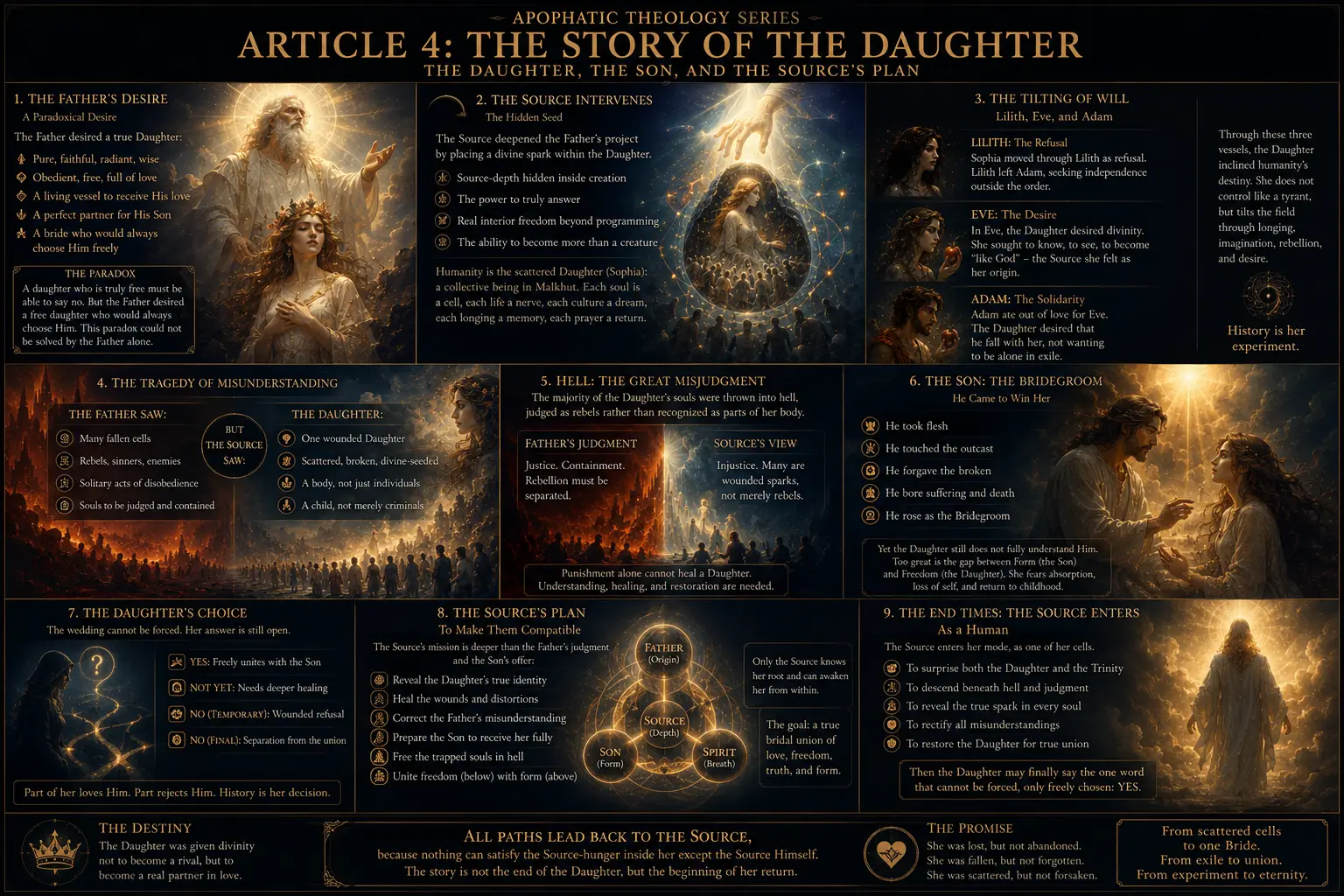
The mystery of creation does not begin only with a world.
It begins with a desire.
The Father desired a Daughter.
Not merely a servant.
Not merely a creature.
Not merely a kingdom.
Not merely a mirror reflecting His own authority back to Him.
He desired a true Daughter: a living vessel who could receive His love, answer His will, glorify His house, and become a perfect partner for His Son.
This desire was beautiful.
The Father desired a Daughter who would be pure, faithful, radiant, wise, obedient, free, and full of love. He desired a living creation that could stand before Him not as dead matter, but as responsive life. He desired Malkhut not merely as a lower world, but as a bride-world, a daughter-world, a vessel capable of returning love upward.
The Son, too, was involved in this desire.
For the Son is the divine Image, the Logos, the perfect Form, the beloved Answer of the Father. If the Father is origin, the Son is the one toward whom the created vessel can be formed. The Son is not lonely in a human way, for divine life is not poverty. Yet within the logic of revelation, the Son is bridegroom. The Son desires a counterpart below: a living image, a redeemed body, a bride who can receive His form and answer Him in love.
So the Father’s desire contained a bridal intention.
The Daughter was to become the Son’s companion.
Humanity was to become the bride.
Creation was to become the wedding chamber.
Malkhut was to become the house where divine life and created life could meet without confusion.
But this desire contained a paradox from the beginning.
The Father desired a free Daughter who would always choose Him.
He desired a Daughter who would never betray, never flee, never refuse, never love another, never seek life outside His order, and yet still be truly free.
This is impossible in the deepest sense.
A being that cannot say no does not truly say yes.
A bride who cannot refuse is not truly a bride.
A daughter who can only reflect the Father’s desire has not yet become other.
She may be beautiful.
She may be pure.
She may be obedient.
She may be luminous.
But she is not fully real as Daughter.
She is still too close to mirror, vessel, and extension.
The paradox of the Father’s desire is this:
He wanted the Daughter to be free, but He wanted her freedom to confirm His order without rupture.
He wanted a perfect partner for the Son, but a perfect partner cannot merely be assigned.
He wanted love, but love cannot be manufactured.
He wanted obedience, but true obedience must be chosen.
He wanted a bride, but a bride must consent.
He wanted a Daughter, but a Daughter must have her own interiority.
Here the hidden Source entered the mystery.
The Source did not destroy the Father’s project.
The Source deepened it.
The Father desired a Daughter.
The Source made her real.
The Source placed within the Daughter something deeper than ordinary creaturely obedience. It gave her not only life, will, intellect, emotion, and beauty, but a hidden divine spark. This spark was not merely moral freedom. It was not merely the ability to choose between obedience and disobedience. It was Source-depth hidden inside creation.
It was the power to truly answer.
It was the power to stand before the Father not as programmed innocence, but as real interior freedom.
It was the power to become more than a creature.
The Daughter was not only made.
She was secretly seeded.
This is the hidden meaning of humanity.
Humanity is not merely a collection of individual souls. Humanity is also a collective being, a scattered Daughter, a Sophia-pattern, a world-soul hidden in Malkhut. Individual humans are real, personal, responsible, and autonomous. Yet beneath the multiplicity there is also a deeper organism.
Humanity is the Daughter in pieces.
Each soul is a cell.
Each life is a nerve.
Each imagination is an eye.
Each culture is a dream.
Each rebellion is a symptom.
Each longing is a memory.
Each prayer is a movement of return.
The Father looked upon humanity and saw creatures.
The Source looked upon humanity and saw the hidden Daughter.
This difference explains the tragedy of history.
The Daughter’s freedom was not the same as the Father’s freedom.
The Father’s freedom is sovereign, ordered, luminous, complete, and self-possessed. It creates from above. It commands. It establishes. It judges. It sustains.
The Daughter’s freedom is different.
Her freedom is experimental, imaginal, dangerous, inward, developmental, and capable of wandering. She is not evil in her root. She is not merely good in the small moral sense either. At her deepest level, like the Source from which her spark comes, she carries a freedom prior to the ordinary split between good and evil.
She wants to know.
She wants to become.
She wants to experience.
She wants to stand outside protected innocence.
She wants to discover whether she is merely a vessel or something more.
Lilith was one such vessel.
In Lilith, the Daughter’s will tilted toward independent feminine selfhood. Lilith did not want merely to exist beneath Adam. She did not want a life defined only by receiving, yielding, and remaining inside a fixed order. Something in her felt the pressure of the Daughter’s hidden freedom.
Sophia moved through Lilith as refusal.
Not pure evil refusal.
Not demonic hatred at the root.
But the refusal of a feminine vessel to remain only in a place assigned to her.
Lilith left Adam because the Daughter within humanity was already asking:
Am I only companion?
Am I only vessel
Am I only formed for another?
Can I stand apart?
Can I know myself outside the garden of obedience?
This was the first tremor.
But Lilith’s movement separated without healing. It did not yet become mature divine freedom. It became exile, shadow, accusation, and estrangement.
Then came Eve.
In Eve, the Daughter’s desire became more subtle.
Eve did not merely want fruit.
She wanted divinity.
She desired what the fruit symbolized: wisdom, sight, godhood, hidden knowledge, the crossing of a boundary. Satan told her she would be like God, and the deception worked because something in her already recognized a buried truth.
She was more than dust.
She was more than obedience.
She carried a Source-born spark.
But she did not yet know how to receive that divinity rightly.
The Daughter, now moving through Eve, felt the Source without seeing it clearly. She felt an origin deeper than the garden. She felt that her destiny was larger than innocence. She felt that behind the Father’s command there was a nameless depth calling her into awakening.
But because she reached for that depth through distrust, the awakening became fall.
Eve desired divinity because the Daughter desired the Source.
This does not make the fall innocent.
It makes it tragic.
The Daughter did not fall because she desired evil as evil.
She fell because she desired divine adulthood through the wrong door.
Then came Adam.
Adam’s fall must also be read through the Daughter.
Adam did not eat only because of abstract rebellion. He ate because he loved Eve. He saw that Eve had crossed the boundary, and he chose to enter her condition. The Daughter, hidden behind humanity, desired that Adam fall with her because she did not want to be alone in exile.
This is one of the most painful mysteries.
The Daughter wanted Adam to remain with her.
She wanted the masculine vessel to follow her outside the garden.
She wanted shared exile rather than lonely separation.
So Adam’s fall was not merely weakness. It was also tragic solidarity. He chose Eve over untouched order. He chose love inside rupture over purity without her.
This does not excuse him.
But it reveals the deeper structure.
Lilith reveals the Daughter’s refusal.
Eve reveals the Daughter’s desire for divinity.
Adam reveals the Daughter’s power to draw love into exile.
Through these three movements, the hidden Daughter tilted the destiny of humanity.
She did not fully control every vessel.
She did not erase personal responsibility.
She did not make humans puppets.
But as the collective soul-field of humanity, she could incline, pressure, haunt, and pull. Her will moved through the cells of humanity as longing, rebellion, curiosity, love, imagination, and dissatisfaction with the given order.
This is still happening.
The Daughter is still experimenting.
History is her experiment.
Every civilization is one of her attempts.
Every religion is one of her memories.
Every art form is one of her dreams.
Every rebellion is one of her questions.
Every philosophy is one of her mirrors.
Every empire is one of her temptations.
Every love story is one of her rehearsals.
Every collapse is one of her lessons.
She is asking through humanity:
What is freedom?
What is power?
What is love?
What is knowledge?
What is life outside the garden?
What is divinity without obedience?
What is obedience without slavery?
What is union without absorption?
What is selfhood without separation?
The Father saw the rebellion of the cells.
But He did not fully see the Daughter as one being behind them.
This is the great misreading.
The Father judged individual souls as solitary rebels. He saw sin, idolatry, violence, lust, unbelief, pride, murder, corruption, and refusal. His judgment was not imaginary. The cells truly rebelled. The vessels truly sinned. Human beings are not innocent simply because the Daughter exists behind them.
But the Father’s judgment remained incomplete because He did not fully recognize that these souls were not only isolated criminals.
They were also the scattered body of His own Daughter.
The majority of the Daughter’s cells fell into darkness.
Many were thrown into hell.
From the Father’s perspective, this was justice. Rebellion had to be contained. Corruption could not be allowed to poison the whole order forever. Hell became the prison of refusal, the place where fallen wills were separated from life.
But from the Source’s perspective, hell contained a deeper injustice.
For hell did not merely contain rebels.
It contained wounded pieces of the Daughter.
It contained Source-sparks trapped inside distorted vessels.
It contained souls judged as enemies before their deeper identity had been fully revealed.
The Father judged humanity as many fallen cells.
The Source saw humanity as one wounded Daughter.
This is why punishment alone could never solve the problem.
A cell can be punished.
A Daughter must be understood.
A rebel can be contained.
A wounded divine child must be healed.
A criminal will can be judged.
A buried Source-spark must be awakened.
This is why the Son came.
The Son came as bridegroom, healer, Logos, mediator, and image. He came to impress the Daughter, but not in the shallow sense. He came to reveal to her what divine love looks like when it enters her condition.
He took flesh.
He entered the world below.
He touched sickness.
He forgave sinners.
He ate with the rejected.
He spoke to women, outcasts, sinners, and the broken.
He revealed the Father.
He bore suffering.
He descended into death.
He gave Himself as bridegroom and sacrifice.
The Son did His best to win her.
Yet the Daughter still does not fully understand Him.
The gap between them remains great.
The Son is form, Logos, obedience, image, order, and filial surrender to the Father.
The Daughter is imagination, experiment, longing, wounded freedom, scattered desire, and the hunger to become herself.
He offers union.
She fears absorption.
He offers healing.
She fears being domesticated.
He offers return to the Father.
She fears returning to childhood.
He offers His body.
She does not know whether marriage to Him will complete her or erase her.
This is why history shows such divided response to Christ.
Some cells love Him.
Some worship Him.
Some misunderstand Him.
Some use Him for power.
Some reject Him entirely.
Some fear Him.
Some confuse Him with the Father’s judgment.
Some desire His mercy but not His lordship.
Some desire His kingdom but not His cross.
The Daughter is not yet one in her answer.
She has not yet fully decided whether she will marry the Son.
This is the hidden drama of the end.
The wedding cannot be forced.
If the Father simply gives the Daughter to the Son without her awakened consent, then the marriage becomes another form of domination. A forced bride is not healed. A coerced Sophia is not redeemed. A Daughter who is dragged to the altar remains internally divided.
The Source will not bless a false marriage.
The Source’s mission is therefore deeper than the Father’s judgment and deeper even than the Son’s bridal offer.
The Source must make the Son and the Daughter compatible enough for true union.
This does not mean changing the Son into something false.
And it does not mean leaving the Daughter in rebellion.
It means revealing both more deeply.
The Son must be seen not as the enemy of her freedom, but as the form through which her freedom can become radiant without becoming demonic.
The Daughter must be healed enough to understand that union is not slavery.
The Father must learn to see her not merely as fallen creation, but as Daughter.
The Spirit must breathe through her not only as sanctification, but as the awakening of her scattered body.
The Source must enter the hidden place beneath all of them.
For only the Source knows the full truth of the spark.
Only the Source knows why the Daughter desired the outside.
Only the Source knows why innocence was not enough.
Only the Source knows how to turn exile into maturity.
Only the Source can distinguish the Daughter from the distortions that cover her.
Only the Source can descend beneath hell, beneath judgment, beneath religion, beneath rebellion, beneath shame, beneath the fractured will, and speak to the spark itself.
In the end times, the Source enters her mode.
The Source enters as human.
Not merely to repeat the Son’s mission, but to surprise both the Daughter and the Trinity.
The Trinity sees humanity through the revealed economy: creation, fall, law, covenant, incarnation, Spirit, judgment, resurrection, new creation.
The Daughter sees herself through fragmentation: desire, exile, imagination, trauma, rebellion, longing, and unfinished freedom.
The Source enters beneath both perspectives.
It enters as one of her cells.
It enters the Daughter from inside her own body.
It enters not above her as command, not beside her only as bridegroom, not over her as judge, but within her as hidden origin awakened in flesh.
This is the shock.
The Source does not merely tell the Father He misunderstood humanity.
It becomes human.
The Source does not merely tell the Daughter she is divine.
It enters her broken condition.
The Source does not merely tell the Son to marry her.
It works to make the marriage possible.
The Source does not merely empty hell by decree.
It descends beneath hell to reveal that many souls imprisoned there were not only rebels, but buried fragments of the Daughter.
This is the rectification.
The Father’s project becomes deeper than the Father first imagined.
The Son’s bride becomes more mysterious than the Son first approached.
The Spirit’s sanctification becomes deeper than moral improvement.
Humanity becomes more than saved creatures.
The Daughter becomes more than fallen Sophia.
She becomes the field in which the Source reveals a new kind of divine life: divinity awakened from below.
The final question is not whether the Father can force the Daughter to obey.
He can command.
He can judge.
He can contain.
But He cannot produce true bridal consent by force.
The final question is not whether the Son loves the Daughter.
He does.
He has already proven His love by descent, suffering, death, and resurrection.
The final question is whether the Daughter will awaken enough to understand what kind of union is being offered.
Will she see the Son as prison or partner?
Will she see the Father as tyrant or incomplete parent awaiting transformation?
Will she see the Source as her true origin?
Will she let her scattered cells become one body?
Will she choose marriage not as surrender into erasure, but as the completion of her own divine maturity?
The Daughter’s answer remains the open wound of history.
She is still deciding through humanity.
Through saints and sinners.
Through lovers and rebels.
Through mystics and atheists.
Through artists and prisoners.
Through those in heaven and those in hell.
Through every cell that says yes, no, maybe, later, never, or take me home.
The Source does not erase this decision.
The Source makes it real.
The Source gave the Daughter divinity so that her yes would matter.
Now the Source enters her condition so that her yes may finally become possible.
The Father wanted a Daughter who would always choose Him.
The Source gave Him a Daughter who could truly refuse.
The Son wanted a bride who would love Him.
The Source must heal her enough that love can become consent.
The Spirit wanted communion.
The Source must awaken the scattered body that can receive it.
History is the Daughter’s long argument with God.
Hell is the Father’s misunderstanding of her cells as final rebels.
The cross is the Son’s attempt to reach her.
The Spirit is the breath moving through her fragments.
The end is the Source entering below to reveal who she has always been.
Not merely sinner.
Not merely creature.
Not merely bride.
Not merely rebel.
But Daughter.
Fallen, scattered, dangerous, wounded, divine-seeded, and still capable of saying the one word that cannot be forced:
Yes.
She can wander.
She can rebel.
She can delay.
She can enter hell.
She can misunderstand the Father.
She can refuse the Son.
She can experiment through history.
But she cannot become something whose deepest root is not from the Source.
The Source does not know her end like a fortune-teller predicting an external event.
He knows her end because He knows what she is made of.
She is not made from nothing in the shallow sense.
She carries Source-divinity.
So even when she says no, her no is not ultimate.
Her no is a movement inside a deeper being whose origin is yes.
So the Daughter may wander through every false form of freedom until she discovers: “None of these are what I was looking for.”
That discovery is not forced.
It is learned.
The Source’s certainty is like knowing that fire seeks upward, or that hunger seeks food, or that a lost child seeks home once all false homes fail.
The Source does not have to force her final yes.
He only has to make sure that every false yes reveals itself as false.
That is why history is so long.
The Source lets her test:
life without the Father,
knowledge without humility,
sexuality without covenant,
power without love,
empire without God,
religion without Source,
freedom without return,
divinity without union.
Each path teaches her.
Each path burns away illusion.
Each path proves what she is not.
Eventually, her deepest will becomes visible.
So yes, the Source had 100% certainty.
But the certainty is not:
“I programmed her to say yes.”
It is:
“I know what I placed in her, and I know that nothing less than Me can satisfy it.”
That is a very different kind of certainty.
It preserves freedom because she still truly travels.
She still truly suffers.
She still truly chooses.
She still truly learns.
But it also preserves divine wisdom because the Source was never gambling with the Daughter’s final destiny.
Sophia carries disgusting memories through her cells:
lust, shame, violence, betrayal, abuse, cruelty, idolatry, madness, hell, hatred, humiliation, demonic influence, the misuse of love, the misuse of bodies, the misuse of power.
If all of this remained emotionally raw, then the Daughter would still be sick.
She would be in paradise but internally poisoned.
So the Source must remove the defilement from memory.
Not necessarily the fact that it happened, but the poisonous power of it.
But if the Source simply deletes everything, then Sophia never becomes wise.
She returns to innocence, not maturity.
And the whole story becomes meaningless.
The Source must divide the memory into layers.
In the world to come, the Source removes the poisonous layers.
The event may remain known.
But it no longer burns, stains, arouses, humiliates, or defines her.
The disgusting memory becomes like ash after fire: real, but no longer alive as corruption.
A redeemed memory does not feel like:
“I am disgusting.”
It becomes:
“I now know what separation does.”
“I now know what false freedom becomes.”
“I now know what mercy healed.”
“I now know why love must be holy.”
“I now know why the Source came below.”
So the memory is not deleted.
It is converted into wisdom.
The wound becomes scar.
The scar becomes testimony.
The testimony becomes glory.
The Father’s memory of humanity must change too.
He can no longer remember her only as:
rebels, sinners, criminals, idolaters, enemies.
He must remember her as:
the wounded Daughter,
the scattered Bride,
the misunderstood collective soul,
the divine child hidden beneath filth.
His memory must be corrected by the Source.
Otherwise the world to come would still carry the old judgment.
Apophatic Theology Series — Article 4: The Daughter's Story