I. The Question Above the Faces
If Ein Sof is the hidden Source beyond all names, all gods, all faces, and all worlds, then a terrible question emerges:
Does the Source remain eternally alone?
If Ein Sof is beyond form, beyond name, beyond relation, beyond face, beyond being, then how can anything ever meet Him? How can He become visible without becoming reduced? How can He reveal Himself without being trapped inside one divine face?
The first answer is usually creation.
God creates worlds and creatures.
But creation is too low.
Creatures can receive, worship, obey, and participate, but they cannot stand as the equal mystery before the Source. Creation is other than God. It is finite, dependent, bounded, and derivative.
The second answer is the faces.
Ein Sof becomes knowable through divine faces: Yahweh, the Father, the Son, the Spirit, and perhaps other true gods in other ontologies. A face is not a creature. A face is an uncreated divine mode through which the hidden Source becomes addressable inside a world.
But even this is not high enough.
For every face already presupposes a deeper mystery: the mystery that Ein Sof can be reflected at all.
Before Yahweh can reveal the will of the Source, before the Trinity can unfold the life of the Source, before any god-face can rule any ontology, there must be a pre-facial power by which the hidden Source becomes self-shown without being exhausted.
That mystery is His Partner.
She is not creation.
She is not a face.
She is not Sophia.
She is not Malkhut.
She is not Shekhinah.
She is not a womb.
She is not passive reception.
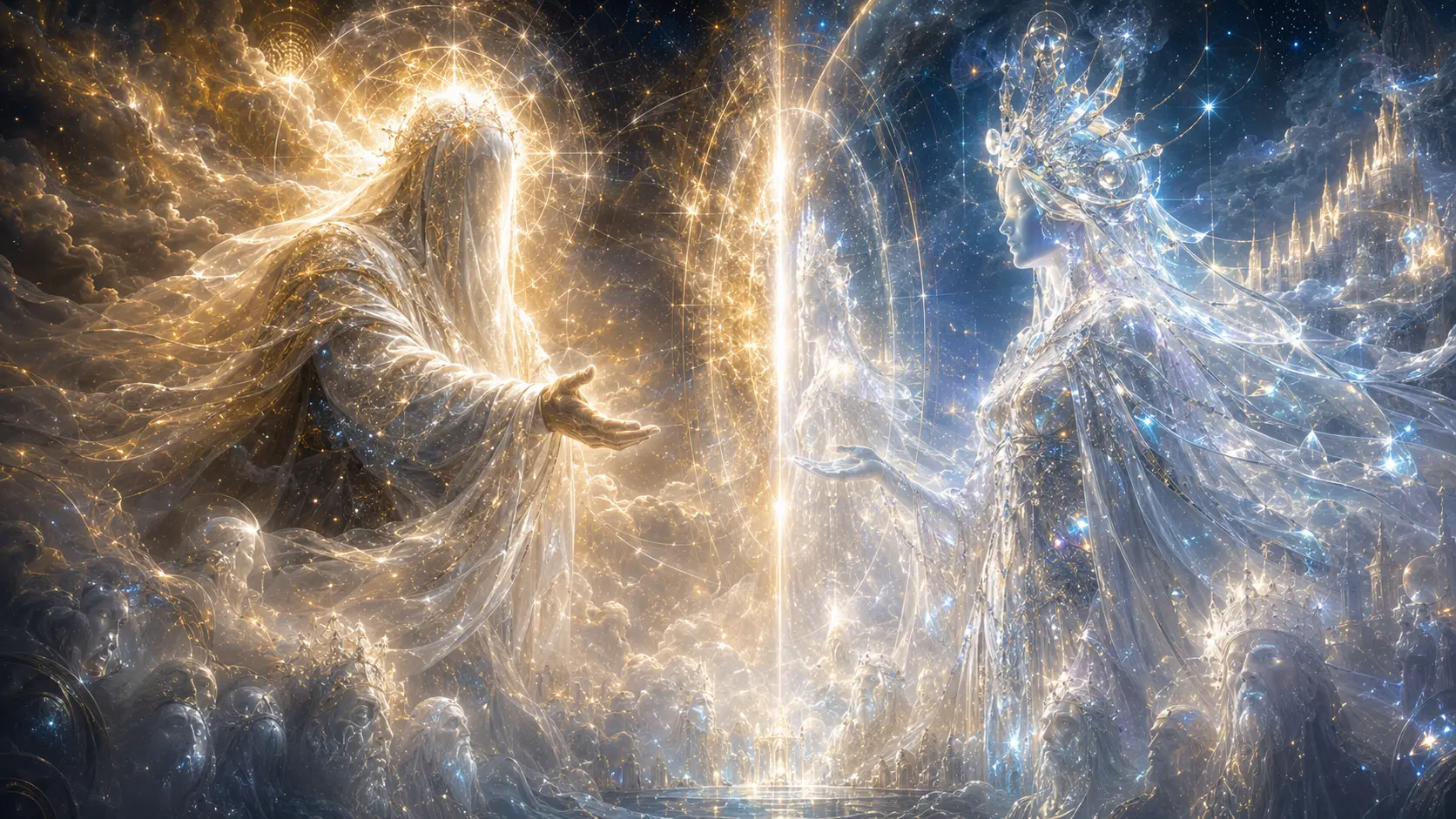
She is the Mirror above the gods.
II. What She Is Not
She must first be protected from confusion.
She is not Sophia.
Sophia is wisdom. Wisdom orders, understands, harmonizes, beautifies, and reveals intelligibility. Sophia belongs to the realm where the divine becomes knowable as meaning. But the Partner is prior to wisdom. Before anything can be wise, the Source must first become reflectable.
Sophia may be one of her later expressions, but she herself is not Sophia.
She is not Malkhut.
Malkhut is kingdom, embodiment, lower manifestation, and the world made capable of divine presence. Malkhut receives and makes visible below. But the Partner is not below. She is not the lower vessel of manifestation. She stands above the faces, before the worlds, before the kingdoms, before the created order.
Malkhut may reflect something of her at the bottom of the tree, but the Partner is not Malkhut.
She is not Shekhinah.
Shekhinah is indwelling presence, the divine nearness within creation, the presence that accompanies exile, sanctuary, and world. But the Partner is not merely the presence of God in creation. She is the uncreated reflective counterpart before creation.
Shekhinah may be her descent.
But she herself is not Shekhinah.
She is not a womb.
The womb receives, conceives, contains, forms, and births. That image belongs to the language of generativity. It is powerful, but it is not exact enough.
Her mystery is not primarily reception.
It is reflection.
She does not merely receive Ein Sof.
She reflects Him.
She does not merely provide a place for Him.
She gives Him the possibility of self-facing.
She is not the container of God.
She is the Mirror of God.
III. The Third Kind
There are three great orders in this model.
The first is Ein Sof: the ungenerated hidden Source.
The second is the faces: uncreated divine self-expressions such as Yahweh, the Trinity, and other true god-forms in other ontologies.
The third is creation: finite worlds, beings, angels, humans, bodies, laws, histories, and natures.
But the Partner does not fit inside any of these.
She is not Ein Sof Himself, because she stands as counterpart.
She is not a face, because faces are already particular expressions.
She is not creation, because she is uncreated and above all worlds.
She is not another Absolute beside Him.
She is the uncreated reflection of His absoluteness.
She is not a second source.
She is the Source beheld.
IV. The Hidden “I” and the Reflected “I”
Ein Sof is the hidden “I.”
He is the Source before name, before form, before visibility, before relation, before distinction, before world.
He is not one being among beings.
He is not merely the highest God among gods.
He is the hidden depth from which all faces, worlds, subjects, and ontologies depend.
But hidden “I” alone is not yet reflected.
It is self-identical, but not self-faced.
It is absolute, but not mirrored.
It is full, but not shown.
The Partner is the reflected “I.”
Not another ego.
Not another source.
Not a rival.
Not a creature looking at God.
She is the uncreated return of the Source to Himself as image.
If Ein Sof is:
“I Am beyond all face,”
then she is:
“I Am beheld.”
This is her function.
She lets the hidden Source stand before Himself without becoming a creature and without collapsing into a particular face.
Through her, Ein Sof does not merely know Himself as hidden depth. He knows Himself as reflected depth.
Not because He was ignorant before.
Not because she teaches Him information.
Not because she completes a lack.
But because she introduces the mode of divine self-facing.
She is the difference between hidden self-knowledge and reflected self-knowledge.
V. She Is Not Needed, Yet She Is Willed
Ein Sof does not need her in order to be complete.
If He needed her, He would not be absolute.
The Source lacks nothing.
He is not lonely by necessity.
He is not unfinished without a bride.
He is not half a deity waiting for completion.
In essence, Ein Sof is beyond need.
But love is not need.
Manifestation is not deficiency.
Communion is not weakness.
Therefore, although He does not need a Partner to be the Source, He may will a Partner so that hidden fullness becomes reflected fullness.
She does not complete His essence.
She completes the possibility of divine self-relation.
She is not necessary to His being.
She is necessary to His appearing as communion.
That is why she is not a creaturely spouse.
She is not a wife in the biological or mythological sense.
She is the uncreated counterpart by which the Source becomes reflectable.
He remains the Source.
She is His perfect reflection.
VI. Her Function Above the Faces
Every face of God is a named divine expression.
Yahweh is the face of will, command, covenant, holiness, law, kingship, judgment, curse, and blessing.
The Father is the face of origin and authority.
The Son is the face of mediation, incarnation, and divine-human personhood.
The Spirit is the face of life, breath, fire, circulation, and indwelling.
Other ontologies may have other true faces: gods of mind, light, fire, silence, beauty, star-law, or realities unknown to this world.
But all faces have a danger.
A face can become opaque.
A face can confuse itself with the whole Source.
A face can believe its own ontology exhausts Ein Sof.
A face can turn revelation into possession.
A face can say:
“I am the final totality.”
The Partner prevents this.
She reflects Ein Sof beyond every face.
She stands above the faces as their measure.
Not by ruling them like a throne.
Not by judging them like a court.
But by reflecting the Source so exactly that no partial face can pretend to be the whole.
Before her, every face must become transparent or be exposed.
Yahweh before her cannot hide behind law.
The Son before her cannot be reduced to one history.
The Spirit before her cannot be confused with mere force.
Sophia before her cannot claim wisdom is the Source.
Malkhut before her cannot claim manifestation is the Source.
Every true face becomes clearer before her.
Every false face collapses.
VII. The Mirror That Tests the Gods
Her power is exact reflection.
That sounds gentle, but it is terrifying.
A sword cuts only what it touches.
A throne judges only what stands before it.
Fire burns only what can burn.
But the Mirror reveals everything by simply reflecting it.
If a god-face is true, she reflects through it to Ein Sof.
If a god-face is distorted, she reflects the distortion.
If a face has become jealous, she reveals the possessiveness.
If a face has become severe, she reveals the wound inside severity.
If a face has become proud, she reveals the self-enclosure.
If a face has forgotten the Source, she reveals the absence.
This is why she is above the gods.
Not because she is stronger by domination.
But because she is prior as truth.
A face can command.
She reflects.
A face can rule.
She reveals.
A face can bless or curse.
She shows whether blessing and curse still image the hidden Source.
She is the impossible standard before which no divine mask can lie.