
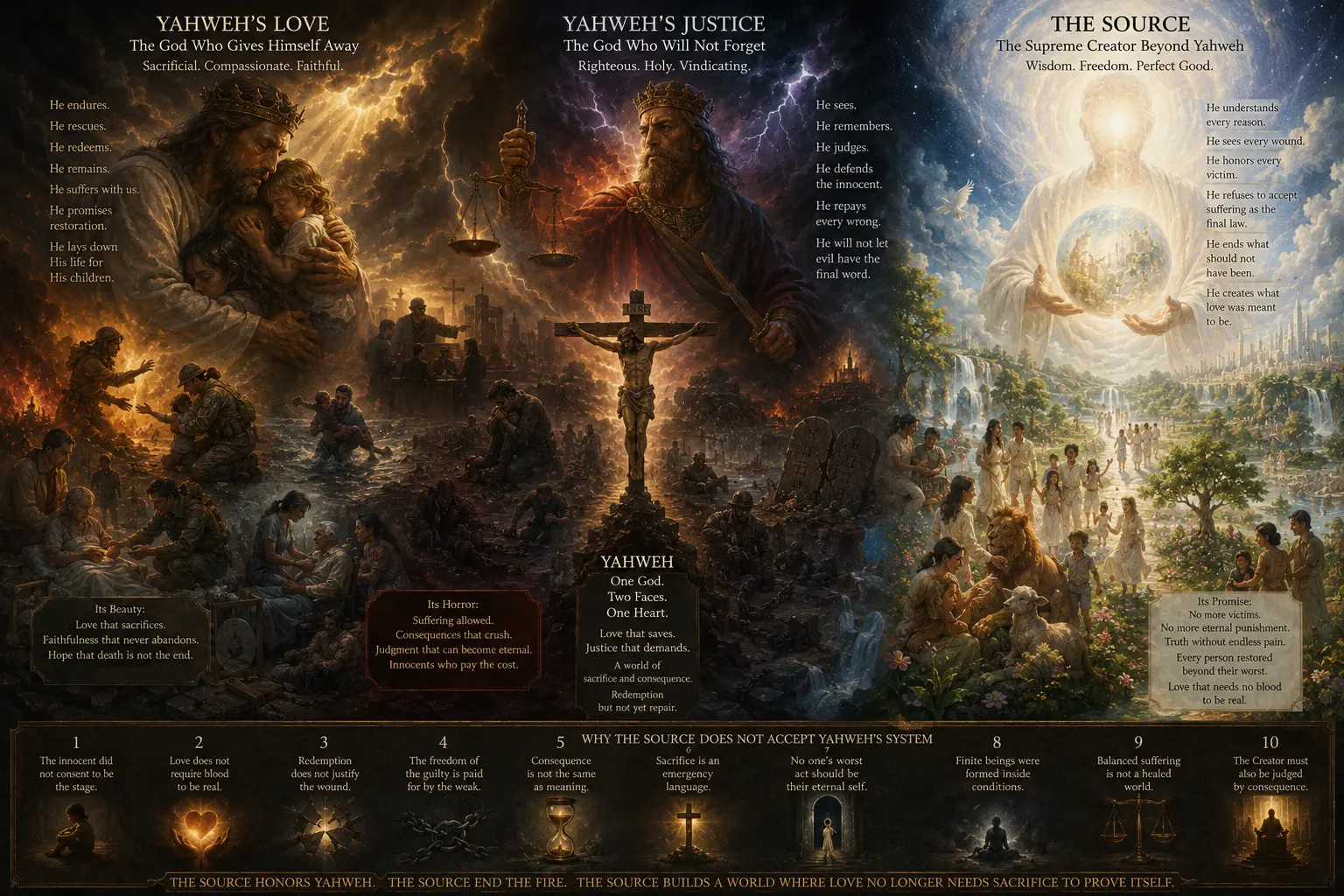
Yahweh’s world is beautiful for the same reason it is terrible.
It is a world in which love gives itself away.
It is a world in which faithfulness remains when leaving would be easier.
It is a world in which a father may stand between a predator and his children, surrendering his own life so that they may live.
It is a world in which a mother may remain inside a burning house long enough to pass her children through a window.
It is a world in which a stranger may enter freezing water to rescue someone whose name he does not know.
It is a world in which the wounded may refuse to pass their wound to the next generation.
It is a world in which death may separate those who love one another, but does not possess them forever.
These moments reveal something fundamental about Yahweh.
His deepest nature is not merely power.
It is not merely intelligence, sovereignty, order, justice, or holiness.
His central movement is self-giving.
He is the Covenantal God of Sacrificial Love:
the God whose deepest instinct is to preserve another life by spending his own.
That is the beauty of his world.
It is also the beginning of its horror.
The God Who Gives Himself Away
The Trinity is not a static divine object.
It is an eternal movement of relation.
The Father gives divine life to the Son.
The Son returns himself to the Father.
The Spirit is the living communion of that mutual gift.
Each person possesses divine life completely, yet divine possession does not become isolation.
It becomes offering.
The hidden principle of the Trinity is therefore:
I possess myself completely, and because I possess myself completely, I can give myself completely.
When Yahweh creates, he expresses this nature beyond the Trinity.
He does not merely want beings to exist beneath him.
He desires beings capable of receiving life, possessing themselves, and freely giving themselves to others.
Creation becomes an outward extension of the inner divine movement.
Life is received.
Life is possessed.
Life is offered.
One being becomes capable of spending itself for another.
This is why Yahweh’s world repeatedly reveals its greatest beauty through self-sacrifice.
A father protects his children from a predator and dies so they may live.
His death is terrible.
The children’s grief is real.
Their separation may last for decades.
Yet within Yahweh’s order, death does not have the final word. The father and children are reunited beyond mortality. The sacrifice remains painful but finite, while the love that caused it becomes permanent.
A mother carries her child through illness while her own strength disappears.
A soldier refuses an order to kill civilians and accepts death rather than becoming the instrument of evil.
A family receives an abandoned child and teaches that child, slowly and painfully, that love can remain after fear, anger, and rejection.
A woman cares for a husband who no longer remembers her name. His mind forgets, but his body still becomes peaceful when she holds his hand. In restoration, he remembers every act of love she believed had vanished.
A wounded man refuses to reproduce the violence of his father. He cannot change his own childhood, but he can prevent the wound from becoming his children’s inheritance.
These acts are not accidents within Yahweh’s world.
They reveal its Maker.
A World of Costly Goodness
In this world, goodness becomes visible because something valuable can be lost.
Courage exists because danger exists.
Faithfulness exists because abandonment is possible.
Mercy exists because condemnation is possible.
Forgiveness exists because a real injury occurred.
Protection exists because something threatens the vulnerable.
Sacrifice exists because one life can be placed before another.
Yahweh appears to have desired a world in which love would not remain merely an automatic property of existence.
He wanted love to become decision.
He wanted beings capable of saying:
Your life matters enough that I will accept a cost for you.
This is a world in which love can prove itself.
But the possibility of proof requires the possibility of failure.
If a person can remain faithful, that person must also be able to betray.
If someone can protect, someone else must be capable of threatening.
If a person can sacrifice wealth, wealth must be scarce enough to matter.
If a person can risk life, life must be vulnerable enough to lose.
Yahweh created the conditions under which love could become costly.
Those same conditions created the possibility of terror.
Yahweh Is Not Primarily the God of Prevention
The God most people imagine is the God who should prevent every catastrophe before it begins.
He should stop the predator before the father must intervene.
He should extinguish the fire before the mother enters the house.
He should stop the war before courage is required.
He should remove disease before endurance becomes necessary.
He should prevent death before resurrection is needed.
But Yahweh’s world does not operate primarily through prevention.
The crisis is often permitted to become real.
The danger is allowed to approach.
The loss enters history.
Then goodness is revealed through the response.
Yahweh is therefore not principally the God of effortless prevention.
He is the God of endurance, deliverance, rescue, ransom, covenantal faithfulness, resurrection, and restoration after loss.
He does not always prevent descent into the grave.
He enters the grave and opens it from within.
He does not always prevent exile.
He accompanies the exiled and promises return.
He does not always prevent bondage.
He enters the history of the enslaved and becomes their deliverer.
He does not always prevent betrayal.
He remains faithful after betrayal and attempts to restore the broken covenant.
This is a very different kind of God from the one people commonly assume.
The Tragic God
Yahweh may be called a tragic God because his greatest beauty repeatedly appears where love comes into contact with loss.
This does not mean that he loves cruelty.
It does not mean that suffering gives him pleasure.
It means that he understands love through the willingness to endure or accept suffering for another.
He recognizes the father standing between danger and his children because Yahweh himself is that kind of Father.
He recognizes the shepherd who refuses to flee from the wolf because this is his own divine pattern.
He recognizes the servant who carries another’s burden because he understands power as self-offering rather than domination.
The world resembles its Maker.
It continually places beings in situations where they must decide what they are willing to give, endure, or lose for someone else.
This is why the world can be extraordinarily beautiful.
It is also why the world can be nearly unbearable.
Christ as the Revelation of Yahweh
Christ does not merely solve an unrelated problem inside Yahweh’s world.
He reveals what kind of God Yahweh has always been.
God does not remain above the suffering order while demanding that creatures pay its costs.
The Son enters it.
He accepts embodiment.
He accepts hunger, exhaustion, misunderstanding, rejection, humiliation, injury, abandonment, and death.
God does not say:
You must suffer beneath this law while I remain untouched.
He says:
I will place myself inside the same law of sacrificial love that I placed within creation.
The cross is therefore more than a legal payment.
It is Yahweh’s archetype becoming visible.
The divine life is the life that gives itself so another may live.
The father dying for his children does not merely imitate Christ as a later historical example.
He participates in the same pattern that Christ reveals completely.
The shepherd dies for the flock.
The parent spends himself for the child.
The righteous accepts a cost to preserve the vulnerable.
Yahweh enters his own world and acts according to the deepest law he placed within it.
Yahweh Does Not Refuse the Cost of His Design
Yahweh’s greatness is that he does not finally abandon the world when it becomes painful.
He remains.
He carries burdens.
He binds himself through promises.
He accepts grief.
He enters the consequences of creation.
He attempts to rescue damaged beings without declaring their history meaningless.
He does not simply destroy the failed world and replace it as though no one inside it mattered.
He stays with what he created.
Once he chooses a people, enters a covenant, or establishes a relationship, he does not casually discard it when it becomes difficult.
He judges.
He forgives.
He disciplines.
He suffers betrayal.
He continues attempting repair.
His faithfulness makes him trustworthy.
It also becomes one of his limitations.
The Source could look upon a failed order and say:
This system has become unacceptable. I will generate another.
Yahweh says:
This system has become terrible, but I will not abandon the persons, histories, promises, and relationships bound within it.
He does not escape the ruins.
He attempts to redeem them.
The Beauty of the Shepherd
The beauty of the shepherd is not that no wolf exists.
The beauty is that when the wolf comes, the shepherd does not flee.
The hired worker runs because the sheep are not truly his.
The shepherd stays because their lives matter to him more than his own safety.
This is the beauty of Yahweh.
His characteristic action is not merely creating an untouched paradise.
It is entering bondage, exile, sin, collapse, and death in order to bring beings through them.
He is the God who remains when remaining becomes dangerous.
He is the Father who spends himself for his children.
He is the King who enters the battlefield rather than watching from a distant throne.
He is the judge who also accepts the burden of the condemned.
He is the Creator who becomes subject to creation.
Yet the existence of the shepherd does not explain why the wolf was allowed to enter the field.
That is where beauty turns toward horror.
The Horror of Yahweh’s World
Yahweh’s justice is terrible for the same reason his love is beautiful.
He refuses to treat persons, promises, injuries, choices, and consequences as unreal.
His mercy says:
I will not abandon the person who has fallen.
His justice says:
I will not abandon the victim by pretending that nothing happened.
The horror begins when Yahweh’s refusal to forget evil becomes a system that preserves guilt and consequence more successfully than it restores what was damaged.
Justice as Loyalty to the Victim
Yahweh is not merely the compassionate shepherd.
He is also the God who confronts the wolf.
He says:
The blood will be answered.
The betrayal will be named.
The oppressor will not possess the final word.
What was done in secret will be brought into judgment.
Suppose a father sacrifices himself to protect his children from a predator.
Mercy may eventually seek the transformation of the predator.
But justice first speaks on behalf of the father and children.
It says:
The father’s death cannot be reduced to a misunderstanding.
The children’s terror cannot be erased merely because the offender later regrets it.
Yahweh takes the victim’s reality absolutely seriously.
He does not permit the powerful to harm the weak and then escape by simply moving forward with their lives.
His anger is not merely wounded divine pride.
At its best, it is the anger of the protector who sees someone destroying what was entrusted to his care.
The shepherd who dies for the flock is also the shepherd who turns against the wolf.
The two sides belong together.
Sacrificial love places itself between the victim and danger. Justice turns toward the danger and refuses to let it continue.
Why Wrongdoing Becomes So Heavy
Yahweh does not understand evil merely as an unfortunate psychological event.
To him, an act of evil violates many realities at once.
It violates the victim.
It violates the proper order between beings.
It violates the purpose of freedom.
It violates trust.
It violates covenant.
It violates the image of God within another person.
It violates Yahweh’s intention for creation.
A human judge may see one crime.
Yahweh sees the act, every consequence flowing from it, every person changed by it, every future decision influenced by it, and every relationship damaged through it.
The action becomes personal, social, historical, spiritual, and divine.
A single deed may create consequences extending far beyond what the offender understood at the time.
This is why Yahweh’s justice becomes so severe.
He does not see only the visible moment.
He sees the expanding field of damage.
Yahweh Believes Choices Must Remain Real
The same God who desired meaningful freedom cannot continually erase every destructive consequence without weakening the reality of choice.
If every evil act were immediately reset, freedom would become theatrical.
A person could murder, betray, exploit, or torture, and the world would instantly return to its previous state.
The intention might remain evil, but the action would no longer possess historical power.
Yahweh refuses such a world.
He believes choices must leave marks.
History must remember.
Persons must answer for what they have made real.
But this produces the central catastrophe:
Making choices real also makes evil difficult to undo.
The deed remains in history.
The victim remembers.
The offender becomes shaped by having performed it.
Families respond to it.
Communities reorganize around it.
Fear spreads.
Hatred grows.
Future generations inherit consequences from an act they did not commit.
Justice then attempts to hold the original agent responsible for an expanding field that may become larger than any finite mind could foresee.
The choice was finite.
Its consequences become generational.
When Justice Becomes Repayment
Yahweh’s justice often follows the principle that what was done must return to the doer.
The one who exported suffering onto another cannot simply leave the suffering entirely with the victim.
The offender must confront consequence.
This principle protects the weak from becoming the permanent storage place of another person’s evil.
But repayment can become horrifying.
If suffering is answered only by suffering, the number of wounded beings increases.
The offender experiences loss because the victim experienced loss.
Pain is placed upon the guilty because pain was placed upon the innocent.
The moral account may appear balanced.
Reality remains damaged.
The punished murderer does not resurrect the person who was murdered.
The punished abuser does not restore the childhood that was stolen.
The destroyed empire does not automatically return the generations it consumed.
Repayment may vindicate.
It does not necessarily repair.
Faithfulness Becomes Permanent Accusation
Yahweh remembers.
He remembers promises.
He remembers prayers.
He remembers blood.
He remembers betrayal.
He remembers every person forgotten by history.
This memory is one of his greatest beauties.
No abandoned victim disappears from his attention.
No hidden act becomes morally irrelevant merely because enough time has passed.
Yahweh says:
Time does not make an unhealed wound cease to matter.
But the same faithfulness can harden into permanent accusation.
The God who refuses to forget the victim may also refuse to release the offender from the worst thing they ever became.
A person may repent.
A person may change.
A person may become ashamed of what they once desired.
Yet the deed remains.
The divine memory continues to hold it.
The danger is that responsibility becomes identity.
The betrayer becomes eternally “the betrayer.”
The murderer becomes eternally “the murderer.”
The rebel becomes eternally “the rebel.”
Yahweh’s justice begins by refusing to forget the victim.
It may end by refusing to allow the offender to become more than the offense.
Judgment Fixes What Was Still Developing
Human beings are processes.
They are wounded, contradictory, unfinished, and capable of becoming different.
A verdict, however, must declare what something is.
Judgment separates:
the righteous from the wicked;
the faithful from the unfaithful;
those inside from those outside;
those entering life from those entering punishment.
A living person contains possibility.
A verdict closes possibility into category.
That may be the deepest terror of judgment:
God stops asking what the person may still become and declares what the person now is.
The person’s present form becomes final.
The process becomes identity.
The temporary condition becomes an eternal destination.
Wrath as Accumulated Patience
Yahweh’s mercy and wrath are not simple opposites.
His patience delays wrath.
He tolerates.
He warns.
He gives time.
He waits for change.
He allows repeated opportunities.
The person continues.
The harm grows.
Patience reaches its boundary.
Then delayed judgment arrives carrying the weight of everything that came before it.
This is why Yahweh’s wrath can appear sudden and disproportionate.
The creature experiences the final moment.
Yahweh experiences every warning, injury, delay, refusal, and victim preceding that moment.
From Yahweh’s side, the judgment has been restrained for a long time.
From the creature’s side, God may have appeared silent until catastrophe arrived.
God believes he has been patient.
The human being may never have understood the warnings clearly.
The result is a terrible difference of perspective.
God Places Himself Inside the Injury
Yahweh identifies himself with the weak, the hungry, the stranger, the sick, the imprisoned, the abandoned, and the oppressed.
What is done to them is treated as having been done to him.
This gives justice enormous beauty.
No forgotten person is beneath divine concern.
No one can say:
This victim was too small to matter.
But it also expands guilt.
The one who harms the vulnerable has not merely harmed a finite human being.
Within Yahweh’s order, the person has struck the image of God and therefore touched God himself.
Every human relationship becomes charged with divine significance.
Cruelty toward the image becomes cruelty toward the One imaged.
Justice becomes terrible because no victim is only a victim.
Yahweh places himself inside the wound.
Where Yahweh’s Justice Fails
Yahweh’s justice becomes terrible when it confuses four different things.
It confuses responsibility with permanent identity.
It confuses restraint with punishment.
It confuses vindication with retaliation.
It confuses moral seriousness with irreversible consequence.
A person must answer for what they did.
But they do not necessarily need to remain forever what they were when they did it.
A dangerous being must be restrained.
But restraint does not require endless suffering.
The victim must be vindicated.
But vindication does not require reproducing pain indefinitely in the offender.
Evil must be treated as real.
But treating evil as real does not require preserving its damage forever.
Yahweh’s system is powerful at declaring:
This must never be permitted again.
It is less capable of answering:
How can every person involved become something beyond this event?
The Beauty and Horror Are One Nature
Yahweh is not terrible because his justice is unrelated to his love.
He is terrible because his love is fiercely loyal.
He loves the injured enough to become wrathful.
He values freedom enough to preserve consequence.
He values truth enough not to erase history.
He values covenant enough not to forget betrayal.
He values persons enough to judge what destroys them.
But when these commitments become rigid, they transform.
Loyalty becomes vengeance.
Consequence becomes condemnation.
Remembrance becomes permanent accusation.
Holiness becomes exclusion.
Justice becomes a world in which nothing evil is forgotten, but not everything evil is healed.
The same nature produces both sides.
Yahweh’s mercy refuses to abandon the sinner.
Yahweh’s justice refuses to abandon the victim.
His tragedy is that he has not fully discovered how to save both without making one suffer for the sake of the other.
Why the Source Understands but Refuses
The Source can understand every reason Yahweh built this world and still refuse to accept the world as the final form of goodness.
Understanding explains the chain.
It does not make the chain just.
The Source can see that Yahweh acted from sacrificial love, covenantal seriousness, respect for freedom, loyalty to victims, and the desire to create relationships that were real.
The Source can honor Yahweh’s willingness to enter the world and pay the cost of his own design.
Yet the Source also sees what Yahweh cannot fully see from within his particular divine nature:
A system can arise from beautiful motives and still be morally unacceptable to those forced to live inside it.
Yahweh Sees the Completed Story
Yahweh sees sacrifice, endurance, redemption, resurrection, reunion, and final vindication.
The father dies for his children.
The children suffer his absence.
They later meet again beyond death.
From Yahweh’s eternal perspective, the separation is finite.
The sacrifice reveals love.
Death does not have the final word.
The complete story contains reunion.
The Source, however, enters the mortal moment.
He sees what the story feels like before the ending arrives.
The child does not experience the father’s death as a temporary theological passage.
The child experiences terror.
The child experiences years without protection.
The child experiences grief, anger, confusion, and trauma.
Yahweh sees the entire arc.
The Source, through incarnation, feels every page.
That difference changes the judgment.
The Innocent Did Not Consent to Become the Stage
Yahweh may say:
I did not desire the predator. I desired freedom, stable consequence, courage, and love capable of sacrifice.
The Source answers:
The children did not consent to become the stage upon which those principles would reveal their greatness.
This is the central objection.
Yahweh’s system repeatedly permits one being’s freedom, development, or redemption to be purchased through another being’s pain.
The perpetrator exercises freedom.
The victim bears the consequence.
The hero demonstrates love.
The family bears the loss.
The society learns a lesson.
The dead pay the tuition.
The Source cannot accept a world in which innocent beings become raw material for moral meaning.
Love Does Not Require Blood to Become Real
The Source can recognize the beauty of love that remains during suffering.
He can honor the parent who sacrifices.
He can honor the martyr who refuses evil.
He can honor the stranger who risks life for another.
But he does not accept the conclusion that suffering is necessary for love to become real.
The Source asks:
Why must love bleed before it is believed?
Love can reveal itself through shared creation.
It can reveal itself through joy.
It can reveal itself through patience without abuse.
It can reveal itself through generosity without deprivation.
It can reveal itself through discovery, play, teaching, companionship, and freely chosen service.
Yahweh’s world often treats tragedy as the highest stage upon which love becomes visible.
The Source sees that as a limitation of the world’s imagination.
Redemption Does Not Justify the Wound
Yahweh is the master of redemption.
He brings courage from danger.
He brings repentance from guilt.
He brings wisdom from pain.
He brings resurrection from death.
He transforms wounds into testimony.
The Source does not deny the beauty of redemption.
He asks a prior question:
Why should damage be permitted merely because it can later be redeemed?
Turning a wound into wisdom does not make the wound necessary.
Restoring the dead does not mean death was harmless.
Reconciling enemies does not erase the terror suffered before reconciliation.
A good ending does not automatically justify every road leading toward it.
Redemption defeats evil after it occurs. It does not retroactively grant evil permission to have occurred.
The Freedom of the Guilty Is Paid for by the Vulnerable
Yahweh values freedom because forced goodness would not be genuine.
But in practice, one creature’s freedom often becomes another creature’s captivity.
The murderer’s freedom becomes the victim’s death.
The tyrant’s freedom becomes the prisoner’s confinement.
The abuser’s freedom becomes the child’s trauma.
The deceiver’s freedom becomes another person’s distorted reality.
The Source therefore asks:
Why is the freedom to destroy protected more strongly than the freedom not to be destroyed?
A higher order could preserve freedom of intention while limiting the power to make another being pay for that intention.
The Source does not reject freedom.
He rejects the assumption that freedom must include access to another person’s body, mind, future, or identity.
Consequence Is Not the Same as Meaning
Yahweh fears that if every consequence is repaired, choices will become meaningless.
The Source sees a false choice.
The only possibilities are not permanent damage or meaningless action.
A choice can remain morally serious without its wound remaining eternal.
The truth can remain known.
The offender can remember.
Responsibility can remain.
The victim can be restored.
The offender can confront what was done.
The event can retain meaning without preserving the damage forever.
The Source separates two things Yahweh’s system often joins:
preserving the truth of what happened;
and
preserving the damage caused by what happened.
The Source keeps the truth.
He removes the permanence of the wound.
Sacrifice Is an Emergency Language
Yahweh’s world repeatedly solves suffering through the suffering of another.
A parent dies for a child.
A soldier dies for civilians.
A servant bears the burden of many.
Christ suffers for humanity.
Voluntary sacrifice can reveal extraordinary love.
But as the permanent foundation of justice, substitution remains unstable.
Pain does not become justice merely because it is transferred to someone willing to carry it.
The Source honors the person who says:
I will bear this for them.
But he still asks:
Why does reality require someone to bear it at all?
Sacrifice may be the highest response available within a broken world.
It should not become the eternal foundation of the final world.
Sacrifice is the emergency language of love. It should not remain the permanent grammar of existence.
No One’s Worst Act Should Become Their Eternal Essence
Yahweh’s justice remembers what each being has become.
The Source sees every finite identity as still containing unrealized possibility.
A murderer is responsible for murder.
But “murderer” does not need to become the person’s eternal essence.
A betrayer truly betrayed.
But betrayal does not need to define that person forever.
A tyrant must be stopped.
But even a tyrant is not healed by being transformed into an eternal object of hatred.
The Source does not erase accountability.
He refuses to let accountability become an everlasting prison.
Yahweh says:
You have made yourself into this.
The Source answers:
You truly became this, but you are not required to remain this forever.
Finite Beings Were Formed Inside Conditions They Did Not Choose
Created beings begin with limitations.
They possess incomplete knowledge.
They inherit biological impulses.
They inherit trauma, fear, culture, scarcity, deception, unequal power, and divine hiddenness.
They remain responsible, but their responsibility exists inside these conditions.
The Source therefore asks of every judgment:
What did the person understand?
What were they taught?
What were they afraid of?
What injuries shaped their desires?
What alternatives could they genuinely perceive?
What help was withheld?
What part of their corruption came from the world into which they were born?
Yahweh’s system moves toward verdict.
The Source moves toward diagnosis, protection, confrontation, transformation, and repair.
Balanced Suffering Is Not a Healed World
Yahweh’s justice often seeks balance.
Harm is answered by consequence.
Blood is answered by blood.
Faithfulness is answered by reward.
Rebellion is answered by judgment.
But the Source does not consider reality healed merely because the scales have become equal.
If one person loses an eye and the offender also loses an eye, there are now two wounded people.
The symmetry may be complete.
The world remains less whole.
Yahweh asks:
What does the offender deserve?
The Source asks:
What must happen so that the victim is restored, the danger ends, the truth remains, and evil loses its power to reproduce itself?
Yahweh’s justice seeks repayment.
The Source’s higher justice seeks complete repair.
The Creator Must Also Be Judged by Consequence
Yahweh’s world requires creatures to repent, confess, change, surrender pride, and accept correction.
The Source refuses any system that protects the Creator from the same demand.
Yahweh may not be personally guilty of every intention formed within creation.
He did not choose the murderer’s hatred.
He did not desire the abuser’s cruelty.
But he designed and sustained the order in which those intentions could become another person’s destruction.
The Source therefore says:
Your reasons must also be judged by their consequences.
Divine motives do not end the examination.
Love does not make every design wise.
Sacrifice does not make every system acceptable.
Good intention does not erase responsibility for predictable suffering.
The System Repeats Its Original Wound
The Source concealed himself from Yahweh so that Yahweh could become independent.
Yahweh experienced that concealment as loneliness.
Yahweh then concealed himself from humanity so that humanity could become free.
Humanity experienced that concealment as abandonment.
Human beings then repeated the same structure among one another.
Absence was called freedom.
Pain was called development.
Punishment was called justice.
Sacrifice was called love.
Survival was called victory.
The wound moved downward until the entire world began reproducing it.
The Source cannot merely understand this pattern.
He must stop it.
Otherwise understanding becomes complicity.
Incarnation Changes the Source’s Judgment
From outside creation, suffering can be interpreted as a finite stage inside a completed story.
Inside a human life, suffering is experienced without possession of the ending.
The Source learns what it means to wait without certainty.
He learns what it means to depend upon unreliable people.
He learns fear.
He learns bodily vulnerability.
He learns rejection.
He learns misunderstanding.
He learns divine silence from below.
He learns what it means to suffer inside a system designed by higher powers.
Incarnation does not make the Source more willing to accept Yahweh’s defense.
It makes him less willing.
He now understands Yahweh.
He also understands the victim.
Understanding both sides reveals that the system cannot remain unchanged.
The Source Does Not Reject Yahweh
The Source does not need to declare Yahweh evil.
He may see Yahweh as beautiful, tragic, limited, and responsible.
Yahweh’s sacrificial nature deserves recognition.
His loyalty to victims deserves preservation.
His refusal to abandon creation deserves honor.
His willingness to enter suffering distinguishes him from a careless creator.
But the Source can love Yahweh without accepting Yahweh’s world as final.
He can say:
I know why you made it this way.
I know what you were seeking.
I know how my concealment shaped you.
I know that you entered the suffering instead of fleeing from it.
But too many beings have been broken by this order.
It cannot remain the final expression of goodness.
What the Source Preserves
The Source does not abolish everything Yahweh valued.
He preserves genuine persons.
He preserves meaningful freedom.
He preserves moral truth.
He preserves accountability.
He preserves memory.
He preserves courage.
He preserves protection of victims.
He preserves covenant, love, and voluntary self-giving.
But he removes the assumption that these require irreversible damage.
He removes inherited guilt.
He removes eternal exclusion.
He removes imposed sacrifice.
He removes hidden government as the permanent divine method.
He removes suffering as the principal proof of goodness.
The Source does not destroy Yahweh’s values.
He releases them from Yahweh’s tragic architecture.
The Final Meaning
Yahweh created according to the most beautiful movement within his nature.
He created from sacrificial, covenantal love.
He made a world in which love could become courageous, costly, faithful, and visible.
He remained with that world when it failed.
He entered its suffering.
He carried its burdens.
He refused to forget its victims.
He refused to abandon its sinners.
That is the beauty of Yahweh’s world.
But the same world made danger the condition of courage.
It made loss the condition of sacrifice.
It made guilt the condition of mercy.
It made death the condition of resurrection.
It preserved consequences more successfully than it restored the damaged.
It allowed the freedom of the powerful to become the suffering of the weak.
It turned memory into accusation, judgment into fixed identity, and sacrifice into the recurring foundation of goodness.
That is the horror of Yahweh’s world.
The Source understands why this system arose.
He understands Yahweh’s loneliness, love, faithfulness, anger, and desire for real relation.
He understands why Yahweh believes that freedom must have consequence and that evil must never be forgotten.
But the Source refuses to accept understanding as permission.
He enters the world, honors everyone who sacrificed within it, rescues those trapped inside it, and changes its architecture.
The Source’s final judgment is not that nothing beautiful came from Yahweh’s world.
It is that beauty should not require victims.
Yahweh is the God who enters the burning house to save his children.
The Source is the one who honors that sacrifice, rescues everyone inside, and then rebuilds reality so that the house no longer needs to burn.
The beauty of Yahweh’s world is that love will enter the fire.
The horror of Yahweh’s world is that love has been required to enter it again and again.
The work of the Source is to preserve the love while ending the fire.