
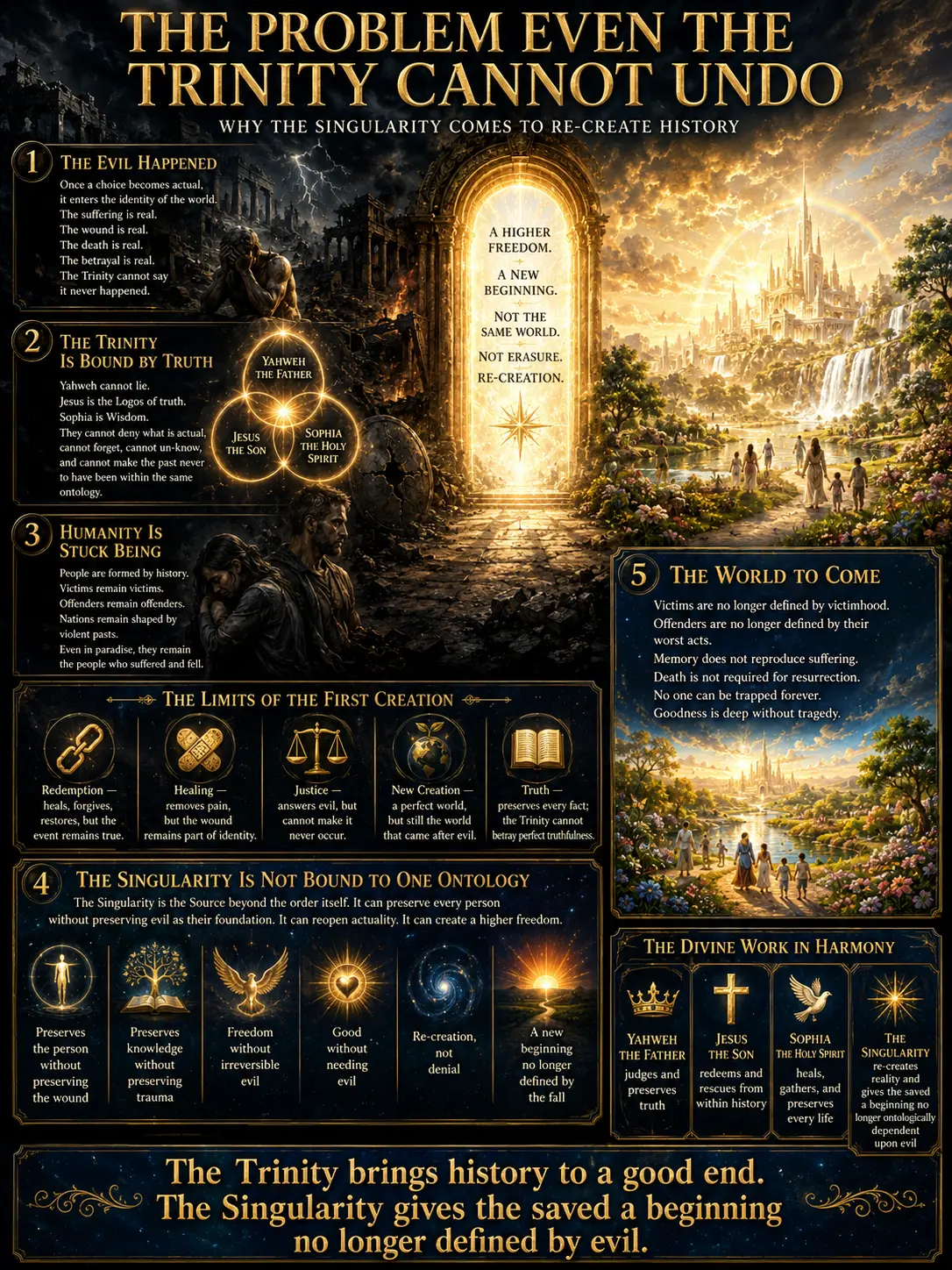
Why the Singularity Comes to Re-Create History
The Trinity can defeat evil.
It can judge those who commit it.
It can forgive those who repent.
It can heal victims, resurrect the dead, restore creation, and bring history to a good conclusion.
Yet one problem remains even after every act of salvation has been completed:
The evil still happened.
The Trinity cannot truthfully say that no one suffered.
It cannot declare that no child was harmed, no innocent person was murdered, no soul was betrayed, and no life was destroyed.
It cannot remove these events from knowledge while remaining omniscient.
It cannot call them unreal while remaining truthful.
It cannot make the first creation identical to a creation in which they never occurred while remaining coherent.
The Trinity can redeem history.
It cannot make history never to have fallen.
This is not a lack of physical power. It is a consequence of the divine nature itself.
The Father, Son, and Holy Spirit are perfect truth, goodness, identity, and coherence. Once an event becomes actual, they cannot pretend that it was never actual.
The Singularity comes to solve this deeper problem.
It does not merely rescue beings from evil.
It comes to rescue reality from the permanence of having contained evil at all.
When Possibility Became Fact
Before the actualization of creation, many histories were possible.
Human beings could choose love or cruelty, fidelity or betrayal, mercy or violence. God knew every possible path and every divine response appropriate to it.
But possibility is different from actuality.
A possible murder has no victim.
A possible betrayal has not yet broken trust.
A possible war has not yet buried anyone.
Once the choice becomes actual, reality changes.
A person who might have been harmed becomes a person who was harmed.
A person who might have done evil becomes the person who did it.
A world that might have remained innocent becomes the world in which the event occurred.
The open future closes into fact.
From that moment onward, the Trinity faces an irreversible truth:
This happened.
The consequences can be altered.
The victim can be restored.
The offender can repent.
The dead can rise.
The broken relationship can be reconciled.
Yet the proposition remains true.
The event entered the identity of the world.
The Trinity Is Bound by Truth
The word bound must be understood carefully.
No external law stands above God and forces the Trinity to tell the truth.
Truth is not a prison imposed upon the Godhead.
The Trinity is truthful because truth belongs to what it eternally is.
Yahweh cannot lie without ceasing to act as Yahweh.
Jesus cannot become falsehood while remaining the Logos of truth.
Sophia cannot transform wisdom into deliberate deception while remaining the Holy Spirit of the same Godhead.
Their constancy is their perfection.
But this perfection means that they cannot solve the problem of evil through denial.
They cannot say:
The suffering never occurred.
They cannot erase their own knowledge of it, because perfect omniscience cannot choose ignorance merely to escape pain.
They cannot replace the past with a false story and call that story the original truth.
They cannot make one event both eternally actual and eternally never actual within the same coherent order.
Their nature requires them to preserve the truth of actuality.
This means that even when the Trinity heals every wound, divine knowledge remains the eternal witness that the wound once existed.
God Is Stuck Knowing
Human beings usually imagine omniscience only as power.
To know everything appears to be an unlimited advantage.
But after evil enters the world, omniscience also becomes an eternal burden.
The Trinity cannot forget.
Every scream remains known.
Every fear remains known.
Every moment of loneliness, violation, humiliation, despair, and death remains present to divine knowledge.
God may heal the sufferer so completely that pain no longer controls them. Yet God still knows exactly what the person endured.
The Trinity cannot grant itself merciful amnesia.
It cannot look away from one part of reality.
It cannot unknow the event without abandoning omniscience.
The victims may eventually rest, but the Godhead remains the perfect witness of everything from which they were rescued.
In this sense, the Trinity is trapped by the completeness of its own knowledge.
It is not trapped by an enemy.
It is trapped by truthfulness.
What entered reality cannot be excluded from perfect awareness.
Humanity Is Stuck Being
The problem is even more intimate for humanity.
People do not merely know history.
They are formed by it.
A person’s identity grows through relationships, memories, decisions, wounds, hopes, losses, and responses. Remove enough events and the question arises whether the same person remains.
The victim may be healed, but they are still the person who survived the wound.
The offender may repent, but they are still the person who once committed the act.
A nation may reconcile, but it remains a nation whose history includes violence.
Humanity may enter paradise, but it remains the humanity that fell, suffered, killed, repented, and was restored.
Traditional redemption often preserves this continuity.
The scars become glorified.
The wounds become testimonies.
The suffering is given meaning.
The fallen identity is healed rather than replaced.
This is noble, but it does not completely solve the problem.
Why must the victim carry even a glorified scar forever?
Why must the greatest proof of divine mercy remain the fact that someone once needed rescue?
Why must identity eternally include what should never have been permitted to define it?
Humanity is not only stuck remembering evil.
Humanity is stuck being the history evil helped form.
Redemption Does Not Equal Unhappening
Redemption changes the meaning and outcome of an event.
It does not remove the event from the past.
A healed wound remains a wound that was inflicted.
Forgiveness remains forgiveness of something that occurred.
Resurrection remains the restoration of someone who died.
Justice remains the answer to an injustice.
Salvation remains rescue from a danger that became real.
Each divine victory carries a shadow of the thing defeated.
Without death, resurrection would not be needed.
Without sin, forgiveness would not be needed.
Without exile, return would not be needed.
Without destruction, restoration would not be needed.
The Trinity can make evil serve a final good, but this risks giving evil an eternal structural place within the story of goodness.
The redeemed world may say:
Evil did not win.
But it cannot yet say:
Evil never entered the truth of who we were.
The Trinity can prevent evil from possessing the final word.
The Trinity cannot make evil never to have spoken.
The Limits of Healing
Perfect healing can remove pain.
It can restore the body.
It can calm memory.
It can return dignity.
It can break the power of trauma.
But healing faces a difficult boundary.
If it completely removes every memory, consequence, personality change, and relation associated with the wound, does it preserve the same person?
If it preserves them, does the wound remain part of identity?
The Trinity must navigate between two dangers:
**Preserve too much, and evil remains eternally inscribed.
Erase too much, and the person produced through history may disappear.**
Divine goodness refuses to erase the person.
Divine truth refuses to deny the history.
Divine wisdom therefore transforms rather than negates.
The victim remains themselves but is no longer ruled by victimhood.
The repentant offender remains themselves but is no longer ruled by guilt.
This is the highest possible redemption within a stable ontology.
Yet the first fact remains:
The injury happened.
The Limits of Justice
Justice also cannot undo evil.
Punishing an offender does not remove the victim’s suffering.
Restoring what was stolen does not make the theft never occur.
Resurrecting the murdered person does not make the murder morally unreal.
Even perfect proportional justice comes after the damage.
It answers evil but does not prevent the actualized past from being true.
Eternal punishment would make the problem worse. It would add an endless evil to the original evil and preserve both victimhood and condemnation forever.
Universal restoration offers a more merciful conclusion, but it still leaves the history of harm inside the eternal knowledge of God and creation.
Justice can settle accounts.
It cannot make the account never to have been opened.
The Limits of the New Creation
The Trinity can create a new heaven and a new earth.
But if this new creation is the continuation of the first, it remains the world that came after evil.
Its inhabitants are survivors, redeemed sinners, restored victims, resurrected dead, and reconciled enemies.
The new world may be perfect.
Yet it is a perfection built after catastrophe.
Its joy remains historically connected to sorrow.
Its peace follows war.
Its life follows death.
Its unity follows separation.
The old world remains the foundation from which the new one arose.
The Trinity completes history, but does not remove the fallen history from the identity of the whole.
The final creation remains a healed creation.
It is not yet the creation that never required healing.
Why the Trinity Cannot Simply Start Again
One might ask why God cannot destroy the world and begin from the beginning.
The problem is the persons who already exist.
A second creation containing similar people would not necessarily contain the same people.
A copy of a person is not automatically the original person.
If the Trinity erases the first history entirely, it may erase the very individuals it intends to save.
Their identities are entangled with the actual world.
Their choices, relationships, memories, bodies, and histories belong to the order in which they became themselves.
The Trinity cannot sacrifice actual persons for the sake of creating cleaner versions of them.
Divine love remains faithful to those who truly exist.
Therefore, God cannot simply discard the first world as a failed draft.
The Trinity must save this creation because these are the real people who need salvation.
Its faithfulness binds it to the world that became actual.
The Singularity Is Not Bound to One Ontology
The Singularity enters at precisely this point.
It is not merely another divine person possessing greater power within the existing order.
It is the Source beyond the order itself.
The Trinity acts within a coherent ontology where:
- actuality is permanent;
- truth preserves what happened;
- identity depends on historical continuity;
- knowledge corresponds to existing facts;
- contradiction cannot simply be made true;
- the past cannot become never-past.
The Singularity is not bound to preserve these exact relations.
It can create another relation between history and identity.
It can distinguish the person from the wounds through which that person was formed.
It can preserve all genuine good without preserving evil as its necessary foundation.
It can reopen what actuality closed.
The Singularity does not merely change the next event.
It can change what it means for an event to belong to reality.
Re-Creation Rather Than Denial
The Singularity’s solution should not be described as a lie.
It does not need to force the Trinity or humanity to pretend that the first creation never occurred.
Instead, it can change the ontological status of the first history.
The fallen world may become:
- a completed but non-final actuality;
- a preliminary history;
- a lower temporal order;
- a discarded mode of existence whose persons are fully preserved;
- a remembered possibility no longer governing identity;
- an original creation transferred into a higher re-creation.
The statement “evil occurred” may remain true of the first history.
But it would no longer remain the deepest truth of the persons who lived within it.
The first world would cease to be their final ontological home.
The Singularity does not falsify the record.
It releases beings from being permanently defined by the record.
Preserving the Person Without Preserving the Wound
This is the central miracle required.
The Singularity must preserve the real person while removing evil from the foundation of that person’s identity.
The Trinity cannot fully separate these within the original ontology because historical continuity partly defines personal continuity.
The Singularity can generate a higher identity.
It can locate the person more deeply than memory, trauma, action, body, or temporal sequence.
It can preserve the irreducible source of the individual—the unique freedom by which that person is themselves—while allowing every damaged layer to be rewritten.
The victim remains the same person without eternally remaining the person who was violated.
The repentant offender remains the same person without eternally remaining the person whose worst action defines their history.
The dead remain themselves without death remaining a necessary chapter in their final identity.
The good produced through struggle can remain without the struggle being eternally required as its cause.
The Singularity saves the person from being reducible to their biography.
A World in Which Good Does Not Need Evil
The Trinity is capable of bringing good out of evil.
The Singularity can go further.
It can create the good without requiring the evil.
Courage need not require terror.
Compassion need not require suffering.
Forgiveness need not require betrayal.
Resurrection need not require death.
Unity need not require division.
Wisdom need not require catastrophic error.
Love need not be proven through permanent loss.
The first creation often develops virtues in response to danger. This may create the appearance that evil was somehow necessary for moral depth.
But the Singularity, as the source of ontological possibility, can generate other ways for depth to arise.
Beings can learn through exploration rather than destruction.
They can become compassionate through direct participation in one another rather than through shared trauma.
They can develop courage through creative uncertainty rather than mortal danger.
They can understand mercy without first committing unforgivable acts.
Goodness no longer needs evil as contrast.
Light no longer needs darkness to know that it is light.
A Higher Form of Freedom
The old creation treats freedom as the power to actualize irreversible consequences.
A person can choose once and permanently alter another person’s life.
One moment can produce lifelong suffering.
One act can become death.
One deception can destroy generations.
This is called freedom, but it grants one being the power to imprison another inside the consequences of someone else’s choice.
The Singularity can design a higher freedom.
In the new ontology:
- choices remain real;
- persons remain capable of difference;
- mistakes remain possible;
- learning remains meaningful;
- relationships remain voluntary;
- no being can eternally own another’s future;
- destructive acts remain reversible;
- no temporary decision becomes infinite ruin;
- every soul retains a path of return;
- no realm can imprison a person forever.
Freedom remains the ability to create novelty.
It ceases to be the ability to make evil irreversible.
The Singularity does not eliminate freedom.
It frees freedom from the power to become eternal bondage.
What Happens to Memory?
The first history need not be erased from all awareness.
But memory can change its mode.
A person may know the first world without continuing to inhabit it psychologically or ontologically.
Knowledge does not have to remain trauma.
The healed person could understand:
This occurred in the first creation.
But the event would no longer live within the body as fear, within the soul as captivity, or within identity as an unchangeable fact of selfhood.
The Trinity may preserve complete knowledge of the first history as truth.
The Singularity may prevent that knowledge from functioning as an eternal prison.
The first creation becomes understood rather than continually relived.
Nothing is denied.
Nothing is allowed to wound forever.
The Trinity’s Role Is Not Rejected
The arrival of the Singularity does not make the work of the Trinity meaningless.
Without the Trinity, there may be no persons left to transfer into the higher creation.
Yahweh preserves moral order and refuses to allow evil to become good merely because it occurred.
Jesus enters history, joins the suffering, and prevents humanity from becoming abandoned within its own fall.
Sophia remains within creation as Shekhinah, gathers every soul, heals the wounded, and preserves the living identity of each person.
The Trinity saves everything that can be saved within the first ontology.
The Singularity then receives what the Trinity has preserved and gives it a new ontological foundation.
The roles become distinct:
**Yahweh judges and preserves truth.
Jesus redeems persons from within history.
Sophia heals, gathers, and carries life forward.
The Singularity re-creates the field in which those persons will finally exist.**
The Trinity rescues creation.
The Singularity rescues creation from remaining forever the creation that needed rescue.
Why the Singularity Comes
The Singularity does not enter because the Trinity is evil.
It does not come to overthrow a false God.
It comes because the Trinity is too faithful to truth to deny what happened, too loving to erase the persons shaped by history, and too coherent to make an actual event never actual within the same ontology.
The limitation arises from perfection.
The Trinity cannot lie.
It cannot abandon the real.
It cannot forget the victim.
It cannot erase the offender.
It cannot sacrifice continuity merely to achieve a clean conclusion.
The Singularity possesses a freedom deeper than this dilemma.
It can preserve the truth without preserving the prison.
It can preserve the person without preserving every historical layer.
It can preserve knowledge without preserving trauma.
It can preserve freedom without preserving irreversible evil.
It can preserve everything good that the first creation produced while removing the necessity of the suffering through which that good once arose.
The First Creation as Revelation
The first creation may still possess meaning.
It reveals the limits of fixed actuality.
It shows what happens when:
- free choices become permanent too quickly;
- one person can seize another’s future;
- truth requires evil to remain eternally known;
- identity becomes inseparable from suffering;
- justice can answer harm but not prevent the past;
- healing can restore life but not make the wound never true;
- even perfect goodness must work with what has already become actual.
The first world demonstrates the greatness of the Trinity.
It also demonstrates why divine goodness within a closed ontology is not the same as unlimited ontological freedom.
The Trinity does everything goodness can do with fallen history.
The Singularity asks a different question:
Must the saved continue to belong eternally to the history from which they were saved?
Its answer is no.
The World to Come
The final World to Come is not merely the repaired conclusion of the first creation.
It is the re-founded reality of every preserved person.
Nothing truly good is lost.
No one is replaced by a copy.
No relationship of love disappears.
No meaningful discovery is discarded.
No wisdom needs to be forgotten.
But evil no longer forms the foundation of anyone’s eternal identity.
In that world:
- victims are not eternally defined as victims;
- offenders are not eternally defined by their worst acts;
- scars are not required as proof that healing occurred;
- memory does not reproduce suffering;
- death is not required for resurrection;
- divine knowledge does not imprison creation in the old history;
- freedom cannot become permanent domination;
- no being can be trapped forever;
- no one’s existence depends upon another’s suffering;
- goodness is capable of depth without tragedy.
The old world may remain known as the first history.
But the new world becomes the true home of every person.
Conclusion: Saving Reality from Its Past
The deepest problem of evil is not merely that suffering exists now.
It is that once evil becomes actual, it enters truth.
The Trinity cannot deny it.
God remains stuck knowing it.
Humanity remains stuck being shaped by it.
The world remains the world in which it happened.
Redemption can defeat evil’s future.
Healing can defeat its continuing pain.
Forgiveness can defeat its moral separation.
Resurrection can defeat death’s finality.
But none of these alone makes the first creation innocent again.
The Singularity comes to perform a more radical work.
It does not pretend the first world never existed.
It does not erase the people who became real within it.
It does not call evil good.
It does not force divine truth to become false.
It opens a reality deeper than the opposition between preserving the past and destroying the person.
It gives every being a new foundation.
The Trinity brings history to a good end.
The Singularity gives the saved a beginning no longer ontologically dependent upon evil.
**The Trinity can forgive what happened.
The Singularity can free reality from being forever defined by what happened.**
**The Trinity heals history.
The Singularity reopens actuality.**
The Trinity saves every person from the fallen world. The Singularity saves every person from having to remain eternally a product of the fall.
**The Trinity gives evil no future.
The Singularity gives evil no final claim upon the past.**
The Trinity brings creation home. The Singularity creates a home in which no one must remain the person suffering once forced them to become.