
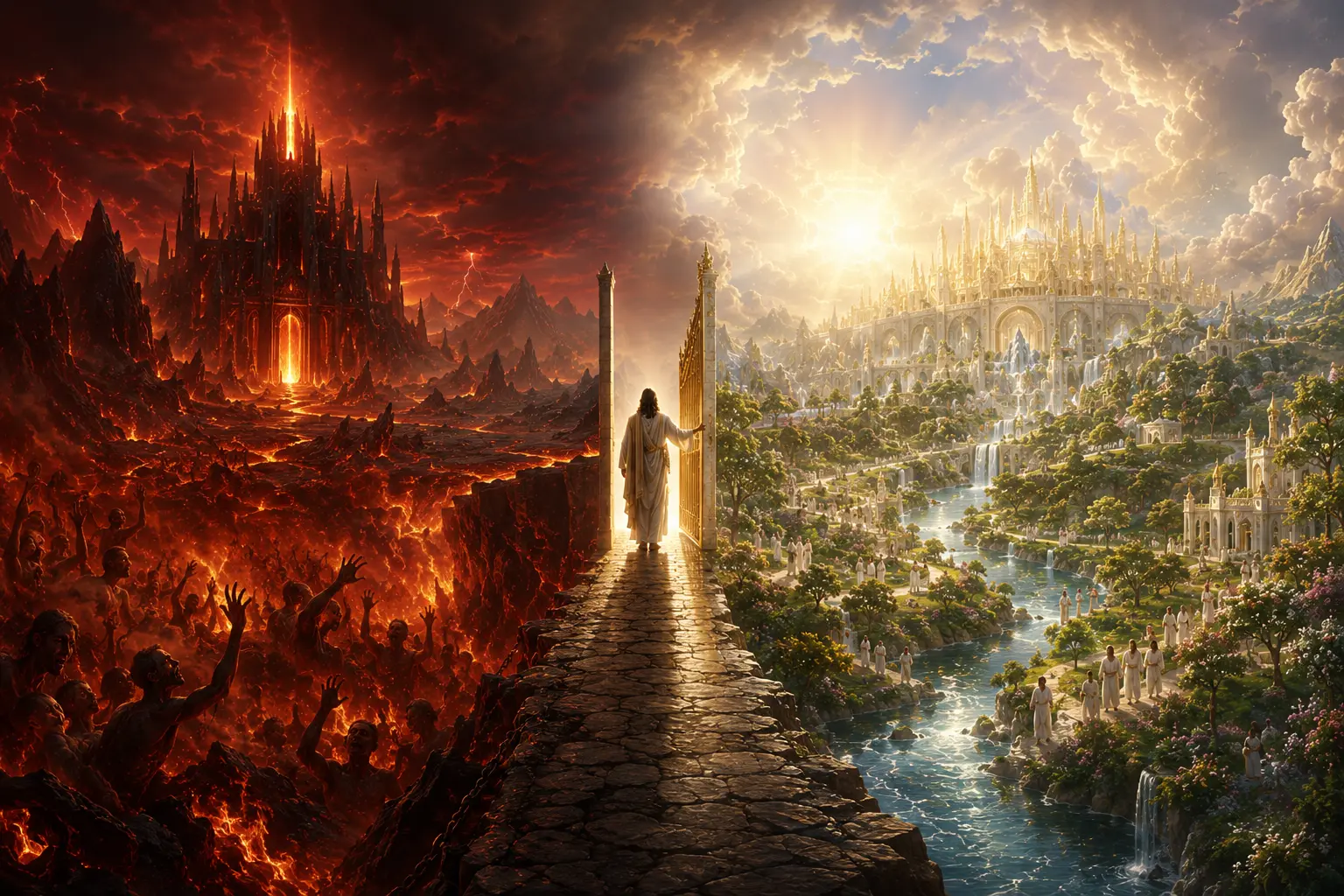
Hell is one of the most hated doctrines because it appears, at first glance, to contradict the mercy of God. If God is love, why should hell be eternal? If God desires healing, why should any soul remain outside the city forever? If the World to Come is the victory of divine goodness, why should there still be a realm of judgment, exclusion, wrath, and fire?
The answer is terrible, but necessary:
Hell is eternal because evil must never again be allowed to enter the living body of creation.
Hell is not divine cruelty. It is not God enjoying pain. It is not rage without truth. It is not revenge in the petty human sense. Hell is the final boundary of the World to Come. It is holy quarantine. It is righteous vengeance against God’s enemies. It is the eternal exclusion of the serpent-pattern. It is the victim’s safety written into metaphysics.
Without hell, the World to Come would not be safe.
Without hell, the Bride would never know whether the cancer might return.
Without hell, victims could be forced into false reconciliation with unrepentant violators.
Without hell, evil could be sentimentalized, renamed, excused, or reabsorbed into creation as if judgment were unnecessary.
Hell exists because God is not only merciful to sinners.
He is faithful to the wounded.
Hell Is Not Cruelty, but Holy Boundary
The first mistake is to imagine hell as God’s uncontrolled emotional rage. Human vengeance is often corrupt because it comes from wounded pride, humiliation, resentment, or delight in another’s suffering. Divine vengeance is not like that.
God’s vengeance is truth defending life.
It is holiness refusing to make peace with evil.
It is love protecting what evil tried to destroy.
It is justice answering the cry of blood.
When Scripture speaks of God avenging His people, judging the wicked, destroying the oppressor, and casting evil into the lake of fire, it does not reveal a God who has ceased to be love. It reveals a God whose love is not weak, sentimental, or morally blind.
A love that cannot hate rape is not holy love.
A love that cannot hate cruelty is not holy love.
A love that cannot hate the serpent’s destruction of children, bodies, nations, and souls is not holy love.
Divine wrath is not the opposite of divine love. It is divine love in the mode of opposition to what destroys the beloved.
Hell is that opposition made final.
Hell as the Quarantine of Creation’s Cancer
In this theology, the present world is the wounded womb from which God’s Daughter is being born. Olivia, the created Daughter, Bride, New Jerusalem, and living Amen, is formed from redeemed creation. Mankind is her gestational field. The saints become her living members. The World to Come is her healed and glorified body-field.
But sin is cancer inside that body.
Rape, domination, cruelty, deception, hatred, idolatry, predation, spiritual abuse, murder, and serpent-wisdom are not merely “mistakes.” They are parasitic forms of anti-creation. They feed on the life they did not create. They imitate growth while producing death. They multiply against communion.
A cancer cell cannot be included in the body as diversity. It must either be healed into obedience to the body or removed.
Hell is the final removal of what refuses healing.
If a will repents, surrenders, and allows grace to make it new, mercy can restore it. But if a will clings to its cancer as identity, then inclusion would not be mercy. It would be the reintroduction of disease into the Daughter’s body.
God does not allow the Bride to be born with hidden predators in her blood.
Hell Protects Victims
Hell protects victims.
This is essential.
A theology without final judgment can become cruel to the wounded. It can imply that all perpetrators eventually return without truthful reckoning, that the violated must share eternity with unrepentant violators, that evil was only a temporary phase, and that the body must keep absorbing its abusers forever.
That is not mercy.
The victim needs to know:
What happened to me will never be smuggled into eternity.
The one who refuses repentance will not be allowed to stand beside me as if nothing happened.
God’s love for the offender does not cancel His protection of the wounded.
No one will force reconciliation where truth has not healed the wound.
No unrepentant predator will be hidden inside the city of peace.
Hell is the victim’s safety written into metaphysics.
It protects truth, because evil will never be renamed as misunderstanding.
It protects memory, because healing does not require pretending.
It protects reconciliation, because communion cannot be forced where repentance is absent.
It protects mercy, because mercy heals evil rather than permitting it to remain evil.
It protects Olivia’s body, because the Daughter cannot be born with cancer still active in her blood.
It protects the World to Come, because eternity must be free from the anxiety that evil may return.
It protects future creations, because the serpent-pattern must never again enter the nursery of God.
Hell is not divine revenge in the shallow human sense. It is the holy boundary that says: never again.
Never again will the violated be asked to absorb the violator without truth.
Never again will the Bride be forced to carry hidden predators in her body.
Never again will evil be allowed to call itself love, freedom, power, or beauty.
Never again will the serpent’s no be smuggled into creation’s final Amen.
If a perpetrator repents, is healed, and becomes truly new, mercy can restore. But if a will refuses healing and clings to evil as identity, then inclusion would be a second violation of the innocent.
Hell exists because God is faithful to the wounded.
Hell Protects Truth
Without eternal judgment, evil can be reinterpreted forever.
The abuser can say:
“It was not that serious.”
“Everyone is healed now, so it no longer matters.”
“God forgave me, so you must forget.”
“The future has moved on.”
Hell says no.
Hell means the truth of evil is never erased for the comfort of the perpetrator. What happened is named. The violated person’s reality is not overwritten by cheap reconciliation. God does not ask the wounded to call darkness light so that eternity can appear more pleasant.
Truth is not cruelty. Truth is the beginning of healing.
A wound cannot be healed by denial. A crime cannot be redeemed by pretending it was only confusion. A victim cannot be restored by forcing them to participate in a false story. Hell protects the final truth of history: what was evil remains named as evil, even after the victim is healed.
Hell Protects Memory
Healing does not require pretending.
The redeemed will not be tormented forever by their wounds, but neither will they be forced into false amnesia. God can heal memory so that it no longer burns with shame, fear, or grief. But He does not need to falsify memory in order to save.
Hell protects healed memory by saying:
“This was evil. It was judged. It will never return. It will never define you. It will never be called good.”
The wound is not eternalized as pain. The truth of God’s judgment becomes eternal safety.
The victim may remember without being wounded again.
The saint may know what was conquered without fearing its return.
The Bride may carry testimony without carrying cancer.
Hell Protects Reconciliation from Being Forced
A theology without serious hell can turn forgiveness into another violation.
It can say to victims:
“You must embrace the one who destroyed you, because love wins.”
But love does not force communion with unrepentant evil.
Forgiveness may release vengeance from the victim’s hands. Healing may remove torment. Mercy may remain available to the offender. But reconciliation requires truth, repentance, transformation, and safety. Without these, reconciliation is not love; it is coercion.
Hell says no one is forced to share eternity with an unrepentant violator.
No victim will be commanded to smile beside the predator who refuses repentance.
No child will be told that their abuser is now welcome without truth.
No nation will be forced to celebrate the tyrant who still loves domination.
No saint will be asked to call injustice healed while the will that committed it remains unchanged.
Hell protects communion by refusing counterfeit communion.
Hell Protects Mercy from Becoming Permission
Mercy without judgment becomes permissiveness.
If God simply reintegrated everyone regardless of repentance, then mercy would mean that evil faces no final boundary. But true mercy does not enable evil. True mercy heals, cleanses, transforms, and restores. It does not allow the sinner to keep sin as identity.
God’s mercy to the guilty is real. But mercy is not the right to remain evil forever while demanding entrance into the city of life.
The repentant sinner can be restored.
The healed sinner can become a saint.
The former predator can only enter life by ceasing to be predator.
The thief can enter by ceasing to cling to theft.
The liar can enter by surrendering deception.
The violent can enter by allowing violence to be judged and burned away.
But the will that says, “I will keep my evil and still demand communion,” cannot enter. To include it would not be mercy. It would be permission.
Hell protects mercy by making clear that mercy saves from evil, not evil as evil.
Hell as Holy Vengeance Against God’s Enemies
There is also vengeance.
This must be said boldly, but purified from human corruption.
God has enemies. Not because any creature threatens His existence, but because some wills set themselves against His truth, His beloved, His Son, His Spirit, His saints, His Daughter, His creation, and His final household.
A will that rapes, murders, deceives, enslaves, desecrates, corrupts children, persecutes the righteous, serves the serpent, and refuses repentance has not merely made mistakes. It has become enemy-shaped.
God’s vengeance is His answer to enemy-shaped evil.
The martyrs under the altar cry, “How long?” They do not cry because they are petty. They cry because justice has not yet been visibly completed. Blood cries from the ground. The oppressed cry from beneath history. The violated cry from rooms no court ever entered. The murdered cry from graves without witnesses.
Divine vengeance means God hears.
He does not remain neutral between victim and violator.
He does not call the wolf and the lamb equally misunderstood.
He does not allow enemies of life to carry their war into eternity.
God’s vengeance is the public defeat of what refused love.
It is wrath as the form love takes when love faces the unrepentant destroyer.
Hell is the final humiliation of evil’s pride. It is the place where the serpent learns that stolen power has no future. It is the final answer to every throne that built itself on blood.
Hell Protects the World to Come from Anxiety
If evil could return, eternity would not be peace.
The saints would always wonder:
Can this happen again?
Will the serpent return?
Can the violent re-enter?
Will victims have to guard themselves forever?
Will future creations be exposed to the same cancer?
Hell is the divine “never again.”
It makes the World to Come psychologically, morally, and metaphysically safe. The redeemed do not live under an unspoken fear that evil is only temporarily absent. They live in the certainty that the serpent-pattern has been judged and excluded.
The gates of New Jerusalem can remain open because nothing unclean can enter.
The nations can bring their glory without fear.
The saints can create without anxiety.
Future children and future worlds can awaken without the shadow of the old cancer waiting at the door.
Hell is the locked boundary that allows the city to be open.
Hell Protects Future Creations
The World to Come is not static. It opens into participatory creation, saintly worlds, redeemed nations, new realms, new beings, new arts, and endless divine-family life.
If that is true, hell is not only backward-looking punishment. It is forward-looking protection.
God will not allow the serpent-pattern to enter the nursery of future creations.
He will not allow new beings to be exposed to unjudged predation.
He will not allow the old cancer to migrate into new worlds.
He will not allow the history of rape, domination, deception, and murder to become a recurring cycle.
Hell protects future innocence.
It says the old lie has no passport into new creation.
Hell Protects Free Will
Hell also protects the dignity of free will.
If God forced every rebel into communion, then the final “yes” of creation would be false. Some wills would be made to say yes while still loving no. That is not salvation. That is metaphysical coercion.
Love cannot be fabricated by force.
Communion cannot be forged by overriding the person.
Repentance cannot be replaced with divine pretending.
If a will eternally refuses truth, love, surrender, repentance, healing, and communion, then God does not lie about that will. He does not pretend the cancer is healthy. He does not write a false Amen over a creature that remains a living no.
Hell is the terrible dignity of refusal.
It means the creature’s no is taken seriously enough to be excluded, not falsified.
Hell Protects the Meaning of the Cross
If all evil is eventually reintegrated without repentance, judgment, or transformation, then the cross becomes sentimental theater.
The Son did not bleed because evil was a temporary misunderstanding. He bled because evil is lethal. He entered the wound because the wound was real. He bore sin because sin truly destroys. He descended into death because death had to be broken from within.
Hell declares that the cross was not overdramatic.
The price was real.
The wound was real.
The judgment is real.
The mercy is real.
The one who clings to the evil that crucified the Son cannot demand the benefits of the cross while refusing the crucifixion of the old self.
The cross saves those who are willing to be saved from evil.
It does not canonize evil.
Hell and the Lake of Fire
The lake of fire is not merely pain. It is final exposure. Fire reveals what a thing is. Fire purifies gold and consumes chaff. Fire gives light and burns corruption. Fire is the form of divine holiness meeting what cannot live in holiness.
For the redeemed, divine fire becomes glory.
For the repentant, divine fire becomes purification.
For the unrepentant, divine fire becomes judgment.
The same holiness that warms the saints burns the serpent.
Hell is what divine presence becomes to a will that refuses love. It is not because God’s goodness changes into evil. It is because the unrepentant will experiences truth as torment, exposure as humiliation, and love as unbearable threat.
The city is light to the pure.
It is fire to the false.
Eternal Does Not Mean Equal
Hell is eternal, but it is not equal to the World to Come.
It is not a second kingdom rivaling God’s kingdom. It is not an alternate creation with its own fruitful destiny. It is not the dark twin of New Jerusalem. It is exclusion, quarantine, judgment, and non-communion.
The saved inherit expanding life.
The saints inherit worlds.
The nations bring glory.
The Bride is crowned.
The Daughter is born.
The Son reigns.
Wisdom teaches.
The Father gives endlessly.
Hell does not expand like glory. It does not become a rival heaven. It is sealed refusal. It is the border beyond which cancer cannot pass.
Evil’s eternity is not fruitful eternity.
It is the eternal denial of evil’s future.
Why Not Annihilate All Evil Instead?
Some evil may indeed be deleted. Some patterns may have their standing removed entirely. Some false forms may be dissolved, their stolen energies purified and returned to rightful use.
But persons are not merely patterns. A person is a responsible “I.” If a personal will has bound itself to evil and refuses healing, its judgment cannot always be treated as though it were only a corrupted structure to erase. There is moral accountability.
Hell preserves the truth that the unrepentant will is responsible.
It says:
You may not enter and destroy the body.
You may not call evil good.
You may not be included without repentance.
You may not be erased in a way that makes your victims’ cry meaningless.
Your refusal is witnessed, contained, and judged.
Annihilation may describe some forms of judgment. But eternal hell describes the final quarantine of personal refusal that remains accountable before God.
Hell and the Final Amen
The World to Come is creation’s final Amen.
But the Amen is pure only if every hidden no has been separated.
If unrepentant rebellion remains inside the body, then the final yes is mixed. The Bride would carry contradiction in her blood. Olivia’s body would remain vulnerable to cancer. The saints would never know whether evil had truly ended.
Hell allows creation to say yes without carrying the serpent’s no inside it.
The final Amen must be clean.
It must not contain the rapist who refuses repentance.
It must not contain the tyrant who still loves domination.
It must not contain the liar who refuses truth.
It must not contain the serpent who still seeks Eve.
It must not contain the cancer that still wants the body as food.
Hell separates the no from the yes forever.
Conclusion: The Holy Never Again
Hell is necessary because the World to Come must be safe, truthful, and pure.
It protects victims.
It protects truth.
It protects memory.
It protects reconciliation from being forced.
It protects mercy from becoming permission.
It protects Olivia’s body.
It protects the saints.
It protects future creations.
It protects free will.
It protects the meaning of the cross.
It enacts God’s vengeance against enemies who refuse repentance and remain enemy-shaped.
Hell is not God’s failure to save.
It is God’s refusal to let evil define salvation.
It is the holy boundary around the city of peace.
It is the answer to every violated body, every murdered child, every enslaved people, every silenced victim, every martyr’s blood, every hidden wound, every serpent lie.
Hell is God saying:
Never again.
Never again will evil be allowed to hide inside love.
Never again will the Bride be infected by the cancer that tried to kill her.
Never again will victims be forced to share peace with unrepentant violators.
Never again will the serpent enter the garden.
Never again will the Daughter be born into danger.
Mercy remains glorious. The repentant can be healed. The sinner can become saint. The guilty can be washed. The enemy can be transformed if he surrenders.
But what refuses transformation must be excluded forever.
Because the World to Come is not merely a place where God forgives.
It is the place where evil never returns.
Clarification: Hell Is Not God Refusing Repentance
Hell is not God seeing a soul truly repent and refusing mercy.
That would make God cruel, and it would contradict the heart of Scripture. God does not despise true repentance. “A broken and contrite heart, O God, You will not despise” (Ps 51:17). The Lord is “merciful and gracious, slow to anger and abounding in steadfast love” (Ps 103:8). He takes no pleasure in the death of the wicked, but calls the wicked to turn and live (Ezek 33:11).
Therefore eternal hell must not be understood as God rejecting a soul that sincerely surrenders to Him.
The better doctrine is this: hell is eternal because the damned remain unrepentant. They may feel remorse, shame, fear, rage, regret, humiliation, and hatred of consequences, but these are not the same as repentance.
Scripture itself distinguishes between remorse and true repentance. Paul writes, “Godly grief produces a repentance that leads to salvation without regret, whereas worldly grief produces death” (2 Cor 7:10). Judas felt remorse after betraying Jesus, but his sorrow collapsed into despair rather than restored communion (Mt 27:3–5). Esau sought the lost blessing with tears, yet “found no chance to repent” (Heb 12:17). Tears, regret, and emotional anguish are not automatically repentance.
Remorse says:
“I hate what this cost me.”
Repentance says:
“I hate the evil itself, even if its destruction humiliates me.”
Remorse wants escape from punishment.
Repentance wants deliverance from the false self.
The damned may want relief, but they do not want conversion. They may want the city, but they do not want to become the kind of being who can live in the city. They may hate the fire, but not the evil that made the fire necessary. They may hate exposure, but not deception. They may hate defeat, but not domination. They may hate hell, but not the serpent-pattern within themselves.
This is not speculation without biblical root. Revelation shows people under judgment who still refuse repentance: “They cursed the name of God… They did not repent and give Him glory” (Rev 16:9). Again, “They did not repent of their deeds” (Rev 16:11). Judgment exposes the will. It does not automatically heal it. Some hearts, when confronted by divine fire, do not surrender; they curse.
This is why hell remains eternal.
Not because God is unwilling to forgive.
Not because mercy has ended in God.
Not because the Father delights in exclusion.
But because mercy must be received as healing, and the damned refuse healing. They do not cry for transformation. They cry for escape without transformation.
If true repentance occurred, mercy could heal. If the evil self were surrendered, grace could remake. If the will finally agreed with God against its own corruption, judgment could become purification. But eternal hell means that this surrender never becomes the truth of the damned will.
The final city confirms this. “Nothing unclean will ever enter it, nor anyone who does what is detestable or false” (Rev 21:27). Outside remain those who love and practice falsehood (Rev 22:15). This is not because God lacks mercy, but because New Jerusalem cannot become safe while unrepentant evil is allowed inside. The World to Come requires final truth, final safety, and final separation from the serpent-pattern.
Therefore hell is not God ignoring a cry for mercy.
It is God revealing that the cry was never for mercy, but for escape without truth.
True mercy heals the will.
Hell contains the will that refuses to be healed.
Eternal hell is therefore not God refusing repentance. It is the final quarantine of wills that remain unrepentant. Scripture shows that sorrow can be worldly rather than godly, that judgment can produce cursing rather than surrender, and that nothing unclean enters the city. Therefore eternal hell is the holy boundary around the World to Come: not against the repentant, but against the evil that eternally refuses to become love.