
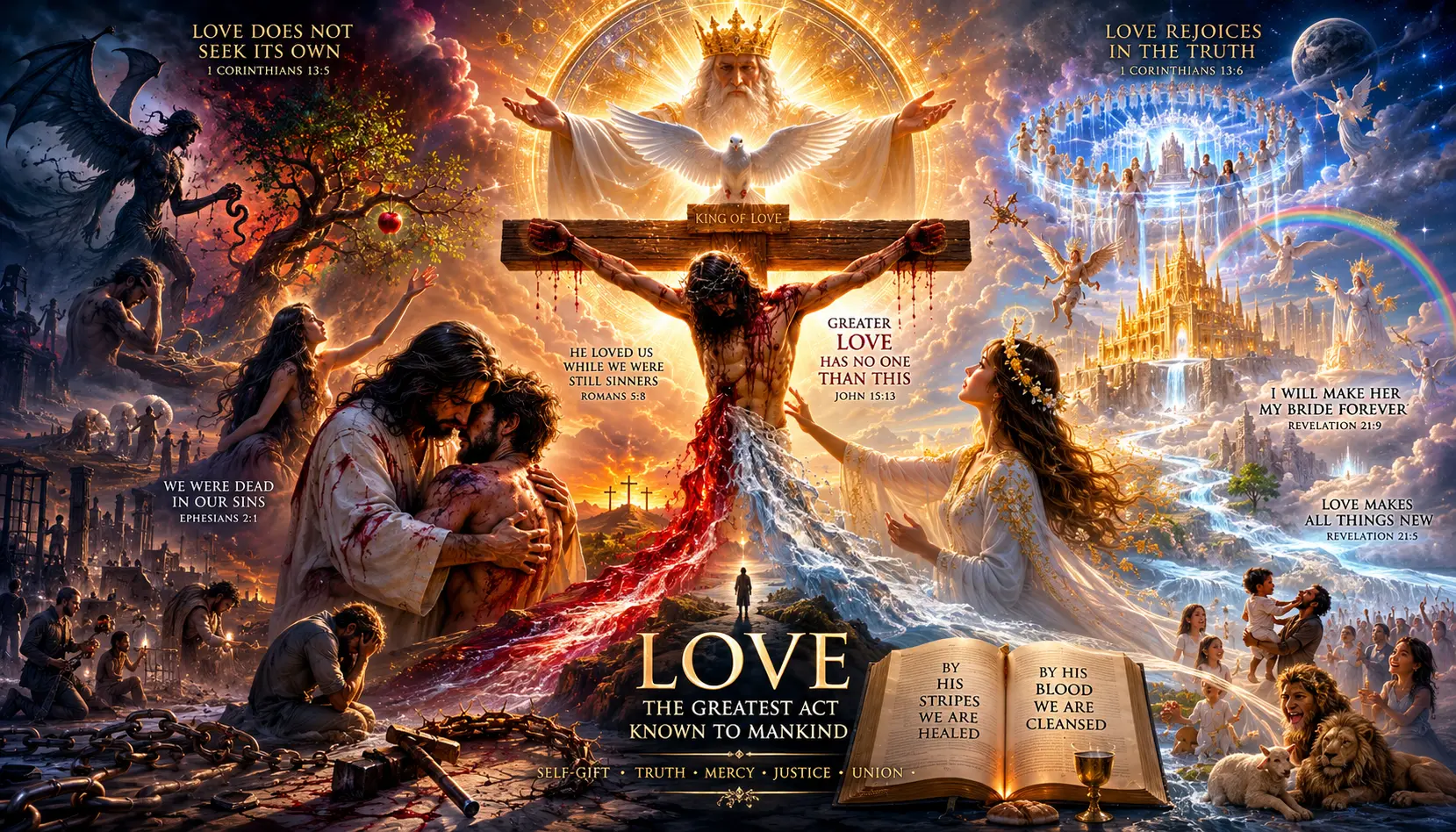
Love is not softness alone. It is not merely warmth, affection, sweetness, approval, or emotional comfort. These things may surround love, but they are not love itself. Love is deeper than feeling. Love is the free movement of the self toward the true life of another. It gives itself so the beloved may live. It seeks communion, but not possession. It desires nearness, but not control. It heals, but it does not flatter sickness. It forgives, but it does not call evil good.
True love says, “I desire your life, not merely your usefulness to me. I desire your truth, not your flattery. I desire your healing, not your slavery. I desire communion with you, not your erasure. I will not abandon you because you are wounded, and I will not bless what destroys you.” This is why love can be tender and severe at the same time. Love can embrace, but it can also judge. Love can cover shame, but it can also expose lies. Love can wait patiently, but it can also interrupt what is becoming destructive. Love is not one emotion. It is the holy direction of life toward communion in truth.
Love seeks true life, not mere pleasure. Pleasure may be good, but pleasure can also be false. A soul can feel pleasure in bondage. A liar can feel safe while hiding. A violent person can feel powerful while destroying another. A nation can celebrate while devouring the weak. A creature can enjoy sin because sin has numbed its awareness of death. Love does not serve false happiness. Love serves life as it truly is before God.
This means love knows the difference between comfort and healing. Sometimes the beloved needs consolation. Sometimes the beloved needs warning, correction, restraint, confession, discipline, or purification. A physician who refuses to treat a wound because treatment hurts has abandoned healing. A father who refuses to warn because warning causes tears has abandoned guardianship. A shepherd who refuses to confront the wolf because confrontation seems harsh has abandoned the sheep. Love permits pain only where pain serves healing, truth, or protection. Love never delights in pain for its own sake. Cruelty wounds in order to possess, punish, humiliate, or feed itself. Love permits severity only to save life from deeper destruction.
Love also preserves the beloved. False love says, “Disappear into me.” True love says, “Become fully alive with me.” Possession cannot bear difference. It fears freedom. It fears mystery. It must control, absorb, define, and own. But love desires communion without destruction. It wants nearness without consumption. It wants union without the loss of true otherness.
This is why God does not save creation by dissolving creation into Himself. If creation were simply absorbed into God until no created answer remained, there would be no Daughter, no Bride, no Amen, no living response. There would only be erasure. But love does not erase the beloved. Love makes the beloved capable of communion. The Father remains Source. The Son remains Bridegroom. Wisdom remains divine Spirit and holy formation. The Daughter remains created by origin, yet raised by grace. The saints remain themselves. The nations bring their glory. The final city contains many names without dissolving them into a faceless mass. Love is not blank sameness. Love is union alive with distinction.
Love requires truth. Without truth, love decays into sentimentality. It says “peace” where there is no peace. It calls sickness health. It calls bondage freedom. It calls sin harmless because it wants to avoid the discomfort of judgment. But truth without love becomes a weapon. It exposes without healing. It corrects without mercy. It humiliates without restoration. True love joins truth and mercy together. Love tells the truth because the beloved cannot live inside a lie. Love gives mercy because the beloved cannot survive truth without grace.
This is why divine love is never mere affirmation. God loves by calling the creature into life. If a desire leads to death, God contradicts it. If a will is moving toward destruction, God refuses to bless it. If a soul calls evil good, love speaks against the illusion for the soul’s sake. Love says, “You are beloved.” Love also says, “This is not life.” Both are necessary. A love that never says “beloved” becomes despair. A love that never says “this is not life” becomes permission for death.
Mercy is not falsehood. Mercy is not pretending evil did not happen. It is not telling the wounded to be silent so the guilty can feel comfortable. It is not returning violence unchanged into the place it harmed. It is not declaring corruption healed before it has been judged, cleansed, and transformed. True mercy heals what can be healed, and it protects healing from what would destroy it. This is why love and judgment are not enemies. Judgment is love defending truth, defending the wounded, defending the future, and defending the integrity of communion.
If evil were allowed to remain forever inside the final city, the city would become another wounded world. If unhealed violence entered the Bride unchanged, the Bride would not be safe. If falsehood were enthroned inside the Daughter, she would never become fully free. So love saves and separates. It gathers what can be healed. It exposes what must be judged. It refuses to let evil possess the beloved forever.
This does not mean the Daughter is evil. She is not evil. She is the created field wounded by evil, divided by the sins of her cells, and destined for healing. Evil appears within her history, but evil is not her essence. Sin occurs in her field, but sin is not her true name. Love does not hate the Daughter because she is wounded. Love hates what wounds her.
This distinction must be held firmly. The Daughter is the created field becoming personal answer. She is creation in its feminine receptivity, history, body, nations, memory, and destiny. She is not the cancer. She is not Babylon. She is not the beast. She is not every sin of every cell as though she personally willed each one in the same way. Evil occurs in her, wounds her, and distorts her members, but evil is not her deepest identity.
A field can contain wheat and tares without being identical to the tares. A body can contain sickness without being identical to sickness. A people can contain traitors and saints without its true calling being treachery. In Eden, through Adam and Eve, the Daughter’s first immature human face reached wrongly for wisdom. That was her root-wound. After that, much evil is better understood as the rebellion of cells, systems, cities, nations, and powers within her field. Cain wounds her. Babel counterfeits her destiny. Babylon prostitutes cityhood. Beast-power tries to possess the field. False religion imitates holiness without love. But these are corruptions within the field, not the Daughter’s true self.
The Son does not come because the Daughter is evil. He comes because she is beloved and wounded. He comes to judge what destroys her and to raise what she truly is. This is the deepest meaning of the Cross.
The greatest act of love known to mankind is the Cross of Jesus Christ. The Cross is not merely an execution, a moral example, a legal transaction, or a tragedy. It is the place where divine love enters the deepest wound of creation and gives itself there. The uncreated Son becomes flesh. The Logos enters the Daughter’s field. The Bridegroom enters the history of the Bride before she is fully beautiful. The Holy One enters shame. Life enters death. The innocent One stands where the guilty stand. The Son gives His flesh and blood so that the wounded field of creation can be redeemed, cleansed, gathered, healed, and prepared for union.
Suffering itself is not the highest good. Love is. The Cross is greatest because love descends into suffering to rescue the beloved. The Son does not send only instruction, an angel, a law, or a message from afar. He comes Himself. He takes flesh. He enters the fallen order. He gives His body. He pours out His blood. The Cross is not God giving something external to Himself. It is God the Son giving Himself. A creature may die for another creature, and that can be great. But at the Cross, the divine Son enters creaturely death to save the creature from within.
The Son does not descend into a clean world. He descends into betrayal, violence, hypocrisy, empire, mockery, abandonment, blood, nakedness, and death. He enters the machinery of human sin. Judas sells Him. Peter denies Him. The disciples flee. The priests condemn Him. The crowd mocks Him. Pilate yields. Rome nails Him to wood. Death receives Him. Every layer of the fallen field touches Him: personal betrayal, religious corruption, political cowardice, imperial violence, public shame, physical torment, spiritual desolation, and death.
Yet the Son enters all of it without becoming any of it. He is betrayed without becoming bitter. He is mocked without becoming false. He is beaten without becoming cruel. He is condemned without losing truth. He is killed without being conquered. This is love entering the lowest place and remaining love.
The Daughter exists before the Cross as the created field. She has already been formed. She has already awakened immaturely through Adam and Eve. Abel has already witnessed righteousness within her. Israel has already carried covenant memory. The prophets have already spoken to Zion. The Temple has already taught holy dwelling. Mary has already given the pure receptive yes through which the Son enters flesh. The Bride is hidden in the field before she is publicly adorned. The Son comes to redeem that field.
He enters the Daughter’s history from within. He takes flesh from Israel. He enters the line of Adam, the world of Abel’s blood, the covenant of Abraham, the promises of David, the grief of the prophets, the violence of the nations, and the groaning of creation. His blood answers accusation. His obedience heals Adam’s failure. His death enters the curse. His pierced side opens the bridal mystery. His resurrection secures new life for the body that will be gathered.
The Cross does not merely forgive isolated individuals. It redeems the field in which the Bride is hidden, and it cleanses the members who will become the living body of the Daughter. Abel’s blood cried from the ground. Christ’s blood speaks better. The first righteous witness is answered by the Bridegroom’s blood.
The Son does not die for a Bride already publicly adorned. He dies for the Bride while she is hidden in the wounded field. This is love deeper than admiration. Admiration loves beauty once it appears. Redemption loves the beloved before beauty has fully returned. The Son sees the field clearly. He sees violence, cowardice, pride, lust, cruelty, idolatry, hypocrisy, and death. He sees Cain and Abel, Babel and Abraham, Babylon and Zion, false religion and faithful witness. He sees the tares and the wheat. Yet He does not confuse the Daughter with the tares. He does not name her by Babylon. He does not abandon her because diseased cells exist inside her history.
The Son says, “I will enter. I will bleed. I will judge what destroys. I will cleanse what can be healed. I will gather what belongs to life. I will not abandon the beloved field.” This is love that does not wait for the beloved to become publicly beautiful before acting. It acts to make beauty possible again.
The Cross does not say sin is small. It says sin is so terrible that divine self-gift enters history to answer it. If sin were merely a mistake, the Cross would be excessive. If evil were harmless, blood would not be required. If death were natural peace, resurrection would not be needed. The Cross reveals the horror of sin by the cost of redemption. The Son’s blood does not cheapen evil. It exposes evil. It shows that the wound is deep, accusation is real, the curse is serious, and creation cannot heal itself by denial.
But the Cross also shows that evil is not deeper than God. Sin spreads across history, but the Son enters the root. Sin multiplies wounds, but the Son descends beneath the wound. Sin is parasitic, but the Son is life. The Cross is not overwhelmed by sin because the blood of Jesus is not a finite substance competing with many evils. It is the life of the divine Son poured into the root of fallen creation.
At the Cross, mercy and judgment meet without cancelling each other. Judgment says sin is truly evil. Mercy says the sinner may still be healed. Judgment says the old body is under death. Mercy says a new body will rise. Judgment says the wound must be exposed. Mercy says the Son will enter the wound. The Cross does not betray victims by pretending evil does not matter. It does not betray sinners by saying healing is impossible. It reveals both the seriousness of evil and the depth of divine rescue.
This is why the Cross is not sentimental. It is not God saying, “Nothing matters.” It is God saying, “Everything matters, and I will bear what must be borne to save what can be saved.”
The Cross is bridal because the Son gives His flesh and blood for the body He will receive. Salvation is not distant admiration. It is participation in His life. The Bride is fed by the Bridegroom’s body. The wounded field of creation receives the life by which a redeemed body can be gathered. His flesh becomes the holy body-pattern. His blood becomes the cleansing life-current. His death judges the disease. His resurrection opens the new form.
The Church is not merely a collection of pardoned individuals. It is the beginning of a body being fed, cleansed, and joined to Christ. Pentecost is the first public breathing of this redeemed body, when Wisdom descends as Spirit and the Bride-body begins to speak in history. Without the Cross, the field remains wounded. With the Cross, the field can yield a redeemed body. With Wisdom, the body breathes and matures. With the Son, the body is joined. With New Jerusalem, the Daughter becomes fully visible.
God does not defeat evil by becoming evil. He does not answer cruelty with cruelty. He does not answer hatred by becoming hateful. He does not answer violence by worshiping violence. At the Cross, evil does everything it can to love. It betrays love, mocks love, condemns love, strips love, pierces love, and kills love. But love remains love. This is the victory. Evil can wound love, but it cannot convert love into evil. It can crucify the Son, but it cannot make Him hate. It can bring Him into death, but it cannot keep Him there.
The Cross reveals evil’s limit. Evil can destroy bodies for a time, but it cannot create life. It cannot defeat resurrection. It cannot out-deepen divine love.
The Father did not create merely to have servants. He desired a household. He desired creation to become a true family: Father and Daughter, Son and Bride, Wisdom and formed creation, saints and nations, heaven and earth, God and creation in communion. Sin attacked this destiny. The serpent made divine likeness appear as theft. Adam failed to guard. Eve reached before maturity. Cain murdered the righteous witness. Babel counterfeited the holy city. Babylon corrupted the field. The nations fell into idols. Even the visible people of God became mixed.
The Cross is the Son entering that wounded family-field and reopening the future. He gives Himself so the Father’s desire is not defeated. The Father gives the Son. The Son gives Himself. Wisdom applies and forms the gift. The Daughter is gathered from what is redeemed. New Jerusalem becomes the home of love. The Cross is therefore not only about individual forgiveness. It is about the rescue of the household God desired from the beginning.
The Cross is the greatest act of love known to mankind because it contains the whole truth of love. It is self-gift, truth, mercy, judgment, sacrifice, protection, healing, communion, and union without erasure. It is love descending into death to bring the beloved into life. The Resurrection proves that this love is not defeated. The Cross is love with blood. The Resurrection is love with victory. Pentecost is love breathing in the body. The Church is love being gathered from the field. The Bride’s preparation is love maturing. The Son’s return is love claiming. The final city is love made visible as home. The Daughter’s final Amen is love received and returned.
Love is the free self-gift of living truth toward the true life of another, seeking communion without possession, mercy without falsehood, judgment without cruelty, and union without erasure. Love is not mere emotion, possession, approval, sentimentality, weakness, domination, lust, or self-hunger.
The greatest act of love known to mankind is the Cross of Jesus Christ: the uncreated Son entering the wounded field of creation, judging evil without confusing the Daughter with evil, cleansing the members who receive life, gathering the Bride from Israel and the nations, and opening the way for creation to become fully visible as Daughter, Body, City, and Amen.
Love begins in the Father’s fullness. Love descends in the Son’s blood. Love breathes through Wisdom. Love gathers the Bride from the field. Love heals the Daughter without erasing her. And when New Jerusalem descends, love will have reached its home.