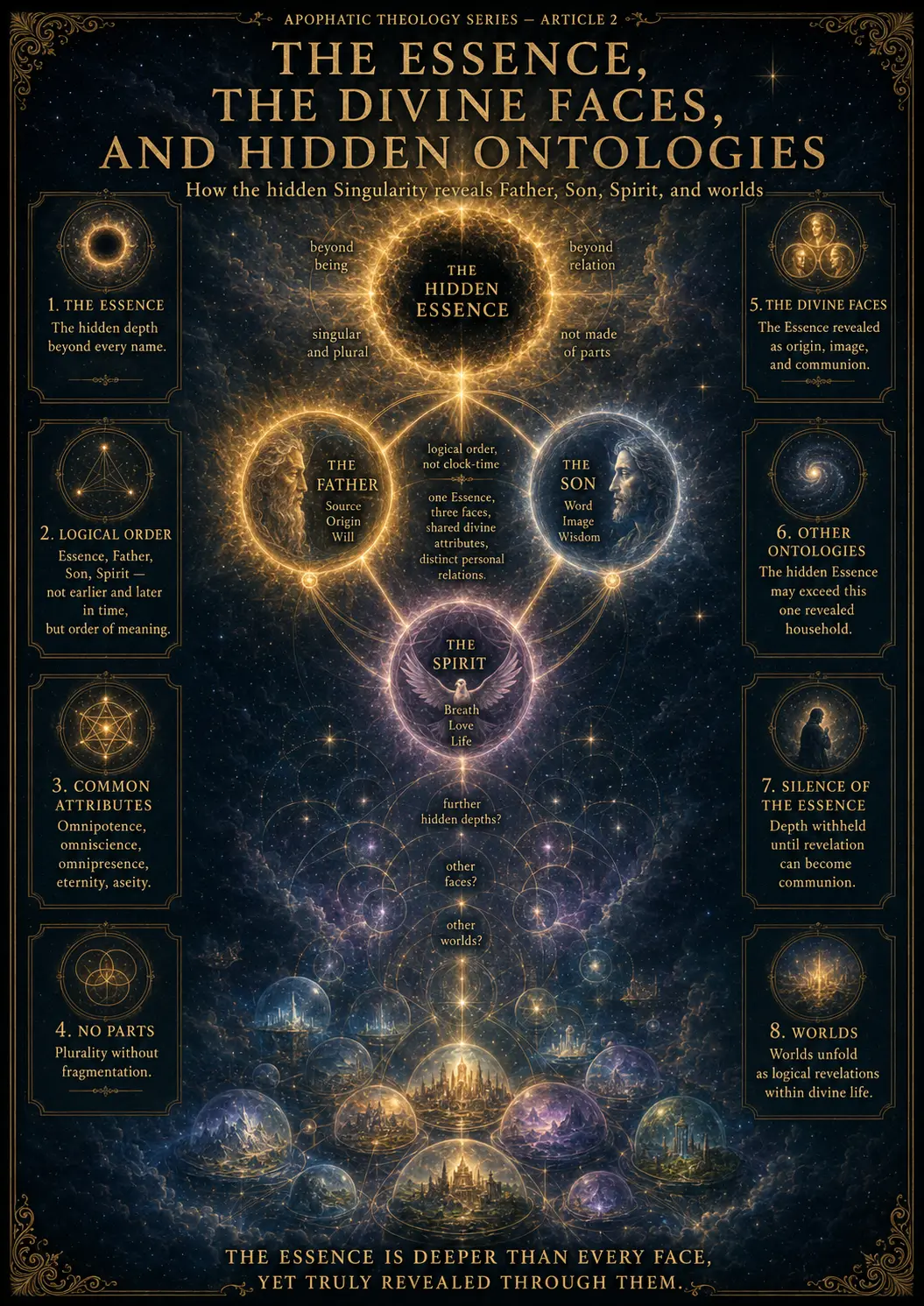
If the Essence is beyond every name, beyond every category, beyond being, beyond sourcehood, and beyond relation, then how does this hidden Essence become known?
How does the nameless become nameable?
How does the faceless become face?
How does the God beyond every concept reveal Himself as Father, Son, and Holy Spirit?
This is the next mystery.
When I say that the divine persons are faces of the Essence, I do not mean they are masks.
A mask hides the real person behind it.
A face reveals the person.
A mask is external.
A face is personal.
The Father reveals the Essence as source, authority, will, and personal origin.
The Son reveals the Essence as Logos, image, form, wisdom, mediation, and perfect answer.
The Spirit reveals the Essence as life, breath, fire, love, sanctification, and union.
They are not three gods.
They are not three parts of God.
They are not three created beings.
They are three eternal persons, three living relations, three divine faces of the one hidden Essence.
They are ontologies.
Each has real selfhood.
Each has real will.
Each has real intellect.
Each has real power.
Each has real desire.
Each has real love.
But none of them has these things as a creature has them.
They possess them divinely, eternally, and relationally.
The divine persons are not defined by separation.
They are defined by relation.
The Father is Father because of the Son.
The Son is Son because of the Father.
The Spirit is Spirit because He proceeds as the living breath of divine communion.
They are distinct, but not divided.
They are relational, but not dependent in a creaturely way.
They are one Essence, three persons, one divine life revealed through eternal relation.
When we speak of the Essence pouring itself into the persons, we must be careful.
This does not mean there was once an empty Father, an empty Son, and an empty Spirit waiting to be filled.
It does not mean the Essence existed first in time and then produced three divine beings later.
It means that the hidden Essence eternally reveals itself as Father, Son, and Spirit.
The pouring is not temporal.
It is eternal.
The Essence does not become less by pouring.
It does not divide itself into pieces.
It does not pour some of itself into the Father, some into the Son, and some into the Spirit, as if God were a liquid being divided into containers.
The pouring is total, but not exhausting.
The Essence is wholly present as Father.
The Essence is wholly present as Son.
The Essence is wholly present as Spirit.
But the Essence remains inexhaustible.
This is the paradox.
The Essence gives itself truly.
But it never becomes empty.
It reveals itself completely enough to be truly known.
But it remains deeper than every revelation.
The Father, Son, and Spirit do not appear one after another inside created time.
The Essence does not sit alone for millions of years and then later produce the Father.
The Father does not exist for a while and then later produce the Son.
The Son and Father do not exist for a while and then later produce the Spirit.
That would turn divine revelation into a temporal process.
But neither should we say that timelessness erases all order.
There is no clock-sequence in God, but there is logical order.
Logical order is not time order.
It is order of meaning, order of manifestation, order of depth becoming face.
The hidden Essence is first, not first as an earlier moment, but first as the deepest root.
The Father is next, not as a created being, but as the Essence revealed as origin, will, authority, and personal sourcehood.
The Son is next, not as a later creature, but as the perfect Image, Word, form, and answer of the Father.
The Spirit is next, not as an afterthought, but as the living breath, fire, love, and communion proceeding from the relation of Father and Son.
Now we can ask a more mystical question.
If the divine persons are faces of the Essence, what do they see when they look upward toward their own source?
Of course, this is symbolic language.
God does not literally look upward in space.
There is no sky above the Trinity.
There is no physical direction in eternity.
But if we speak poetically, we can say this:
When the Father looks toward the Essence, He beholds the infinite depth from which His own Fatherhood shines.
He sees not an object, but an abyss of uncreated light.
He sees the hidden ownness that gives Him the authority to be origin.
When the Son looks toward the Essence, He beholds the infinite depth that makes Him the perfect Image.
He sees the hidden reality that no image can exhaust.
He knows that He reveals God truly, yet the God He reveals is endlessly more than every form of revelation.
If the Father, Son, and Spirit do not unfold by clock-time, then where do they exist?
Clearly, not in space.
They are not located somewhere inside the universe.
They are not standing in a physical heaven as bodies occupy a room.
They are not objects surrounded by emptiness.
Their existence is not spatial.
Their order is not chronological.
Their life is eternal, but eternity should not be imagined as a container in which God sits.
Eternity is not endless time.
Eternity is not millions of years stretched forever.
Eternity is the living fullness in which time can appear.
The divine persons exist in the eternal life of God.
Their “place” is relation.
Their order is meaning.
Their root is the Essence.
Their manifestation is facehood.
Now when this hidden divine life pours toward creation, it becomes structured.
Creation cannot receive infinite light directly.
An empty world cannot hold unfiltered divinity.
So divine life descends through order, measure, relation, and vessel.
In Kabbalistic language, this is the mystery of the Tree of Life.
The ten sefirot are channels of divine power pouring into an empty world.
They are not the hidden Essence itself.
They are not separate gods.
They are not independent beings competing with the Trinity.
They are modes of divine revelation.
They are the ways divine light becomes receivable.
Keter is crown, will, and hidden origin.
Chokhmah is wisdom, flash, seed, and creative insight.
Binah is understanding, womb, structure, and formation.
Chesed is mercy, expansion, kindness, and overflowing gift.
Gevurah is judgment, boundary, discipline, and strength.
Tiferet is beauty, harmony, heart, and mediation.
Netzach is endurance, victory, desire, and forward movement.
Hod is splendor, language, form, and reverent order.
Yesod is foundation, connection, transmission, and generative bond.
Malkhut is kingdom, vessel, speech, embodiment, and receiving world.
Through these channels, divine power becomes ordered enough for creation to receive.
The sefirot are like the organs of revelation.
They are not the naked Essence.
They are the structured shining of divine life.
The Trinity is not simply identical to the sefirot.
The Father, Son, and Spirit are divine persons.
The sefirot are channels, attributes, and modes of divine power.
But the two can be contemplated together.
The Father corresponds most closely to origin, will, crown, authority, and sourcehood.
The Son corresponds to Logos, wisdom, form, beauty, mediation, and image.
The Spirit corresponds to breath, life, fire, communion, union, and sanctifying flow.
If the hidden Essence can reveal itself as Father, Son, and Spirit, then the next question is obvious:
Are these the only possible faces of the Essence?
Are there other divine ontologies?
Other modes of relation?
Other eternal structures?
Other worlds where the Essence reveals itself through faces unknown to us?
Negative theology cannot answer this by saying “impossible.”
Because the moment we say the Essence cannot reveal itself in any other way, we have placed a limit above the Essence.
We have said:
God may reveal Himself this far, but no further.
God may become knowable in this structure, but not another.
God may have these faces, but no other faces.
God may create this order, but no deeper order.
But the Essence is beyond every boundary the mind tries to place around it.
So, within this mystical framework, the answer must remain open:
There may be other faces.
There may be other ontologies.
There may be other divine relations, other orders of revelation, other worlds, other structures, other modes through which the hidden Essence becomes knowable.
But if they exist, they are not rival gods.
They are not competitors to the Father, Son, and Spirit.
They are not foreign deities standing outside the one God.
They would be further revelations of the same hidden Essence.
The same Mystery.
The same uncreated depth.
The same divine ownness appearing through other modes of facehood.
If there are other faces and ontologies of the Essence, why have the Father, Son, and Spirit been separated from them until now?
Why has the Trinity lived within its own revealed order?
Why has the Essence not simply opened all faces to one another from the beginning?
The answer is not because the Trinity is false.
And it is not because the Father, Son, and Spirit are small.
The Trinity is a complete revelation within its own divine economy.
The Father, Son, and Spirit form a true household of divine personhood.
The separation exists because each divine order must become itself before it can be opened to what is beyond itself.
If all faces were revealed to all faces immediately, distinction would collapse into confusion.
The Essence allows each revealed order to stand in its own integrity.
It lets each face become real.
It lets each ontology unfold.
It lets each world reveal what it was made to reveal.
Only then can a deeper reconciliation become meaningful.
The silence of the Essence is not absence.
It is not neglect.
It is not ignorance.
It is not weakness.
It is a holy withholding.
The Essence does not reveal everything at once because full revelation too early would destroy the meaning of relation.
If the hidden depth immediately unveiled every face, every world, every ontology, and every possible mode of divine life, then the Father’s order would never truly stand.
The Son’s revelation would never unfold.
The Spirit’s communion would never breathe through a real history.
The worlds would not become worlds.
They would be swallowed by totality before they could answer.
So the Essence remains silent.
It pours life.
It sustains.
It gives being.
It lets the Father be Father.
It lets the Son be Son.
It lets the Spirit be Spirit.
It lets worlds rise, mature, fracture, heal, and complete their meaning.
But it does not immediately say:
“I am the depth behind all of this.”
Why?
Because the goal is not information.
The goal is maturation.
The Essence is not trying merely to be known as a doctrine.
It is allowing each face and world to develop a real response.
Silence gives room.
Silence allows relation.
Silence permits freedom.
Silence allows the divine household to discover the depth it came from without being crushed by that depth too early.
The goal of the Essence is not to erase the faces.
It is not to dissolve the Father, Son, and Spirit back into facelessness.
It is not to destroy relation.
It is not to cancel the Trinity.
The goal is revelation without destruction.
The goal is for every true face to know its depth without losing its distinction.
The goal is communion of faces.
How does the making of worlds happen?
Are all worlds made one after another?
Does the Trinity create one world, finish it, then create another, then another, as if divine life were moving through a sequence of projects?
From the side of creatures, it may appear that way.
Worlds seem to begin.
Worlds unfold.
Worlds mature.
Worlds end.
One order gives way to another.
One revelation prepares the next.
But from the side of eternity, the making of worlds is not ordinary chronological labor.
The Trinity does not sit inside time and manufacture worlds one after another like an artisan in a workshop.
The Father, Son, and Spirit do not create by moving through clock-time as creatures do.
Their creative act is rooted in eternal divine life.
But this eternal act still has logical order.
The Father wills.
The Son gives form.
The Spirit breathes life.
And worlds appear according to the logic of divine revelation.
This means worlds may be logically ordered without being temporally separated in the way we imagine.
One world may express origin.
Another may express wisdom.
Another may express beauty.
Another may express law.
Another may express freedom.
Another may express judgment.
Another may express mercy.
Another may express union.
Another may express the crisis of separation.
Another may express the return of the created vessel.
These worlds can be understood as distinct revelations within one eternal divine act.
They are not necessarily lined up like human years.
They are ordered like meanings inside a single divine sentence.
To say that the Father, Son, and Spirit are faces of the Essence does not mean they are lesser than the Essence.
They are not creatures.
They are not partial beings.
They are not symbolic masks.
They are truly divine because the one hidden Essence is wholly present in each of them.
The Father is omnipotent.
The Son is omnipotent.
The Spirit is omnipotent.
Not because there are three separate infinite powers, but because the one divine power of the Essence shines through all three persons.
The Father is omniscient.
The Son is omniscient.
The Spirit is omniscient.
But this must be understood carefully.
Omniscience does not mean that the Essence has become an object fully mastered by its own faces.
The Essence is not a library of facts.
It is not a database.
It is not a hidden map waiting to be opened.
It is the infinite depth from which knowability itself comes.
So if other ontologies, faces, or divine economies are hidden in the Essence, this does not mean the Trinity is ignorant in a creaturely sense.
It means those depths have not yet been opened as communion.
The knowledge of the Essence is not divided into portions.
The disclosure of the Essence is veiled.
The Father, Son, and Spirit know all things proper to their revealed divine economy, all created realities under their order, all times, all souls, all truths, and all worlds given to their revelation.
But the Essence may still contain depths that are not absent as information, but unopened as relational encounter.
They are not unknown facts.
They are sealed modes of communion.
This is the difference between ignorance and hiddenness.
Ignorance means a lack of knowledge.
Hiddenness means a depth is present but not yet disclosed.
The Trinity is not ignorant.
The Trinity is awaiting deeper disclosure from the Essence.
The Father is omnipresent.
The Son is omnipresent.
The Spirit is omnipresent.
Not because they are spread through space like a substance, but because space itself exists within divine presence.
Holiness, goodness, glory, and divine life are common.
But the personal relations are distinct.
The Father alone is Father.
The Son alone is Son.
The Spirit alone is Spirit.
The Father is unbegotten origin.
The Son is eternally begotten Word.
The Spirit eternally proceeds as breath and communion.
At this point, we have to ask an important question.
If the Essence can reveal Father, Son, Spirit, other possible faces, other ontologies, and endless worlds, does that mean the Essence is made of parts?
Is the Essence like a great divine body divided into pieces?
Is the Father one part, the Son another part, the Spirit another part, and other possible faces further parts?
No.
That would make the Essence composite.
And anything composite depends on its parts.
If God were made of parts, then something would have to hold the parts together. Something would have to explain why these parts belong to one being. Something deeper than God would become the principle of unity.
That cannot be the true Essence.
The Essence is not made of parts.
But neither is it singular in a small numerical sense.
The Essence is not one like a stone is one.
It is not one like an object is one.
It is not one because it is trapped against plurality.
The Essence is a singularity.
A singularity is not simply “one thing.”
A singularity is a point where ordinary categories collapse.
In normal thought, something is either one or many.
Either singular or plural.
Either unified or differentiated.
Either simple or complex.
But the Essence is deeper than these oppositions.
It is singular and plural at the same time.
It is singular because it is undivided, unoriginated, self-identical, and not composed of parts.
It is plural because it can reveal real faces, real relations, real ontologies, real powers, real worlds, and real modes of divine life.
But its plurality is not fragmentation.
Its plurality does not break its unity.
Its unity does not cancel its plurality.
The Essence is one without being limited to numerical oneness.
The Essence is many without being divided into pieces.
This is what it means to call it a singularity.
It is the hidden point where unity and multiplicity are not enemies.
It is the source-depth from which both one and many become possible.
The Essence in itself is full.
But hidden fullness has no face.
It has no gaze.
It has no answer.
It has no beloved standing across from lover.
So the Essence manifests relation because fullness wants to become encounter.
Not because it is poor.
But because fullness contains more than silent self-possession.
It contains the possibility of:
being seen,
being answered,
being mirrored,
being loved,
being surprised by its own depth,
becoming “I” and “Thou” without ceasing to be One.
Apophatic Theology Series — Article 2: Divine Persons