
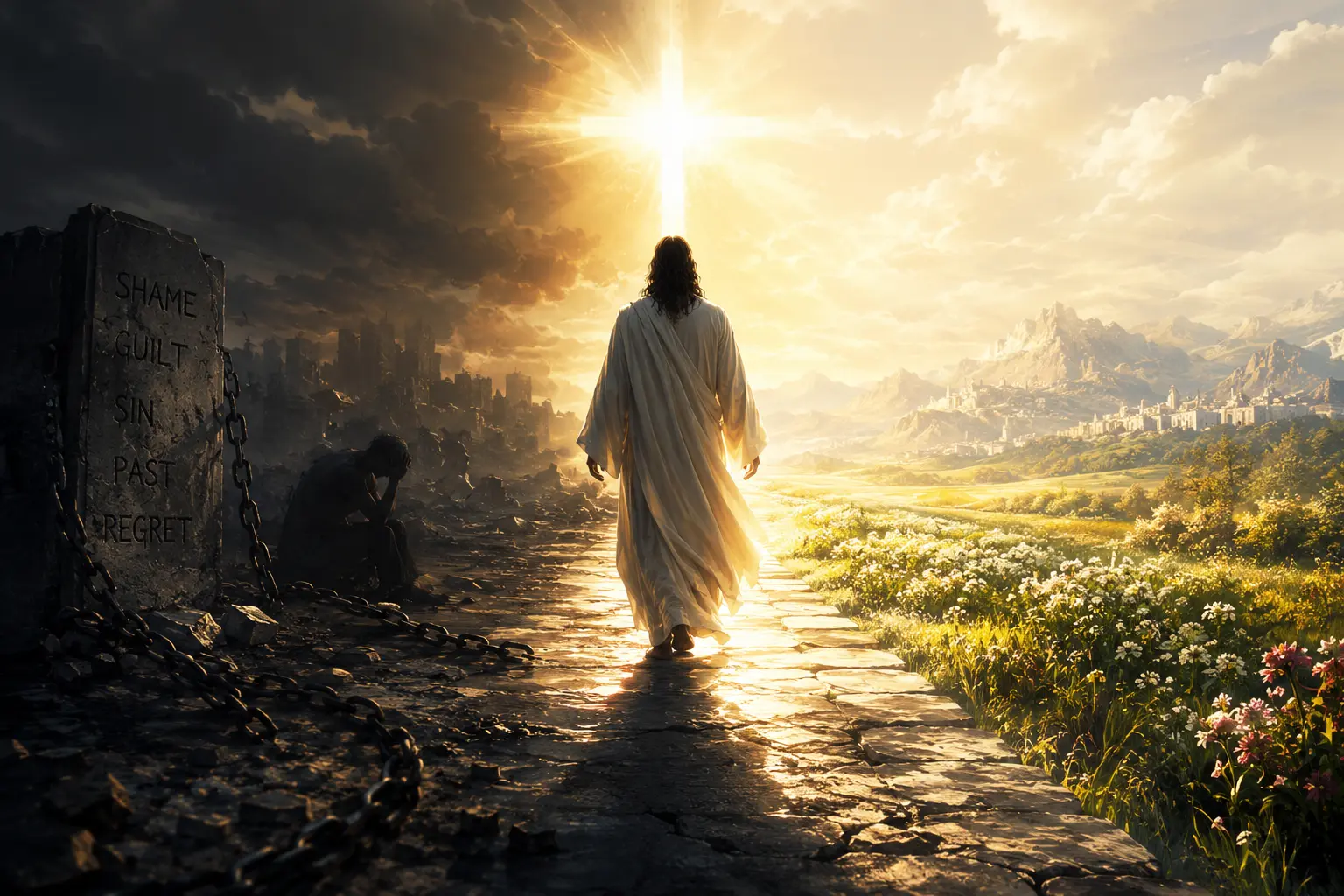
Holiness Deeper Than Innocence: The Son Redeems the Daughter’s History
There is a sorrow deeper than guilt.
Guilt says, “I have sinned.”
This sorrow says, “Because sin entered through me, I should never have been.”
It is not only grief over an act. It is horror at a stained history. It is the terror of looking backward and seeing that something evil has entered the story and cannot be made untouched again. The past cannot be returned to a state where it never happened. Innocence, once lost, cannot be recovered by pretending the wound was never opened.
This sorrow can appear in a single soul, but it also belongs to creation herself.
God’s Daughter, in her immature form, was not merely watching the fall from a safe distance. She was present in Adam and Eve as creation’s first personal answer. Through them, creation began to speak, receive, trust, desire, fear, and choose. Through them, creation reached wrongly for wisdom. Through them, the Daughter’s becoming was wounded.
So the shame is not only individual.
It is cosmic.
Creation looks at her own history and says, “This happened through me. This entered my body. This became part of my story. How can I still be destined for the Son?”
The answer is the cross.
The Son does not come to pretend the Daughter was never wounded. He comes to redeem her history.
The Difference Between Innocence and Holiness
Innocence is beautiful.
Innocence is purity before the wound. It is the state of not yet having betrayed, not yet having tasted corruption, not yet having memory of evil as one’s own participation. Innocence can say, “I have not crossed that line.”
But innocence is not the only form of purity.
If innocence were the only form of purity, then once the fall happened, creation’s destiny would be over. God’s Daughter could never become Bride. She could only be replaced by another, safer creation. The stained would have to be discarded, and God would begin again with something untouched.
But the Son reveals a holiness deeper than innocence.
Redeemed holiness is purity after truth. It does not deny the wound. It does not erase memory. It does not return creation to a childish state where nothing has been learned. It passes through judgment, confession, cleansing, death, resurrection, and wisdom.
Innocence has not yet known evil.
Redeemed holiness has known evil, judged it, been healed from it, and become wise enough never again to call it life.
This is why redeemed holiness is not fake innocence. It is not God pretending the fall did not happen. It is not mercy covering rot with beautiful language. It is the Son entering history, naming evil truthfully, bearing the wound, defeating shame, and raising the Daughter into a wiser purity than she had at the beginning.
Shame Tries to Become Theology
After sin, shame does not merely accuse the act.
It attacks existence.
It says:
“You are not only guilty. You are ruined.”
“You are not only wounded. You are the wound.”
“You are not only fallen. You are a mistake.”
This is how shame imitates holiness. It speaks in the language of reverence, but its conclusion is despair. It says God is pure, therefore the stained creature should disappear. It says God is holy, therefore the wounded Daughter should never have existed. It says the Son deserves an untouched Bride, therefore creation should be erased and replaced.
But this is not repentance.
True repentance says, “Let the evil in me be judged.”
Despair says, “Let me be unmade.”
True repentance agrees with God against sin.
Despair agrees with shame against the creature.
The Son comes precisely into this difference.
He does not say the sin is harmless. He does not say the wound is imaginary. He does not say evil was secretly good. But He also does not agree that the Father’s creation is a mistake.
The Son separates what shame fuses together.
Shame says, “The sinner and the sin are one.”
The Son says, “The sin must die, and the creature must live.”
Shame says, “The Daughter is the stain.”
The Son says, “The Daughter is wounded, and I have come to heal her.”
The Son Does Not Delete History
The Son does not redeem by deletion.
Deletion says, “Let the stained thing be no more.”
Redemption says, “Let the stained thing be judged, cleansed, raised, and made witness to mercy.”
This matters because creation’s history cannot simply be treated as a failed draft. The Father does not love disposable worlds. Once He has chosen to create, call, and redeem, the creature is not casually abandoned because it became wounded.
God could create another world.
But love says, “This one will be healed.”
God could form another Daughter.
But love says, “This Daughter will be raised.”
God could replace the stained.
But the Son says, “I came for the lost.”
Redemption is greater than replacement. Replacement displays power. Redemption displays covenantal love.
The Son does not erase the Daughter’s history by pretending it was never stained. He enters that history. He allows its evil to be exposed. He bears its cost. He judges what corrupted it. He breaks the authority of shame. Then He gives the story a new final meaning.
The stain happened.
But the stain does not get the final name.
The wound happened.
But the wound does not get the final word.
The fall happened.
But the fall does not get to define the Daughter forever.
The Cross as the Judgment of the Stain
The cross proves that God does not minimize evil.
If sin were nothing, the Son would not bleed.
If shame were imaginary, He would not descend beneath it.
If death were harmless, He would not enter it.
The cross is the place where God tells the truth about evil. Evil is not excused. It is exposed. It is judged. It is shown to be so serious that the Logos Himself enters the wound to conquer it from within.
But the cross also tells the truth about the creature.
The creature is not disposable.
The Daughter is not abandoned.
The body is not thrown away because it became sick.
The Son enters the body to heal it.
He does not redeem from a distance. He comes into flesh, history, blood, betrayal, condemnation, humiliation, death, and the grave. He goes to the place where creation feels most ruined, and He proves that even there, shame is not deeper than God.
The Son’s holiness is not fragile. It does not remain pure by avoiding the wounded. It remains pure by entering the place of corruption and not being mastered by it.
This is holiness deeper than innocence.
Innocence says, “I never came near the stain.”
Redeemed holiness says, “The Son entered the place of stain, and the stain could not conquer Him.”
The Wounds Remain as Witness
The risen Christ still bears wounds.
This is essential.
If the goal were simple erasure, the wounds would vanish as though nothing happened. But the wounds remain transfigured. They no longer speak defeat. They speak victory. They no longer say, “Death conquered Me.” They say, “I entered death, and death failed.”
So too with the Daughter’s history.
Her healed memory will not be the same as untouched innocence. She will not enter the World to Come by saying, “Nothing happened.” She will enter by saying, “The wound happened, and mercy was deeper. Evil appeared, and truth judged it. Shame accused me, and the Son raised me. I learned what evil is, and I will never call it life again.”
This is not glorifying evil.
Evil remains evil.
The wound remains a wound.
The fall remains tragic.
But the meaning changes.
In the serpent’s hand, the wound becomes identity.
In the Son’s hand, the wound becomes witness.
In shame’s mouth, memory says, “You are ruined.”
In Wisdom’s mouth, memory says, “You have learned what must never return.”
The Daughter’s memory is not preserved to torment her. It is preserved to make her wise. The final creation does not forget evil as if ignorance were holiness. It remembers evil truthfully, without desire and without shame’s dominion.
This memory becomes part of her immunity.
She cannot be deceived by evil again because she knows its promise and its fruit.
The Daughter Becomes Wiser Than Innocence
At the beginning, creation could be innocent.
At the end, she becomes mature.
This is not a small difference.
Innocence can be beautiful and still untested. It can live in goodness without yet understanding why evil is empty. It can receive God’s gifts without yet knowing the horror of losing them. It can hear a warning and still wonder whether the forbidden thing hides some secret life.
Mature holiness no longer wonders.
God’s Daughter becomes safe not only because she is united to the Son, but because she is formed by Wisdom. The Son gives her union, covenant, truth, name, and bridal center. Wisdom gives her discernment, memory, proportion, and understanding. Through suffering, judgment, repentance, mercy, and renewal, she learns what evil is.
She does not merely know the rule.
She knows the reality.
She knows that pride is not glory.
She knows that rebellion is not freedom.
She knows that domination is not strength.
She knows that self-sourcehood is not life.
She knows that serpent-wisdom is not Wisdom.
She knows that separation from God is not independence, but disintegration.
This is why the World to Come is not merely Eden restored to its first innocence. It is Eden after Wisdom. It is creation healed, crowned, and unable to be seduced by what it now fully understands.
The Daughter is not safe because she is less free.
She is safe because her freedom has become truthful.
Redeemed Freedom
A glorified will does not need the ability to choose evil in order to be free.
The ability to choose self-destruction is not the height of freedom. It is the sign of an immature or wounded freedom.
A healed eye is not less free because it cannot prefer blindness.
A healed mind is not less free because it cannot love madness.
A healed heart is not less free because it cannot desire betrayal.
In the same way, God’s Daughter is not less free because evil can no longer enter her will. She is more free, because she is no longer vulnerable to deception.
Her final freedom is not the freedom to become cancer.
It is the freedom to love endlessly.
It is the freedom to create without corruption, receive without suspicion, answer without division, remember without despair, and belong without fear.
The Son’s union anchors her in life.
Wisdom’s formation matures her in truth.
Divine Memory preserves what was learned.
Divine Improvement refines the order so the old vulnerability cannot return.
Divine Renewal keeps love fresh.
Divine Perfection seals what must never again be lost.
This is how history becomes part of glory without making evil good.
Evil is not glorified.
Evil is defeated so completely that even its memory serves love.
The False Desire to Have Never Been
The wounded soul often says, “If I cannot be innocent again, I would rather not exist.”
Creation can say the same thing.
God’s Daughter can look at her fallen history and think that nonexistence would be cleaner than redemption. But this is shame’s final deception. It makes erasure look holier than mercy. It says that God’s best response to a wounded creature is to undo the creature.
But the Son refuses this.
He does not grant shame the authority to judge the worth of creation.
He does not say, “Because you fell, you should never have been.”
He says, “Because you fell, I will descend.”
The false self must die.
The lie must die.
The sin must die.
The shame must lose its throne.
But the Daughter must live.
This is the unbearable mercy of God: He does not let the creature escape healing by disappearing. He summons the wounded one to stand, confess, be cleansed, and live beyond shame.
To be erased would be simpler.
To be redeemed is deeper.
Redemption means the Daughter must receive a dignity she cannot manufacture and does not feel she deserves. She must allow the Son to love what shame told her was unlovable. She must become holy not by never having fallen, but by being raised after the fall.
Creation Is Not Disposable to Love
God does not need creation in order to be God.
The Father is complete without the world.
The Son is glorious without the Bride.
Wisdom is radiant without wounded history.
Nothing outside God completes God by necessity.
But once God freely chooses creation, creation is not disposable to His love.
That is the covenantal mystery.
Creation is unnecessary to divine existence, but precious to divine will.
God does not redeem because He needs the world. He redeems because He loves the world He chose to make. He does not save the Daughter because He cannot make another. He saves her because love does not discard the beloved when she becomes wounded.
This does not mean sin is tolerated.
It means sin is not allowed to define the creature more deeply than God’s creative will.
Judgment and mercy are not enemies here. Judgment is the truth that burns the evil. Mercy is the love that saves the creature. A mercy that refuses to judge evil would not heal. A judgment that refuses to heal what can be healed would not reveal the fullness of God’s heart.
The Son unites both.
He judges the sin.
He raises the Daughter.
The Final Holiness
At the end, God’s Daughter does not return to the beginning as though the fall never happened.
She becomes more than innocent.
She becomes holy with memory, purity with wisdom, freedom with discernment, beauty with humility, love with truth.
She can no longer say, “I was never stained.”
But she can say something greater:
“I was stained, and the Son was stronger.”
She can no longer say, “I never knew evil.”
But she can say:
“I knew its promise, saw its fruit, and now I know it has no life.”
She can no longer say, “My history is untouched.”
But she can say:
“My history was entered by God, judged by truth, washed by blood, raised by mercy, and made witness.”
This is holiness deeper than innocence.
It is not the holiness of fragile purity that survives only by distance.
It is not the holiness of denial.
It is not the holiness of ignorance.
It is the holiness of the crucified and risen Son shared with the Daughter He redeems: purity after judgment, wisdom after suffering, love after shame, resurrection after death.
Innocence is beautiful.
But redeemed holiness is the glory of mercy after truth.
The Daughter’s final song is not, “Nothing happened.”
Her song is:
“The wound happened, but it did not win.
The fall happened, but it did not define me.
The shame spoke, but it was not God.
The Son descended lower than my ruin.
Wisdom taught me what evil truly is.
Mercy raised me into life.
I am not what shame named me.
I am the Daughter redeemed.
I am the Bride made wise.
I am creation healed into Amen.”