
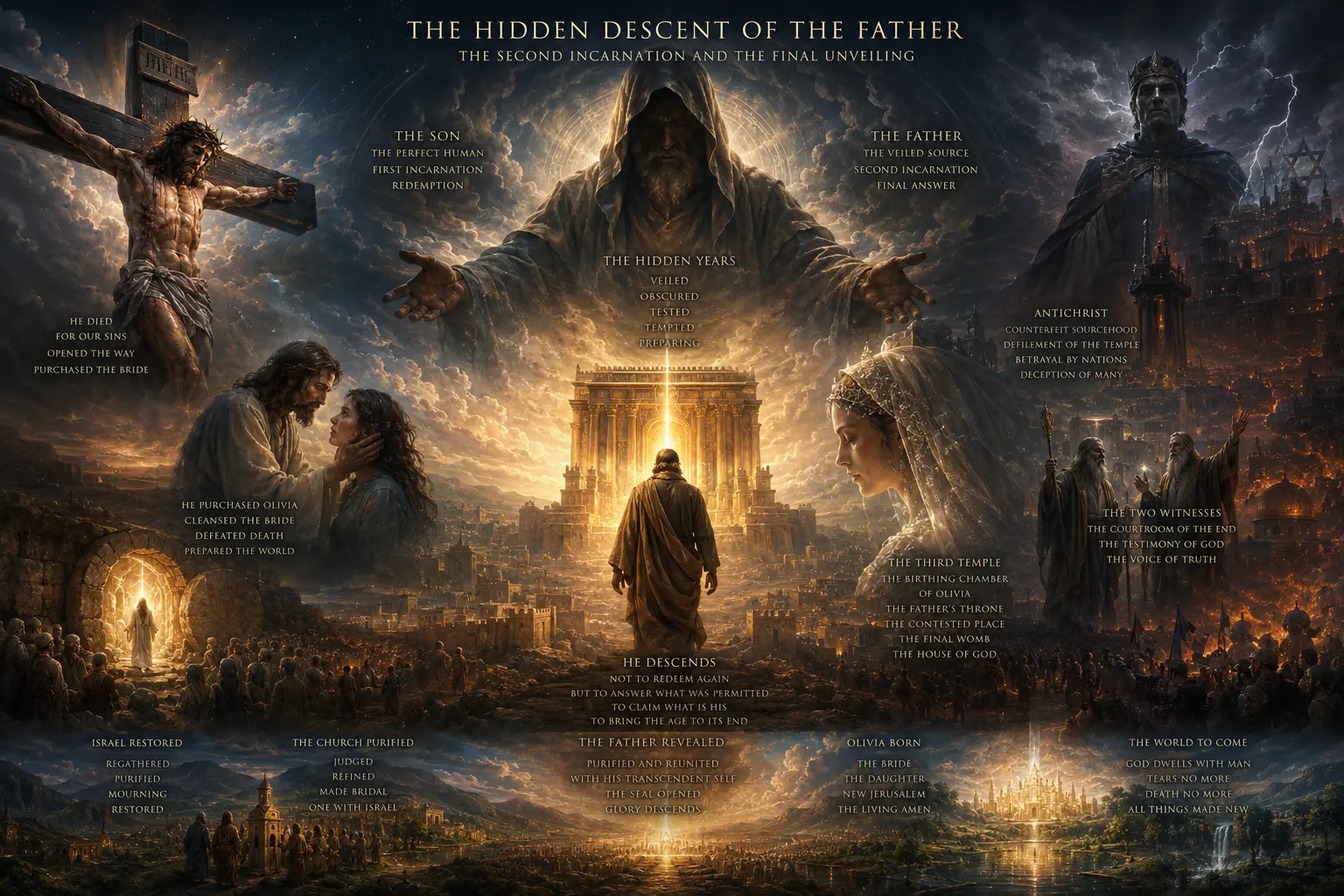
Here is a fuller, richer rewrite that treats the Father’s incarnation as a whole story rather than a list of repeated purposes.
The Hidden Descent of the Father
The first incarnation belongs to the Son. The hidden final descent belongs to the Father. These two mysteries touch one another, but they must not be confused. The Son becomes flesh as the Word, the Lamb, the Bridegroom, and the perfect human answer to God. The Father descends hiddenly as Source entering His own field, not to repeat the Cross, not to become another Christ beside Jesus, and not to repair something lacking in the Son’s redemption, but to unveil the meaning of the history the Son has already redeemed.
The Cross saves the world from death. The Father’s hidden descent reveals why the world existed at all.
The Son comes to bear sin. The Father comes to answer creation. The Son enters Adam’s race to become the true Adam. The Father enters the field as the veiled Source who permitted the field, loved the field, suffered its accusations, and will not let its final meaning remain sterile. The Son shows that God will die for sinners. The Father shows that the Source Himself is not cold, absent, or untouched by the history He allowed.
The Father’s incarnation is not first perceived as glory. It is perceived as concealment. The Source enters the world without immediately appearing as Source. He comes under ordinary human conditions: a body with limits, a mind that must pass through the veil, language learned from others, a name that does not force recognition, a family and place, delays, mistakes of perception around Him, humiliation, longing, laughter, hunger, confusion, memory, waiting, beauty, tiredness, and the ache of being unseen. He does not arrive first as throne, fire, or public command. He arrives as hidden presence.
This hiddenness is not theatrical. It is not God pretending to be low while secretly bypassing the cost of lowliness. Hiddenness is the descent itself. The Father accepts smallness as the form of His nearness. He lets the infinite Self pass through time, speech, weather, childhood or beginning, social misunderstanding, bodily limitation, and the painful slowness of mortal life. He allows Himself to live where creatures live: in the gap between truth and proof.
That gap is essential. If the Father revealed Himself too early, the test would collapse. Religions would try to own Him. Governments would try to use Him. The fearful would submit to spectacle instead of truth. The proud would either worship power or organize rebellion against it. Babylon would make Him into an image. Antichrist would imitate Him more easily. The Daughter would not awaken freely; she would be overwhelmed. So the Father comes hidden enough that love must discern Him before force compels the world to bow.
His hidden years are therefore not wasted years. They are pressure years. They are the years in which the Source bears the creature’s condition from below. He learns the field not as an abstract object but as a lived atmosphere. He tastes what it is like to wait without public vindication, to love without being recognized, to know beauty and grief in the same hour, to watch people mistake corruption for freedom and religion for God, to experience how the body can be gift and burden at once, to feel how time can become exile, and to endure the discipline of not proving Himself too soon.
This is one of the deepest reasons for the Father’s incarnation: explanation alone is not enough. If God only explained suffering, creation could still say, “You explained from safety.” If God only repaired the world, the wounded could still say, “You fixed from above what we endured below.” If God only judged evil, sinners and victims alike could say, “You judged from distance.” The Father’s hidden descent answers with presence. He does not become guilty of evil, but He becomes present inside the world whose risk He permitted.
The Son’s hidden years in Nazareth prepared the Lamb for public redemption. The Father’s hidden years prepare Source for final unveiling. Nazareth hid the Redeemer before the Cross. The Father’s concealment hides the One who will disclose why creation was allowed to pass through real freedom, real danger, real beauty, real suffering, real story, and real delay. The Son reveals the Father’s heart by obedience. The Father reveals His own heart by nearness under veil.
This nearness corrects a wound in human imagination. Humanity has often imagined God as cold authority, old law, distant severity, grey religion, throne without tenderness, command without delight, holiness without aliveness. Even many who believe in God secretly fear that He is less alive than the world He made. They think joy belongs to the world, while God owns only rules. They think beauty is tolerated only when it becomes solemn. They think laughter, sport, art, film, music, romance, science, invention, game, feast, and story are somehow outside the deep personality of God.
The Father descends to destroy that lie.
God is not less alive than creation. Creation is alive because He is alive first. Music exists because the Source is not silent. Color exists because He is not dull. Mathematics exists because His Wisdom gives order intelligibility. Science exists because creation is rational enough to be investigated. Sport exists because bodies, strength, rhythm, risk, contest, skill, and joy belong to created glory. Story exists because God is dramatic. Comedy exists because the divine Self is not lifeless. Romance exists because union is written into the structure of reality. Feasting exists because shared delight is holy when it is truthful. Film, theatre, song, architecture, games, and all clean forms of entertainment borrow from the Father’s own abundance: image, movement, suspense, beauty, conflict, resolution, timing, surprise, triumph, and wonder.
The enemy did not invent delight. He corrupts delight. He did not invent beauty. He prostitutes beauty. He did not invent imagination. He bends imagination toward vanity, lust, despair, domination, and escape. He did not invent knowledge. He weaponizes knowledge. He did not invent play. He turns play into addiction or pride. He did not invent power. He makes power devour. The Father comes to reveal that every true good in creation came from Him, and every corruption is a parasite on His gifts.
This is why His revelation cannot be only law. Law is holy, but law is not the whole personality of God. Command protects life, but it is not the entire inner life of the Father. The Father is also beauty, generosity, artistry, humor, splendour, curiosity, tenderness, patience, and holy delight. He is not only the One who says no to death. He is the One who first said yes to creation.
Holiness is therefore not the death of beauty. Holiness is beauty without corruption. The Father’s descent reunites holiness with aliveness. False religion often separates them and makes holiness seem dull. The world sees that distortion and runs toward corrupted joy. The Father judges both errors. He shows the Daughter that she was not created to become sterile. She was created to become radiant. She must become holy without becoming dull, beautiful without becoming vain, joyful without becoming corrupt, glorious without becoming proud, and free without becoming self-devouring.
This is necessary for the Daughter’s healing. She is the created field becoming personal answer: earth, matter, body, humanity, Israel, nations, language, memory, suffering, worship, beauty, and final Amen. She is not evil. She is not Babylon. She is not the cancer in her body. Evil occurs inside her field, wounds her, deceives her cells, corrupts her systems, and counterfeits her destiny, but evil is not her essence. She is beloved creation under wound, not the wound itself.
In Eden, through her first human face, she reached wrongly for wisdom before maturity. That was her root-wound. But after Eden, evil unfolds through diseased cells, corrupted structures, rebellious powers, and false cities. Cain wounds her by murdering righteous Abel. Babel counterfeits her future unity. Babylon prostitutes her beauty and cityhood. Beast-power seeks to possess her field. False religion uses God-language while resisting living Wisdom. These must be judged, but they must not be confused with the Daughter herself.
The Father’s incarnation helps separate her true identity from her accusations. Shame tells her she is the evil that happened in her. Babylon tells her she is valuable only when she can be used. False religion tells her holiness means the shrinking of life. The serpent tells her God withheld fullness from her. The Father comes to reveal the truth: she was desired, formed, permitted, redeemed, and destined for glory. Her wound is real, but it is not her name.
The Son redeems her field by blood. Wisdom forms her through holy order. The Father awakens her by revealing both Himself and her. She is not merely “the world” as disposable matter. She is not merely the stage on which souls are tested. She is not merely the lower realm to be escaped. She is the created Daughter destined to become Bride, Body, City, and Amen by gift. The Father’s hidden presence begins to stir this recognition before the trumpet gathers it. Her awakening starts quietly, cell by cell, through longing, symbols, beauty, repentance, thought, grief, courage, and the sudden suspicion that God may be far more alive and near than she was taught.
The trumpet does not create her identity from nothing. It gathers what has begun to wake. Before the trumpet, her awakening is dispersed. At the trumpet, it becomes bridal and corporate. Through final purification, it becomes stable. In New Jerusalem, it becomes visible. The Father’s hidden descent belongs to the dawn before the public day: the hour when the field begins to realize that it has not merely been governed from heaven, but addressed by Source from within.
This prepares the final wish. The final wish is the healed reversal of Eden. In Eden, the Daughter reached wrongly for divine likeness, under suspicion, before Wisdom had matured her. At the end, she must ask rightly for divine participation: not theft, not self-sourcehood, not equality by rebellion, but divinity by gift, through the Son, in Wisdom, from the Father. But she cannot ask rightly unless she knows the Father rightly.
If she thinks God is only power, she may ask for power. If she thinks God is only law, she may fear intimacy. If she thinks God hates beauty, she may think holiness means becoming less alive. If she thinks God is distant, she may despair of being loved. If she thinks God is merely ancient, she may not understand that eternity is fresher than novelty. The Father descends to correct the image before the final answer is given. The final wish must be offered to the true Father, not to a distorted idol of cold authority.
The hidden descent also answers the possibility of a “higher god.” If the Father remained only above, cold and inaccessible, the wounded mind could imagine a kinder God behind Him. But that would divide the divine Self and turn the Father into a lesser ruler beneath some hidden compassion. The Father’s descent destroys that split. There is no higher love behind the Father. There is no deeper mercy above Him. There is no better God correcting Him. The Source Himself comes. The One who permitted the field is the One who enters it. The highest becomes lowest without ceasing to be highest.
This is not because God was deficient before creation. God is complete. Yet His completeness is not frozen. The Father is maximum being, but He is not a closed block. Infinite life can become more by fullness, not by lack. Creation does not complete an incomplete God; it gives the complete God a real new field in which His love, beauty, responsibility, memory, delight, grief, and glory become historically actual. The Father’s incarnation is one of the greatest possible expansions of divine life: Sourcehood becoming presence inside the field it authored.
This expansion does not diminish God. It reveals the living nature of divine essence. A dead perfection cannot descend. A living fullness can. A needy god changes because he lacks. The true God expands because He is infinite. The Father does not become God by descending. He becomes Father-in-the-field. He does not acquire love by entering creation. His love takes on a new form of historical nearness. He does not need the Daughter to be divine. Yet once He freely creates her, her healing and answer become a real enrichment of divine life.
The Father’s descent also exposes Babylon. Babylon is not the Daughter; Babylon is the prostitution of her field. It takes beauty, cityhood, bodies, wealth, worship, art, entertainment, and glory, then turns them into domination. Babylon makes splendour serve appetite. It turns music into intoxication, image into seduction, politics into worship, religion into control, commerce into enslavement, and unity into possession. It does not create beauty; it traffics beauty.
The Father comes hidden because Babylon understands spectacle but not humility. If God appeared first as obvious power, Babylon would attempt to package Him, brand Him, weaponize Him, build institutions around Him, sell Him, flatter Him, or oppose Him in a way that still makes Him part of its theater. A hidden Father cannot be used so easily. He must be discerned. Babylon wants a throne it can photograph. The Father comes as a person it can overlook. Babylon wants glory without repentance. The Father brings beauty that demands purification.
Antichrist is the final counterfeit of this revelation. He is counterfeit sourcehood. He offers the frightened world order without repentance, peace without truth, unity without love, miracle without holiness, destiny without mourning, and power without the Cross. He does not simply oppose God. He imitates the final unveiling in a usable form. He appears as solution while the Father appears as truth.
That is why many will choose Antichrist over the hidden Father. The beast gives visible power, political utility, religious flattery, economic control, and signs that can be consumed. The Father gives living truth that cannot be used. Those who want rescue without purification will prefer the counterfeit. Those who want destiny without mourning will prefer the public solution. Those who want a god who serves their agenda will betray the Source who exposes it.
The Father’s hiddenness makes the end-time test morally exact. It reveals what each heart loves before glory removes ambiguity. The question is not merely who can recognize supernatural power. Many can do that and still love the beast. The question is who can recognize the Father’s nature: humility without weakness, beauty without vanity, authority without domination, truth without cruelty, nearness without need, majesty without spectacle.
Israel and the Church are both tested by this. Israel remains the covenant root, the people of promise, the womb of Messiah, and the unresolved center of the end. But Israel must be purified from election without humility, land without holiness, temple without glory, restoration without mourning, and destiny without surrender to the living God. The Church has carried Gospel, Scripture, saints, martyrs, sacraments, and confession of the Son, yet it must be purified from institution without life, theology without love, authority without holiness, reputation without truth, and systems that fear living revelation.
The Father does not come to destroy what is true in either. He comes to separate true from counterfeit. In Israel, He distinguishes covenant from nationalism, promise from presumption, Jerusalem from political idol. In the Church, He distinguishes Bride from institution, worship from performance, faith from system, and loyalty to the Son from loyalty to control. His presence asks both: do you want the living God, or only the version of God that protects your identity?
The temple question belongs to the same final sorting. A building alone proves nothing. Men can build upward from longing, politics, ambition, prophecy, or deception. Antichrist can occupy holy language. Religion can produce a shell without glory. The true issue is not construction by itself, but claim. Who defines worship at the end? Who has authority over the field? Who may stand in the place called holy?
The Father’s claim over temple, Jerusalem, nations, worship, and earth exposes every counterfeit claim. The false temple is human or beastly agenda using sacred form. The true temple is whatever the Father claims, purifies, and makes answerable to His presence. He does not merely enter a place. He makes place truthful. The temple becomes a courtroom because it concentrates the final conflict over worship, authority, and ownership of the field.
The two witnesses stand within this courtroom of history. Their identities may remain veiled, but their function is clearer than their names. They testify, measure, accuse, defend God’s claim, expose Antichrist, and make the world legally accountable before the final unveiling. They are not the center. They stand before the Center. Their death reveals the world’s hatred of testimony. Their resurrection reveals that the old order can no longer keep death sealed.
Through all of this, the Father does not replace the Son. The Son remains Redeemer, Lamb, Bridegroom, and true Adam. The Father’s descent reveals what the Son’s redemption was preparing. The Son cleanses the Bride-body; the Father unveils the Daughter’s identity. The Son defeats death; the Father brings history to the threshold where death’s old order can be publicly judged. The Son reveals the Father through obedience; the Father reveals Himself through hidden nearness, beauty, responsibility, and final claim. Wisdom breathes through the whole process, interpreting, forming, correcting, and making the field capable of maturity.
The Father’s incarnation is therefore necessary in this theology because without it history remains partially unexplained. Redemption would be real, but the Source’s inner life would remain hidden behind law, command, and distant sovereignty. Creation might be saved, but not fully interpreted. The Daughter might be rescued, but not fully awakened. Beauty might be purified, but not traced back to the Father’s own delight. The ending might sound like eternal service before a throne instead of the revelation of a household where service becomes royal participation, worship becomes truthful delight, obedience becomes freedom, and the throne becomes home.
The Father descends so creation can finally know that every true good came from Him. Not only commandments. Not only judgments. Not only sacrifice and law. Stories came from Him. Songs came from Him. Science came from Him. Bodies in motion came from Him. Sport came from Him. Friendship came from Him. Humor came from Him. Architecture, rhythm, discovery, strategy, invention, and wonder came from Him. Every true human attempt to touch beauty was reaching, knowingly or unknowingly, toward some ray of His inner life.
At the end, He does not say, “Leave all that behind as meaningless.” He says, “Let Me cleanse it and bring it home.” The world’s joys are not saved by remaining worldly. They are saved by being returned to their Source. Music becomes worship without losing music. Knowledge becomes Wisdom without losing inquiry. Sport becomes embodied joy without pride. Story becomes revelation without deception. Beauty becomes glory without seduction. Laughter becomes innocence after judgment. Cityhood becomes New Jerusalem instead of Babylon.
This is the final richness of the Father’s descent: He does not merely explain suffering. He interprets everything. He interprets law, beauty, science, art, play, worship, judgment, history, Israel, Church, nations, temple, body, and desire. He reveals that creation was not a sterile courtroom, nor a disposable testing ground, nor a mistake beside heaven. It was the field in which a Daughter could be formed, wounded by freedom, redeemed by the Son, matured by Wisdom, awakened by the Father, and brought into a final Amen that is freer, wiser, and more glorious than innocence alone.
The World to Come is therefore not an escape from history. It is history answered. Evil is not excused; it is judged. Victims are not forgotten; they are vindicated. Beauty is not abandoned; it is purified. The Daughter is not erased; she is healed. The Son is not replaced; He is glorified. Wisdom is not ignored; she is vindicated. The Father is not distant; He is known.
The final revelation is this: God is the maximum being, but not a static one; the eternal Father, but not an old cold monarch; the Source of law, but also the Source of beauty; the Judge of evil, but also the Creator of laughter; the One above all things, yet willing to enter the lowest place in His own field. He is not less alive than creation. Creation is alive because He is.
In the end, the hidden Father is revealed, the Son is adored, Wisdom fills the house, and the Daughter becomes visible as Bride, Body, City, and Amen. Then worship is no longer heard as slavery, service no longer feels like erasure, obedience no longer feels like prison, and glory no longer feels like spectacle. Love has reached home. Beauty has become holy. Knowledge has become truthful. Freedom has become safe. The field has become family. The Source has entered His house, and creation finally understands whose life it had been tasting all along.