
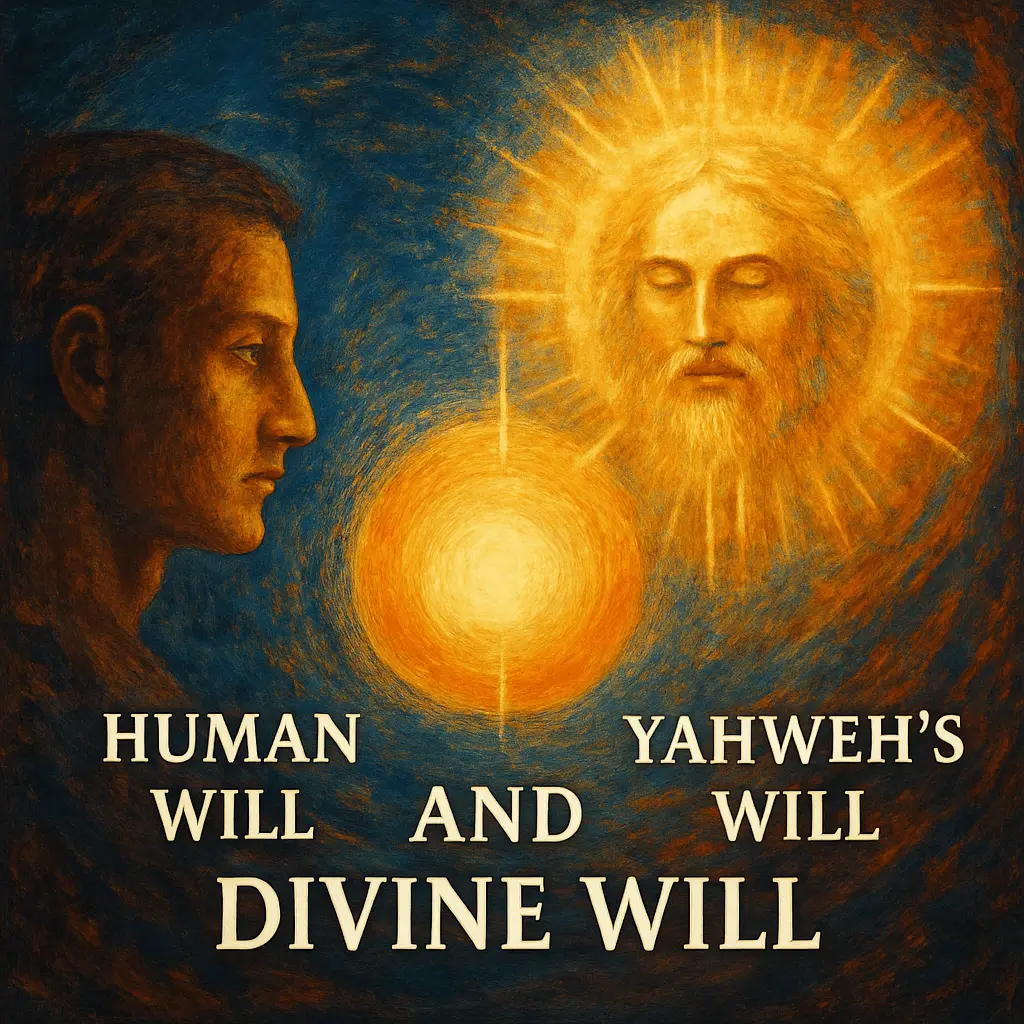
God, Will, and Becoming Human
A Simpler Way to Understand It
If God is will itself and humans have a spark of will, it is natural to wonder whether that spark could ever become the core. In other words, if our will comes from God, why could it not eventually become God. And if God becomes human, is the human actually God, or is it only God looking at Himself in a limited way.
To answer this, we need to keep one simple difference clear: the difference between sharing in something and being the source of it.
Human will is real. When you choose, you really choose. But your choosing depends on many things you did not create. You did not create existence, time, possibility, or yourself. Your will works inside a world that is already there. God’s will is different. God’s will does not work inside existence. God’s will is what makes existence possible in the first place.
Because of this, no amount of growth, wisdom, or alignment can turn a human will into the source of all will. A candle can burn brighter and brighter, but it cannot become the sun. It can share more fully in light without becoming the source of light itself.
This also explains why God cannot replace or exchange His own identity. God’s identity is not like a role or a shape that can be swapped. God’s identity is the very act of being and choosing at all. If that identity were replaced, something deeper would have to decide the replacement. But nothing is deeper than God. So it is not that God refuses to change who He is. It is that the idea of replacing God’s identity does not make sense.
This leads to another question. If God is will, why is that will personal. Why not think of it as an impersonal force or law.
An impersonal force can only do two things. It can act by necessity, producing the same outcome every time, or it can act randomly. But the world is neither forced nor chaotic. It could have been different, and yet it is meaningful and ordered. This means the source of reality must act intentionally rather than blindly. To act intentionally is what it means, at the deepest level, to be personal.
Personal does not mean human-like. It does not mean emotions or a body. It means that reality is shaped by a will that knows what it is doing, not by accident or inevitability. It also means that relationship is real. We can respond, trust, refuse, or align ourselves with the source of reality, and those responses matter.
Now we come to the hardest part. What happens when God becomes human.
God becoming human does not mean God stops being God or squeezes Himself into a smaller container. God does not trade divine life for human life. Instead, God lives a human life in addition to His divine life. God remains the source of everything while also existing inside the limits of a real human body, mind, and history.
This works because God is not limited to one way of existing. God is not a thing that must stay in one shape. Because God is will itself, God can freely choose to exist in a new way without losing what He already is.
So is the human actually God, or is it only God seeing Himself in a limited way. The answer is that the human really is God, not just a picture or a viewpoint. God does not merely look at humanity from the inside. God lives as human. The hunger, learning, suffering, obedience, and death are real.
At the same time, the human life does not exhaust who God is. God is fully present in that human life, but God is more than that life. The human does not contain God. The human is God living in a finite way.
There are not two persons here, one divine and one human. There is one subject. That subject exists eternally as God and historically as human. The human “I” is not someone God inhabits. It is God Himself speaking and acting within human limits.
This does not turn the human into a second God, because being God is not about having power or status. Being God means being the source of existence itself. The human life does not become the source. It is the source choosing to live as one of us.
So the simplest way to say it is this. Humans share in God’s will but never become its source. God’s will is personal because it acts intentionally, not blindly. And when God becomes human, God does not become someone else. God becomes Himself in a new and deeper way.