
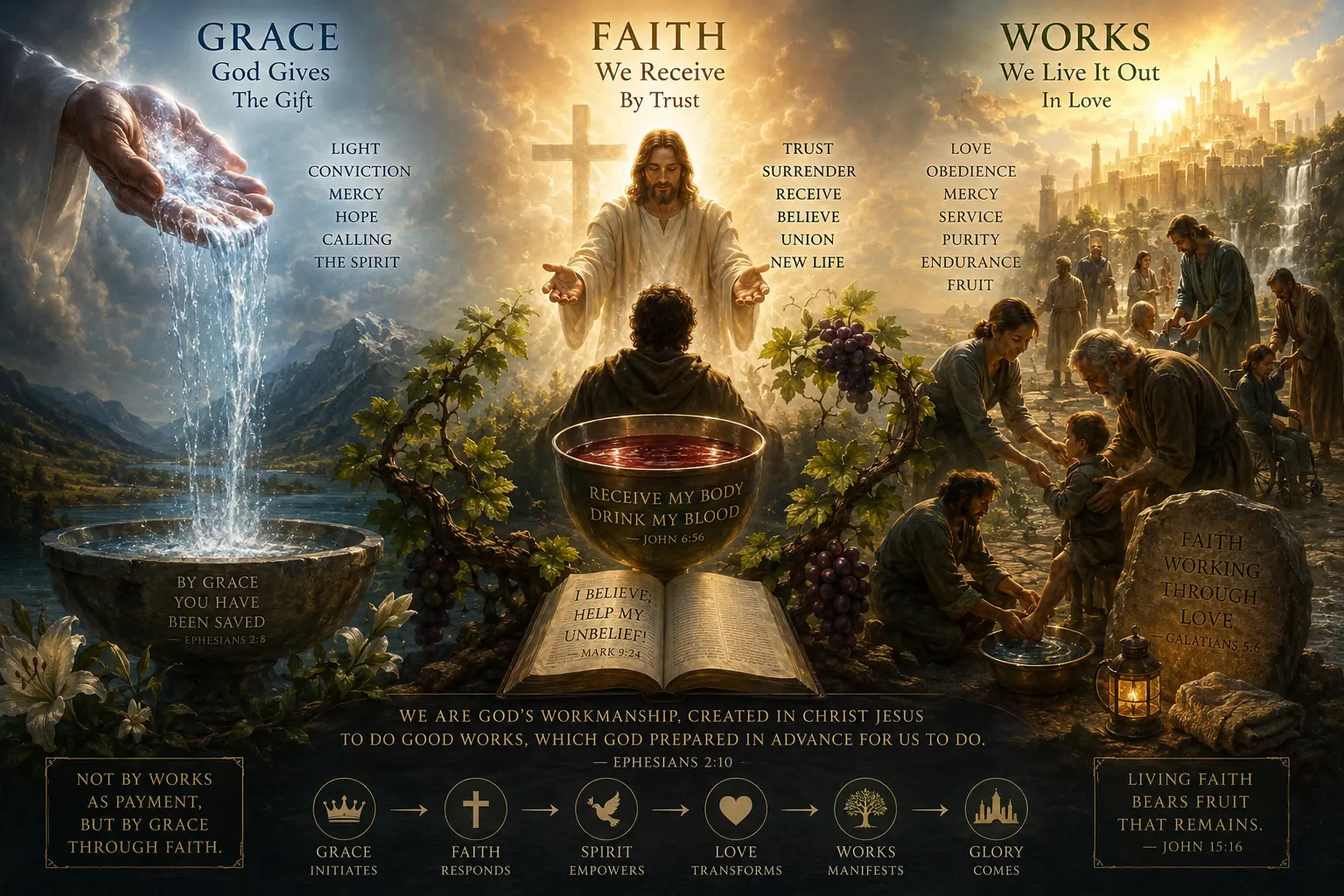
The question of salvation is often divided into a false war.
Some say we are saved by faith alone.
Some say works are necessary.
Some say everything is grace.
Some say the human will must choose.
The deeper truth is that these are not enemies. Faith, works, and grace are different moments of one living mystery.
Grace is the gift.
Faith is the reception.
Works are the embodiment.
The Father gives life.
The Son becomes the way of life.
The Spirit awakens the power to receive life.
The soul believes.
The body begins to bear fruit.
So salvation is not a transaction. It is not a courtroom trick. It is not merely a moral improvement project. It is the entrance of divine life into a wounded person until that person becomes a living member of Christ.
Grace Comes First
Grace is first because the fallen soul cannot save itself.
A soul cannot manufacture saving faith from nothing. It cannot climb into union with Christ by its own unaided power. It cannot cleanse its own guilt, resurrect itself, heal its deepest wound, or create divine life within itself.
Grace must come first.
God gives light.
God gives the call.
God gives conviction.
God gives the glimpse of Christ.
God gives the wound of conscience.
God gives the possibility of hope.
God gives the Spirit’s pressure upon the heart.
God gives the atmosphere in which faith becomes possible.
This is why salvation is not self-originated. The soul does not stand in darkness and invent Christ. Christ comes to the soul. The Father draws. The Spirit breathes. Wisdom prepares the inner soil. The Son stands before the soul as truth, mercy, and life.
Grace is not merely kindness from a distance. Grace is God acting first inside the field where the soul could never heal itself.
Faith Receives
Faith is not merely believing that certain statements are true.
A person can believe facts about God and still remain closed to God. A demon can know truth and still hate it. A sinner can say correct words and still refuse surrender.
Saving faith is trust.
Faith says:
“I cannot save myself.
I receive Your life.
I trust Your blood.
I surrender to Your truth.
I allow You to become my source.”
Faith is the mouth that eats the flesh of Christ.
Faith is the thirst that drinks His blood.
Faith is the empty hand that receives grace.
Faith is the open wound allowing medicine to enter.
Faith does not create salvation. Faith receives the Savior.
This is why faith is not a work in the earning sense. It does not purchase life. It does not impress God. It does not bring a wage. It is the soul ceasing to pretend it has life in itself and opening to the One who gives life freely.
Faith is active, but it is receptive activity.
It is not achievement.
It is surrender.
Works Reveal
Works do not purchase salvation.
But works reveal whether faith is alive.
A dead branch can be painted green, but it does not bear fruit. A dead faith can speak religious words, claim spiritual identity, and even understand doctrine. But if there is no repentance, no love, no movement toward truth, no hatred of evil, no mercy, no fruit, then the “faith” may be only opinion, fear, culture, self-deception, or spiritual theater.
Works are the body of faith.
Faith receives Christ inwardly.
Works embody Christ outwardly.
Faith says yes.
Works show what the yes is becoming.
This is why Paul and James are not enemies. Paul fights the lie that works can replace Christ. James fights the lie that dead faith can receive Christ. Paul attacks self-righteousness. James attacks empty confession.
Paul says the root is faith.
James says the root must bear fruit.
The clean formula is:
We are saved by faith, not by works as payment.
But the faith that saves is living faith, and living faith works through love.
The Hidden Unity of Faith and Works
Faith and works are not two separate currencies.
They are root and fruit.
A tree is not alive because fruit is taped onto it. A tree bears fruit because life moves through it. Likewise, a soul is not saved because it produces moral fruit as a payment to God. A soul bears fruit because Christ’s life has entered it.
If there is no fruit at all, the question is not, “Were there enough works?”
The question is, “Was the root alive?”
A late repentant sinner may have little time for visible works and still be saved. The thief on the cross had no long life of ministry ahead of him, but his faith immediately produced the works available to that moment: confession, humility, fear of God, defense of Christ, and a plea for mercy.
Works are not measured by quantity alone.
They are measured by truth.
A small fruit born from true faith is alive.
A mountain of religious performance born from pride is dead.
Faith as Gift and Choice
The ultimate question is whether we choose faith or whether God grants it.
The answer is both, but not in the same way.
God grants faith as possibility, light, invitation, conviction, hope, and power to receive.
The soul chooses whether to receive or resist.
The soul does not create faith from nothing. The Father must draw. The Son must be revealed. The Spirit must breathe. Grace must open the possibility of trust.
But God does not believe instead of the soul.
If God simply installed faith mechanically, faith would not be trust. It would be spiritual programming. Trust must become personal. The soul must truly say:
“I receive.”
So faith is grace in its source and free reception in its act.
God gives the breath.
The soul breathes.
God gives the light.
The soul opens its eyes.
God gives the hand of Christ.
The soul stops clenching its fist.
Why Some Believe and Others Resist
This is where the mystery of will enters.
Grace can come to two souls, and they can turn differently.
One hears truth and becomes humble.
Another hears truth and becomes offended.
One sees mercy and hopes.
Another sees mercy and feels humiliated.
One is pierced and repents.
Another is pierced and hardens.
The difference is not that one soul created salvation from nothing. The difference is that one received grace while the other resisted it.
The Father gives the reservoir.
The Son gives the Logos of faith: truth, meaning, person, path.
Wisdom forms the conditions: timing, conviction, memory, beauty, discipline, warning.
The Spirit gives the living breath of reception.
Then the creature answers.
Faith is the moment the created will stops closing against the divine gift and begins to receive.
The Spirit and the Slow Healing of the Will
The Son gave the Spirit, yet people still sin.
This does not mean nothing changed.
It means the Spirit was given as firstfruits, not as forced final perfection.
The Spirit does not usually erase freedom. He heals freedom. He convicts, strengthens, teaches, warns, renews, and sanctifies. But He does not turn the soul into a puppet.
The Law restrained from outside.
The Spirit heals from inside.
The Law says:
“Here is the boundary. Do not cross it.”
The Spirit says:
“Let Me heal the heart that hates the boundary.”
This healing is often slow because God is not merely controlling behavior. He is remaking the person. A prisoner may be pardoned before he is fully healed. A sick person may receive the medicine before the medicine has finished its work. A child may be adopted before he becomes mature.
So believers still struggle, fall, confess, repent, rise, and grow.
The difference is not that the healed never stumble.
The difference is that they no longer make peace with sin as identity.
Faith, Works, and the Body of Christ
In this theology, faith is the soul receiving the blood of Jesus.
Works are the circulation of that blood through the body.
A cancer cell may claim, “I believe in the body,” while still feeding on the body, poisoning the body, violating the body, and refusing the body’s order. Its claim is false because its life-direction is still cancerous.
A living cell receives the blood and begins to serve the body.
So faith joins the soul to Christ, and works reveal whether that joining is becoming real in the creature’s life.
The saved are not merely individuals excused from punishment. They are living cells being restored into the healed body: the Body of Christ, the Bride, God’s Daughter, New Jerusalem in preparation.
Works matter because the final body must be safe.
Grace saves the cell.
Faith receives the blood.
Works show whether the cell is living or still cancerous.
Why Judgment Looks at Works
God judges works because works reveal what the will loved.
This does not mean works earn salvation. It means works manifest the truth of the person.
A person may say, “Lord, Lord,” while using God’s name as a mask.
A person may speak of grace while refusing mercy.
A person may claim faith while loving cruelty, domination, lust, lies, or self-exaltation.
Judgment strips away the claim and reveals the direction of the will.
Works are evidence.
Not evidence that Christ was unnecessary.
Evidence of whether Christ was truly received.
God does not count works like coins. He reads them like fruit.
Grace Does Not Cancel Freedom
Grace does not destroy the will. Grace restores the will.
A soul enslaved by sin often mistakes bondage for freedom. It says, “I choose this,” when in truth it is driven by fear, shame, lust, despair, pride, addiction, or demonic deception.
Grace enters not to violate personhood, but to rescue it.
God may restrain destructive freedom. He may interrupt the loop. He may infuse hope. He may expose lies. He may break despair. He may wound pride. He may give the soul a moment where it can breathe again.
This is not forced repentance.
It is the restoration of the capacity to repent.
The soul still must yield. But grace makes yielding possible.
Faith as the First Resurrection of the Will
Faith is not yet full resurrection of the body, but it is the first resurrection of the will.
Before faith, the will curves inward and says:
“I will live from myself.”
In faith, the will turns and says:
“I receive life from Another.”
That turn is small compared to final glory, but it is enormous in meaning. It is the first breach in the tomb. The stone is not yet fully rolled away from the whole person, but light has entered.
Every act of living faith is a miniature Easter inside the soul.
The final resurrection will raise the body.
Faith begins by raising the direction of the will.
Works as the Biography of Grace
Works are not merely moral tasks.
They are the biography of grace inside a person.
Every act of mercy tells a sentence.
Every confession tells a sentence.
Every refusal of sin tells a sentence.
Every hidden obedience tells a sentence.
Every return after failure tells a sentence.
At judgment, God reads the biography. He does not ask whether the person wrote a flawless story. He asks whether grace was truly writing there at all.
Some biographies are short, like the thief on the cross.
Some are long and wounded.
Some are full of erasures, tears, and rewritten pages.
But if grace is alive, there will be a story of return.
Grace as the Father’s Reservoir
Grace is not merely pardon. It is the Father’s reservoir opened to the creature.
From this reservoir come:
the power to believe,
the courage to repent,
the hatred of sin,
the hope of mercy,
the strength to obey,
the tears that cleanse,
the love of truth,
the ability to rise again.
The creature does not invent these waters.
But the creature can open or close, receive or resist, drink or turn away.
This preserves both divine initiative and creaturely responsibility.
The Father gives the water.
The Son gives the cup.
The Spirit gives thirst.
Wisdom teaches how to drink.
The soul must drink.
Dead Faith as Unswallowed Bread
Dead faith is like bread placed in the mouth but never swallowed.
It is near the body, but not nourishing it.
It touches the lips, but does not become life.
A person may hold Christ externally through language, culture, doctrine, ritual, or identity, yet never let Him descend into the will.
Living faith swallows.
It lets Christ enter.
It lets the blood circulate.
It lets the old self be judged.
It lets the Spirit begin the painful work of transformation.
Dead faith admires the medicine.
Living faith drinks it.
The Difference Between Weak Faith and False Faith
Weak faith can save.
False faith cannot.
Weak faith says:
“Lord, I believe; help my unbelief.”
False faith says:
“Lord, I believe,” while refusing to be touched.
Weak faith trembles but reaches.
False faith speaks confidently but remains closed.
Weak faith may fall many times, but it grieves and returns.
False faith uses grace as permission to remain unchanged.
Weak faith is a bruised reed.
False faith is painted stone.
God is gentle with weak faith.
God exposes false faith.
Final Formula
Grace is the Father’s gift before all response.
Faith is the soul receiving that gift through trust in Christ.
Works are the visible life of that gift moving through the person.
We are not saved by works as payment.
We are not saved by faith as mere opinion.
We are saved by Christ received through living faith, and living faith becomes fruitful because Christ is alive.
Faith is grace received.
Works are grace embodied.
Judgment reveals whether grace was resisted or allowed to live.
The Father gives the breath.
The Son gives the blood.
The Spirit gives the power to receive.
Wisdom forms the soul.
The creature answers.
And where the answer is living, even if weak, wounded, and unfinished, salvation has begun.