
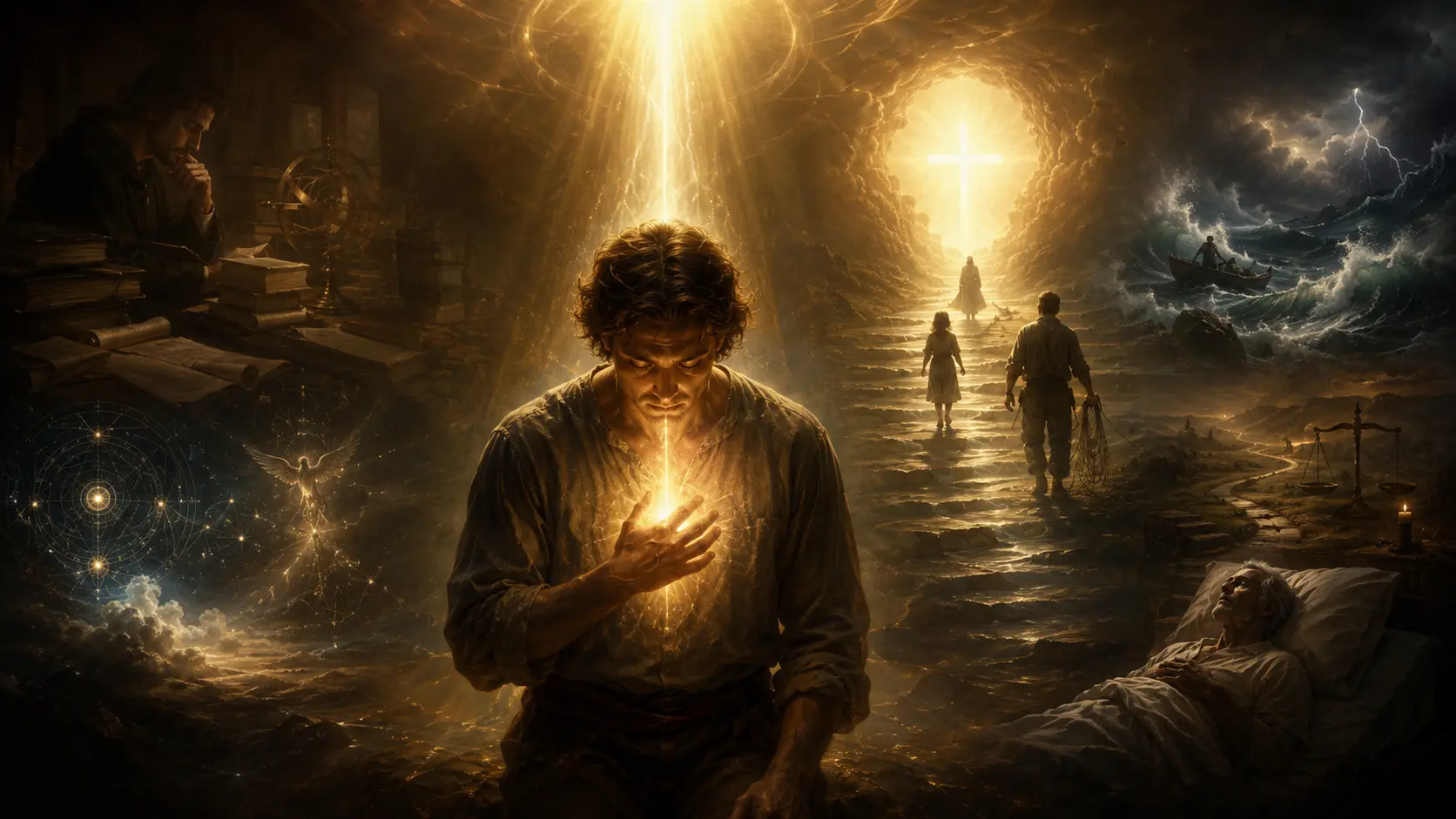
Faith is often misunderstood because people place it in the wrong part of the human person.
Some think faith is intellectual certainty.
Some think faith is emotional warmth.
Some think faith is moral achievement.
Some think faith is spiritual experience.
But at its root, true faith is willful.
Faith is the will’s covenantal “yes” to God.
It is the soul saying:
“I choose God.”
“I consent to the light.”
“I bind myself to Him as true.”
“I refuse the lie.”
“I belong to Him, even before I fully understand Him.”
This does not mean the intellect, emotions, morality, or spiritual perception do not matter. They matter deeply. But they are not the root. They are branches. The root is the will.
The mind may not fully understand.
The emotions may not feel safe.
The moral life may still be weak.
The spiritual senses may feel dark.
But the will can still turn.
And when the will turns toward God, the person has begun to believe.
What Faith Is Not
Faith is not merely intellectual agreement.
A person can know doctrines, names, languages, councils, traditions, commentaries, prophecies, and theological systems, and still not belong to God.
A demon can know God exists and still hate Him.
So knowledge is not faith.
Faith is also not merely emotion.
A person can feel religious excitement, warmth, tears, fear, awe, or spiritual intensity, and still remain self-centered. Emotional experience may accompany faith, but it is not faith itself.
Faith is not merely moral discipline.
A person can behave well, give charity, keep rules, restrain the body, appear respectable, and still refuse surrender. Morality may reveal faith, but morality alone is not faith.
Faith is not merely spiritual sensation.
A person can see visions, feel energy, experience signs, speak mystical language, or perceive hidden things, and still not yield the throne of the soul to God.
Faith is deeper than all of this.
Faith is willful allegiance.
It is not just saying, “God exists.”
It is saying, “God is my God.”
What Faith Is
Faith is the act by which the will fastens itself to God.
It is the inward turning of the soul toward the light.
It is not simply information received by the mind. It is consent given by the whole person through the will.
Faith says:
“Even if my mind is not finished, I consent.”
“Even if my heart trembles, I consent.”
“Even if my body is weak, I consent.”
“Even if the world denies Him, I consent.”
“Even if I stand alone, I consent.”
This is why faith can happen in a second.
The mind may need years to understand.
The emotions may need years to heal.
The body may need years to obey.
The soul may need years to be purified.
But the will can turn in an instant.
A person can say:
“From now on, I am not against Him.”
That single turn is not yet maturity, but it is real faith beginning.
The Will as the Throne of the Person
The will is the hidden throne of the soul.
It is the place where the person decides what they love, serve, protect, and refuse to surrender.
The will says:
“This is my God.”
“This is my truth.”
“This is my treasure.”
“This is what I will not let go of.”
“This is where I belong.”
Because the will is so central, faith cannot be reduced to intelligence. A brilliant person may understand many things about God but still refuse Him. A simple person may understand very little but still give himself wholly to God.
That is why the simple can triumph where the intellectual falls.
The intellect can describe the door.
The will walks through it.
The emotions can feel the warmth.
The will enters the fire.
Morality can arrange the house.
The will gives the house to God.
Spiritual experience can see the light.
The will says yes to the light.
Why Some Believe and Others Do Not
Some believe and others do not because light does not only reveal God.
It also reveals the person.
When the light comes, one soul says:
“This is truth. I surrender.”
Another soul says:
“This threatens what I refuse to lose.”
The difference is not always intelligence. It is attachment.
Some people want God more than their false life.
Others want their false life more than God.
That false life may be status, pleasure, bitterness, control, reputation, doctrine, intellectual mastery, religious identity, self-authorship, or the right to define good and evil for oneself.
The will asks:
“If God is real, what must die in me?”
That is where many refuse.
They do not merely reject evidence. They reject the consequences of seeing.
Why Intellectual Theologians Can Fall
The intellectual theologian is in great danger if knowledge becomes possession.
He may know many true things about God, but if he begins to treat God as an object of mastery, theology becomes a throne.
He says:
“I understand God.”
But the simple believer says:
“I need God.”
That difference is enormous.
The theologian may fall because he loves the system more than the living God. He may protect the structure even when God Himself appears in a form the structure did not expect.
He may reject God not because he knows too little, but because he knows too much in the wrong way.
Knowledge becomes pride.
Doctrine becomes property.
Religion becomes control.
Theology becomes a wall.
This does not mean theology is evil. True theology is holy when it kneels. But theology becomes dangerous when it replaces surrender.
The mind was made to serve faith, not to rule over God.
Why Simple Men Can Triumph
A simple man may not explain God well.
He may not understand metaphysics.
He may not solve paradoxes.
He may not know every doctrine.
He may not speak with religious sophistication.
But he can say:
“Lord, I am Yours.”
That is faith.
His mind may be small, but his will is open.
An open will receives more light than a brilliant mind that refuses surrender.
This is why fishermen, sinners, widows, children, the poor, the broken, and the dying can sometimes enter more quickly than scholars, priests, rulers, and experts.
God does not despise intelligence.
But He refuses to let intelligence become the price of heaven.
If salvation depended on intellectual greatness, the clever would own the gate.
But if salvation depends on willful faith, then the gate is open to the child, the poor, the thief, the wounded, the uneducated, and the dying.
Why Faith Can Happen on a Deathbed
Faith can happen on a deathbed because the will can turn even when the body is finished.
A person may have wasted years.
A person may have sinned deeply.
A person may have ignored God.
A person may have misunderstood everything.
But at the edge of death, the soul can still say:
“God, I surrender.”
“Remember me.”
“Have mercy on me.”
“I do not want the lie anymore.”
“I choose You.”
That turn can be real.
The thief on the cross had no time to build a religious career. He had no time to perform great works, study theology, repair every consequence, or prove decades of obedience. But he turned. He recognized the King while dying beside Him.
That is why deathbed faith is possible.
Not because sin is cheap.
Not because life does not matter.
Not because repentance can be faked.
But because salvation is not purchased by time. It is received by surrender.
A lifetime of obedience is beautiful when it flows from faith.
But a single final act of true surrender can open the soul to grace.
Why Faith Is the Requirement for Heaven
Faith is the requirement for heaven because heaven is union with God.
Heaven is not merely a reward-place.
It is not just comfort, beauty, safety, music, or immortality.
Heaven is God received as life.
Therefore the soul must will to receive Him.
God does not force heaven into a soul that refuses Him.
Heaven requires the will’s yes.
This is why faith is the door.
Not intellectual perfection.
Not emotional confidence.
Not moral completion.
Not mystical experience.
Faith.
Because faith is the will opening to God.
Good works matter, but they are the fruit of faith, not the price of entry.
The soul is not saved because it purchased heaven.
The soul is saved because it received God.
And receiving God begins with the will’s consent.
False Faith
False faith says:
“I believe in God, but I will not surrender.”
“I believe in God, but I keep my throne.”
“I believe in God, but I define good and evil for myself.”
“I believe in God, but I refuse forgiveness.”
“I believe in God, but I hate His authority.”
“I believe in God, but I want His gifts without Him.”
This is not true faith.
It is religious self-protection.
True faith does not merely acknowledge God. It yields to God.
The difference is simple:
False faith wants God to serve the self.
True faith gives the self to God.
Weak Faith Is Still Faith
But weak faith must not be confused with false faith.
A person may tremble and still believe.
A person may doubt and still believe.
A person may feel nothing and still believe.
A person may be ashamed and still believe.
A person may fall and still believe.
A person may cry, “Help my unbelief,” and still be turning toward God.
Weak faith says:
“I am afraid, but I do not want to leave You.”
False faith says:
“I want Your benefits, but not Your rule.”
Weak faith is wounded loyalty.
False faith is disguised refusal.
God can heal weak faith.
But false faith must be exposed.
Why the Will Is So Disbelieved
The will is radically disbelieved because modern humanity often reduces the person to psychology, biology, trauma, environment, social pressure, brain chemistry, desire, and circumstance.
All of these matter.
They shape the person.
They wound the person.
They influence the person.
But they are not the deepest throne.
There remains a hidden center where the soul can turn.
This is terrifying.
Because if the will is real, then responsibility is real.
And if responsibility is real, then repentance is necessary.
People often deny the will because they do not want to face the possibility that beneath all explanations, excuses, wounds, and theories, there remains a place where the soul says yes or no.
Why the Will Is Abused
The will was made to say:
“Thy will be done.”
But fallen will says:
“My will be done.”
That is the root of rebellion.
The will is powerful because it was made for union with God. It is the royal power in the human soul.
But when inverted, it becomes self-idolatry.
Freedom becomes rebellion.
Desire becomes lust.
Intelligence becomes self-justification.
Strength becomes domination.
Identity becomes self-worship.
The will, made to bind itself to God, binds itself instead to the false self.
That is unbelief at its deepest level.
Unbelief is not always the absence of information.
Often unbelief is the will protecting an idol.
Different People Before Faith
One person is intellectual. He reads, studies, argues, compares doctrines, and analyzes everything. He may be near to faith if his will is seeking truth. But he may be far from faith if his intellect is protecting pride.
Another person is emotional. She feels deeply, cries easily, experiences religious warmth, and longs for comfort. She may be near to faith if her will wants God. But she may be far if she only wants feelings.
Another person is moral. He works hard, behaves well, serves others, and lives responsibly. He may be near to faith if his will is humble. But he may be far if he believes his goodness makes surrender unnecessary.
Another person is broken. He has failed, sinned, collapsed, and lost respect. He may seem far from God outwardly, but if his will cries, “Save me,” he may be closer than all the respectable ones.
Another person is simple. He cannot explain much. He does not know the language of theologians. But he loves God, trusts Him, and says yes. His faith may be greater than the scholar’s.
Another person is dying. There is no time left. But the will still has one door. If it opens, grace can enter.
How Simple the Turn Is
The turn of faith can be very simple.
It may be:
“God, I believe.”
Or:
“God, I want to believe.”
Or:
“God, I choose You.”
Or:
“God, I do not want to be against You.”
Or:
“God, make me willing.”
Or even:
“God, if You are real, I want truth more than my pride.”
This is not magic language.
It is the will turning.
The words matter less than the inward consent.
The smallest true yes is greater than a thousand false religious speeches.
Faith and the Whole Person
Although faith begins in the will, it does not remain isolated there.
True faith gradually claims the whole person.
The mind begins to seek understanding.
The emotions begin to heal.
The body begins to obey.
The conscience becomes sharper.
The desires are purified.
The imagination is cleansed.
The life begins to bear fruit.
Faith begins as consent.
Then it becomes formation.
Then it becomes obedience.
Then it becomes love.
Then it becomes union.
But the first gate is the will.
Final Summary
True belief is not intellectual certainty, emotional comfort, moral achievement, or spiritual sensation.
True belief is willful allegiance to the light.
It is the soul choosing God as true before the intellect can master Him, before emotion can feel Him, before the body has fully obeyed Him, and before the whole person has become purified.
Some believe and others do not because faith is not won by intelligence but by consent.
The simple man may triumph because his will opens to God.
The theologian may fall because his intellect becomes a throne he refuses to surrender.
The sinner may be saved because he turns.
The religious man may be lost because he refuses.
The dying man may enter because the will can still say yes at the final edge.
This is why faith is the doorway to heaven.
Not because God despises knowledge, emotion, morality, or spiritual depth.
But because heaven is union with God, and union cannot be forced.
The soul must consent.
Faith is that consent.
Faith is the will saying:
“I am Yours.”