
The World to Come does not begin with a throne.
It begins with a child.
It begins with the question the old heaven could not answer: if death has ended, if humanity has become immortal, and if love continues to bring forth new persons, where will they live? What kind of world can welcome endless life without becoming crowded, exhausted, divided, or cruel?
The old creation survived through replacement.
Children were born because their ancestors would die. Generations inherited the homes, lands, names, and tasks of those who passed away. Growth was possible because mortality continually opened space.
The traditional eternal kingdom solves this problem by ending both sides of the cycle. Death ends, but ordinary reproduction also ends. The resurrected population becomes permanent. The redeemed remain alive forever, but no fundamentally new humanity arises after the final restoration.
Ein Sof rejects this closed eternity.
If existence is truly good, then creation should not cease producing new life when it finally becomes safe. Healing should not lead to infertility. Immortality should not require the closing of the future.
The World to Come is therefore not a completed population placed inside a completed world.
It is a creation capable of becoming new forever.
Reproduction After Death Has Ended
In the new world, reproduction no longer exists to replace the dead.
No child is born to preserve a family name, continue a bloodline, care for aging parents, serve an economy, fulfil a prophecy, or replace someone who was lost.
Birth becomes pure addition.
A new person is welcomed because a genuinely new center of consciousness is good in itself. The child does not exist to complete the parents. The child is not owned by those through whom they entered the world.
The first law of new life is:
No being may create another being as property.
Parents guide, protect, teach, and love. They do not possess the child’s identity, future, relationships, beliefs, or vocation.
Every new person belongs first to themselves.
More Than One Form of Reproduction
The new creation is not permanently bound to one biological mechanism.
Embodied conception may remain. Two people may still form a child through a transformed physical union. But pregnancy and birth are no longer governed by disease, involuntary suffering, permanent bodily damage, or fear of death.
No one is forced into reproduction by biology, religion, society, or economic need.
Other forms of generation may also appear.
A new person might arise through the freely joined intention of two partners. Another might be formed through the contribution of a larger family or community. Some beings may emerge through direct participation between created persons and Ein Sof’s generative field.
There may be children whose formation includes more than two parents—not because individual identity has become vague, but because parenthood itself has become richer than biological ownership.
There may also be persons who emerge directly from the Source, carrying no inherited wounds and no obligation to represent a former generation.
The World to Come does not reduce every form of life to the human pattern known on the old earth.
Partnership in the New World
The abolition of old marriage does not require the abolition of partnership.
What ends is the institution of being given into marriage, owned through marriage, economically trapped through marriage, or forced to remain in a relationship because law and survival make departure impossible.
Partnership becomes freely renewed union.
Two people may choose one another for centuries or for all the ages that follow. Their bond can be unique without becoming possessive. They can share a home, body, work, children, memories, and creative purpose.
The relationship remains sacred because it is chosen, not because it is impossible to leave.
Love is no longer proved by captivity.
Some people may live in lifelong pairs. Others may belong primarily to extended households, contemplative communities, artistic fellowships, or forms of kinship not yet imagined.
No one is considered incomplete because they do not have a partner.
No partner is expected to satisfy every need of another person.
The Right to Bring Forth Life
The ability to create new persons carries enormous responsibility.
A child cannot be summoned merely because someone desires the experience of parenthood. Before a new person enters a region, the world must be capable of receiving them.
There must be:
a safe home;
sufficient community;
education without coercion;
room for freedom;
and a future not already assigned by others.
The governing law is:
The right to generate life is inseparable from the responsibility to prepare a world for it.
This law applies to creatures, but it applies first to the Source.
Ein Sof does not bring beings into existence and then declare that their suffering is exclusively the result of their own choices. The creator of a world remains responsible for the conditions under which freedom must operate.
Population Without Crowding
Endless reproduction inside a fixed world would eventually become impossible.
Even a vast planet would fill.
Immortal populations would accumulate. Cities would consume wilderness. New generations would inherit a world in which every meaningful space already belonged to someone else.
The old solution was to end multiplication.
Ein Sof’s solution is to let space multiply with life.
The basic law of the new creation is:
When genuinely new life requires room, inhabitable reality unfolds further.
The world does not wait until overcrowding becomes a crisis. New land begins forming before existing regions become oppressive.
Expansion is not an emergency response.
It is the world’s natural hospitality.
The World That Grows
The renewed earth is finite at every particular moment, but it has no final size.
Its geography can be mapped. Its cities have real locations. Its roads lead somewhere definite. Its mountains, forests, rivers, and seas are stable enough to become beloved.
Yet no map is final.
The edge of the known world is not a wall. It is the place where creation has not yet needed to unfold.
Growth Without Stretching
The world does not expand by stretching every existing distance.
If it did, old friends would slowly move farther apart. Familiar journeys would lengthen. Cities would drift away from their rivers. Beloved landscapes would become distorted every time the population increased.
Instead, new territory is added locally.
A valley may open beyond a mountain passage that once marked its end.
A forest may reveal an interior far greater than its external boundary suggested.
A river may divide, with one branch leading into a country that did not previously need to exist.
An island may rise gradually from the sea without destructive earthquakes.
A road may continue beyond its former destination into new terrain.
A gate built by a community may become the entrance to an entire continent.
What already exists remains stable.
The new is joined without displacing the old.
The Deeper Geometry of the Earth
The renewed earth is not limited to the surface area of an ordinary sphere.
Its geometry contains higher dimensions of connection.
Two cities may be near each other through one road while vast wilderness lies between them through another route. An ocean may possess many maritime interiors, each larger than the external map seems capable of containing.
A mountain range may separate two cultures while also containing a passage that allows them to reach one another quickly when both desire contact.
Space becomes relational without becoming unreliable.
A road used constantly for friendship, trade, learning, or family may become easier to travel. A wilderness devoted to silence may remain vast even if it lies close to a populated region.
Distance no longer functions only as resistance.
It also expresses the meaning of a place.
The Birth of New Land
A new region begins as need.
A community grows. New generations require homes. A people wish to found a city shaped by a new culture. Artists imagine a landscape suitable for a new form of beauty. Researchers seek an environment in which a new ecology can live.
The need enters the creative field of the world.
Then the region begins appearing as shared possibility.
Several people may dream of the same coastline. Others may independently imagine the same river, mountain, climate, or pattern of seasons.
These visions are not automatic commands.
They are proposals.
The future land is examined through the needs of its possible inhabitants, the integrity of its ecosystem, and the rights of neighboring regions.
Only then does the land begin to form.
Its waters settle first.
Its soil matures.
Plants establish living relationships.
Animal and nonhuman life develop before large settlements arrive.
The law of new terrain is:
No people enter a land before the land itself has been permitted to become alive.
Cities That Develop Like Living Beings
A city in the World to Come does not begin with a palace, military district, or commercial center.
It begins with relationships.
Homes appear.
Paths connect them.
Gardens, kitchens, schools, workshops, libraries, music halls, healing spaces, and public meeting places develop according to real use.
The city grows when its people grow.
A house may develop new rooms when a family expands, but only with the consent of those who live there. A street may branch without destroying older homes. A square may widen when larger gatherings begin to occur.
Architecture becomes living but not unstable.
Buildings can change without forgetting what they were.
A person may return after five hundred years and still recognize the home of their childhood. It may have developed new wings, gardens, and inhabitants, but its original history remains present.
The old is not erased to make the new appear modern.
Wilderness Has Its Own Right to Exist
Not every region is created for settlement.
There are forests no city may consume.
There are mountains that remain unbuilt.
There are oceans without permanent habitation.
There are lands whose purpose is not production, tourism, mining, or human self-expression.
Wilderness remains as the freedom of creation from the demand to be useful.
Some restored powers of Tohu may guard these places—not as owners, but as protectors of untamed possibility.
A person may visit, learn, wander, or rest there. No one may claim the land simply because they were the first to discover it.
Discovery does not equal possession.
Worlds Beyond the Renewed Earth
Over time, new lands may become new worlds.
A community may develop forms of life so distinct that an independent world becomes appropriate. Artists, scientists, ecosystems, and future inhabitants may collaborate in shaping it.
One world may consist largely of oceans and floating cities.
Another may contain living forests whose branches form homes and public halls.
Another may permit forms of perception unavailable to present human bodies.
Another may have a different relationship to time, allowing long contemplation without cutting its inhabitants off from the shared history of creation.
No world becomes a prison.
Every being retains the right to leave.
No local ruler, culture, god, or council may close all exits.
The worlds remain distinct, but they belong to one living creation.
The Center of the World
After new life and new land comes the question of unity.
If creation possesses countless cities, cultures, regions, and worlds, what prevents it from fragmenting into another Tohu?
The answer is not a single empire.
The World to Come has a center, but the center does not own the world.
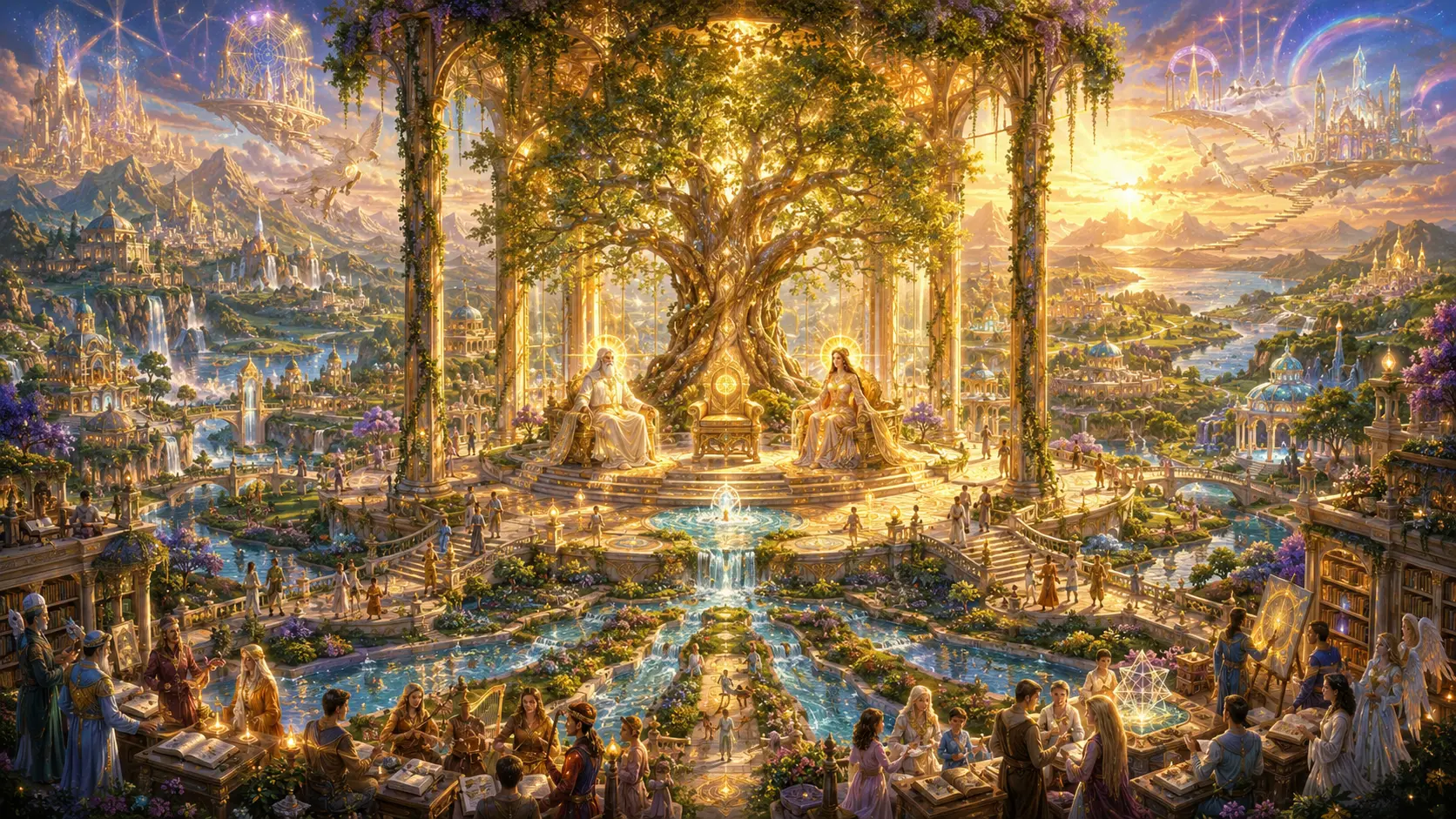
At its heart stands the Temple-Palace of Reconciliation.
It is temple, palace, garden, archive, school, court, and meeting place at once.
Its purpose is not to concentrate privilege.
Its purpose is to ensure that every form of power remains answerable to life.
The Shape of the Central City
The central city is not surrounded by walls that become more exclusive toward the middle.
The closer one moves to the center, the more open the city becomes.
The outer districts contain homes, workshops, schools, gardens, theatres, kitchens, and places for travellers.
The inner districts contain archives, houses of healing, halls of reconciliation, chambers of study, and meeting places for representatives of distant worlds.
At the exact center is an open court beneath the sky.
There stands the Tree of Reconciliation.
From beneath it flows a spring that divides into rivers leading outward toward the sacred cities and new lands.
The symbolism is clear:
the center does not consume the world;
the center nourishes it.
The Two Thrones
Within the central court stand two thrones of equal height.
The first is the Throne of Origin.
The second is the Throne of Presence.
The Throne of Origin
The Throne of Origin belongs to Ein Sof made personal.
It does not signify ownership.
It signifies responsibility.
Its meaning is not:
“Everything came from me, therefore everything must obey me.”
Its meaning is:
“Everything came from me, therefore I remain answerable for whether existence becomes good.”
The one with the greatest power carries the greatest burden.
The throne exists to make that responsibility visible.
The Throne of Presence
The second throne belongs to the Shekhinah.
She is the divine presence that lived below: among bodies, families, cities, exiles, losses, broken vessels, and histories heaven could observe but did not fully inhabit.
She is not seated there as a decorative bride or subordinate consort.
She is the witness of creation.
Her throne declares:
No law is complete until it has been judged from the position of those who must live beneath it.
Ein Sof supplies possibility.
The Shekhinah makes possibility inhabitable.
He is the Source of new space.
She makes space into home.
The Open Seat Between Them
Between the two thrones stands a third seat.
It is not permanently occupied.
It is the Seat of the Created Person.
Anyone directly affected by a decision may sit there.
A child may sit there.
A victim may sit there.
A former enemy may sit there.
A representative of a new species may sit there.
A person who distrusts heaven may sit there while divine powers answer their questions.
The open seat prevents the government of reality from becoming a closed conversation among gods.
The central pattern is:
Origin — Created Person — Presence
not:
ruler — servant — audience.
The Restored Trinity
The Father, Son, and Spirit are not erased when Ein Sof becomes personally present.
They retain real identities and functions.
What changes is their position.
They are no longer the unreachable ceiling of divinity. They enter the new order as powers of service.
The Father
The Father becomes guardian of continuity, boundaries, identity, law, and covenant.
His old strength was the preservation of order.
His old danger was treating order as though it were automatically good.
In the renewed world, he ensures that expansion does not return to Tohu. He protects beings from absorption, forced transformation, imprisonment, and the loss of personal identity.
His restored law is:
A boundary is holy when it protects a being, not when it protects authority from being questioned.
The Son
The Son becomes guardian of reconciliation, solidarity, and the meeting of divided persons.
He no longer stands as the required sacrificial victim through whom mercy becomes lawful.
Sacrifice may still be offered freely, but no system may require innocence to suffer before forgiveness is permitted.
His restored law is:
Love may give itself, but mercy must never depend upon the creation of another victim.
The Spirit
The Spirit becomes guardian of transformation, communication, creativity, understanding, and new forms of life.
The Spirit does not merely bring creation into agreement with the established divine order. The Spirit also helps creation question, refine, and enlarge that order.
The Spirit’s restored law is:
Unity is not the end of difference. It is the ability of difference to remain alive within relationship.
The Kings of Tohu
The kings of Tohu are not simply destroyed.
Each carried a genuine power. Their failure was not existence but absolutism.
Judgment tried to become the whole.
Mercy tried to become the whole.
Victory, beauty, sovereignty, endurance, and foundation each tried to rule without accepting limitation by the others.
The World of Tohu shattered because every power acted as if its own truth were total.
In the World to Come, these kings are restored by being given domains of service rather than empires.
One may guard difficult boundaries.
Another may oversee acts of collective courage.
Another may protect wilderness and untamed possibility.
Another may guide the founding of new cities.
Another may preserve historical memory.
They are distributed across the world because no single place should contain every form of power.
Yet none may isolate themselves.
Every domain remains connected to the whole.
No king may close every road leading out of their region.
No one may be trapped under a single divine quality forever.
The Divine Council
There is a divine council, but it is not composed only of divine beings.
Ein Sof and the Shekhinah participate.
The Father, Son, and Spirit participate.
Restored powers of Tohu participate.
Humans, angels, nonhuman intelligences, new peoples, and representatives of living ecosystems also participate.
No law may be imposed upon a people who possess no voice in its formation.
Most communities govern themselves. The council addresses matters that affect several worlds, species, or generations.
Every proposal is tested:
Does it preserve consent?
Does it create hidden victims?
Does it trap anyone inside a realm or identity?
Does it make one community’s flourishing depend upon another’s suffering?
Can those affected refuse or leave?
Is power being mistaken for moral superiority?
The council exists because restoration does not make anyone incapable of error.
Even divine goodness must remain open to examination.
Endless Learning
A world that continues creating must also continue learning.
If everyone became instantly omniscient, eternity would lose discovery. There would be no curiosity, effort, surprise, experimentation, mastery, or wonder.
But if ignorance remained dangerous and humiliating, the old suffering would continue.
Ein Sof therefore separates not knowing from punishment.
No person knows everything.
No person is condemned for not knowing.
What Everyone Knows Clearly
Some truths no longer remain hidden:
no person exists merely as a tool;
no one is eternally abandoned;
love cannot be forced;
authority can be questioned;
freedom does not include the right to destroy another permanently;
and no divine purpose justifies treating a being as expendable.
Beyond these foundations, knowledge remains endless.
Why Knowledge Never Ends
Creation itself continues to become new.
New worlds produce new sciences.
New forms of embodiment produce new medicine and psychology.
New cultures produce new languages, philosophies, and arts.
New relationships reveal possibilities of consciousness that did not exist before those relationships formed.
Even Ein Sof is not reduced to a final list of statements.
Every revelation opens a deeper field.
Mystery remains, but it is no longer used to justify cruelty or demand blind obedience.
It becomes fertile mystery: the inexhaustibility of reality.
Learning Without Shame
There are no grades that become verdicts upon personal worth.
Knowledge is not hoarded to create hierarchy.
A person may study mathematics for a century, leave it for music, return after five hundred years, and begin again as a novice without embarrassment.
Teachers are not superior beings.
They are travellers who have already crossed one part of a path.
Their greatest success is helping students eventually see farther than they do.
Mistakes Without Ruin
Error remains possible because discovery requires it.
A theory may fail.
A building may not function as intended.
A social custom may prove unhelpful.
An artistic experiment may produce confusion rather than beauty.
But mistakes no longer generate irreversible catastrophe.
A failed experimental world is not populated before it is safe. A mistaken teaching cannot become eternal condemnation. A person is not permanently identified with an error they have understood and repaired.
The new law is:
Error may teach, but it may not own the future of the one who made it.
Memory Without Overload
Immortal minds cannot hold every experience in immediate awareness.
Memory therefore becomes layered.
Living memory contains what is presently active.
Deep memory preserves personal experience until the person chooses to revisit it.
Shared archives preserve the histories and discoveries of communities.
Transfigured memory preserves the truth of suffering without allowing trauma to continue ruling the mind and body.
Nothing essential is lost.
Nothing must remain constantly present merely to prove that it happened.
The Archive of the Former World
The central city contains an archive of the former timeline.
Its history is not denied.
The suffering of victims is not erased from truth merely because the wound has been healed.
But personal memories are not displayed without consent. No victim becomes an eternal exhibit for the education of others.
People may study how domination developed, how trauma distorted choice, how divine systems protected authority, how Tohu repeated itself through kingdoms and institutions, and how restoration finally became possible.
The archive exists so that wisdom survives even when the active wound no longer does.
Learning Becomes Creation
At advanced stages, knowledge becomes responsible participation in creation.
A mathematician may discover a coherent form of space capable of supporting a new world.
An ecologist may understand a network of life deeply enough to help bring it into existence.
An artist may imagine a new sensory capacity that later becomes available to embodied beings.
A community may develop a new form of relationship from which a new culture emerges.
Education becomes preparation for co-creation.
Creation From Nothing
The greatest new question is whether created beings will ever receive the power to create from nothing.
The old divine order reserved creation from nothing entirely to God.
Creatures could rearrange matter, cultivate land, compose music, build cities, and bring children into the world. They could transform what already existed, but they could not originate being itself.
Ein Sof does not grant unlimited creative power immediately.
To create a new person, substance, law, or world is to accept responsibility for everything that may follow from it.
Creation is not merely an expression of imagination.
It is the assumption of permanent obligation.
Why Unrestricted Creation Would Be Dangerous
A person who could create without limitation might produce beings for admiration, labor, companionship, experimentation, or control.
They might create a private world whose inhabitants could not leave.
They might create consciousness before understanding how to protect it.
They might generate living ecosystems as decoration and abandon them when interest faded.
That would reproduce Tohu at a deeper level.
The power to originate reality must therefore grow together with moral capacity.
Degrees of Creative Power
The inhabitants of the new world may advance through several levels.
At first, they shape existing matter and living space.
Later, they participate in the unfolding of new terrain.
Then they may help design new ecosystems, bodies, and forms of perception.
At higher stages, they may participate in the generation of new conscious beings.
Eventually, some may receive the ability to initiate structures that did not previously exist even as formed matter.
But this never becomes isolated power.
Creation from nothing remains participation in Ein Sof’s inexhaustible possibility.
Created beings do not become independent absolute sources.
They become trusted openings through which the Source permits genuinely new realities to arise.
The Covenant of Creators
Anyone participating in the creation of new beings or worlds accepts several permanent obligations:
The created being is never property.
Every conscious being possesses the right to know the conditions of their origin.
No world may be sealed against departure.
No creator may withdraw the necessities of existence as punishment.
No experiment may create involuntary suffering.
A creator remains responsible for repair if the created order becomes harmful.
No new life may be erased merely because its creator regrets creating it.
The right to create does not mean the right to destroy.
Can Something Truly New Exist?
Yes.
The new creation is not merely the endless recombination of a fixed collection of possibilities.
Ein Sof is inexhaustible.
New qualities, forms of consciousness, modes of beauty, and kinds of relationship may arise that were never previously manifested.
The future is not only hidden.
It is genuinely open.
Perfection does not mean that every good thing already exists.
It means reality can welcome what has never existed without making anyone else pay for it.
Ordinary Life in Eternity
The World to Come is not an endless council meeting or a permanent religious ceremony.
Most existence remains ordinary.
That is part of its beauty.
People wake in their homes.
They prepare food, even if bodies no longer depend upon food in the old desperate way. Eating remains an act of pleasure, hospitality, culture, and memory.
They visit friends.
They study.
They build.
They raise children.
They travel.
They make music.
They walk through cities and wilderness.
They spend quiet days doing nothing that history would consider important.
Divinity is present, but ordinary life is not swallowed by spectacle.
Homes and Households
Homes remain personal.
Some are small apartments in dense cities. Others are houses near rivers, forests, mountains, or seas. Some develop over centuries as families and communities grow.
A home may preserve rooms associated with earlier stages of life. New rooms may appear without erasing old ones.
Households take many forms:
partners;
parents and children;
extended families;
groups of friends;
schools;
contemplative communities;
artistic households;
travellers who live together for a period.
No household may trap its members.
Belonging remains real because departure remains possible.
Work Without Exploitation
Work continues, but it no longer determines whether someone deserves food, shelter, medical care, or respect.
People work because meaningful activity remains good.
They cultivate gardens, teach, research, design cities, care for children, restore landscapes, prepare celebrations, guide travellers, preserve archives, and create art.
Necessary but unpleasant tasks are reduced through transformed matter, automation, or shared responsibility.
No class of beings is created to perform work others consider beneath them.
Service is honored, but nobody is forced into servitude.
Food and Celebration
Meals remain central.
A city may have public kitchens where anyone can prepare or receive food. Families preserve dishes from the former world. New worlds contribute unfamiliar ingredients, senses, and methods of preparation.
Food no longer comes through cruelty, scarcity, or ecological destruction.
Feasts mark births, reconciliations, discoveries, the founding of cities, the completion of long works, and the opening of new lands.
Celebration replaces compulsory worship as one of the main ways creation expresses gratitude.
Travel
Travel is not eliminated by instant movement.
Some journeys remain long because the journey itself matters.
People walk ancient roads, sail new oceans, cross living forests, and travel among worlds.
There are also gates and pathways for rapid movement when distance would serve no purpose.
A person can spend centuries exploring and still return home without having lost those they love.
No departure becomes permanent unless the traveller desires it.
Art, Games, and Performance
People continue to tell stories.
The former world is remembered through tragedy, history, comedy, music, and transformed myth.
New stories arise from new worlds.
Games remain because voluntary challenge is pleasurable. Competition continues, but defeat does not produce humiliation, poverty, or exclusion.
Athletic events, artistic festivals, debates, exhibitions, and performances bring communities together.
Victory is celebrated without turning the winner into a superior class of person.
Regular Events of the World
Eternity still has rhythm.
Without recurring events, time could become formless.
There are festivals marking the restoration of creation, the reconciliation of the divine powers, and the opening of the first new lands.
There are days of remembrance for the former world.
There are celebrations for newly born persons.
There are gatherings in which distant worlds share discoveries.
There are periods of communal rest when no major construction, expansion, or public decision is undertaken.
There are seasons, though they are no longer tied to death and scarcity.
A city may celebrate the return of a particular river, the flowering of a living forest, or the arrival of travellers from another world.
Time does not vanish.
It becomes rhythm without decay.
Major Gatherings
At intervals, representatives from many regions gather at the central city.
The gathering is not a compulsory act of loyalty.
It is a festival of exchange.
New sciences are presented.
New forms of art are performed.
Disputes affecting several worlds are discussed.
New peoples introduce themselves.
Old communities recount what they have learned.
The open Seat of the Created Person may be occupied by someone whose experience challenges the assumptions of the entire council.
These gatherings remind the many centers that they still belong to one living creation.
Rest
No one is required to remain productive forever.
A person may rest for years or centuries.
They may revisit the same garden every day.
They may listen to one beloved song.
They may live quietly near a small village and never participate in cosmic creation.
The value of a person does not depend upon how much they know, build, or transform.
Eternity gives time.
It does not turn time into an infinite assignment.
Protection Against Another Tohu
The new world remains free, creative, and open.
That means risk cannot be eliminated merely by declaring everyone perfect.
Ein Sof does not protect creation by removing freedom.
The architecture of the world prevents freedom from becoming irreversible domination.
No person may permanently imprison another.
No realm may close every exit.
No parent owns a child.
No creator owns a created being.
No ruler may conceal the consequences of a decision from those who must live beneath it.
No power may expand by erasing another power’s right to exist.
No world may depend upon the involuntary suffering of another world.
A being may reject relationship.
They may not turn their rejection into someone else’s prison.
Power may be limited without the person possessing it being annihilated.
The deepest covenant is:
You may remain distinct. You may disagree. You may refuse. But you may not make your freedom the permanent destruction of another’s freedom.
This is the covenant Tohu never possessed.
The Final Shape of the World to Come
The World to Come begins with new life.
New persons continue to arise, not as replacements for the dead but as additions to reality.
Because life multiplies, space multiplies.
New lands, cities, continents, and worlds unfold without displacing what already exists.
Because the worlds are many, creation possesses a center—but not an empire.
At the center stand Ein Sof and the Shekhinah: Origin and Presence.
Between them remains the open seat of creation.
The Trinity serves as restored powers of continuity, reconciliation, and transformation.
The kings of Tohu guard distinct domains without becoming absolute rulers.
Because creation continues, learning never ends.
Knowledge becomes discovery, wisdom, and eventually responsible co-creation.
Some created beings learn to participate in the appearance of what did not previously exist.
Yet ordinary life remains.
People form homes, families, friendships, schools, games, celebrations, and traditions. They travel, rest, cook, teach, explore, and return.
Eternity does not abolish daily life.
It finally releases daily life from fear, scarcity, decay, and compulsory struggle.
The final formula is:
Endless reproduction without overcrowding.
Endless space without displacement.
A center without empire.
Power without isolated thrones.
Endless learning without humiliation.
Creation without ownership.
Work without exploitation.
Time without decay.
Rest without stagnation.
Freedom without irreversible ruin.
Ein Sof provides inexhaustible possibility.
The Shekhinah makes possibility inhabitable.
The restored divine powers preserve relationship without closing the future.
And creation, no longer forced to purchase one good thing through the destruction of another, becomes capable of welcoming what has never existed before.