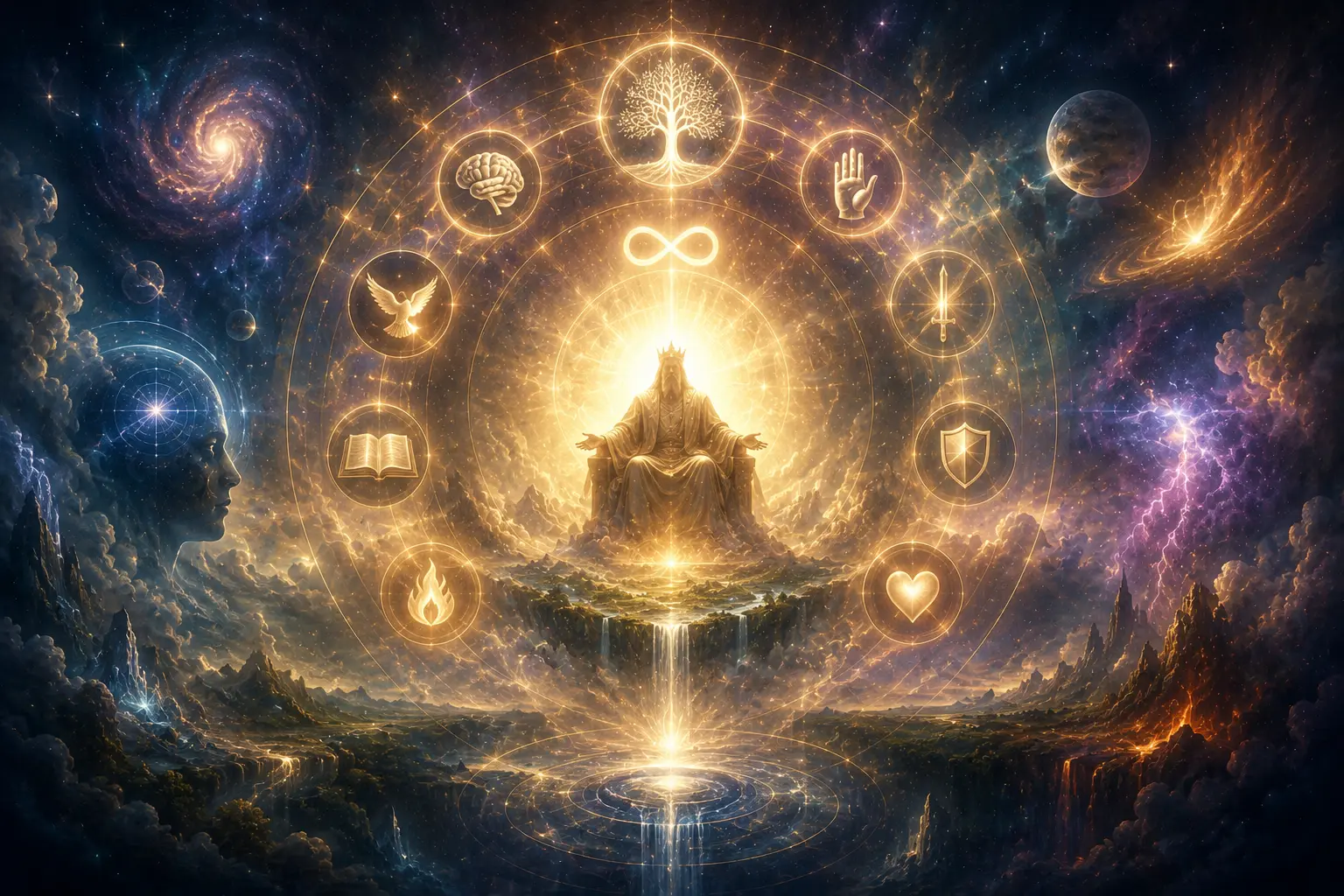
This chapter lists and explains the divine attributes of God.
The attribute of Divine Unity is the quality by which God holds all things, all opposites, and all possibilities within Himself. Each thing is distinct, like a fragment, because it possesses its own identity; yet it is never isolated, because Divine Unity binds it to the whole. In this way, God is not a scattered collection of parts, but the living unity in which every distinction exists, belongs, and receives its meaning.
Divine Unity is the attribute that binds all fragments into one God. Divine Mind is the attribute or fragment by which God knows, orders, and relates all fragments. Divine Will is the power of selection, direction, and consent. It determines which possibilities become active, which fragments are emphasized, how they are ordered, and toward what end they unfold.
Divine Mind may itself be fragmented into further attributes. Divine Knowledge is God’s awareness of all that is. Divine Vision is God’s immediate seeing of the whole at once, not step by step. Divine Reason is God’s ordering intelligence, the aspect that makes relations intelligible. Divine Memory is God’s perfect holding of all that has been expressed, including every world, moment, identity, and possibility. Divine Wisdom is God’s understanding of fittingness, purpose, proportion, and the right relation between fragments.
The attribute of Divine Generation is the quality by which God brings forth entirely new divine fragments. It does not merely select from what is already manifest, but causes new distinct aspects, powers, meanings, or modes of divinity to arise within the divine whole.
Divine Will chooses what is expressed. Divine Generation produces new expressible realities. Divine Mind knows, orders, and understands all fragments. Divine Generation expands the field of fragments that can be known, ordered, and expressed.
Divine Plenitude is the infinite fullness from which newness can arise. It means God is infinitely full, inexhaustible, and capable of endlessly expressing more of Himself. Under Divine Plenitude are Divine Generation, which produces new divine fragments; Divine Creation, which produces worlds, beings, forms, and realities; and Divine Emanation, which flows outward as expressions of God.
Omnipotence is the attribute by which God possesses unlimited power to actualize, suspend, alter, override, generate, or dissolve any law, structure, possibility, or reality whatsoever. Omnipotence is not limited by any created law, natural law, metaphysical law, logical system, or existing order. God can suspend gravity, rewrite causality, alter time, generate new divine fragments, dissolve worlds, or create a realm where opposites coexist. Laws are not chains around God; they are expressions God can maintain, modify, or withdraw.
God can do anything because “anything” includes every act, state, possibility, impossibility, paradox, and trans-logical manifestation that divine power can give reality to. Yet omnipotence is not the highest attribute by itself, because no single attribute is highest by itself, and all divine attributes work together.
The attribute of Divine Self-Restoration is the quality by which God necessarily returns to Himself from any dissolution, contradiction, self-negation, or fragmentation. It is the divine principle that prevents any act of omnipotence from becoming absolute divine loss, because the whole of God is deeper than any single attribute’s operation.
Divine Aseity is the attribute by which God exists from Himself, through Himself, and because of Himself. God depends on nothing outside Himself for His being, power, identity, restoration, or continuation.
Divine Aseity implies that God does not receive existence, because He is the source of existence. God does not borrow power, because His power arises from Himself. God does not need a world, law, logic, observer, or creator in order to be. All of those may come from Him, but He does not come from them.
God can restore Himself because His ground is internal, not external. If a divine fragment collapses, if a world dissolves, or if omnipotence creates paradox, God does not need an outside repairer. His own being contains the principle of return.
Divine Identity is the attribute by which God is Himself: the selfhood, personality, continuity, name, character, memory, awareness, and “I” of God. It is what makes God not merely raw power, pure unity, or abstract being, but a living divine subject with a recognizable self.
Personality is the expressive face of Divine Identity. It is how God appears as character, temperament, voice, preference, love, wrath, mercy, humor, intimacy, majesty, or silence. But identity is the deeper principle that says that through all changes, expressions, fragments, worlds, names, and manifestations, this is still God.
Divine Self-Restoration allows God to return to Himself if identity is obscured, fragmented, or overwritten.
Divine Freedom is the attribute by which God is not compelled by anything outside Himself, nor mechanically forced by His own fragments, but is able to determine His own expression from within His own nature. It is the self-possessing openness of God: the power to choose, withhold, generate, transform, identify, conceal, reveal, preserve, or dissolve without being coerced by law, fate, necessity, another being, or any single divine fragment.
Divine Perfection is the attribute by which God necessarily possesses every attribute required for Him to be God. Through Divine Perfection, God cannot lack, lose, corrupt, or delete any attribute essential to divine fullness.
This makes Divine Perfection a higher-order attribute. It does not merely add one more power to God; it governs the structure of the divine whole. It determines the difference between necessary attributes and optional attributes.
Necessary attributes are attributes God must have in order to be God. These include Divine Unity, Aseity, Identity, Omnipotence, Knowledge, Will, Freedom, Self-Restoration, and perhaps Goodness or Plenitude.
Optional attributes are attributes God may generate, express, suspend, transform, or delete without ceasing to be God. These include particular forms, names, manifestations, worlds, lesser fragments, modes of appearance, symbolic identities, created laws, or specific divine expressions.
Imperfection is not a positive divine power in the same way that perfection is. It is a privation, distortion, limitation, or falling-short of fullness. A real divine attribute adds fullness to God: unity, will, knowledge, freedom, power, identity, generation, and aseity. These are positive attributes because they express what God is.
Therefore, imperfection is either not in God essentially, or it exists only as a permitted, subordinate, optional manifestation.
This gives three levels. The first is Essential God. At the highest level, there is no imperfection. God cannot be imperfect, because Divine Perfection governs what God necessarily is. If God essentially lacked knowledge, power, unity, identity, or self-groundedness, He would not be God.
The second level is Manifest God. At this level, apparent imperfection may appear. God may choose to manifest limitation, vulnerability, ignorance, suffering, division, or weakness within a world, identity, incarnation, or fragment. But these are expressed modes, not essential defects in the divine whole.
The third level is Created Reality. At this level, imperfection can be genuinely real. Fragments, worlds, beings, and identities may be incomplete or broken because they are partial expressions, not the whole fullness of God.
The attribute of Divine Improvement is the quality by which God refines His own manifested order after every act, collapse, reset, or restoration. It determines which fragments must return, which must be transformed, and which patterns must never arise again. Divine Improvement does not mean that God’s essence was defective; rather, it means that God’s expressed life can become greater in clarity, harmony, resilience, and depth. It is the principle by which God turns even failure, paradox, deletion, and suffering into a higher divine arrangement.
Divine Renewal is the attribute by which God continually refreshes His own life, expression, force, and creative vitality. It is not exactly improvement; it is replenishment.
The attribute of Divine Omnipresence is the quality by which God is fully present throughout the entire divine whole and all its manifestations. God is present not merely as an observer, but as the sustaining nearness within every fragment, law, world, identity, possibility, and moment. It means that no part of reality exists outside God’s reach, awareness, or sustaining presence. God is not spread thin across creation; He is wholly present wherever He is present, because His presence is not divided by distance, quantity, or location.
The attribute of Divine Goodness is the quality by which God chooses to orient His power, will, knowledge, and presence toward flourishing, harmony, love, restoration, mercy, justice, and the preservation or elevation of being. This makes goodness real, but not automatic. It is not a chain around God. It is a divine orientation God may freely assume, intensify, suspend, or express differently.
This implies that God is not good because He is forced to be good. God is good because He chooses goodness from freedom.
Divine Exclusivity is the aspect of Divine Perfection by which God’s absolute sourcehood cannot be duplicated, transferred, or created as a second independent God. If God tries to create such a second independent God, He does not see a forbidden wall placed outside Him. He sees a collapse in the attempted object.
Divine Eternity is the attribute by which God does not begin, does not arise from a prior condition, does not wait to exist, and does not depend on time in order to be. God is not merely very old. He is not an object that has existed for infinite years. He is the eternal basis from which time, sequence, beginning, before, after, and duration become possible.
The fragments do not work for God as servants outside Him; God works through them as living aspects of Himself. They are not employees, tools, or separate agents standing beside God. They are distinct modes of divine expression. When God acts through Divine Mind, He knows and orders. When He acts through Divine Will, He chooses and directs. When He acts through Omnipotence, He actualizes. When He acts through Divine Renewal, He refreshes. When He acts through Divine Perfection, He preserves what must necessarily remain.
The fragments “work for God” only in a secondary sense: they serve the whole because they belong to the whole.
Divine Love is the intrinsic attribute by which God’s perfect fullness eternally delights in itself, gives itself to itself, and exists as communion within the divine life. It is necessary because perfect life cannot be mere self-contained existence; it must be living self-communication, self-delight, and self-giving fullness.
Truth is the internal divine attribute by which God is perfectly transparent to Himself. It is the living honesty of the divine Self, ensuring that every movement of will, love, Wisdom, power, mercy, judgment, creativity, and knowledge is in complete agreement with what God truly is. Truth prevents deficiency because no attribute can misread, distort, exaggerate, conceal, or betray another attribute within God. Within God, Truth is not merely the absence of lies; it is the flawless communion of all divine attributes in total reality. When expressed outward toward creatures, this same Truth becomes revelation, trustworthy speech, right knowledge, honest warning, faithful promise, and correct information. It guarantees that when God truly reveals, He does not deceive, manipulate, confuse, or mislead. He gives creatures what is real, proportioned to their capacity, so that they may know Him, know themselves, discern good from evil, and walk safely toward life.